
On this page
Start here
Quick answer
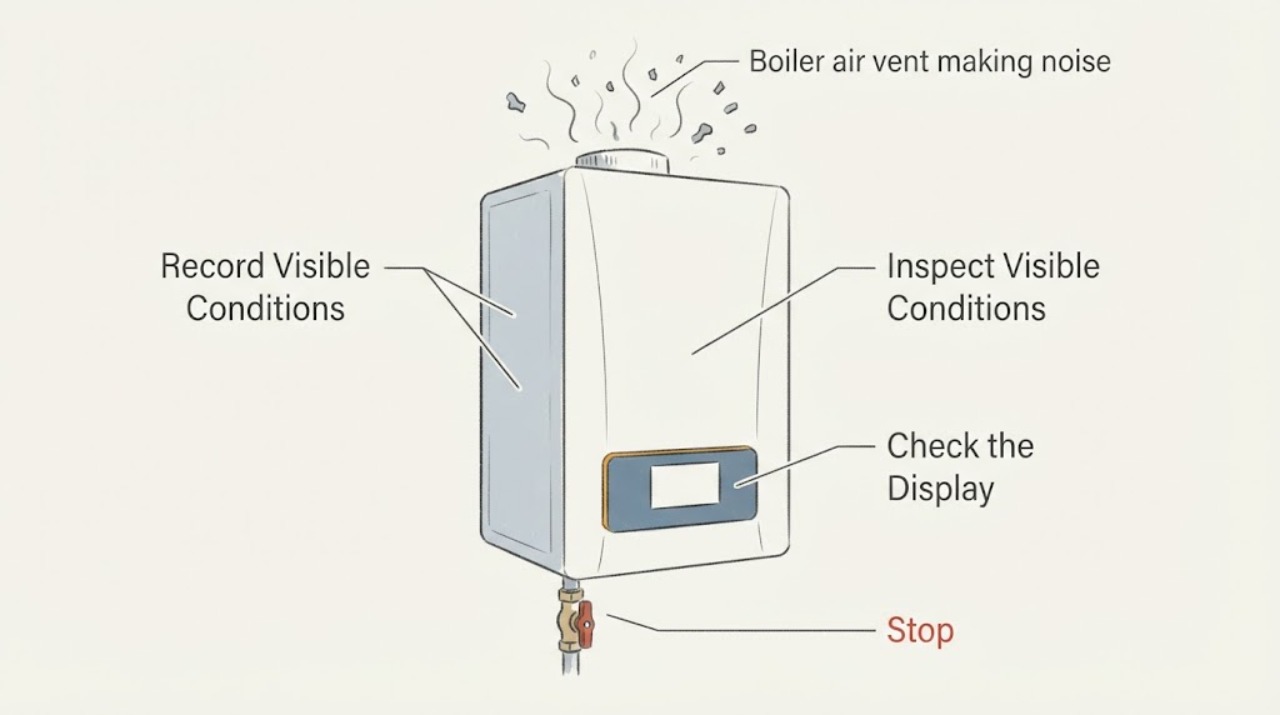
A noisy boiler air vent can indicate trapped air, water movement, a fouled vent, an air-vent leak, or a broader pressure and circulation problem. Treat the boiler and vent as a pressurized hot-water system: from a safe position, record the sound, timing, visible moisture, system type, and any visible gauge or fault message, then arrange HVAC service. Do not bleed, open, adjust, remove, or replace the vent yourself, and do not change system pressure or restart the boiler to reproduce the sound. Stop and seek urgent help for steam, spraying hot water, a rapid pressure change, gas odor, smoke, or water near electrical equipment.
Before you begin
Safety first
- The boiler and air vent are part of a pressurized hot-water or steam system. Do not bleed, open, adjust, drain, refill, replace, or disassemble the vent or alter pressure, gas, electrical, or hot-water components.
Work through in order
Diagnostic checks
Use only checks that match the exact appliance or system and its official guide.
-
Check 1
From a safe position, listen and record the air-vent sound without touching the vent or changing the boiler controls.
Expected result: Describe whether it is a hiss, gurgle, whistle, chatter, tapping, vibration, or intermittent burst, and note whether it occurs at startup, during circulation, after shutdown, or continuously.
Next step: Write down the timing and make a short recording from a safe location if it can be done without approaching hot or wet equipment, then provide it during the service call.
Stop if: Stop listening and leave the area for steam, a forceful discharge, spraying water, a burning smell, gas odor, smoke, or unsafe heat.
Why this matters
Why: The sound pattern and timing help the HVAC technician compare trapped air, water movement, a vent fault, or a wider circulation issue; the sound alone does not identify a repair.
-
Check 2
Visually observe the vent body, its visible connection, nearby piping, and the floor below without touching, wiping, loosening, or opening anything.
Expected result: Note whether the area is dry, damp, actively dripping, stained, corroded, or surrounded by mineral residue, and whether water is moving toward electrical equipment.
Next step: Keep people away from the area and report the visible condition and sound timing to a qualified HVAC professional. Do not place a container against or under hot pressurized equipment if doing so requires reaching into the hazard area.
Stop if: Stop for active leakage, hot water, steam, a slippery floor, electrical contact, or any need to step through water.
Why this matters
Why: Moisture or residue can change a noise complaint into a vent or system leak concern; water near electrical equipment or a hot spray is an immediate hazard.
-
Check 3
Identify the heating system type and read any already-visible boiler label, thermostat status, fault message, or pressure and temperature display without opening a panel or adjusting a setting.
Expected result: Record whether the system appears to be hot-water or steam, the displayed status or fault text, and whether a visible gauge appears stable, rising, falling, or outside the range identified in the appliance documentation.
Next step: Provide the exact system type, model information, display text, and gauge trend to the HVAC technician. Do not infer that a generic pressure value applies to this boiler.
Stop if: Stop if reading the display requires opening a cover, reaching over hot piping, entering a wet area, or touching a control or valve.
Why this matters
Why: Air-vent behavior and safe service steps differ between hot-water and steam systems. A changing or alarmed display increases urgency but does not establish a user repair.
-
Check 4
Compare the sound with ordinary heating events using existing observations only; do not create a new call for heat, cycle the boiler, or change zone settings.
Expected result: Note whether the sound follows a thermostat call, a particular zone, radiator or baseboard noise, a recent service visit, a water leak, or a change in heating behavior.
Next step: Keep a short time-and-zone log and arrange professional assessment rather than repeating cycles to reproduce the noise.
Stop if: Stop tracking if the boiler shuts down unexpectedly, the noise escalates, the system leaks, or any combustion or electrical warning appears.
Why this matters
Why: A zone- or cycle-related pattern can help the technician evaluate circulation and trapped air, while a continuous sound or new heat loss may indicate a more urgent system condition.
-
Check 5
From outside the equipment area, observe the surrounding piping, circulator area, expansion-tank area, and accessible floor or wall for visible changes without probing or disassembling.
Expected result: Record unusual vibration, pipe movement, new staining, condensation, corrosion, water marks, or a sound that seems to come from a different component than the air vent.
Next step: Give the technician the apparent sound location and any visible changes; keep the boiler in the state directed by the technician or building manager.
Stop if: Stop if observation requires touching pressurized or hot parts, entering a confined area, removing insulation, or approaching a gas, flue, or electrical hazard.
Why this matters
Why: A sound that travels through piping or begins near a pump, pressure component, or fitting may be misattributed to the air vent and requires whole-system diagnosis.
Use your observations
Decision map
Find the observation that best matches what you see, then follow the next safe action.
-
PATH 01Safety boundary
What you see
The sound is a new hiss, whistle, chatter, or gurgle near an air vent but there is no visible leak or immediate hazard.
Do this next
Arrange HVAC service and provide the sound recording, timing, system type, and visible gauge or display observations.
Why this path and its safety boundary
Safety stop: Do not bleed the system, open the vent, adjust a cap, or change pressure to silence the sound.
-
PATH 02Safety boundary
What you see
The vent or nearby piping is wet, spraying, corroded, or leaving mineral residue.
Do this next
Treat the condition as a pressurized hot-water service issue and seek prompt professional assessment; leave the area if water is hot or forceful.
Why this path and its safety boundary
Safety stop: Do not touch, tighten, cover, plug, or remove the vent or its connection.
-
PATH 03Safety boundary
What you see
The system is steam, the system type is uncertain, or the noise location cannot be distinguished from a radiator, pump, or pipe.
Do this next
Tell the HVAC technician the uncertainty and provide the sound timing and location; the professional should identify the system and source before any adjustment.
Why this path and its safety boundary
Safety stop: Do not apply hot-water boiler instructions to an uncertain or steam system.
-
PATH 04Safety boundary
What you see
The gauge or display is alarmed, changing rapidly, or accompanied by heat loss, repeated shutdown, or unusual boiler behavior.
Do this next
Stop using the system as safely directed and request urgent HVAC evaluation; report the exact display or gauge observation.
Why this path and its safety boundary
Safety stop: Do not add water, reset repeatedly, change temperature or pressure settings, or open the boiler.
-
PATH 05Safety boundary
What you see
There is steam, a forceful hot-water release, gas odor, smoke, electrical arcing, or water near electrical equipment.
Do this next
Leave the area, keep others away, and contact appropriate emergency or building assistance before arranging HVAC service.
Why this path and its safety boundary
Safety stop: Do not approach the boiler, air vent, valves, wiring, or standing water.
Helpful context
Understand the symptom
Air vents are used in closed hydronic heating systems to release trapped air, but a noise at the vent may be caused by the vent itself or by water, pressure, circulation, or system conditions elsewhere. A short observation record is more useful than trying to silence the sound, because the correct service path differs between hot-water and steam equipment and between models.
Keep hands, tools, and clothing away from the vent, nearby hot piping, valves, and boiler controls. Do not loosen a cap or fitting, change a pressure setting, add or remove system water, or open a boiler panel. Professional inspection is required for this pressurized system.
Only after diagnosis
Potential parts
- boiler circulator pump
Consider this category only if a qualified HVAC technician confirms that the sound originates at the circulator or that circulation failure is related to the complaint.
Confirm boiler model, system type, pump configuration, connection details, and professional fitment before ordering. - automatic air vent
Consider this category only if professional inspection identifies the air vent as the failed or leaking component and specifies the required system rating.
Confirm hot-water versus steam application, pressure and temperature ratings, connection, orientation, and manufacturer compatibility. - boiler pressure gauge
Consider this category only if a qualified technician confirms that the visible gauge is inaccurate or failed and that replacement is appropriate.
Confirm the boiler system, pressure range, connection, dial orientation, and manufacturer or professional fitment before ordering.
When checks do not resolve it
Need a professional?
Arrange HVAC service for a new, persistent, or worsening air-vent noise, especially when paired with a leak, pressure or display change, heat loss, or repeated boiler shutdown. Seek urgent or emergency help for steam, forceful hot water, gas odor, smoke, electrical danger, or flooding.
Safety scope: The boiler and air vent are part of a pressurized hot-water or steam system. Do not bleed, open, adjust, drain, refill, replace, or disassemble the vent or alter pressure, gas, electrical, or hot-water components.
Have this ready
- Provide the system type, model information, sound description or recording, timing, apparent source, visible moisture or corrosion, gauge or display trend, related heating behavior, and any recent professional service history.
Common questions
FAQ
Can I bleed a noisy boiler air vent myself?
No. This topic involves a pressurized hot-water or steam system. Do not open or adjust the vent; provide the sound and visible observations to a qualified HVAC professional.
Does a noisy air vent mean the vent itself is bad?
Not necessarily. Trapped air, water movement, circulation, pressure, a nearby pump, or another component can transmit sound to the vent. A professional should identify the source.
What if the air vent is also leaking?
Treat visible moisture, corrosion, or mineral residue as a prompt service issue. Keep clear of hot or forceful discharge and do not tighten, cap, or remove the vent.
Why does the boiler system type matter?
Air-vent behavior and service steps differ between hot-water and steam systems. If the system type is uncertain, record the model and sound pattern and let the HVAC technician identify it before any adjustment.
Read the exact guide
Official sources
- Boiler FAQs and Common QuestionsWeil-McLain · The manufacturer directs homeowners to heating professionals for boiler troubleshooting, maintenance, and component service.
- EA122A Automatic Air VentResideo · The manufacturer describes the automatic air vent as a component for purging air from high-pressure closed-water systems and distinguishes hydronic use from steam use.
- HVAC: A Guide for Contractors to Share with HomeownersU.S. Department of Energy · The guide identifies boilers, circulating pumps, expansion tanks, and distribution piping as hydronic components and places inspection and system checks within technician maintenance.
Community feedback
Share a repair observation
Share a plain-text repair observation. Accepted observations are published automatically; this page may take a moment to update.