
On this page
Start here
Quick answer
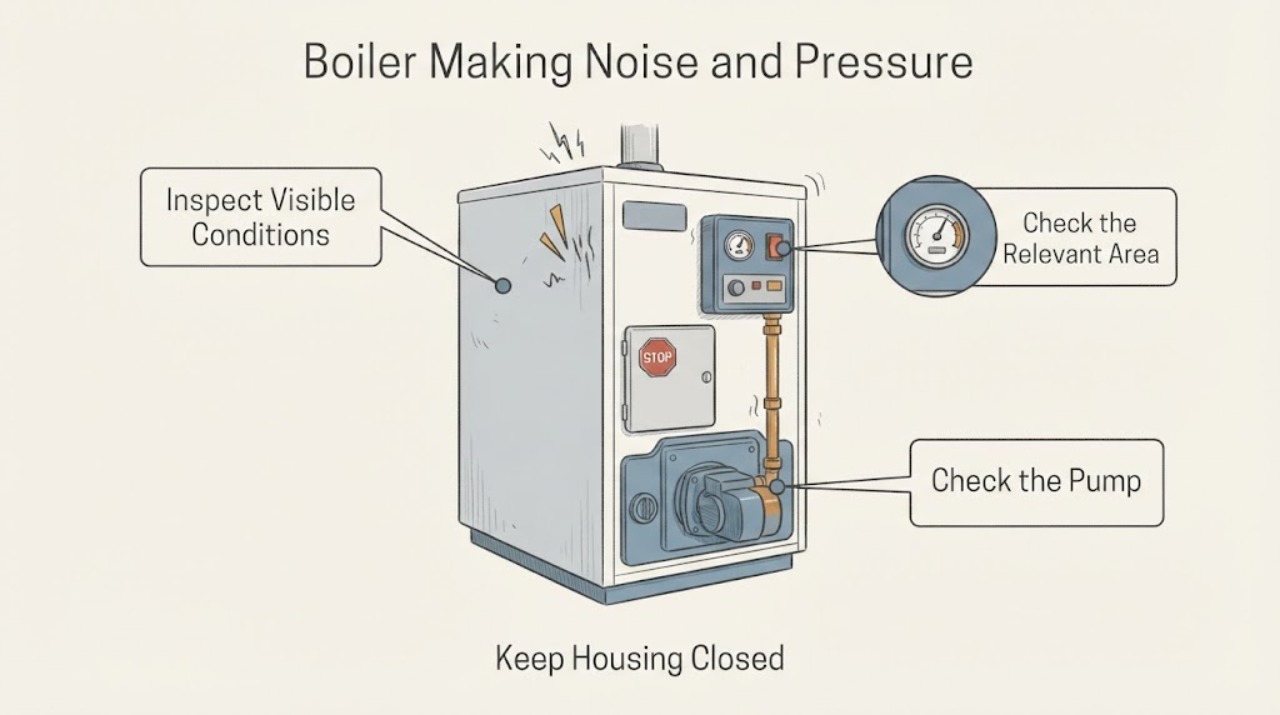
A small pressure rise while the boiler heats and a small fall as it cools can be normal, but the gauge should remain within the range stated in the boiler manual. Noise together with a rise of more than about 1 bar during heating, entry into the high or red zone, pressure rising while the boiler is off, repeated pressure loss, or frequent topping up points to a fault such as an expansion-vessel, filling-link, leak, circulation, or combustion issue. Record the pressure cold and during one normal heating cycle, identify the sound and look only for accessible leaks. Do not open the boiler casing, test gas or flue components, or repeatedly refill it; arrange qualified heating service when the pattern is abnormal or the sound is rumbling, violent, or accompanied by a safety warning.
Work through in order
Diagnostic checks
Use only checks that match the exact appliance or system and its official guide.
-
Check 1
With the boiler in its normal user-facing state and without removing any panel, record the pressure when the heating system has been cool for several hours, then observe the gauge during one ordinary heating cycle and again after it cools. Write down the sound at each point and any displayed warning or fault code; use the model manual for the appliance-specific range.
Expected result: The pressure changes slightly and remains in the manual's normal range, or it rises sharply, moves by more than about 1 bar during heating, reaches the high or red zone, or falls back to a low reading after cooling.
Next step: Keep the readings and sound description for a qualified heating engineer. If the gauge enters the high zone, the boiler locks out, or pressure changes sharply, stop the heating and do not keep restarting or topping up it.
Stop if: Stop immediately for smoke, burning smell, a carbon-monoxide alarm, a loud bang or violent ignition, a hot or damaged casing, or any need to open the boiler.
Why this matters
Why: A modest heat-related change is consistent with thermal expansion. A large rise suggests expansion-vessel or related pressure control trouble, while a low reading after cooling suggests water loss or another system fault; the gauge pattern is more useful than the noise alone.
-
Check 2
From a dry, safe position, look at accessible radiator valves, exposed heating pipe joints, the area below the boiler, and the visible discharge route for dampness, rust marks, staining, or dripping. Do not remove insulation, open the boiler, touch hot water, or dismantle a discharge pipe.
Expected result: There is no visible moisture, or there is a recurring damp spot, rust mark, drip, or discharge after the boiler heats.
Next step: If water is present, keep the boiler off and arrange service; protect nearby belongings without touching hot or pressurised parts. Do not compensate for a recurring drop by repeatedly adding water.
Stop if: Stop for hot water, active leaking, water near electrical equipment, a damaged pipe, or any need to enter the boiler casing or manipulate a relief valve.
Why this matters
Why: A visible leak or discharge can explain repeated pressure loss and may create a burn or property-damage risk. No visible leak does not rule out a concealed leak, internal relief-valve discharge, or another pressure fault.
-
Check 3
Identify the sound from a safe distance during one normal demand: gurgling or rushing in pipework, ticking or expansion noise, pump-like humming, rattling, a deep rumble, or a bang at ignition. Note whether it occurs only on heating, only on hot water, at startup, while shutting down, or continuously.
Expected result: The sound is limited to mild pipework movement, or it is a persistent gurgle, loud flow noise, rattling, rumble, bang, or violent ignition sound.
Next step: Capture a short audio description or recording from outside the enclosure and give it to the engineer with the pressure readings. Do not adjust gas settings, pump settings, burner controls, flue parts, or internal valves.
Stop if: Stop using the boiler for a bang, violent ignition, abnormal flame, soot, flue concern, burning smell, carbon-monoxide alarm, or symptoms of exposure; leave the property and obtain emergency help when appropriate.
Why this matters
Why: A mild, short-lived sound can follow normal heating and pipe expansion, but persistent flow or gurgling noise can need circulation or system diagnosis. Rumble, poor or violent ignition, and combustion-type noise require engineer checks of gas, air, burner and flue systems.
-
Check 4
Without turning a valve, inspect whether an accessible filling link or filling device appears fully closed and whether the pressure rises even when the boiler has been off for an extended period. Follow the owner's manual only for identifying the device; do not remove a key, loosen a connection, or operate a valve as a test.
Expected result: The pressure rises while the boiler is off, or it remains stable while off and changes mainly when the heating runs.
Next step: Leave the device alone and arrange qualified service for an unexplained rise. Do not drain, bleed, repressurise, or repeatedly reset the boiler to chase the reading.
Stop if: Stop for water, a damaged filling device, pressure in the high zone, a leaking discharge, or any need to remove a boiler cover or work on pipework.
Why this matters
Why: A rise while off makes a passing filling device or another pressure-control fault more likely. A rise mainly during heating is more consistent with thermal expansion, but a rise greater than the manual allows can still indicate an expansion-vessel or related problem.
-
Check 5
Check the boiler display and make a handoff note containing the appliance make and model if known, pressure when cold and hot, timing of the noise, whether radiators heat normally, visible moisture, recent topping-up, and whether the symptom repeats after the boiler cools. Do not use a reset as a substitute for diagnosis.
Expected result: The issue clears after one normal cycle and pressure remains in the manual's range, or the noise and pressure change recur, the boiler locks out, or topping-up is needed again.
Next step: Arrange service for any recurring pattern and provide the complete note. Keep the boiler off when a safety warning or abnormal combustion noise is present rather than continuing cycles for more evidence.
Stop if: Stop for repeated lockouts, smoke, soot, abnormal flame, carbon-monoxide alarm or symptoms, active water, or any instruction that would require internal electrical, gas, pressure or flue work.
Why this matters
Why: A stable, small heat-related movement can be monitored against the manual. Recurrence, lockout, repeated topping-up, or a growing pressure swing points to a system or appliance fault that needs testing by a qualified person.
Use your observations
Decision map
Find the observation that best matches what you see, then follow the next safe action.
-
PATH 01Next step
What you see
Pressure rises modestly only while the heating is on, falls as it cools, stays in the appliance manual's normal range, and the sound is brief ticking or mild pipework movement.
Do this next
Monitor one or two normal cycles without changing settings. If the movement grows, the sound becomes persistent, or the gauge leaves the stated range, stop and arrange heating service.
-
PATH 02Next step
What you see
Pressure rises by more than about 1 bar when hot, reaches the high or red zone, or climbs even while the boiler is off.
Do this next
Leave the boiler off and arrange qualified service to assess the expansion vessel, filling device, relief discharge and pressure controls. Do not keep bleeding or refilling the system as a workaround.
-
PATH 03Next step
What you see
Pressure drops repeatedly, the system needs frequent topping-up, or dampness, rust, staining or discharge is visible around accessible heating components.
Do this next
Stop repeated topping-up and arrange service to locate the loss, including concealed pipework or an internal discharge that cannot be confirmed safely from outside. Keep people away from hot or leaking water.
-
PATH 04Next step
What you see
The noise is a deep rumble, loud combustion noise, bang or violent ignition, or it occurs with soot, an abnormal flame, a flue concern, burning smell, carbon-monoxide alarm or illness symptoms.
Do this next
Stop using the boiler and do not open or test it. If carbon monoxide may be involved, leave the property, ventilate only if safe, contact the applicable gas emergency service and seek urgent medical advice for symptoms.
Helpful context
Understand the symptom
Pressure movement and boiler noise do not automatically mean the same fault. Water expands when heated, so a gauge can move upward during a heating cycle and downward as the system cools. The useful distinction is whether the change is modest and repeatable, or whether the gauge reaches a high zone, rises while the boiler is off, falls again after topping up, or moves with a loud or abnormal sound. Use the manual for the exact pressure range for the appliance; generic ranges are only a comparison point.
A gurgle, rushing or flow noise can travel through water-filled pipework and may be associated with air, circulation or system condition. A deep rumble, violent ignition, or combustion noise is a different category: gas supply, air-to-gas ratio, burner and flue checks are engineer work. A pressure gauge alone cannot prove which component has failed, so do not remove the case or adjust valves inside the boiler.
Treat gas-safety signs separately from ordinary hydraulic noise. If a carbon-monoxide alarm sounds, anyone has headache, dizziness, nausea or breathlessness, or there is soot or an abnormal flame on an accessible appliance, stop using fuel-burning appliances, leave the property and follow the emergency guidance for the country. Do not investigate the flue yourself.
Safety boundary
Stop conditions
- Stop immediately for a carbon-monoxide alarm, headache, dizziness, nausea, breathlessness, soot, abnormal flame, smoke, burning smell, or a flue concern.
- Leave the boiler off for a high-zone pressure reading, rapid pressure change, active leak or discharge, repeated lockout, bang or violent ignition.
- Stop any check that requires opening the casing, touching hot or pressurised water, operating an unfamiliar filling or relief valve, changing gas or pump settings, or working on wiring, burner or flue components.
Only after diagnosis
Potential parts
- heating-system expansion vessel
Only consider this category after a qualified engineer confirms that a pressure rise during heating is caused by insufficient expansion capacity; pressure movement alone does not identify the part.
Confirm boiler model, system design, vessel specification and manufacturer fit information before any part is selected. - boiler pressure relief valve
Only consider this category if professional diagnosis links a recurring discharge or pressure-control fault to the relief valve; do not test or replace it as a homeowner.
Confirm the exact appliance model and approved component specification with the manufacturer or qualified engineer.
When checks do not resolve it
Need a professional?
Arrange qualified heating service when pressure changes by more than the appliance manual allows, rises by more than about 1 bar during heating, reaches the high or red zone, rises while the boiler is off, or drops often enough to require repeated topping-up., Call promptly for persistent gurgling or flow noise, rattling, a deep rumble, a bang, violent ignition, a lockout, visible water or discharge, or a sound that is getting louder or more frequent., Do not remove the boiler casing, test gas pressure, adjust the burner or pump, inspect the flue internally, test an expansion vessel or relief valve, or bypass a safety control. Those checks belong to a qualified heating professional., If a carbon-monoxide alarm sounds or anyone has possible exposure symptoms, leave the property and follow local gas-emergency and medical guidance rather than troubleshooting the boiler.
Common questions
FAQ
Is it normal for boiler pressure to rise when the heating comes on?
A modest rise as the water heats and a fall as it cools can be normal. Check the range in the boiler manual. A rise of more than about 1 bar, entry into the high zone, or pressure that keeps rising needs qualified diagnosis.
Can low boiler pressure cause a noisy boiler?
Low pressure can indicate water loss and may coexist with gurgling or flow noise, but the pressure gauge cannot identify the noise's cause. Look only for accessible signs of leakage, avoid repeated topping-up, and arrange service if the pressure falls again.
What does a boiler rumble or loud combustion noise mean?
A rumble or loud combustion-type noise is not a safe homeowner adjustment. Manufacturer fault-finding guidance calls for checks of gas supply, gas-air ratio, burner and flue by a qualified engineer. Stop for a bang, violent ignition, soot, abnormal flame, burning smell or carbon-monoxide warning.
Should I keep topping up a boiler whose pressure keeps dropping?
No. Repeated pressure loss can indicate a leak, discharge or appliance fault. Record the reading, look only for accessible dampness or staining, leave the boiler off when water or a safety issue is present, and arrange qualified service.
Read the exact guide
Official sources
- What pressure should my boiler be?Vaillant · Vaillant homeowner guidance on boiler pressure when heating is on or off, thermal expansion, high pressure and low pressure
- WORCESTER — Fault finding and diagnosisWorcester Bosch · Worcester Bosch boiler fault-finding guidance on system gassing, pressure changes, flow noises, combustion or rumbling noises and engineer checks
- Gas safety - Carbon monoxide awareness frequently asked questionsHealth and Safety Executive · HSE domestic gas and carbon-monoxide warning signs, symptoms and emergency actions for fuel-burning appliances
- How often should I need to top up the pressure in the heating system?Worcester Bosch · Worcester Bosch homeowner guidance on cold pressure, high pressure, pressure rise during heating, expansion vessel service and frequent topping-up
Community feedback
Share a repair observation
Share a plain-text repair observation. Accepted observations are published automatically; this page may take a moment to update.