
On this page
Start here
Quick answer
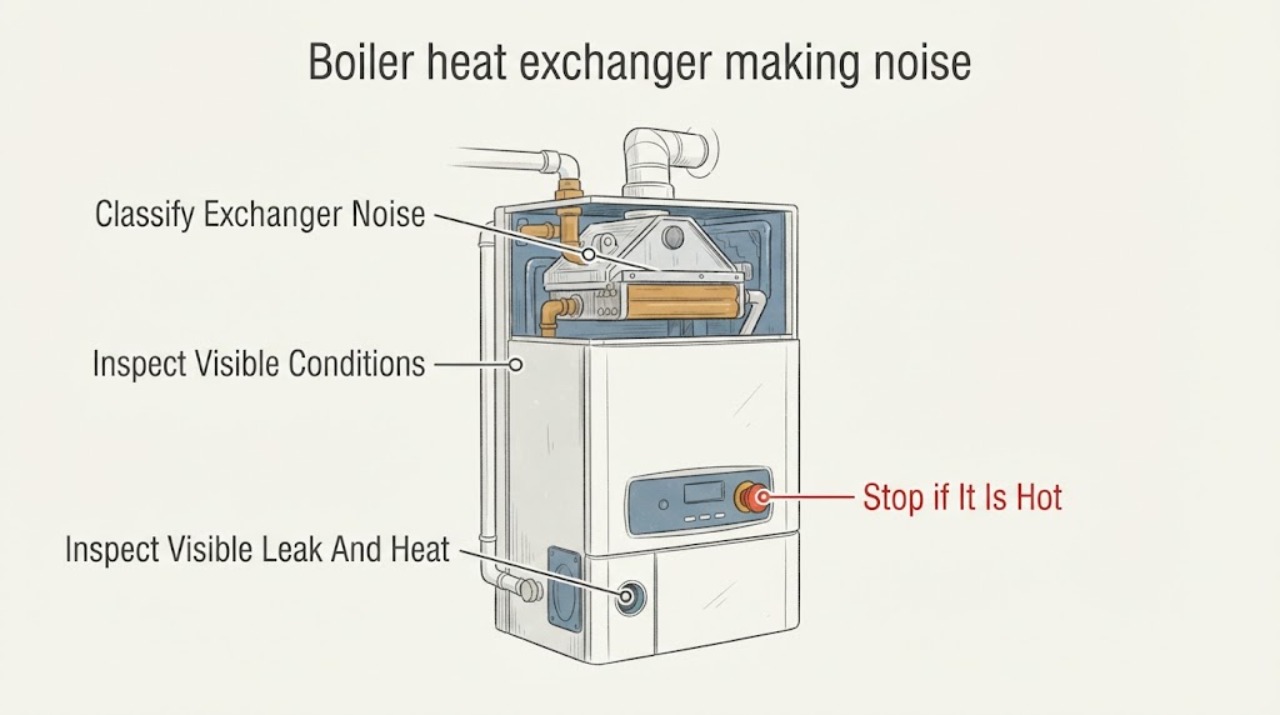
A noisy boiler heat exchanger cannot be confirmed or safely repaired from outside the appliance. From a dry, safe position, record the sound type and when it occurs, compare it with the boiler display and heat delivery, and look for visible leaks or overheating warnings without opening the casing. Whistling, banging, gurgling, tapping, or unusual humming can be linked to restricted flow, scale or sludge, trapped air, pump or control problems, or a damaged exchanger, and the same sound may come from nearby piping. Do not open, drain, refill, adjust pressure, or work on gas or electrical parts; stop and call a qualified boiler technician for persistent noise or any warning sign.
Before you begin
Safety first
- This is an observation-only guide for a boiler with hot water, fuel, electrical, and pressurized components. Do not open the casing, drain or refill the system, adjust pressure or valves, bleed radiators, clean or descale the exchanger, or work on gas or wiring.
Work through in order
Diagnostic checks
Use only checks that match the exact appliance or system and its official guide.
-
Check 1
From a dry standing position away from the boiler enclosure, listen only during normal operation and record whether the sound is whistling, kettling-like banging, gurgling, tapping, humming, grinding, or rushing water.
Expected result: Note whether it starts at ignition, when circulation begins, during a heat call, after the boiler has warmed, or continuously; also note whether it is loudest at the boiler or in nearby pipework or radiators.
Next step: Make a short description or recording from a safe distance and give the sound and timing to the heating professional; do not move closer to hot equipment.
Stop if: Stop listening and leave the area for gas odor, smoke, burning smell, steam, spraying water, or a rapidly worsening bang or vibration.
Why this matters
Why: Whistling or banging can support a flow, scale, or overheating-related investigation; gurgling can support an air-related investigation; tapping can support deposits or movement. These are clues, not a diagnosis of the exchanger.
-
Check 2
Without removing any cover, observe the boiler's external display, indicator lights, and visible controls from their normal user position.
Expected result: Record normal operation, a fault code or warning, repeated ignition or lockout behavior, an indicator that is dark when heat is expected, or an unusual temperature or pressure warning shown by the appliance.
Next step: Photograph the display without changing settings and provide the exact message and when it appeared to the qualified boiler technician.
Stop if: Stop and do not reset or restart repeatedly for a fault, overheating indication, smoke, burning odor, or evidence of gas or electrical trouble.
Why this matters
Why: A warning, lockout, or abnormal status makes the noise a service issue rather than a maintenance experiment. A normal display does not rule out exchanger fouling, air, flow restriction, or mechanical wear.
-
Check 3
From outside the appliance and without touching the casing or piping, look at the floor and visible connections for water, staining, corrosion, condensate changes, or signs that the boiler area is unusually hot.
Expected result: Note dry conditions, a slow drip, active water or steam, discoloration below the boiler, or moisture near electrical equipment; do not step into water.
Next step: Keep people away, record the location from a dry position, and request prompt professional service; use emergency utility or building procedures for immediate danger.
Stop if: Stop immediately for active leakage, steam, a flooded area, a sagging surface, or water contacting electrical equipment.
Why this matters
Why: Water or steam may indicate a pressure, exchanger, condensate, or other system fault and cannot be safely attributed to one component. Moisture near electricity adds an immediate hazard.
-
Check 4
Without touching radiators, pipes, or the boiler, note whether the home's accessible heating zones deliver their usual heat while the noise is present.
Expected result: Record normal heat, delayed or weak heat, several cold zones, frequent cycling, or a change in heat delivery at the same time as the noise.
Next step: Give the technician the affected zone names, cycle timing, and whether the noise appeared before or after the heat-delivery change.
Stop if: Stop operation and obtain prompt service for loss of heat in cold conditions, severe banging, overheating, or any safety warning.
Why this matters
Why: A heat-delivery change supports a circulation, air, flow, control, or exchanger investigation. Normal heat does not establish that the exchanger is healthy because a defect can develop before heat loss is obvious.
-
Check 5
Review recent service, refill, water-quality, or heating-system changes and compare the noise with prior normal cycles without deliberately cycling the boiler or changing controls.
Expected result: Determine whether the sound started after service or a long shutdown, follows every heat call, occurs only while warming, or has gradually become more frequent or louder.
Next step: Arrange qualified service and provide the timeline, sound description, display status, and any visible leak or heat-delivery change.
Stop if: Stop all testing once the symptom is documented or immediately if the boiler trips, overheats, leaks, smells of gas, smokes, or makes a severe noise.
Why this matters
Why: Timing after system work can help a technician investigate air or flow context, while a gradual increase can support deposits, wear, or a developing exchanger problem. Recurrence is useful evidence but not a reason to open the boiler.
Use your observations
Decision map
Find the observation that best matches what you see, then follow the next safe action.
-
PATH 01Safety boundary
What you see
The sound is whistling or banging and is concentrated during heating or warm-up.
Do this next
Request prompt professional boiler service to assess flow, scale or sludge, heat-exchanger condition, pump operation, and controls.
Why this path and its safety boundary
Safety stop: Do not descale, drain, refill, open, or operate the boiler repeatedly to test the theory.
-
PATH 02Safety boundary
What you see
The sound is gurgling, sloshing, or rushing and heat is uneven or delayed.
Do this next
Tell the technician the sound and affected zones; air and flow work in a pressurized system require professional handling.
Why this path and its safety boundary
Safety stop: Do not bleed radiators, open valves, or alter system pressure.
-
PATH 03Safety boundary
What you see
The sound is persistent tapping, grinding, or severe vibration near the boiler.
Do this next
Stop unnecessary operation and arrange qualified inspection of the exchanger, pump, mounting, and system contamination.
Why this path and its safety boundary
Safety stop: Do not remove panels, touch the equipment, or attempt cleaning or disassembly.
-
PATH 04Safety boundary
What you see
A leak, steam, fault display, overheating warning, or abnormal pressure indication accompanies the noise.
Do this next
Keep clear and request prompt professional service; use emergency utility or building support if people or the property are at immediate risk.
Why this path and its safety boundary
Safety stop: Do not reset repeatedly, drain or fill the system, or approach wet electrical equipment.
-
PATH 05Safety boundary
What you see
The noise is mild or intermittent and there is no visible leak, warning, or heat loss.
Do this next
Keep a dated sound and operating log and arrange a routine qualified boiler inspection if it persists or returns.
Why this path and its safety boundary
Safety stop: Escalate promptly if the sound becomes louder, changes to banging or grinding, or any warning or leak appears.
Helpful context
Understand the symptom
Why the heat exchanger may sound noisy
The heat exchanger transfers heat into the boiler water while water circulates through the system. Manufacturer guidance associates whistling or banging with kettling and restricted flow, gurgling with air, tapping with deposits or debris, and unusual noise with possible exchanger or pump problems. A sound heard at the boiler does not prove that the exchanger itself is faulty, so a professional needs the timing, location, and operating symptoms before choosing a repair.
Do not open a hot pressurized appliance
This guide is limited to safe external observation. Do not remove the boiler casing, touch hot surfaces, open a drain or fill valve, bleed the system, adjust pressure, clean or descale the exchanger, test wiring, alter gas controls, or reset a recurring fault. Heat exchangers and their connected hydronic and fuel systems require qualified service.
Only after diagnosis
Potential parts
- boiler circulator pump
Consider this category only if a technician confirms that inadequate circulation or a failed pump is causing the heat-exchanger noise.
Confirm boiler design, flow requirements, connection style, operating conditions, and exact model fitment professionally. - automatic air vent
Consider this category only when professional diagnosis confirms trapped air and a faulty or unsuitable air-management component.
Confirm system design, installation location, temperature and pressure suitability, and manufacturer requirements before selection. - boiler pressure gauge
Consider this category only if a technician confirms that an inaccurate or failed gauge is preventing safe diagnosis of the noise.
A gauge is connected to a pressurized system; confirm range, connection, temperature suitability, and professional installation requirements.
When checks do not resolve it
Need a professional?
Have this ready
- Provide the sound type, timing, apparent location, display message, heat-delivery result, visible leak information, recent service or refill history, and whether the symptom is worsening.
Common questions
FAQ
Does a noisy boiler prove the heat exchanger is bad?
No. Similar sounds can come from air, flow restriction, deposits, the pump, controls, or nearby piping. Record the sound and symptoms, then have a qualified technician identify the source.
What is boiler kettling?
Kettling describes whistling or banging associated with water heating too quickly or restricted flow, sometimes involving scale or debris. It needs professional diagnosis because the system can contain hot water under pressure.
Can I clean or descale the heat exchanger myself?
No. Heat-exchanger cleaning, descaling, draining, and access require qualified service. Do not remove the boiler casing or disturb the pressurized or fuel-related components.
When is heat-exchanger noise urgent?
Escalate promptly for steam, active water, a fault or overheating warning, gas odor, smoke, burning smell, severe vibration, abnormal pressure indication, wet electrical equipment, or loss of safe heat.
Read the exact guide
Official sources
- The heating system makes noises – what now?Viessmann Climate Solutions · General hydronic system noise guidance; no Viessmann model-specific setting or procedure is applied.
- Why is my boiler making a noise?Vaillant · General manufacturer guidance used for symptom distinctions; no Vaillant model or exact operating value is assumed.
- What is a heat exchanger?Vaillant · General heat-exchanger symptom context; the article does not assume a specific boiler model or material.
Community feedback
Share a repair observation
Share a plain-text repair observation. Accepted observations are published automatically; this page may take a moment to update.