
On this page
Start here
Quick answer
A Buderus boiler heat exchanger that makes new bubbling, boiling, crackling, rumbling, or whistling sounds should not be diagnosed by sound alone. First note whether the noise occurs only during a call for heat, whether it comes from the boiler cabinet or nearby piping, and whether there is a fault display, temperature instability, pressure change, water leak, or loss of heat. Buderus water-quality guidance says scale, sediment, or sludge in the heat exchanger can reduce heat transfer and lead to localized overheating, corrosion, and noise. Air or restricted circulation can create a similar sound, while a burner, fan, pump, mounting, or flue issue may be nearby rather than inside the exchanger. From ordinary safe access, read the model manual and display, look for visible leaks or frost, confirm that no package or object blocks service clearances, and record when the sound starts and stops. Do not remove the cover, adjust gas or combustion settings, drain or refill the system, descale the exchanger, or perform live electrical tests. Stop for gas or oil odor, a carbon-monoxide alarm, smoke, flame irregularity, escaping steam, a major leak, or an overheating or pressure warning, and arrange qualified boiler service for any persistent or worsening noise.
Before you begin
Safety first
- This article supports safe observation of sound, display, visible leaks, heating delivery, and maintenance history only. Do not open the cabinet or heat exchanger, access the burner, adjust gas or combustion settings, perform live electrical tests, drain or chemically treat the system, bypass safety devices, or continue operation with odor, alarm, smoke, flame irregularity, steam, leak, severe heat, or a safety warning.
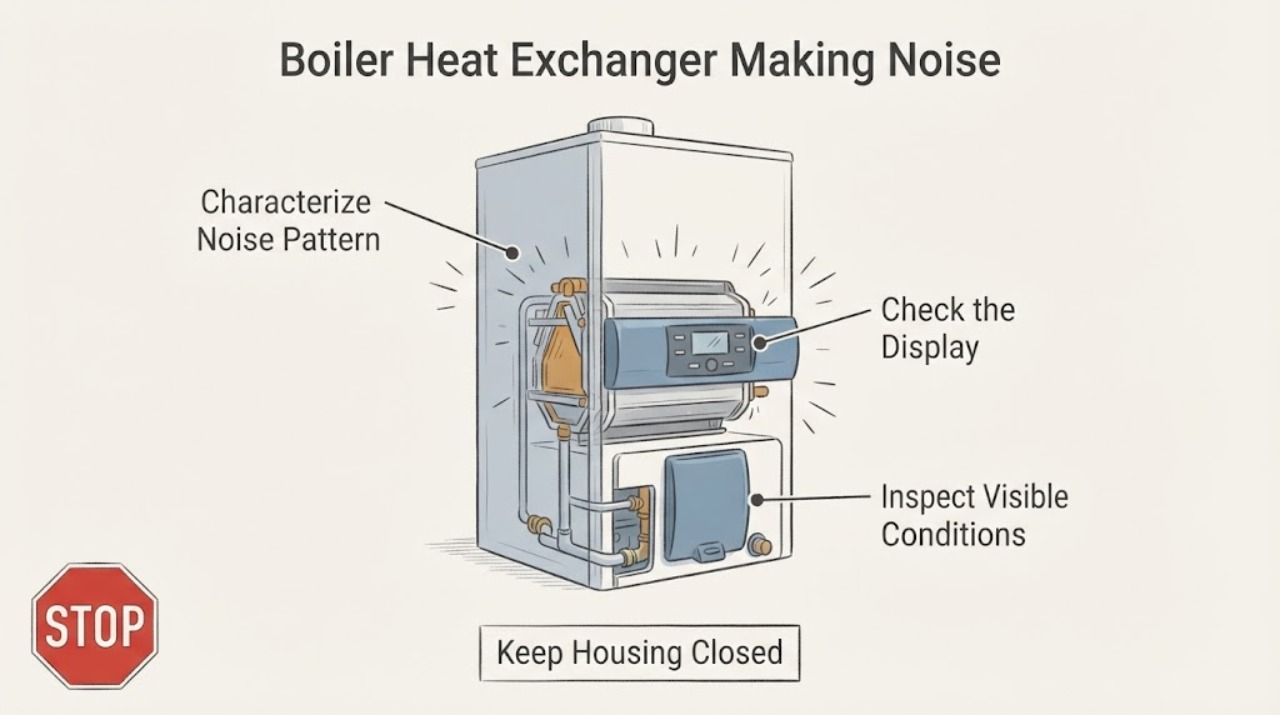
Work through in order
Diagnostic checks
Use only checks that match the exact appliance or system and its official guide.
-
Check 1
From a safe position, listen only while the boiler is operating normally and record whether the sound is bubbling, rumbling, whistling, humming, vibrating, clicking, or a sharp ignition noise; note whether it starts with firing, continues during circulation, or occurs after shutdown.
Expected result: Record the sound location as the boiler cabinet, supply or return piping, circulator area, flue area, or uncertain, along with the heat call, domestic-hot-water call if applicable, and any change in heating performance.
Next step: Use the display, leak, and circulation observations below, then provide the timing and a short recording to a qualified heating technician if the noise is new, persistent, or worsening.
Stop if: Stop observing and shut down only according to the model's safe operating instructions for gas or oil odor, smoke, flame irregularity, carbon-monoxide alarm, escaping steam, major water leak, or an overheating warning.
Why this matters
Why: A boiling-like sound during firing makes heat-transfer, water-quality, air, or flow issues worth checking; a hum or vibration may be a pump, fan, mounting, or pipe issue; ignition or flue-related noise needs combustion and venting assessment. Sound location alone does not prove a heat-exchanger defect.
-
Check 2
Read the boiler display, status lights, and any visible pressure or temperature indication without opening the cabinet or touching hot surfaces; note the fuel type and exact model from the rating label only if it can be read safely.
Expected result: Record a fault code, high-limit or pressure warning, unusual temperature swing, normal-looking display, water around the boiler, relief discharge, or no visible indication.
Next step: Use the exact Buderus model manual to interpret any code and give the technician the code, timing, and visible symptoms; do not reset repeatedly to silence the sound.
Stop if: Stop for a leak near electrical parts, steam, a rapidly rising indication, a relief discharge, smoke, an odor, or any need to remove a cover to read or test a component.
Why this matters
Why: A code, limit condition, leak, discharge, or unstable temperature turns a noise complaint into a service diagnosis rather than a cleaning task. A normal display does not rule out scale, air, pump, flow, burner, or heat-exchanger problems.
-
Check 3
Without changing unknown valves, compare whether the radiators or heating zones warm normally, whether the pump or circulation sound changes with a heat call, and whether the noise follows one zone or the whole boiler.
Expected result: Record normal heat delivery, one cold zone, several cold zones, uneven supply and return behavior, air-like gurgling, a pump that is silent or unusually loud, or a boiler that heats rapidly while heat does not reach the zones.
Next step: Leave system valves in their known operating positions, record the affected zone and sound timing, and arrange qualified hydronic service for air purging, pump, valve, or flow diagnosis.
Stop if: Do not bleed a hot radiator, open a drain, adjust an unlabeled valve, or touch the pump or piping when surfaces are hot or access requires removing a cover.
Why this matters
Why: A cold zone, gurgling, or poor heat transfer can make trapped air, a circulation restriction, pump issue, or system valve problem more likely than a damaged exchanger. Rapid boiler heating with poor zone delivery warrants prompt service because restricted flow can overheat the exchanger.
-
Check 4
With the boiler off only as the model instructions permit and the area cool enough to approach safely, inspect ordinary-access joints, the floor, and the visible cabinet exterior for drips, staining, corrosion, or mineral deposits; do not remove insulation or panels.
Expected result: Record no visible moisture, a small recurring drip, white or green deposits, rust, a relief-pipe discharge, or water inside the cabinet or near electrical components.
Next step: Keep the boiler off if instructed by the manual or if water is reaching electrical parts, collect photos from a safe distance, and arrange qualified boiler service; do not seal, tighten, or patch a hot or pressurized connection.
Stop if: Stop for active leaking, steam, a relief discharge, water near wiring, a hot wet surface, or any need to drain or depressurize the system.
Why this matters
Why: A leak or corrosion can involve a connection, relief device, exchanger, or system component and should not be treated as harmless noise. Mineral deposits and water-quality history support a service discussion but do not identify a cleanable part from outside.
-
Check 5
Gather the boiler model, fuel type, installation age, service records, water-treatment history, makeup-water events, prior flushing or descaling, and whether the sound appeared after plumbing work or a system refill; do not add chemicals or alter water chemistry yourself.
Expected result: Record frequent makeup water, hard or untreated water, sludge or sediment found at service, use of an unapproved additive, recent refill, or no known water-quality issue.
Next step: Give the history to a qualified technician and ask for water-quality, heat-exchanger, flow, and corrosion assessment using the model's service procedure; do not self-dose a cleaner or inhibitor.
Stop if: Stop if the system is leaking, pressure is unstable, a chemical container is unlabelled, or a proposed test requires opening the boiler or draining the circuit.
Why this matters
Why: Buderus says water quality affects scale, sediment, sludge, corrosion, heat transfer, and noise. Frequent makeup water or unknown additives can change the service path, but only system-specific testing can establish the cause.
-
Check 6
If there is no odor, alarm, leak, overheating indication, flame irregularity, or electrical concern, observe one normal call for heat from a safe position without changing settings or repeatedly resetting the boiler.
Expected result: Record whether the sound remains brief and unchanged, grows louder, continues through the call, appears with poor heat delivery, triggers a code, or is accompanied by water, odor, smoke, or abnormal temperature.
Next step: Stop further testing, save the recording and notes, and arrange qualified Buderus boiler service for a recurring or unexplained noise.
Stop if: Stop immediately for gas or oil odor, carbon-monoxide alarm, smoke, flame irregularity, sparks, escaping steam, active leak, severe heat, or an overheating or pressure warning.
Why this matters
Why: A brief stable expansion or circulation sound may be normal for the installation, but a new persistent sound with poor transfer, overheating, or a code needs diagnosis. A normal observation does not authorize exchanger cleaning or combustion adjustment.
Use your observations
Decision map
Find the observation that best matches what you see, then follow the next safe action.
-
PATH 01Safety boundary
What you see
Bubbling, kettle-like, crackling, or rumbling noise occurs during firing and the boiler heats rapidly, the zones remain cool, or the sound is accompanied by temperature instability.
Do this next
Stop changing settings and arrange qualified boiler service for flow, water quality, heat exchanger, pump, and safety-limit assessment.
Why this path and its safety boundary
Why it matters: Scale, sludge, air, restricted flow, pump trouble, or another heat-transfer problem is plausible; a heat-exchanger defect is not proven by the sound.
Safety stop: Do not descale, drain, purge, or adjust gas or combustion controls as a DIY test; stop for steam, leak, odor, alarm, or overheating.
-
PATH 02Safety boundary
What you see
The noise is new or worsening and records show hard or untreated system water, frequent makeup water, sediment, corrosion, or an unapproved additive.
Do this next
Provide the records to a qualified technician and request model-specific water-quality and exchanger inspection; use only products and procedures approved for the exact system.
Why this path and its safety boundary
Why it matters: Scale, deposits, sludge, and corrosion in or around the heat exchanger become more plausible and can reduce heat transfer or cause localized overheating.
Safety stop: Do not add a cleaner, inhibitor, antifreeze, or descaler based on a generic recipe, and stop for a leak or unstable pressure.
-
PATH 03Safety boundary
What you see
Gurgling or rushing water follows a refill or plumbing change, one zone is cold, the pump behavior is abnormal, or the boiler heats while circulation is poor.
Do this next
Arrange qualified hydronic service to verify the pump, air removal, valves, flow, and system pressure using the Buderus model procedure.
Why this path and its safety boundary
Why it matters: Air, a closed or restricted path, pump trouble, or system-flow imbalance may be causing noise and concentrating heat at the exchanger.
Safety stop: Do not open drains, alter unknown valves, bleed hot emitters, or operate with a leak or a high-limit warning.
-
PATH 04Safety boundary
What you see
A sharp ignition, roaring, whistling, or combustion-like noise comes from the burner or flue area, or flame behavior, exhaust, or odor is abnormal.
Do this next
Stop the appliance according to its operating instructions and arrange a licensed heating or gas professional to assess combustion and venting; do not adjust the gas valve or burner.
Why this path and its safety boundary
Why it matters: The sound may not originate in the heat exchanger and could involve combustion, gas or oil supply, intake, venting, or burner setup.
Safety stop: Leave the area as appropriate for gas or oil odor, carbon-monoxide alarm, smoke, flame rollout, or other fire or combustion signs and seek urgent help.
-
PATH 05Safety boundary
What you see
Noise is accompanied by water at the boiler, relief discharge, a fault or high-limit indication, steam, rapidly changing temperature, or an electrical smell.
Do this next
Stop using the boiler and follow the model's emergency shutdown and building-safety procedure, then obtain qualified boiler service.
Why this path and its safety boundary
Why it matters: A pressurized, overheating, leaking, or electrical safety condition is possible; continuing operation can damage the boiler or property.
Safety stop: Do not tighten fittings, remove covers, drain the system, reset a safety limit repeatedly, or touch wet electrical components.
-
PATH 06Safety boundary
What you see
The sound is brief, unchanged, and limited to startup or shutdown, with normal heat delivery, no leak, no warning, no odor, and no worsening pattern.
Do this next
Record the sound and monitor for change during normal operation; schedule routine inspection if the sound becomes louder, longer, or associated with poor heating.
Why this path and its safety boundary
Why it matters: Thermal expansion, normal pump or valve operation, or building-pipe movement may be more likely than a failing heat exchanger, although the installation manual controls what is normal.
Safety stop: Stop and seek service if any code, leak, odor, alarm, overheating, flame irregularity, or loss of heat develops.
Helpful context
Understand the symptom
Identify the sound before blaming the heat exchanger
A heat exchanger is a possible source, but a boiler sound can travel through water lines and the cabinet. Bubbling or a kettle-like sound during firing can fit a flow, scale, sediment, or air problem; a hum or vibration may come from a pump, fan, mounting, or nearby pipe; a sharp ignition or combustion sound needs a qualified heating professional. Note the exact timing, location, and accompanying symptoms instead of removing the cover to listen closer.
Water quality and circulation can change heat-transfer behavior
Buderus documentation says poor system-water quality can produce scale, sediment deposits, or sludge in the heat exchanger, reducing heat-transfer efficiency and leading to localized overheating, corrosion, and noise. Restricted flow, air in the boiler or loop, closed or misconfigured valves, and pump problems can also leave heat where it should not be. Those conditions require model- and system-specific diagnosis; do not pour in a cleaner or alter a valve because a sound resembles boiling.
Use visible symptoms to choose the safe escalation path
A noise paired with an error, an overheating or pressure warning, a relief discharge, a leak, or rooms not heating is more urgent than a brief benign expansion tick. Check the display and visible gauges only from a safe position, and look for water around accessible connections without touching hot surfaces. If a gas- or oil-fired appliance produces an odor, smoke, flame irregularity, or a carbon-monoxide alarm sounds, leave the area as appropriate and use emergency and qualified heating help.
Heat-exchanger service is not an ordinary sound-based repair
Descaling, flushing, combustion adjustment, burner access, pump testing, electrical work, and sealed boiler repairs depend on the model and system. A technician needs the model, fuel type, sound recording, operating state, display code, pressure or temperature behavior, water quality history, and any recent work. Do not order a heat exchanger, pump, or control until the technician identifies the failed part and confirms the fit.
Safety boundary
Stop conditions
- Stop the boiler for gas or oil odor, a carbon-monoxide alarm, smoke, flame irregularity or rollout, sparks, escaping steam, severe heat, active water leak, relief discharge, or an overheating or pressure warning; follow emergency and qualified-service procedures.
- Do not remove the boiler cabinet or heat-exchanger cover, access the burner, adjust gas or combustion settings, perform live electrical testing, or bypass a safety control.
- Do not drain, refill, purge, descale, flush, or chemically treat the boiler circuit based on sound alone; do not add an unapproved inhibitor, cleaner, antifreeze, or descaler.
- Do not chip deposits, force valves, bleed hot emitters, tighten hot or pressurized fittings, or touch wet electrical components.
- Stop and arrange qualified boiler service when noise persists or worsens, heat transfer is poor, a code appears, water quality is suspect, or diagnosis requires internal, combustion, venting, electrical, or sealed-system access.
Only after diagnosis
Potential parts
- heat exchanger assembly
Consider this category only when a qualified technician confirms exchanger leakage, damage, corrosion, or an irreparable obstruction after water quality, flow, and combustion-related causes are assessed.
Confirm the exact Buderus model, exchanger material, configuration, fuel, and manufacturer fit information; do not infer replacement from noise or order before diagnosis. - circulator pump
Consider this category only if qualified flow diagnosis confirms the pump is seized, noisy, underperforming, or otherwise causing poor circulation and exchanger overheating symptoms.
Confirm the exact boiler and hydronic-system configuration, pump specification, electrical requirements, and manufacturer-approved replacement before ordering. - air separator or automatic air vent
Consider this category only when a technician confirms persistent air or an air-removal component fault after checking system filling, leaks, circulation, and the model's water-quality requirements.
Confirm the exact system connection, temperature and pressure rating, model guidance, and installation requirements; do not open or replace a pressurized component as a sound test. - temperature or safety sensor
Consider this category only when a fault code or measured operating behavior leads a qualified technician to confirm a sensor or limit device failure rather than a real flow or overheating condition.
Confirm the exact Buderus model, sensor type, connector, and safety rating; never bypass a sensor or high-limit device.
When checks do not resolve it
Need a professional?
Arrange qualified Buderus boiler service when the heat-exchanger noise is new, persistent, or worsening; when it occurs with poor heat delivery, temperature or pressure instability, a fault code, visible deposits, frequent makeup water, frost or corrosion, or abnormal pump or burner behavior; or whenever inspection requires opening the boiler. Use a licensed heating or gas professional for combustion, fuel, venting, or burner symptoms. Seek urgent help for gas or oil odor, a carbon-monoxide alarm, smoke, flame irregularity, sparks, escaping steam, severe heat, an active leak, relief discharge, or a safety warning.
Safety scope: This article supports safe observation of sound, display, visible leaks, heating delivery, and maintenance history only. Do not open the cabinet or heat exchanger, access the burner, adjust gas or combustion settings, perform live electrical tests, drain or chemically treat the system, bypass safety devices, or continue operation with odor, alarm, smoke, flame irregularity, steam, leak, severe heat, or a safety warning.
Common questions
FAQ
Why is my Buderus boiler heat exchanger making a bubbling or kettle-like noise?
Buderus documentation links poor system-water quality and scale, sediment, or sludge in the heat exchanger to reduced heat transfer, localized overheating, corrosion, and noise. Air, restricted circulation, a pump problem, or combustion noise can sound similar. Note the timing and heating symptoms and arrange qualified service rather than descaling the boiler yourself.
Can hard water cause noise in a Buderus boiler heat exchanger?
It can contribute to scale or deposits, but water history alone does not prove the noise source. Give the technician the model, makeup-water history, additives, prior flushing, and sound pattern so the heat exchanger, flow, and water chemistry can be assessed with the correct procedure.
Could air in the heating loop sound like a heat exchanger problem?
Yes. Gurgling or rushing water after a refill or plumbing change, a cold zone, or poor heat delivery can make air or circulation trouble more likely. Do not open drains or unknown valves; arrange qualified hydronic service to check air removal, pump operation, valves, and flow.
Should I descale my Buderus boiler heat exchanger myself?
No. Descaling, flushing, draining, chemical treatment, burner access, and combustion adjustments depend on the exact Buderus model and system. Do not add a generic cleaner or inhibitor based on a noise symptom; have a qualified technician determine whether deposits, corrosion, flow, or another fault is present.
What if the noise comes from the burner or flue area instead?
A sharp ignition, roaring, whistling, abnormal flame, exhaust odor, or sound concentrated at the burner or flue may be a combustion or venting issue rather than a heat-exchanger issue. Stop according to the operating instructions and use a licensed heating or gas professional; never adjust the gas valve or burner yourself.
When should a Buderus boiler noise be treated as urgent?
Stop and seek urgent qualified help for gas or oil odor, a carbon-monoxide alarm, smoke, flame irregularity, sparks, escaping steam, severe heat, an active leak, relief discharge, or an overheating or pressure warning. Persistent noise with poor heating, a code, or recurring water-quality concerns also needs prompt boiler service.
Read the exact guide
Official sources
- Condensing Gas Boilers TroubleshootingBosch Home Comfort · Bosch troubleshooting guidance for condensing gas boilers; use it for general hydronic and service-boundary context, while the exact Buderus model manual controls the appliance.
- Technical Support ResourcesBosch Home Comfort · Bosch Home Comfort's official support portal for Buderus residential products; exact installation and service instructions vary by model.
- Buderus Stainless Steel Boiler (SSB) Gen 2 | Condensing BoilersBosch Home Comfort · Buderus SSB Gen 2 product information; it illustrates why model and heat-exchanger configuration must be confirmed and does not establish every Buderus model's construction.
- Record book of water quality requirementsBuderus / Bosch Home Comfort · Buderus GB162 water-quality record-book guidance; other Buderus models may have different limits and service procedures, so the installed model manual controls.
Community feedback
Share a repair observation
Share a plain-text repair observation. Accepted observations are published automatically; this page may take a moment to update.