
On this page
Start here
Quick answer
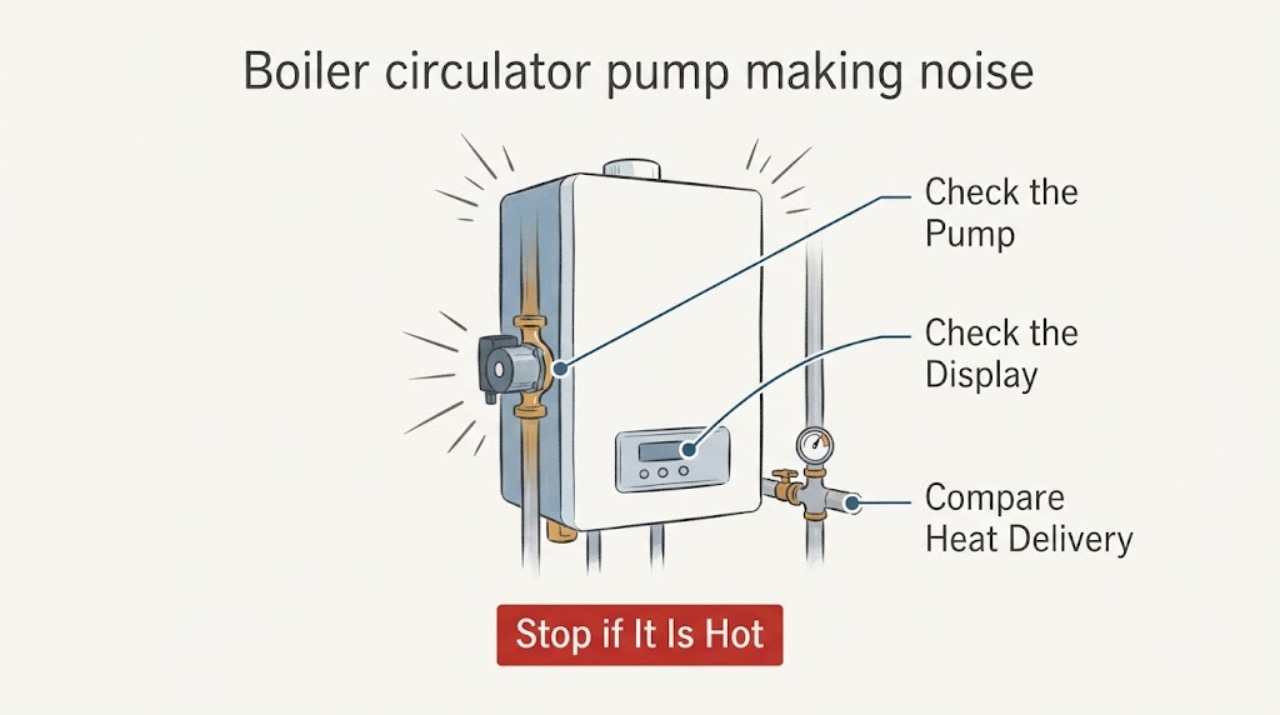
A noisy Buderus boiler circulator pump needs the sound and the heating result considered together. Light water rushing or an occasional pump sound can occur, but persistent rushing, gurgling, buzzing, rattling, or a high-pitched whine can point to air in the hydronic loop, unsuitable pump output, low system pressure or dry running, flow restriction, pipe vibration, or worn pump bearings. From a safe position, record when the sound occurs, whether radiators or zones heat, the pressure shown by the installed gauge, and any boiler fault display. Do not open the boiler, loosen pump fittings, bleed a hot circuit, change service-level pump curves, or work on energized wiring. Arrange qualified heating service if the pump is noisy with poor heat, pressure loss, leakage, a dry-run or temperature fault, repeated lockout, or a harsh mechanical sound.
Before you begin
Safety first
- This article permits listening, reading a visible gauge or display, comparing heat delivery, and observing accessible moisture or pipe contact from a safe position. A qualified technician must handle venting, filling, pump settings, electrical work, pump removal, combustion components, and sealed heating-system work.
Work through in order
Diagnostic checks
Use only checks that match the exact appliance or system and its official guide.
-
Check 1
From a dry, stable location away from the boiler cabinet, listen during a normal call for heat and note the sound type, its location, and when it starts or stops. Do not touch the pump, pipe, burner, or wiring to amplify or test the sound.
Expected result: The sound is a brief smooth hum or flow noise, a gurgle or slosh, a steady buzz, a rattle or squeal, or a repeated click paired with a failed start; record whether it occurs at every call or only one zone.
Next step: Continue with pressure, heat-delivery, and visible-leak checks only for a brief normal observation. Stop and arrange service for a harsh mechanical sound, failed start, or noise that is worsening.
Stop if: Stop immediately for smoke, a burning smell, exposed or wet wiring, water escaping, a gas odor, a high-temperature alarm, or a pump that repeatedly fails to start.
Why this matters
Why: Buderus allows that some temporary flow and pump sounds can occur, while persistent noise is unusual. Gurgling points toward air or flow conditions, a steady harsh buzz or rattle raises mechanical or mounting concern, and repeated click-off with no heat is an escalation pattern.
-
Check 2
Read the installed pressure gauge and boiler display from the normal user position while the system is cool enough to observe safely. Record the pressure trend, any fault code, and whether the display indicates a pump, temperature, or low-pressure condition; do not remove a cover or add water as a guess.
Expected result: Pressure is stable in the exact manual's normal range and no fault is shown, or pressure is low or changing, a pump-dry or temperature fault is displayed, or the boiler is locking out.
Next step: Photograph the gauge and display, then use the model manual or qualified service for any low-pressure, dry-run, or lockout condition. Do not keep refilling a system that loses pressure.
Stop if: Do not open the fill loop, vent a hot radiator or pump, remove the boiler cover, or reset a recurring fault without model-specific instructions and a safe cool system.
Why this matters
Why: Buderus pump documentation links a pump running dry to checking charge pressure and venting. A low or changing gauge reading can support an air, leak, expansion, or fill problem, while a fault display needs the exact model's service procedure rather than a generic reset.
-
Check 3
Compare the affected heating zone with another zone or radiator during a normal call for heat without touching hot surfaces. Note whether heat reaches all zones, only some emitters, or none, and whether the noisy pump starts with the zone call.
Expected result: Heat is even with stable pressure, heat is weak or absent in one zone, the boiler heats but circulation is poor, or the pump runs while the system remains cold.
Next step: Check only that user-accessible thermostatic controls are not deliberately closed and record the affected zone; request qualified hydronic diagnosis if heat remains poor or the pump runs without circulation.
Stop if: Do not turn service valves, remove actuator heads, loosen unions, or touch hot pipes or pump fittings to restore flow.
Why this matters
Why: Even heat makes a severe circulation failure less likely, though persistent noise can still need correction. One-zone or whole-system heat loss with noise makes air, a closed or restricted valve, poor pump output, a control issue, or a pump fault more likely.
-
Check 4
With the system off and viewed from a safe distance, inspect the floor and accessible pipe joints around the boiler and pump for fresh moisture, corrosion marks, or a damp insulation area. Listen for gurgling at radiators without bleeding them.
Expected result: There is no visible moisture and only intermittent flow noise, or there is a leak, repeated gurgling, radiator cold spots, or a need to add water often.
Next step: Keep the boiler off if water is reaching electrical parts, place no container against hot equipment, and arrange service for any leak or repeated pressure loss. Do not bleed or refill by trial and error.
Stop if: Stop for active leakage, steam, a hot wet surface, water near wiring, structural water damage, or any need to drain the system.
Why this matters
Why: Buderus identifies air in the heating circuit as a common source of gurgling or rushing and notes that recurring air can indicate a leak or expansion-vessel issue. Visible water or recurring pressure loss moves the issue beyond a pump-sound adjustment.
-
Check 5
From the floor or another stable position, look for pipework touching framing or panels, loose external insulation, or a pump and pipe arrangement that transmits vibration into the building. Do not hold or brace the pump while operating.
Expected result: The noise is strongest where pipe contacts a structure, a panel resonates, or the pump mounting appears loose; or the noise is clearly generated inside the pump with no visible vibration path.
Next step: Photograph the contact or mounting area and ask a heating professional to correct the support, isolation, alignment, or pump condition; do not wedge material into a hot or moving assembly.
Stop if: Do not loosen pump bolts, add packing, remove pipe supports, or place hands near a moving or hot pump to prove the vibration source.
Why this matters
Why: Buderus explains that metal pipework can transmit noise and that poor acoustic separation can make a remote location sound like the pump. A sound localized to the pump with rattling or squealing makes bearing wear, debris, or another pump fault more plausible.
-
Check 6
Record the exact Buderus model, pump label if visible without removing anything, noise pattern, pressure reading, fault display, affected zones, visible moisture, recent service, and whether the sound changes with a heating call. Review the notes once, then stop testing.
Expected result: The sound persists despite stable pressure and ordinary heat delivery, or it is paired with poor circulation, lockout, pressure change, overheating, leakage, or a failed pump start.
Next step: Arrange qualified heating service and provide the record. Keep the boiler out of operation when a stop condition is present rather than repeatedly cycling power.
Stop if: Do not open the boiler or pump, change service-menu pump settings, handle electrical terminals, drain water, or work on a gas or combustion component.
Why this matters
Why: Stable operation with a mild sound can allow a planned service visit, but combined noise and performance or safety symptoms require prompt professional assessment. Pump speed, curve, sizing, cleaning, bearing condition, and replacement are system-specific decisions.
Use your observations
Decision map
Find the observation that best matches what you see, then follow the next safe action.
-
PATH 01Safety boundary
What you see
The sound is a brief smooth hum or flow noise, pressure is stable, all requested zones heat, and there is no leak, fault display, or worsening trend.
Do this next
Record the sound and model, monitor for change, and ask a heating professional to review pump setup and pipe support at the next service visit.
Why this path and its safety boundary
Why it matters: The pattern is more consistent with ordinary pump or water-flow sound than an immediate pump failure, although persistent or disruptive noise still deserves a planned inspection.
Safety stop: Stop operation if the sound becomes harsh, the system loses heat or pressure, or a leak, odor, fault, or repeated failed start appears.
-
PATH 02Safety boundary
What you see
The noise is gurgling or rushing and the gauge is low or changing, radiators have cold areas, pressure must be restored repeatedly, or moisture is visible.
Do this next
Stop adding water by guesswork, document the gauge and moisture, and arrange qualified hydronic service for leak checking, safe venting, pressure correction, and circulation assessment.
Why this path and its safety boundary
Why it matters: Air, low charge, a leak, or an expansion-vessel issue becomes more likely than a simple pump-speed complaint. Buderus warns that recurring air is a sign to involve an expert.
Safety stop: Do not bleed hot emitters, loosen pump fittings, drain the circuit, or continue operating with active water near electrical equipment.
-
PATH 03Safety boundary
What you see
Pressure is stable but the sound tracks pump operation, some zones have excess flow noise, the pump or pump curve was recently changed, or pipework transmits vibration into the structure.
Do this next
Provide the model, pump label, zone behavior, and vibration location to a qualified heating professional for a system-matched pump setting, balancing, support, or isolation correction.
Why this path and its safety boundary
Why it matters: Pump output, system sizing, hydraulic balance, pipe support, or acoustic isolation is more likely than trapped air alone. Buderus says pump characteristics depend on the installed boiler and system.
Safety stop: Do not change service-menu pump curves, throttle pressure-side valves, loosen supports, or brace the pump while running unless the qualified installer directs and performs the work.
-
PATH 04Safety boundary
What you see
The sound is a rattle, squeal, harsh buzz, or repeated click-off and is paired with poor circulation, overheating, a lockout, or a pump that does not start.
Do this next
Leave the boiler out of service when heating or safety is compromised and arrange qualified diagnosis. A technician can determine whether cleaning, control work, pump repair, or a model-matched replacement is justified.
Why this path and its safety boundary
Why it matters: Worn bearings, debris, a seized or dry-running pump, an electrical start issue, or another internal fault becomes more likely. Sound alone cannot identify which part has failed.
Safety stop: Do not remove the pump, open electrical covers, spin an impeller, drain water, or replace a start or pump component as a blind test.
-
PATH 05Safety boundary
What you see
Noise occurs with gas odor, smoke, combustion or temperature alarm, active leakage, exposed wiring, repeated lockout, or water near electrical parts.
Do this next
Leave the area for a gas odor or fire concern when safe, use the appropriate emergency or gas response, and arrange qualified boiler service from a safe location. Do not re-energize to see whether the sound clears.
Why this path and its safety boundary
Why it matters: This is a boiler safety event, not a user pump adjustment. Continued operation can increase fire, electrical, scalding, water-damage, or combustion risk.
Safety stop: Do not operate, reset, open, drain, or attempt to repair the boiler during a safety event.
Helpful context
Understand the symptom
Identify the sound without assuming the pump is the only source
A circulator can transmit vibration into nearby pipework, so the loudest point at a radiator or wall is not proof that the motor is failing. Buderus describes a quiet, temporary flow sound as potentially normal, while persistent or conspicuous noise is unusual. Note whether the sound is a smooth hum, rushing or gurgling, a rattle, a squeal, or a repeated click, and compare it with burner operation, zone calls, and heat delivery.
Use pressure, heat delivery, and recurrence to separate branches
Air, low system charge, an incorrectly selected pump curve, a restricted circuit, or a mechanical pump fault can overlap in sound. A gauge that is low or changing, repeated need for filling or venting, cold radiators, or a boiler fault display changes the response from a sound check to professional diagnosis. A steady sound with even heat and stable pressure is less urgent, but it still needs service if it is persistent or worsening.
Keep boiler and pump work inside the service boundary
Pump settings, bleeding, electrical checks, isolation valves, and sealed boiler components are system-specific. Buderus documentation states that pump characteristics depend on the installed boiler and system. Treat the pump body, wiring, hot water, and boiler cabinet as service areas unless the exact user manual explicitly permits a cool, external check. A qualified heating technician can test flow, pressure, air removal, valve position, bearing condition, and pump sizing without guessing from sound alone.
Safety boundary
Stop conditions
- Stop the boiler for smoke, gas odor, burning smell, exposed or wet wiring, active leakage, a combustion or temperature alarm, repeated lockout, or water near electrical parts; use the appropriate emergency or gas response from a safe location.
- Do not open the boiler or pump, remove electrical covers, touch energized terminals, take live measurements, or work on gas, burner, combustion, or sealed components.
- Do not bleed a hot circuit, loosen pump unions or bolts, drain water, open a fill loop, or keep adding water when pressure falls repeatedly.
- Do not change service-menu pump curves, throttle valves, alter system balancing, brace a moving pump, or add improvised packing to stop vibration.
- Do not keep resetting a lockout or cycling power when the pump fails to start, the system overheats, heat is lost, or a harsh sound persists.
- Stop ordinary checks when the sound cannot be separated from a pressure, heat-delivery, leakage, electrical, or combustion problem; arrange qualified heating service.
Only after diagnosis
Potential parts
- circulator pump assembly
Consider this category only if qualified testing confirms a seized, worn, leaking, incorrectly sized, or otherwise failed circulator after air, pressure, valves, flow, and installation causes are assessed.
Confirm the exact Buderus boiler, system design, pump connection, flow requirement, electrical data, and manufacturer's fit information before ordering. - pump gasket or seal kit
Consider this category only when service confirms leakage at a pump connection and identifies the seal as the cause during safe isolation and disassembly.
Confirm the exact pump, flange or union type, temperature and fluid requirements, and model-specific service procedure; do not loosen a hot or pressurized joint. - pump control or electrical module
Consider this category only after a qualified technician confirms that the control, wiring, or pump module is causing failed starts or incorrect operation rather than a hydraulic fault.
Confirm the exact Buderus control and pump generation, wiring configuration, and manufacturer's fit information; this is not a user bypass or universal replacement.
When checks do not resolve it
Need a professional?
Arrange qualified heating service for persistent or worsening circulator noise, gurgling with low or changing pressure, repeated filling or venting, poor heat in one or more zones, a pump that runs without circulation, a harsh buzz, squeal, rattle, repeated click-off, visible leakage, a fault display, lockout, or any need to change pump settings, open the boiler, or test electrical or sealed components. Gas odor, smoke, exposed wiring, active leakage near electrical parts, or a combustion or temperature alarm is an immediate stop-use event.
Safety scope: This article permits listening, reading a visible gauge or display, comparing heat delivery, and observing accessible moisture or pipe contact from a safe position. A qualified technician must handle venting, filling, pump settings, electrical work, pump removal, combustion components, and sealed heating-system work.
Common questions
FAQ
Is a noisy Buderus boiler circulator pump always failing?
No. Buderus says some temporary flow or pump sounds can occur, and pipework can transmit sound away from the pump. A stable gauge and even heat make an immediate failure less likely. Persistent rushing, gurgling, rattling, squealing, failed starts, poor heat, pressure loss, or a fault display needs qualified diagnosis.
Can air in a Buderus heating system make the circulator pump noisy?
Yes. Buderus identifies air in the heating circuit and around the pump as a common source of gurgling or rushing. If noise returns after venting or the system repeatedly loses pressure, a leak or expansion-vessel issue may be involved. Do not vent a hot circuit or keep adding water as a guess.
Should I turn down the Buderus pump speed to stop the noise?
Do not change a service-level pump curve or speed by guesswork. Buderus documentation says pump characteristics depend on the installed boiler and system. A qualified heating professional should assess flow, hydraulic balance, zone valves, and heat delivery before changing the setting.
Why does the pump buzz or rattle but the radiators stay cold?
Noise paired with poor heat can result from air, low pressure, a restricted circuit, incorrect pump output, a dry-running or seized pump, a control fault, or another boiler problem. Record the gauge, affected zones, sound pattern, and any display code, then stop repeated resets and arrange service.
Can I replace a Buderus circulator pump myself?
Treat pump replacement as professional work. It involves hot or pressurized water, isolation and draining, electrical connections, system refill and venting, and model- and system-specific flow requirements. Do not order a pump or seal kit until a qualified technician confirms the exact fault and fit.
Read the exact guide
Official sources
- Why is the circulator pump making noise (buzzing or rattling)? Is this normal? What can be done about this?Grundfos · Official circulator-pump manufacturer guidance used to frame diagnostic possibilities; Buderus boiler and installed-pump instructions control any repair.
- Logamatic EMS RC35 user interfaceBosch Home Comfort · Official Buderus service manual used to establish that pump settings are service- and system-dependent; it is not a user instruction to change them.
- Bosch HVAC Technical Support ResourcesBosch Home Comfort · Official support index used to direct model-specific Buderus technical and maintenance documentation; it does not replace the installed manual.
- Warum rauscht meine Heizung?Buderus · Direct Buderus guidance for heating noise; translated concepts are applied to the assigned Buderus boiler circulator topic while exact model instructions control.
- GB042-.. GB042-..V2 ZSB ..-3 CBuderus · Official Buderus technical documentation used for system-dependent pump and pressure boundaries; it is not a universal setting guide for every Buderus model.
Community feedback
Share a repair observation
Share a plain-text repair observation. Accepted observations are published automatically; this page may take a moment to update.