
On this page
Start here
Quick answer
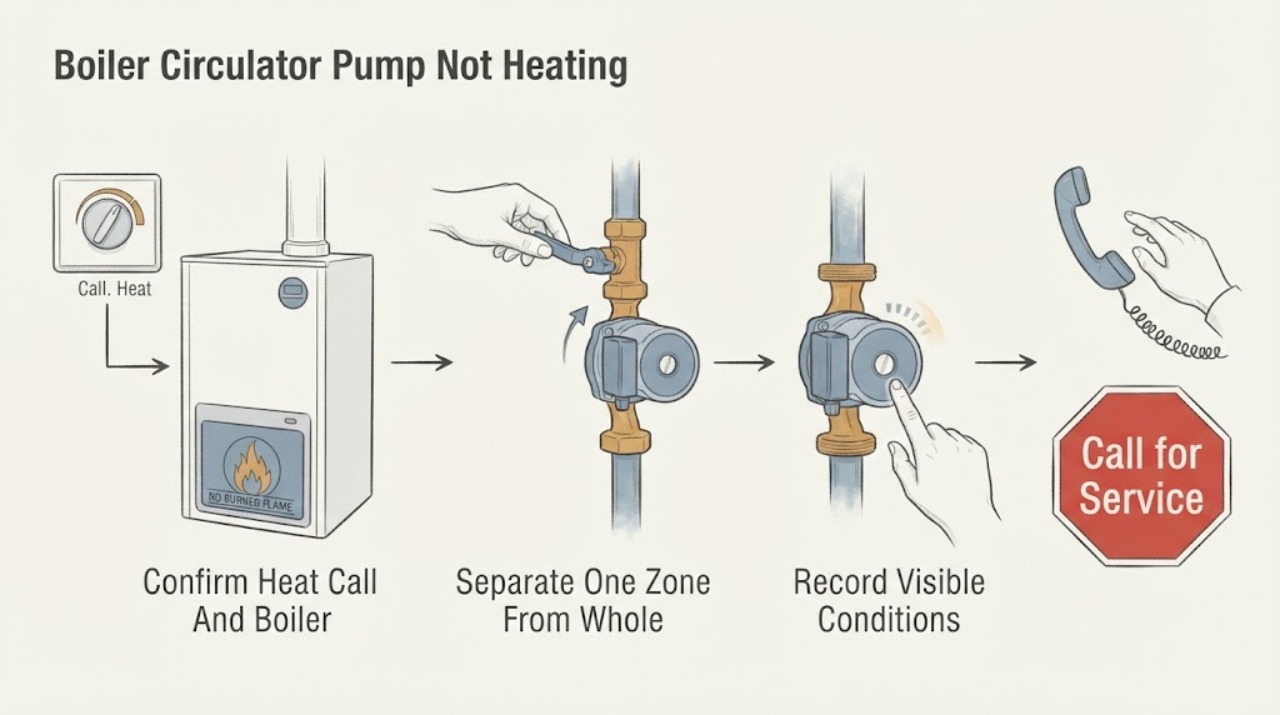
A Buderus boiler that is not heating because the circulator pump may not be moving water needs a safe symptom check, not a pump-cover or wiring test. Confirm that the thermostat is actually calling for heat, note whether the boiler fires, and observe only from outside the casing whether the accessible gauge or controller shows a low-water or flow-related condition. From a safe distance, compare whether the affected zone stays cold while another zone heats, and record unusual pump noise, visible leakage, or a pressure trend without touching hot piping. A failed pump is only one possibility: closed zone valves, air, low pressure, a blockage, deposits, a control fault, or a boiler problem can produce the same no-heat symptom. Do not open the casing, test live voltage, loosen a pump screw, bleed or fill the system, or work on gas, combustion, or electrical parts. Turn the boiler off and arrange qualified Buderus service for a silent pump with a valid heat call, a recurring flow or low-water fault, persistent no heat, or any leak; leave the area and seek urgent help for gas odor, smoke, steam, flooding, sparks, or wet controls.
Before you begin
Safety first
- This article supports only normal thermostat controls, safe exterior observation, reading an accessible display or gauge, recording sound and zone behavior, and isolating known utilities when safe. Pump removal or charging, live electrical testing, system draining or filling, bleeding, pressure testing, gas or combustion work, and boiler-casing access require a qualified technician.
Work through in order
Diagnostic checks
Use only checks that match the exact appliance or system and its official guide.
-
Check 1
Set the thermostat to a normal heat demand and observe the display from its usual position. Note whether the boiler starts, remains idle, locks out, or shows a flow or low-water message; do not repeatedly reset it or open the boiler.
Expected result: The thermostat shows no heat call, the boiler fires but the zone stays cold, the boiler does not respond, or a fault message returns.
Next step: Record the exact display wording and which zones respond. If there is a valid heat call with persistent no heat or a recurring fault, stop normal operation and arrange qualified Buderus service; do not keep resetting the boiler to force heat.
Stop if: Stop immediately for gas odor, smoke, sparks, steam, spraying water, flooding, wet controls, or a rapidly changing pressure indication.
Why this matters
Why: No heat call points first toward thermostat, schedule, or control settings. A firing boiler with a cold zone makes circulation, zone-valve, air, pressure, or flow problems more plausible. No response or a recurring fault can be a control, safety, ignition, or pump-command issue and cannot be separated safely from outside.
-
Check 2
Compare the affected heating zone with another zone or domestic-hot-water function only through normal user controls and safe room-temperature observations. Check that accessible radiator or zone controls are not intentionally closed, without removing covers or adjusting valves on the boiler piping.
Expected result: Only one zone is cold while another heats, every heating zone is cold, or the boiler heats water for another function but not the rooms.
Next step: Write down the affected zone, other working zones, and whether domestic hot water is normal. Give that pattern to qualified service rather than swapping a pump based only on a single cold room.
Stop if: Do not force a stuck valve, remove a motor head, open a drain, or alter boiler-piping valves as a user check.
Why this matters
Why: One cold zone makes a local valve, thermostat, air, or branch-flow issue more likely than a whole-boiler failure. Every zone being cold points more toward a common pump, control, low-water, flow, or boiler condition. A working hot-water function does not prove the heating circulator or heating control is healthy.
-
Check 3
From outside the casing and without touching piping, listen for a new hum, buzz, clicking, grinding, or complete silence during a heat call. If a nearby pipe can be viewed without contact, note whether the zone's visible supply and return areas appear to warm compared with another zone; never use a hand to test temperature.
Expected result: The pump area is silent, unusually noisy, visibly wet, or hot-looking; the boiler appears hot while the affected zone remains cold; or the safe exterior clues are unavailable.
Next step: Keep the boiler out of service if the pump is leaking, the sound is worsening, or no heat persists. Record the sound, zone and heat-call state for a qualified technician; do not remove a pump plug or cover to free the rotor.
Stop if: Do not touch hot pipes or pump surfaces, loosen fittings, remove insulation or casing, test live power, or place hands near moving or energized parts.
Why this matters
Why: Silence during a confirmed heat call can fit a missing pump command, safety lockout, wiring issue, or motor fault. Noise or visible leakage can fit a pump or nearby hydraulic fault. A hot boiler with a cold zone suggests inadequate flow, but sound and exterior warmth cannot prove an impeller, bearing, air pocket, valve, or blockage diagnosis.
-
Check 4
Read the normal user-facing pressure gauge or controller only if it is visible without opening the boiler, and record the indication while cool and during an ordinary heat call when there is no active leak, steam, gas odor, or other hazard. Do not attach a gauge, add water, bleed radiators, or open a pressure or relief fitting.
Expected result: The indication is low, falls after cooling, changes sharply during heating, stays stable, or cannot be read safely; a low-water or flow message may also appear.
Next step: Stop normal operation for low-water, rapidly changing pressure, an active leak, or a recurring flow fault and provide the recorded trend to qualified service. Do not compensate by repeatedly topping up the system.
Stop if: Do not operate a boiler with active discharge, rapidly rising pressure, steam, a low-water condition, or worsening leakage; never open a pressurized fitting.
Why this matters
Why: Low or unstable pressure can prevent circulation or indicate a leak, vessel, feed, or relief problem. A flow message or rapid temperature rise can fit inadequate flow, a nonworking pump, a blockage, deposits, or a control condition. Stable pressure does not rule out a local pump, valve, air, or control fault.
-
Check 5
When the area is safe and the boiler is not hot enough to create a contact hazard, inspect only visible exterior surfaces for water at the pump or nearby fittings, corrosion, damaged insulation, discoloration, smoke, sparks, or water near controls. Keep the casing closed and do not wipe or manipulate fittings.
Expected result: There is water or corrosion at the pump area, a pipe or relief discharge is wet, wiring or controls are wet or damaged, or no exterior hazard is visible.
Next step: Shut down and isolate power, water and gas only when the correct controls are known and doing so is safe; otherwise leave the area. Arrange qualified boiler service and provide a safe photo or description of the exterior condition.
Stop if: Do not touch wet wiring, switches, gas controls, hot water, steam, or a suspected leak; for strong gas odor, leave the area and follow local emergency or gas-utility guidance.
Why this matters
Why: A wet pump or fitting needs hydraulic diagnosis before any part is selected. Water near controls or damaged wiring creates an electrical hazard. No visible leak does not clear an internal pump, air, blockage, sensor, relay, or other flow problem.
-
Check 6
Photograph or record the Buderus model and serial information from an ordinary-access label, if safely visible, and assemble the heat-call state, affected zones, display message, pressure trend, pump sound, visible leak, and utility-shutdown status for the service call.
Expected result: The pump remains silent or noisy during a valid call, no heat persists, a flow or low-water fault returns, pressure is abnormal, or the source of the problem remains uncertain.
Next step: Keep the boiler out of operation when the fault or hazard persists and arrange qualified Buderus boiler service. Provide the exact model, observed pattern and safe records; let the technician confirm the cause and compatible repair.
Stop if: Do not open the casing, remove the pump, test live voltage, drain or fill the system, bleed radiators, or work on gas, combustion or electrical components.
Why this matters
Why: Persistent no heat needs model-specific testing of the circulator, command and wiring, zone valves, air and hydraulic flow, sensors, pressure and boiler controls. Similar symptoms can arise from several components, so appearance alone does not justify a replacement pump.
Use your observations
Decision map
Find the observation that best matches what you see, then follow the next safe action.
-
PATH 01Safety boundary
What you see
Do this next
Check only normal thermostat mode and setpoint controls, then arrange HVAC service if a valid call still does not start the system. Do not open the thermostat or boiler wiring.
Why this path and its safety boundary
Why it matters: A schedule, mode, thermostat, wiring or control condition is more likely than a failed circulator pump; the pump may correctly remain off.
Safety stop: Stop for gas odor, smoke, sparks, water near controls, or any unsafe electrical condition.
-
PATH 02Safety boundary
What you see
Do this next
Record the affected zone and working zones and arrange qualified service to trace that branch. Do not force a valve or bleed the system as a first response.
Why this path and its safety boundary
Why it matters: A local zone valve, thermostat, air pocket, branch blockage or local flow issue is more likely than a pump serving the entire system, although pump operation still needs professional confirmation.
Safety stop: Stop for a wet valve or pump, hot-water leak, steam, or water contacting electrical controls.
-
PATH 03Safety boundary
What you see
Do this next
Turn the boiler off if no heat persists or a fault returns and arrange qualified Buderus service for pump-command and flow diagnosis. Do not test power or remove the pump cover.
Why this path and its safety boundary
Why it matters: A missing pump command, safety lockout, wiring problem or failed motor is possible, but a closed valve or no-flow condition can produce the same pattern.
Safety stop: Stop for smoke, sparks, gas odor, wet wiring, steam, flooding, or rapidly changing pressure.
-
PATH 04Safety boundary
What you see
Do this next
Keep the boiler out of service and provide the pressure trend and display wording to qualified service. Do not add water, bleed radiators, block a discharge or repeatedly reset the control.
Why this path and its safety boundary
Why it matters: Low flow, a nonworking pump, air, blockage, deposits, a leak, a relief or feed issue, or a control condition remains possible; the symptom does not identify one part.
Safety stop: Stop immediately for active discharge, steam, spraying water, flooding, rapidly rising pressure, or any leak near electrical parts.
-
PATH 05Safety boundary
What you see
Do this next
Leave the area if needed. Isolate utilities only when safe and the correct shutoffs are known, then contact appropriate emergency, gas, electrical or qualified boiler help.
Why this path and its safety boundary
Why it matters: This is an immediate fuel, combustion, electrical, hot-water or pressure hazard, not a routine circulator-pump diagnosis.
Safety stop: Do not operate switches in a strong gas odor, touch wet controls, relight a burner, restart the boiler, or approach steam or spraying water.
Helpful context
Understand the symptom
Start with the heat-call and the symptom pattern
A zone that stays cold can have a circulation problem even when the boiler burner runs, but a thermostat that is not calling, a closed zone valve, or a control issue can look identical. Note whether the thermostat shows a heat call, whether the boiler starts, whether all zones are affected, and whether domestic hot water still works. Do not open the boiler to confirm a pump command or electrical supply.
A pump sound does not prove water flow
A hum, buzz, clicking sound, or vibration can mean the motor is energized, but it does not prove that the impeller is moving water. Conversely, a silent pump may reflect a missing heat call, a control or safety lockout, or a motor fault. Compare safe exterior observations with the affected zone and the boiler display; leave internal pump diagnosis to qualified service.
Keep hot, pressurized and fuel-burning equipment closed
Buderus boiler manuals include water-pressure, flow, pump and internal control checks that require model-specific service procedures. An ordinary user can record an accessible display or gauge and inspect for external leakage, but should not remove the casing, touch hot pipes, bleed radiators, refill the system, loosen a pump plug, or work on gas or electrical parts.
Safety boundary
Stop conditions
- Stop and leave the area when there is gas odor, smoke, sparks, abnormal combustion, steam, spraying water, flooding, wet controls, damaged wiring, or rapidly changing pressure; obtain appropriate emergency or qualified help.
- Do not remove the boiler casing, pump cover, insulation or electrical panels; do not test live voltage, loosen a pump screw, free an impeller, or handle internal wiring.
- Do not add water, bleed radiators, drain or refill the system, open a pressure-relief fitting, block a discharge, or operate a leaking or low-water boiler to keep collecting heat symptoms.
- Do not touch hot pipes or pump surfaces, work on gas or combustion parts, force zone valves, or repeatedly reset a fault that returns.
- Keep the boiler out of service and arrange qualified Buderus service when a valid heat call produces persistent no heat, the pump is silent or unusually noisy, a flow or low-water fault returns, pressure is abnormal, or the cause is uncertain.
Only after diagnosis
Potential parts
- Buderus boiler circulator pump
Consider this part only after qualified diagnosis confirms that the pump itself is not operating or cannot deliver the required flow, rather than a command, valve, air, pressure, blockage or control fault.
Pump voltage, head, connections, mounting and control compatibility vary by exact Buderus model and installation; confirm the model-specific replacement before ordering. - circulator motor or cartridge assembly
Some systems use a serviceable motor or cartridge rather than replacing the complete circulator; qualified service must identify the installed design and failure mode.
Motor, cartridge, seal and control compatibility depend on the exact pump and boiler installation; do not select by appearance or sound alone. - zone valve or flow-control component
Consider this category only when a single zone is cold and qualified testing confirms that the branch is not opening or flowing, rather than the common circulator being at fault.
Valve type, actuator, connections and control signal are installation-specific and require model and system confirmation. - boiler flow sensor or control relay
Consider this category only when qualified diagnosis confirms that a sensor, relay or controller is preventing a valid heat call from commanding safe circulation.
Control and sensor parts are model-specific; confirm the exact boiler revision and service procedure before replacement.
When checks do not resolve it
Need a professional?
Arrange qualified Buderus boiler service for persistent no heat during a valid thermostat call, a silent or unusually noisy circulator, a recurring flow or low-water fault, low or unstable pressure, an external leak, or any uncertain diagnosis. Give the technician the exact model and serial information if safely visible, affected and working zones, heat-call state, display wording, pressure trend, pump sound and safe exterior observations. For gas odor, smoke, sparks, steam, flooding, wet controls, damaged wiring or rapidly changing pressure, leave the area and seek urgent emergency, gas, electrical or boiler help as appropriate.
Safety scope: This article supports only normal thermostat controls, safe exterior observation, reading an accessible display or gauge, recording sound and zone behavior, and isolating known utilities when safe. Pump removal or charging, live electrical testing, system draining or filling, bleeding, pressure testing, gas or combustion work, and boiler-casing access require a qualified technician.
Common questions
FAQ
How can I tell whether the Buderus circulator pump is the reason the boiler is not heating?
You generally cannot confirm a failed pump from sound or pipe warmth alone. Confirm a heat call, note which zones respond, read any accessible flow or low-water message, and record safe exterior pump clues. A silent pump can also reflect a control or safety condition, while a noisy pump can still be moving insufficient water. Qualified service must confirm the pump and command circuit.
Why does the boiler fire while the rooms stay cold?
The burner can run while water flow to a zone is inadequate. Possible causes include a circulator problem, closed zone valve, air, low pressure, blockage, deposits, sensor or control trouble, or a local branch fault. Compare affected and working zones, record the pressure and display, and arrange service instead of opening the boiler or bleeding the system.
Should I bleed the radiators or add water when a Buderus boiler is not heating?
Do not use bleeding or refilling as a first response to a suspected circulator or low-flow problem. Low pressure can have several causes, and repeated topping up can worsen corrosion or scaling. Record the accessible indication and leave filling, bleeding, pressure checks and leak diagnosis to qualified service.
Is a humming circulator pump necessarily working?
No. A hum or vibration can occur without adequate water movement, and a flow restriction or air problem can cause no heat even when a motor runs. Do not loosen a pump plug or place hands on hot piping; record the sound and zone symptom for a technician.
When is a Buderus no-heat pump problem urgent?
Treat gas odor, smoke, sparks, abnormal combustion, steam, spraying water, flooding, wet controls, damaged wiring, rapidly changing pressure, or a recurring low-water or flow fault as urgent. Leave the area when necessary, isolate known utilities only when safe, and seek appropriate emergency or qualified boiler help.
Read the exact guide
Official sources
- Logano plus GB312 Installation and Service InstructionsBuderus, Bosch Home Comfort · Official Buderus installation and service manual used for the pump-not-working, low-flow, blockage, deposits, pressure and technician-only safety boundaries; exact procedures vary by model.
- Condensing Gas Boilers Maintenance InformationBosch Home Comfort, including Buderus boiler support · Official Bosch Home Comfort maintenance guidance for Buderus-supported gas boilers; used for safe exterior checks, utility shutdown when safe, and the boundary around pressure, wiring, controls and internal work.
Community feedback
Share a repair observation
Share a plain-text repair observation. Accepted observations are published automatically; this page may take a moment to update.