
On this page
Start here
Quick answer
Do not open a boiler or touch its gas, fuel, electrical, or hot-water components to diagnose a circulator problem. From normal user positions, confirm whether a thermostat is calling for heat, note any boiler display state or warning, compare heat delivery between zones, and listen for unusual circulator noise without touching the pump. If the boiler does not respond, only one zone is cold, the pump is silent or rattling, there is a leak, or heat remains absent, call a qualified HVAC technician. Leave immediately and seek emergency help for a gas or fuel odor, carbon-monoxide alarm, smoke, or signs of overheating.
Before you begin
Safety first
- Do not open the boiler, touch gas, fuel, electrical, hot-water, pump, or valve components, drain or vent the system, reset repeatedly, or change safety controls. Leave for fuel odor or a carbon-monoxide alarm and seek help from a safe location.
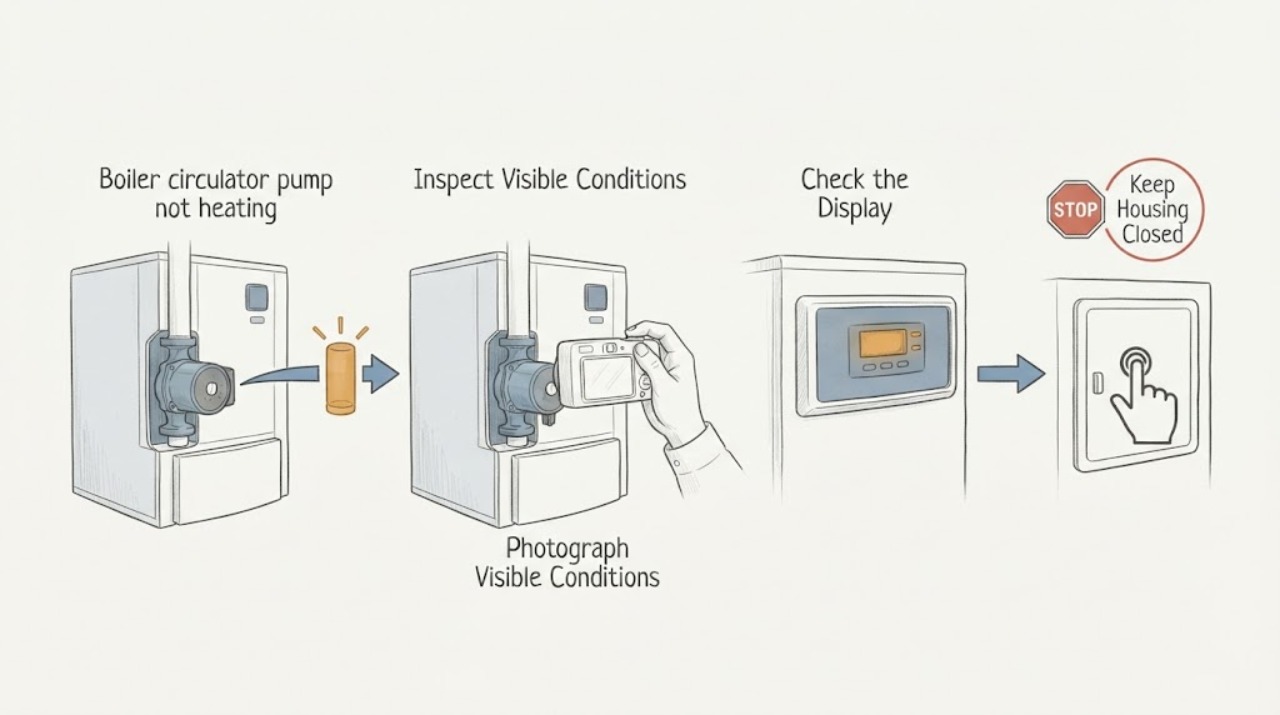
Work through in order
Diagnostic checks
Use only checks that match the exact appliance or system and its official guide.
-
Check 1
From a normal room position, observe the thermostat for the affected zone and note whether it shows a heat call, an occupied or scheduled state, a low-battery warning, or an error. Do not open the thermostat or change wiring.
Expected result: No heat call or a thermostat warning means the boiler may not have been asked to circulate. A clear heat call with no response keeps the boiler, zone controls, and circulator path in consideration.
Next step: Record the thermostat display and time, then provide it to the HVAC technician. Do not jumper terminals or access control wiring.
Stop if: Stop for a burning smell, smoke, exposed wiring, an electrical warning, or any need to open the thermostat or control enclosure.
Why this matters
Why: The demand signal is an upstream branch; it should be established before anyone assumes that the pump itself is defective.
-
Check 2
From outside the boiler cabinet, read any existing boiler or circulator display, indicator color, fault code, or alarm without pressing buttons or removing a cover. Take a photo only if it can be done without approaching a hot, wet, or energized part.
Expected result: A visible alarm, blocked-pump message, or non-normal indicator changes the priority to professional diagnosis. A normal-looking indicator does not prove that water is circulating or that the boiler is heating the requested zone.
Next step: Write down the exact code or indicator state and the time it appeared. Give it to the technician along with the thermostat observation.
Stop if: Stop and leave the equipment alone for smoke, scorching, a fuel odor, a carbon-monoxide alarm, water on electrical equipment, or an instruction to remove a cover.
Why this matters
Why: The display is a model-specific clue, not permission to reset repeatedly or work inside the boiler.
-
Check 3
Compare room comfort and normal zone indicators across the home while the thermostat is calling, without touching radiators, baseboards, exposed pipes, or the boiler. Note whether all zones are cold, one zone is cold, or heat is uneven.
Expected result: All zones cold with a valid heat call points toward the boiler, common control, or system circulation. One cold zone with other zones working points toward that zone's control, valve, air, or circulation path. Uneven recovery can also indicate a flow or system-balance issue.
Next step: Record the affected rooms or zones, thermostat readings if already displayed, and when the temperature difference began. Arrange HVAC service when heat is not restored normally.
Stop if: Stop if a room has a fuel odor, carbon-monoxide alarm, smoke, a leak, or a hot surface that could burn someone; leave the hazard area and seek help.
Why this matters
Why: The zone pattern helps the technician separate a system-wide failure from a single-loop symptom without exposing the user to hot surfaces.
-
Check 4
From a safe distance, listen briefly for the external circulator's normal operating sound during a heat call and look for visible leaking, condensation, rust streaks, or an indicator that changes. Do not touch the pump, piping, wiring, or isolation valves.
Expected result: Silence during a confirmed heat call, repeated buzzing or rattling, a changing fault indicator, or visible water suggests a pump or system issue requiring service. A quiet pump when there is no heat call may be normal, and sound alone cannot confirm circulation.
Next step: Record the sound type, when it occurs, the affected zone, and any visible moisture. Call an HVAC technician rather than trying to vent, drain, unjam, or adjust the pump.
Stop if: Stop immediately for hot water spray, a growing leak, steam, smoke, fuel odor, carbon-monoxide alarm, or any need to touch the pump or remove its cover.
Why this matters
Why: Noise and exterior condition are triage clues only; pump and boiler internals can be hot, pressurized, or electrically hazardous.
-
Check 5
Check from the room side whether the boiler has returned to normal operation after the thermostat's ordinary call, without repeatedly cycling power, resetting a lockout, opening a gas valve, or changing a safety control.
Expected result: If heat returns only briefly, a warning recurs, or the pump symptom returns, the underlying fault remains unresolved. If the boiler stays normal but one zone remains cold, the local zone path still needs assessment.
Next step: Stop user testing, preserve the displayed code or indicator, and schedule qualified HVAC service. Provide the time sequence of thermostat call, boiler response, zone heat, and pump sound.
Stop if: Stop use and leave the area for fuel odor, carbon-monoxide alarm, smoke, scorching, abnormal pressure or water release, or any unsafe boiler behavior.
Why this matters
Why: A temporary recovery is not proof that a circulator or control is healthy, and repeated resets can obscure the fault or create a safety risk.
Use your observations
Decision map
Find the observation that best matches what you see, then follow the next safe action.
-
PATH 01Next step
What you see
The thermostat shows no heat call, a low-battery warning, or a control error.
Do this next
Record the display and obtain HVAC service if the ordinary user setting does not restore a clear call; do not access wiring or jumper terminals.
Why this path and its safety boundary
Why it matters: The boiler may not be receiving a valid demand for the affected zone.
-
PATH 02Next step
What you see
A heat call is present, the boiler display shows an alarm or blocked-pump state, or the circulator is silent or abnormal.
Do this next
Stop repeated resets and call a qualified HVAC technician with the exact indicator, sound, and timing observations.
Why this path and its safety boundary
Why it matters: The boiler, circulator, control, or hydronic system may need professional diagnosis.
-
PATH 03Next step
What you see
Several zones are cold while one thermostat is calling.
Do this next
Keep the equipment closed and provide the zone pattern to the technician; do not drain, vent, or touch system components.
Why this path and its safety boundary
Why it matters: A shared boiler, control, or circulation issue is more likely than an isolated emitter problem.
-
PATH 04Next step
What you see
Only one zone is cold while other zones heat normally.
Do this next
Document the affected rooms and any visible zone indicator, then arrange professional service without opening valves or the pump.
Why this path and its safety boundary
Why it matters: That zone's control, valve, air condition, or circulation path may be involved.
-
PATH 05Next step
What you see
There is a fuel odor, carbon-monoxide alarm, smoke, scorching, steam, or a rapidly worsening leak.
Do this next
Leave the hazard area, avoid switches and ignition sources, and contact emergency services or the fuel provider from a safe location.
Why this path and its safety boundary
Why it matters: This is an immediate life-safety or equipment hazard, not a user troubleshooting branch.
Helpful context
Understand the symptom
A cold zone does not prove the pump alone failed
A hydronic boiler needs a heat call, a functioning boiler sequence, an open path through the zone, and circulation. A missing thermostat call or boiler lockout can look like a dead pump. Conversely, a boiler that heats while one zone stays cold can point toward circulation, a valve, trapped air, or that zone's control. The safest first step is to observe the system's existing indicators and heat pattern.
Use the pump's outside clues only
A circulator may have an indicator or display, and abnormal buzzing, rattling, or silence can be useful clues. Do not touch the pump housing or nearby piping because system water can be hot and pressurized, and do not remove a cover to look for a rotor or wiring. A professional can interpret the pump state with the boiler controls and system design.
Heat differences help map the affected zone
Note which rooms or zones are comfortable and which are cold, and whether the pattern began after a power interruption, service visit, or unusual weather. Keep the observation at room level; do not bleed a radiator, open a valve, drain the system, or alter a control unless a qualified technician directs it for the exact installation.
Fuel and carbon-monoxide safety comes first
Gas- or oil-fired boiler work is professional work. If there is a fuel odor, carbon-monoxide alarm, smoke, scorching, or a rapidly worsening system condition, leave the building or affected area as appropriate, avoid switches and ignition sources, and contact emergency services or the fuel provider from a safe location.
Only after diagnosis
Potential parts
- boiler circulator pump
Consider only after a qualified technician confirms the circulator is failed or unsuitable for the boiler and zone system.
Confirm voltage, connection arrangement, flow requirements, control method, and boiler-system compatibility; no universal pump is assumed. - boiler thermostat
Consider only if service confirms that the thermostat or its compatible control is not producing a valid heat call.
Confirm heat-only or communicating requirements, wiring, power, and system controls before selection; do not infer compatibility from appearance. - boiler air vent
Consider only when a qualified professional confirms trapped air or a failed vent is contributing to poor circulation and identifies the correct service part.
Location, pressure, temperature, connection, and system design determine suitability; venting or draining is not a user step here.
When checks do not resolve it
Need a professional?
Call a qualified HVAC technician promptly when a boiler has a valid heat call but does not heat, one or more zones remain cold, the circulator is silent or noisy, a display shows a warning, or any pump or pipe is leaking. Treat fuel odor, a carbon-monoxide alarm, smoke, steam, scorching, or a rapidly worsening leak as an emergency.
Safety scope: Do not open the boiler, touch gas, fuel, electrical, hot-water, pump, or valve components, drain or vent the system, reset repeatedly, or change safety controls. Leave for fuel odor or a carbon-monoxide alarm and seek help from a safe location.
Have this ready
- Provide the thermostat call and warning state, boiler display or indicator, affected rooms or zones, when the symptom began, whether other zones heat, the circulator sound pattern, visible moisture, and any recent power or service event.
Common questions
FAQ
How can I tell if the circulator pump is the reason a boiler is not heating?
You cannot safely confirm that from sound alone. Record the thermostat call, boiler display, zone pattern, and the pump's external sound or indicator, then have a qualified technician diagnose the pump with the boiler and system controls.
Should I touch the circulator pump to see if it is running?
No. Boiler water and piping can be hot and pressurized, and the pump may have electrical hazards. Observe only from a safe distance and do not remove its cover.
Why is one heating zone cold while another works?
A single-zone pattern can involve that zone's control, valve, air condition, or circulation path, while a whole-system pattern can involve the boiler or common controls. Document the rooms and call an HVAC technician rather than draining or venting the system.
What should I do if I smell gas near the boiler?
Leave the affected area, avoid switches and ignition sources, and contact emergency services or the fuel provider from a safe location. Do not continue troubleshooting or operate boiler controls.
Read the exact guide
Official sources
- Circulator PumpsU.S. Department of Energy · Provides official context for the equipment category; system-specific operation and repair remain professional decisions.
- Why is the circulator pump making noise (buzzing or rattling)? Is this normal?Grundfos Pumps Ltd. · Supports treating buzzing, rattling, air, wear, or blockage as service clues without instructing the user to touch hot or pressurized equipment.
- Troubleshooting the MAGNA3 circulator pumpGrundfos Americas Corporation · Supports reading an existing pump display or alarm state as a model-specific clue; it does not authorize opening or servicing a boiler or pump.
Community feedback
Share a repair observation
Share a plain-text repair observation. Accepted observations are published automatically; this page may take a moment to update.