
On this page
Start here
Quick answer
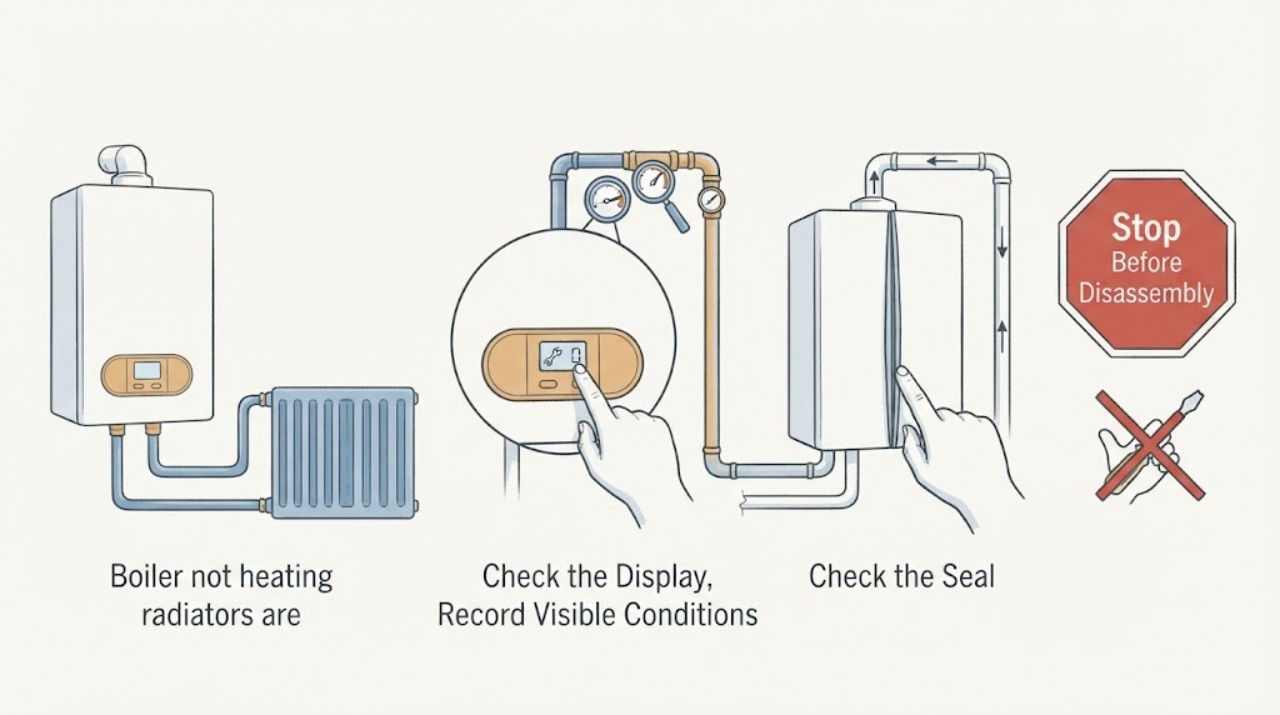
If the boiler is not heating and several radiators are cold, first confirm that the programmer or thermostat is actually calling for central heat and that the boiler is in heating mode, not hot-water-only mode. Check the boiler display for a fault or lockout and inspect its pressure indicator and visible pipework without removing the casing. If only one radiator is affected, check its accessible valve and whether it is cold at the top or bottom; trapped air and sludge produce different patterns. Do not open the boiler, work on gas or electrical parts, repeatedly reset a fault, or add water without following the exact appliance instructions. A returning fault, abnormal pressure, a leak, no improvement after safe control checks, or any gas smell, carbon-monoxide concern, smoke, or burning odor requires qualified heating service.
Before you begin
Safety first
- The homeowner scope is limited to normal controls, display reading, accessible valve settings, cool-radiator observations, and manual-directed checks. Do not remove the boiler casing, test live electrical parts, alter gas or combustion components, drain or chemically flush the system, force valves, or repeatedly reset a fault.
Work through in order
Diagnostic checks
Use only checks that match the exact appliance or system and its official guide.
-
Check 1
Set the room thermostat above the current room temperature and check the programmer or timer for an active central-heating period. Confirm that the boiler is not set to hot-water-only, holiday, summer, or another mode that excludes radiator heating, using only the normal user controls and the appliance manual.
Expected result: The heating demand was off or scheduled later, the boiler was in a non-heating mode, or the controls are calling for heat but the boiler and radiators remain cold.
Next step: Correct only the user-accessible setting described by the manual and observe one normal heating cycle. If the boiler does not respond or the setting will not hold, record it and arrange qualified service.
Stop if: Stop if controls are damaged, wiring is exposed, the boiler behaves abnormally, or changing the setting would require opening a cover or altering internal wiring.
Why this matters
Why: A disabled demand or wrong mode can explain cold radiators without a boiler breakdown; a valid demand with no response shifts concern toward boiler status, power, pressure, or circulation.
-
Check 2
Read the boiler display and indicator lights without removing the casing. Record any fault code, lockout symbol, pressure warning, unusual noise, repeated start attempts, or whether hot water still works while central heating does not. Check the manual for the meaning of the exact code rather than guessing from a generic list.
Expected result: The boiler shows a returning fault or lockout, no demand response, a pressure warning, or normal status despite cold radiators.
Next step: Record the exact display and arrange qualified heating service for a fault, lockout, or no response. Do not keep resetting the boiler or attempt to repair the ignition, burner, pump, sensor, or control board.
Stop if: Stop immediately for gas smell, smoke, burning odor, unusual flame, carbon-monoxide alarm, water escaping from the boiler, or an electrical smell or hazard.
Why this matters
Why: A returning fault or lockout is a boiler-service clue; normal status with cold radiators makes control, valve, pressure, or circulation checks more relevant but does not make internal repair safe.
-
Check 3
Read the pressure gauge or digital pressure display and look from a safe position for visible leaks at accessible radiator valves, pipe joints, and beneath the boiler. Compare the reading with the normal range in the exact appliance manual; do not remove the casing or operate an unfamiliar filling control.
Expected result: Pressure is below or above the manual's normal range, has dropped since a previous check, or appears normal with no visible leak.
Next step: Photograph the display and any visible water, keep the heating off if water is escaping, and contact a qualified engineer. Only follow a documented manual procedure for a one-time user-level pressure correction when the system is cool and no leak is suspected; otherwise ask the engineer to do it.
Stop if: Stop for active leakage, rapid pressure change, hot discharge, damaged pipework, electrical contact with water, or any need to open the boiler or manipulate an unknown valve.
Why this matters
Why: An abnormal or changing reading can indicate lost system water, a leak, or another system fault; normal pressure does not rule out a failed boiler, valve, pump, or circulation problem.
-
Check 4
With the heating off and radiators cool, check the accessible manual or thermostatic valve on each affected radiator for a closed or very low setting, a stuck control, or furniture blocking the radiator. Compare one affected radiator with a normally warm one without removing the valve or pipework.
Expected result: Only one radiator is cold, several radiators on one area are cold, a valve is closed or restricted, or all radiators are equally cold despite open controls.
Next step: Restore only an obviously closed user control and observe a normal cycle. If the valve is stuck, leaking, or the radiator stays cold, ask a heating engineer to inspect the valve and circulation; do not remove or force it.
Stop if: Stop for a leaking valve, hot surfaces, damaged pipework, a valve that will not move normally, or any need to drain the system or remove a component.
Why this matters
Why: A local valve or flow issue is more likely when the boiler and other radiators work; many equally cold radiators point back toward shared heating demand, boiler, pressure, or circulation rather than one radiator valve.
-
Check 5
If one radiator is partly warm and the system manual permits user bleeding, first turn the heating off and let the radiator cool, then follow the exact manufacturer procedure while protecting the surrounding surface. Compare the temperature pattern: top colder than bottom, bottom colder than top, or cold throughout. Do not bleed a hot radiator or continue if the valve leaks.
Expected result: Air escapes and the radiator later warms more evenly, the radiator is cold at the bottom but warm at the top, or bleeding changes nothing and multiple radiators remain cold.
Next step: After any permitted bleeding, check pressure as the manual directs and stop if it falls or the radiator remains abnormal. Arrange qualified service for sludge, repeated air, leaks, or multiple cold radiators.
Stop if: Stop for hot water, a seized or leaking bleed valve, damaged threads, abnormal pressure, repeated need to bleed, or any attempt to add chemicals or flush the system without professional guidance.
Why this matters
Why: A top-cold/bottom-warm pattern is consistent with trapped air; bottom-cold/top-warm can indicate sludge or poor circulation; no improvement or whole-system coldness points toward a broader fault needing diagnosis.
Use your observations
Decision map
Find the observation that best matches what you see, then follow the next safe action.
-
PATH 01Safety boundary
What you see
All radiators are cold, the thermostat and programmer call for heat, and the boiler shows a fault, lockout, no response, or pressure warning.
Do this next
Stop repeated resets and arrange qualified boiler service with the exact display, pressure reading, and whether hot water still works.
Why this path and its safety boundary
Safety stop: Do not open the casing or work on ignition, burner, gas, electrical, pump, sensor, or control components.
-
PATH 02Safety boundary
What you see
The boiler responds to heat demand and most radiators warm, but one radiator is cold throughout or has a closed, stuck, or leaking accessible valve.
Do this next
Keep the valve and pipework intact and have a heating engineer assess the local valve and circulation; restore only an obviously closed user setting if it moves normally.
Why this path and its safety boundary
Safety stop: Do not force, remove, drain, or replace a radiator valve as a first response.
-
PATH 03Safety boundary
What you see
One radiator is warm at the bottom but cold at the top, and the boiler and other radiators operate normally.
Do this next
If the manual allows, let the radiator cool and follow the manufacturer's bleeding procedure once, then recheck pressure as directed; arrange service if the pattern returns.
Why this path and its safety boundary
Safety stop: Stop for a leaking bleed valve, hot water, abnormal pressure, or repeated air accumulation.
-
PATH 04Safety boundary
What you see
A radiator is warm at the top but cold at the bottom, or several radiators have uneven or progressively weaker heat despite open controls.
Do this next
Treat sludge, poor circulation, or another system restriction as possible and arrange professional system assessment and cleaning rather than adding chemicals or flushing it yourself.
Why this path and its safety boundary
Safety stop: Do not drain, chemically flush, or dismantle the heating circuit without qualified guidance.
-
PATH 05Safety boundary
What you see
Pressure is low or high, has dropped suddenly, or visible water is present around the boiler, radiator, or pipework.
Do this next
Keep the system off if water is escaping, photograph the reading and leak, and call a qualified engineer to find and correct the cause before normal heating resumes.
Why this path and its safety boundary
Safety stop: Do not repeatedly top up, open the boiler, or operate an unknown filling or isolation valve.
-
PATH 06Safety boundary
What you see
There is a gas smell, carbon-monoxide alarm, unusual flame or staining, smoke, burning odor, or someone has headache, dizziness, nausea, or breathlessness.
Do this next
Leave the property or affected area, avoid ignition sources and electrical switches, contact the local gas emergency service or emergency services as appropriate, and seek urgent medical advice for symptoms.
Why this path and its safety boundary
Safety stop: Do not re-enter or relight the boiler until the responsible emergency or qualified service provider says it is safe.
Helpful context
Understand the symptom
Start with the pattern, not a replacement part
All radiators cold points first toward a shared heating demand, boiler, pressure, power, or circulation issue. One cold radiator with the others working points more toward its valve, air, sludge, or local flow. The way a single radiator feels also matters: air often leaves the top colder than the bottom, while a bottom-cold/top-warm pattern can indicate sludge or poor circulation. These clues guide a check; they do not identify an internal boiler part.
Pressure is a clue, not a target to guess
The pressure gauge or display should be compared with the range in the exact boiler manual. A low reading can follow radiator bleeding, but a sudden drop can indicate a leak; a high reading can also require an engineer. Do not repeatedly top up a system or remove the boiler casing to find the reason for a pressure change.
Keep combustion and internal repair out of DIY checks
A homeowner can read controls, observe the display, check accessible radiator valves, and record visible leaks or temperature patterns. Gas, oil, combustion, flue, electrical, pump, expansion, and internal control work requires a qualified heating engineer. If there is a gas smell, carbon-monoxide alarm, unusual flame or staining, headache, dizziness, nausea, or breathlessness, leave the area and follow local emergency and medical guidance.
Only after diagnosis
Potential parts
- radiator thermostatic or manual valve
Consider this category only when a qualified engineer confirms that one radiator's valve is faulty, stuck, or leaking and that the connection and system type are known.
Match the exact valve connection, radiator pipe arrangement, system pressure, and manufacturer or installer guidance; do not order a valve from the symptom alone. - central-heating system filter
Consider this category only when a qualified heating professional identifies a circulation or system-water maintenance need and confirms that a filter is suitable for the installed circuit.
Confirm boiler type, pipe size, flow direction, installation clearance, and local requirements before selecting any filter; it is not a substitute for diagnosing a fault or leak.
When checks do not resolve it
Need a professional?
Escalate for multiple cold radiators, recurring error or lockout, abnormal pressure, visible leaks, repeated need to bleed, suspected sludge or circulation failure, or any gas or electrical safety concern.
Safety scope: The homeowner scope is limited to normal controls, display reading, accessible valve settings, cool-radiator observations, and manual-directed checks. Do not remove the boiler casing, test live electrical parts, alter gas or combustion components, drain or chemically flush the system, force valves, or repeatedly reset a fault.
Have this ready
- Provide the boiler make and model if available, exact display code, heating mode and control settings, pressure reading and whether it changes, which radiators are affected, their top/bottom temperature pattern, visible leaks, recent bleeding or repairs, and any gas, flame, odor, or carbon-monoxide concern.
Common questions
FAQ
Why are all my radiators cold when the boiler is on?
Check that the thermostat and programmer call for central heat and that the boiler is not in hot-water-only mode. Then read the display and pressure indicator without opening the casing. A fault, lockout, abnormal pressure, or no response needs qualified service.
Why is one radiator cold at the top but warm at the bottom?
That pattern is consistent with trapped air. If the system manual permits user bleeding, turn the heating off, allow the radiator to cool, follow the manufacturer's procedure, and check pressure afterward as directed. Stop for a leak, seized valve, or repeated recurrence.
What does a radiator that is warm at the top but cold at the bottom mean?
Worcester Bosch says that pattern can indicate sludge buildup or poor circulation rather than trapped air. Arrange professional system assessment and cleaning; do not drain or chemically flush the circuit yourself.
Can I reset or repressurise the boiler myself?
Only follow the exact user procedure in the appliance manual, and do not repeatedly reset a returning fault. A sudden pressure drop may indicate a leak, while high pressure also needs engineer assessment. If unsure, arrange qualified service.
When is a cold-boiler problem an emergency?
Leave and follow local emergency guidance for a gas smell, carbon-monoxide alarm, unusual flame or staining, smoke, burning odor, or symptoms such as headache, dizziness, nausea, or breathlessness. Do not relight or re-enter until the responsible service says it is safe.
Read the exact guide
Official sources
- Boiler services explainedEnergy Saving Trust · Independent UK guidance for gas central-heating boilers; users outside the UK should follow local qualification and emergency-service requirements.
- Gas safety - Carbon monoxide awareness frequently asked questionsHealth and Safety Executive · HSE domestic gas-safety guidance for fossil-fuel appliances; emergency numbers and qualification systems vary by country.
- How to bleed a radiatorWorcester Bosch · Worcester Bosch consumer guidance for radiator bleeding; the appliance and system manual controls the exact procedure.
- Why is my radiator not working?Vaillant · Vaillant consumer guidance for central-heating radiators; exact boiler and system instructions vary by model and installation.
Community feedback
Share a repair observation
Share a plain-text repair observation. Accepted observations are published automatically; this page may take a moment to update.