
On this page
Start here
Quick answer
Do not try to light, adjust, clean, or remove a Buderus burner assembly yourself. First decide whether the boiler has no call for heat, has a control lockout, or calls for heat but does not produce burner heat. From outside the cabinet, check the thermostat or heating control, the boiler display, power indicator, and accessible vent termination for obvious damage or blockage. Do not operate a gas valve or open a burner door. If there is a gas or fuel odor, smoke, soot, unusual flame noise, water on controls, a blocked vent, repeated ignition attempts, or a lockout, leave the boiler off and contact qualified heating service; follow local emergency guidance for an active gas or fire danger. Buderus/Bosch manuals reserve burner, ignition, gas, combustion, venting, and safety-device work for qualified professionals.
Before you begin
Safety first
- Owner checks end at emergency triage, thermostat and display observation, safe external power indication, and visual inspection of the boiler exterior, vent termination, connections, and surrounding area. A qualified professional must handle burner assembly, ignition, flame sensing, gas or oil valve, combustion, vent, pressure, electrical, hydraulic, and safety-device work.
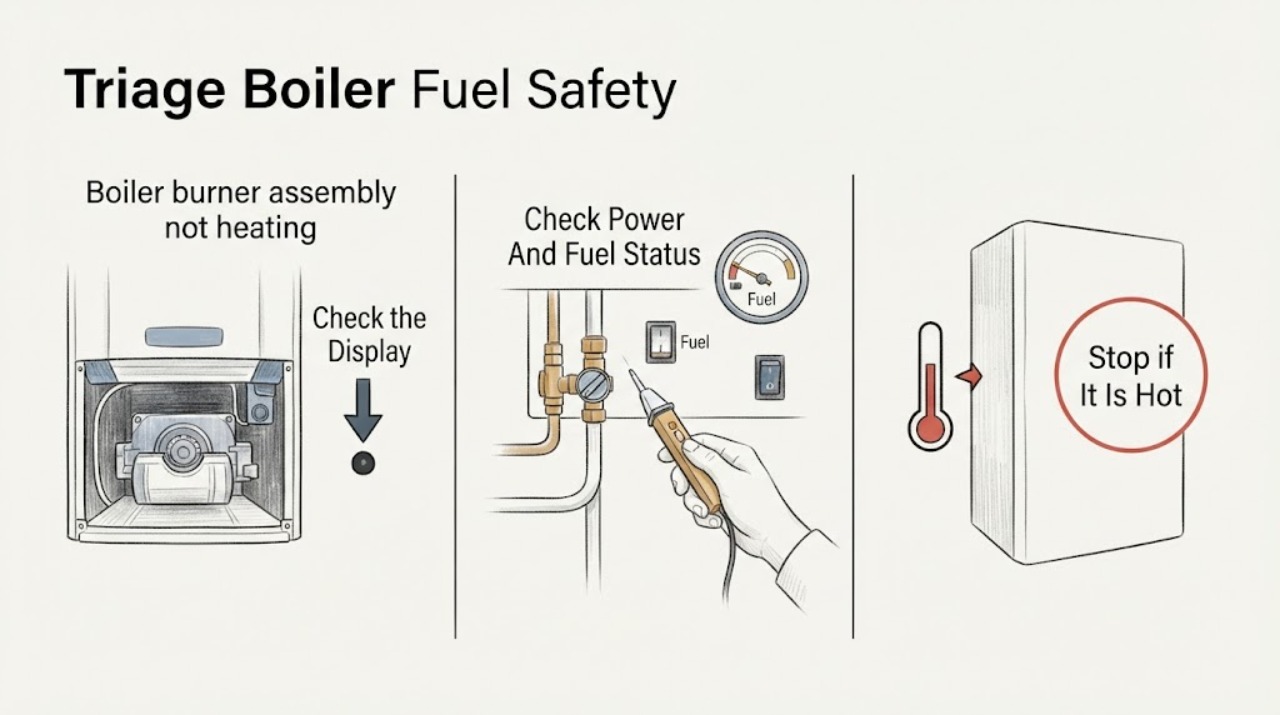
Work through in order
Diagnostic checks
Use only checks that match the exact appliance or system and its official guide.
-
Check 1
From outside the boiler room, stop and observe without opening the cabinet or burner door. Note gas or oil odor, smoke, soot, flames outside the combustion area, unusual roaring or repeated ignition attempts, water on the controls, exposed wiring, or a hot or damaged flue. Do not touch the gas valve, attempt a manual ignition, or use a switch in an area where fuel gas may be present.
Expected result: There is no odor, smoke, leak, or visible damage; the boiler is silent; or an active fuel, fire, electrical, water, or vent hazard is present.
Next step: For an active gas, fire, or smoke danger, leave the area and contact emergency services or the fuel emergency provider from a safe location. Otherwise keep the boiler off and arrange qualified Buderus/Bosch heating service; do not restart it to reproduce the symptom.
Stop if: Stop immediately for fuel odor, smoke, flame outside the chamber, soot, water on controls, exposed wiring, unusual combustion noise, or a blocked or damaged vent.
Why this matters
Why: A quiet boiler with no hazard can proceed to limited control checks. Gas or oil odor, smoke, soot, flame rollout, water on controls, or vent damage is a combustion, fire, shock, or carbon-monoxide concern rather than a simple burner setting.
-
Check 2
Use only the thermostat or heating control interface and the outside of the boiler to verify that the room is below its requested temperature, the heating mode is enabled, and the boiler display or indicator shows a heat request, standby state, or lockout. Do not remove a control cover, change service parameters, or clear a lockout without the exact owner manual.
Expected result: There is no heat demand; the control is off or in a schedule setback; a lockout or fault indicator is shown; or a clear heat demand is present with no burner response.
Next step: Correct only an obvious user setting according to the exact Buderus manual. For a lockout or a confirmed demand with no burner response, leave the boiler off and arrange qualified service; do not repeatedly reset or override the control.
Stop if: Stop if the display is damaged, a lockout returns, the control behaves erratically, or any check requires opening the control panel or testing live voltage.
Why this matters
Why: No demand or an intentional schedule state can explain no burner operation. A lockout or a confirmed demand with no ignition shifts the problem toward control, safety interlock, fuel, ignition, combustion-air, or burner diagnosis.
-
Check 3
From a safe position, verify that the boiler's external emergency switch or electrical supply indicator is on and that no household outage is affecting the heating controls. For a fuel-fired unit, look only for an obvious external service interruption or closed access condition; do not turn a fuel valve, remove a cover, bleed a line, or perform fuel-pressure or electrical measurements.
Expected result: The boiler has no power indicator; the emergency switch is off; a breaker is tripped; fuel service is interrupted; or power and external service appear available.
Next step: Restore only an obvious user-accessible electrical switch if the area is dry and undamaged and the exact manual permits it; do not reset a breaker that trips again. Contact the fuel supplier or qualified heating technician for fuel interruption, internal wiring, or burner diagnosis.
Stop if: Stop for a wet area, damaged switch, repeated breaker trip, fuel odor, a suspected fuel interruption, or any need to operate a gas or oil valve or test electrical supply.
Why this matters
Why: A loss of control power or external fuel service can prevent any burner request. A normal indicator and available service do not prove that fuel reaches the burner or that ignition and flame sensing are safe.
-
Check 4
After the boiler is off and cool, visually inspect from outside the cabinet for discoloration, corrosion, water or fuel leakage, a blocked vent termination, damaged intake or exhaust piping, or combustible material stored close to the boiler. Do not open the combustion chamber, remove the vent, clean an internal flue, or move the boiler to see behind it.
Expected result: A leak, discoloration, corrosion, blockage, damaged vent, or combustible storage is visible; or the exterior appears intact.
Next step: Keep the boiler off and arrange qualified service for any leak, damage, discoloration, or vent concern. Remove only loose combustible items from a safe distance; do not clean or modify the vent or burner yourself.
Stop if: Stop for gas or oil leak, water leak, corrosion, soot, blocked or damaged venting, combustible material near the appliance, or any need to access the combustion area.
Why this matters
Why: Buderus maintenance guidance treats visible damage, leaks, discoloration, and vent blockage as reasons to shut down and report the condition. An intact exterior does not rule out burner, ignition, flame-sensing, combustion, or control failure.
-
Check 5
Without opening the boiler or touching pipes that may be hot, note whether the circulation pump or system emits its normal operating sound after a heat demand, whether radiators or hydronic zones remain cold, and whether any display message returns. Do not use the presence of a pump sound as permission to inspect the burner or reset a safety device.
Expected result: The control calls for heat but the boiler stays silent; the boiler attempts ignition and locks out; the burner fires briefly then drops out; or the burner appears to run but the heating zones remain cold.
Next step: Record the exact sequence and display message, then keep the boiler off for repeated lockouts or failed ignition and arrange qualified service. Do not watch through an opened panel, adjust combustion, or work on the pump or water circuit.
Stop if: Stop for repeated ignition, flame dropout, lockout, hot-water leakage, unusual combustion noise, or any need to open the burner or service panel.
Why this matters
Why: No response can involve controls, interlocks, power, fuel, or ignition. Brief ignition followed by dropout raises flame-sensing, combustion, venting, or fuel stability concerns. A running burner with cold zones may instead involve circulation or hydraulic faults rather than the burner assembly itself.
-
Check 6
Prepare the complete Buderus model and serial information, fuel type, thermostat demand, display or lockout message, power status, ignition sequence, vent and exterior observations, recent maintenance, and whether domestic hot water or space-heating zones are affected. Do not remove the burner assembly or attempt a manual flame check for a better service record.
Expected result: The issue was only a user control setting; a lockout or no-ignition condition persists; the burner lights then drops out; or visible fuel, water, vent, or combustion damage is present.
Next step: Keep the boiler off for a recurring or unsafe symptom and give the service technician the record. Request burner and combustion diagnosis for the exact model; contact the fuel supplier when external fuel service is interrupted.
Stop if: End owner troubleshooting when diagnosis requires burner, ignition, gas or oil valve, combustion, vent, electrical, flame-sensing, pressure, or safety-device access.
Why this matters
Why: A corrected control setting is different from a confirmed heat demand with failed ignition or a safety shutdown. Persistent burner non-heating requires qualified measurement of fuel, air, ignition, flame signal, venting, heat exchanger, controls, and safety interlocks.
Use your observations
Decision map
Find the observation that best matches what you see, then follow the next safe action.
-
PATH 01Next step
What you see
The thermostat or heating control is not calling for heat, is in an off or setback state, or the boiler is in a normal standby state with no fault and no fuel or combustion hazard.
Do this next
Correct only the obvious control setting using the exact Buderus manual. If a confirmed heat demand produces no response, arrange qualified heating service without opening the burner compartment.
Why this path and its safety boundary
Why it matters: The burner assembly may not be receiving a request. A control setting or schedule state is more likely than a burner failure, but a control that will not request heat still needs service if the owner setting is correct.
-
PATH 02Next step
What you see
A heat demand is present, the display shows a lockout or fault, and the burner does not ignite or only makes repeated start attempts; there is no active gas or fire emergency.
Do this next
Do not repeatedly reset or manually light the burner. Keep the boiler off and have a qualified Buderus technician diagnose the exact code and burner assembly; contact the fuel provider if external fuel service is interrupted.
Why this path and its safety boundary
Why it matters: A safety interlock, fuel supply, ignition, flame sensing, combustion-air, vent, or control issue is more likely than a simple thermostat setting. The display code is model-specific.
-
PATH 03Next step
What you see
The boiler has a confirmed heat demand and the burner lights briefly, then shuts down or locks out, or flame appears unstable while the boiler fails to heat.
Do this next
Stop operation and arrange qualified combustion service. Do not adjust the fuel valve, burner air, electrodes, flame sensor, or safety controls, and do not restart repeatedly.
Why this path and its safety boundary
Why it matters: Flame sensing, ignition, fuel stability, combustion air, venting, gas or oil pressure, or a control safety response is more likely. A homeowner cannot verify combustion or flame signal safely.
-
PATH 04Next step
What you see
External inspection finds a gas or oil leak, water leak, soot or discoloration, blocked or damaged vent termination, damaged intake, or combustible material close to the boiler.
Do this next
Keep the boiler off; leave and seek emergency or fuel-provider help for active gas, fire, or smoke danger. Otherwise report the finding to a qualified heating professional and do not operate until cleared.
Why this path and its safety boundary
Why it matters: Fuel, combustion, carbon-monoxide, water, or fire risk takes priority over burner diagnosis. Buderus maintenance guidance says these findings require shutdown and qualified service.
-
PATH 05Next step
What you see
The burner appears to operate under a heat demand without a lockout, but radiators or hydronic zones remain cold and there is no fuel or combustion hazard.
Do this next
Do not open the boiler or work on hot water or pressure components. Arrange qualified HVAC service to evaluate burner output and the hydronic distribution system together.
Why this path and its safety boundary
Why it matters: A circulation pump, air, valve, thermostat zoning, water-side, or heat-transfer problem may be more likely than a burner assembly that is not heating. A burner sound alone does not confirm useful heat output.
Helpful context
Understand the symptom
A burner assembly is not an owner-cleaning part
Buderus burner assemblies combine fuel, ignition, flame sensing, combustion air, venting, and safety controls. A boiler can fail to heat because there is no heat demand, a control is locked out, fuel or power is unavailable, a vent or air path is unsafe, or an internal component has failed. Those possibilities cannot be separated safely by opening the combustion chamber or adjusting the gas or oil system.
Use the model manual for the small number of owner checks
Buderus technical documentation covers many boiler families and provides separate operating, installation, and service manuals. Confirm the complete model and fuel type before applying a control or display instruction. If the manual says the boiler did not start, stop the fuel-fired appliance and contact a technician or the fuel supplier; do not improvise a reset sequence.
Visible damage, leaks, or vent problems end troubleshooting
Buderus maintenance guidance allows only external visual checks for an owner and says damage, discoloration, gas or water leaks, or vent blockage require the boiler to be shut down and reported to a qualified service person. A burner that fails to heat with a confirmed demand needs combustion and control diagnosis, not repeated ignition attempts.
Safety boundary
Stop conditions
- Stop immediately for gas or oil odor, smoke, flames outside the combustion chamber, soot, unusual combustion noise, water on controls, exposed wiring, a blocked or damaged vent, or an active fire or carbon-monoxide concern; leave and seek emergency help from a safe location as appropriate.
- Never manually light a Buderus pilot, adjust a gas or oil valve, change combustion air or fuel pressure, open the burner door, remove the burner assembly, inspect live wiring, bypass an ignition or flame safety, or reuse a rollout or lockout device.
- Do not repeatedly reset a lockout, cycle the boiler after failed ignition, operate it with a leak or damaged vent, or use a sight-glass or flame observation as a substitute for qualified combustion testing.
- Use the exact Buderus model and fuel-specific operating manual for any owner control check. Installation, combustion, burner, ignition, gas or oil, vent, pressure, and safety procedures belong to qualified service personnel.
- Call qualified Buderus/Bosch heating service when a confirmed heat demand produces no burner response, ignition drops out, a lockout returns, the boiler heats poorly, or diagnosis requires burner, fuel, combustion, vent, electrical, hydraulic, or safety-device access.
Only after diagnosis
Potential parts
- Buderus burner assembly or burner gasket
Consider this only when qualified inspection confirms burner damage, contamination, seal failure, or an assembly fault after fuel, ignition, combustion, venting, and control causes are evaluated.
Verify the exact Buderus model, fuel type, burner design, gasket materials, combustion requirements, and manufacturer service documentation; do not remove or order this assembly from a no-heat symptom alone. - Buderus ignition electrode, igniter, or flame-sensing component
Consider this only when qualified testing confirms failed ignition or flame sensing after the heat demand, fuel, vent, and control conditions are addressed.
Confirm exact model, electrode or sensor position, gap or signal requirements, connectors, and service procedure; do not test or adjust in the combustion chamber yourself. - Buderus fuel valve, pump, regulator, or fuel-delivery component
Consider this only after qualified measurement confirms a fuel-delivery fault and the external fuel supply and safety conditions are verified.
Fuel-system diagnosis and adjustment require qualified service; verify exact model, fuel type, pressure requirements, connectors, and manufacturer instructions. - Buderus control, safety, vent, or combustion-air component
Consider this only when qualified diagnosis localizes the no-heat or lockout symptom to a control, safety interlock, vent, air-intake, or related component.
Confirm exact model, control revision, venting configuration, safety rating, and local installation requirements; never bypass a safety device or alter venting by trial and error.
When checks do not resolve it
Need a professional?
Arrange qualified Buderus/Bosch heating service when a confirmed heat demand does not produce burner operation, the burner fails to ignite or drops out, a lockout returns, heating zones remain cold, or any burner, ignition, fuel, combustion, vent, electrical, pressure, hydraulic, or safety-device access is needed. Treat fuel odor, smoke, soot, flames outside the chamber, water on controls, a blocked vent, and exposed wiring as urgent safety conditions.
Safety scope: Owner checks end at emergency triage, thermostat and display observation, safe external power indication, and visual inspection of the boiler exterior, vent termination, connections, and surrounding area. A qualified professional must handle burner assembly, ignition, flame sensing, gas or oil valve, combustion, vent, pressure, electrical, hydraulic, and safety-device work.
Common questions
FAQ
Why is my Buderus boiler burner assembly not heating?
A no-heat symptom may come from no thermostat demand, a lockout, fuel or power interruption, failed ignition or flame sensing, combustion air or venting, the burner assembly, controls, or hydronic circulation. Only the thermostat, display, and safe exterior checks are owner-level; burner diagnosis requires qualified service.
Can I relight a Buderus boiler pilot myself?
Do not manually light a Buderus pilot. The Buderus owner manual describes automatic ignition and warns against manual lighting. If the heating system does not start, follow the model's shutdown guidance and contact a qualified boiler technician or fuel provider.
What should I check first when a Buderus boiler does not heat?
From outside the cabinet, check that the thermostat is requesting heat, the boiler has a normal power indication, and the display does not show a lockout. Do not open the burner door, adjust fuel controls, or reset a recurring safety fault.
What does a Buderus boiler lockout mean?
It means a control or safety condition prevented normal operation, but the exact meaning is model-specific. Record the code, do not bypass or repeatedly reset it, and arrange qualified Buderus service for fuel, ignition, flame sensing, combustion, vent, and control diagnosis.
What if the Buderus burner lights and then goes out?
Brief ignition followed by dropout can involve flame sensing, ignition, fuel stability, combustion air, venting, or a safety response. Keep the boiler off and arrange qualified service; do not adjust the fuel valve, burner air, electrodes, or flame sensor.
Can a blocked vent stop a Buderus burner from heating?
A blocked or damaged vent can create a serious combustion and carbon-monoxide hazard and may activate a safety device. Inspect only the accessible exterior termination for obvious blockage; do not operate the boiler or remove venting if there is a concern. Call qualified service.
Can low boiler water pressure cause the Buderus burner not to heat?
A water-side or low-water safety condition may prevent useful heating, but pressure varies by model and system. Do not add water, open relief components, or change pressure from a generic instruction; have qualified service check the hydronic and burner systems together.
Should I clean the Buderus burner assembly?
No. Buderus maintenance guidance assigns burner, combustion-chamber, ignition, flame, gas, and vent inspections and cleaning to qualified service personnel. Owner checks should remain external and visual.
What if the burner runs but my radiators stay cold?
The burner may be operating while a pump, zone valve, air, control, or water-side fault prevents heat distribution. Do not touch hot pipes or open the boiler; arrange qualified HVAC service to evaluate burner output and hydronic circulation together.
When should I call a technician for a Buderus burner that is not heating?
Call when a confirmed heat demand produces no burner response, ignition drops out, a lockout returns, heating zones stay cold, or any burner, fuel, combustion, vent, electrical, pressure, hydraulic, or safety-device access is needed. Treat fuel odor, smoke, soot, flames outside the chamber, and blocked venting as urgent.
Read the exact guide
Official sources
- Bosch HVAC Technical Support ResourcesBosch Home Comfort · Official Bosch Home Comfort support resource for Buderus products; use the exact model documentation and qualified service route.
- Gas & Oil Boilers and FurnacesBosch Home Comfort · Official Bosch Home Comfort technical-documentation hub; select the exact Buderus model and fuel-specific manual before any owner check.
- Condensing Gas Boilers Maintenance InformationBosch Home Comfort / Buderus · Official Bosch Home Comfort maintenance information for Buderus gas-fired boiler families; exact model, fuel type, and current manual control procedures.
- Buderus GC 124 II User ManualBosch Home Comfort / Buderus · Opened official Buderus user manual for the GC 124 II family; used for safety principles and not as proof of controls or burner fit for another model.
Community feedback
Share a repair observation
Share a plain-text repair observation. Accepted observations are published automatically; this page may take a moment to update.