
On this page
Start here
Quick answer
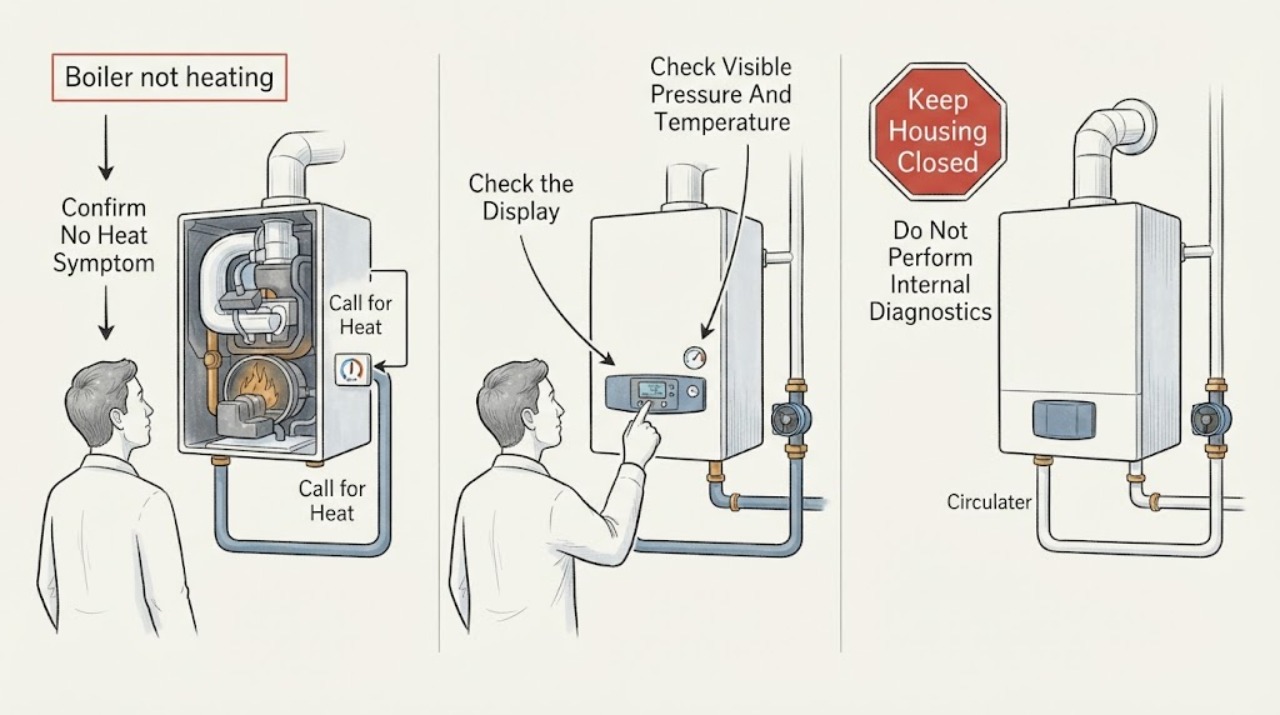
A Buderus boiler that is not heating may have no heat call, a control or power problem, a burner lockout, low water or restricted circulation, air in the system, a blocked vent or condensate path, or a zone-side problem. Start with safe observations: confirm the thermostat is asking for heat, read the boiler display or fault indicator, note whether the boiler has power, check the visible pressure or temperature gauge against the exact manual, and see whether any heating zone or radiator warms. Do not open the boiler, adjust gas pressure, test live voltage, jumper thermostat terminals, bleed or refill the hydronic loop, or repeatedly press a burner reset. Buderus documentation warns against more than three successive burner resets, and Bosch Home Comfort says gas-fired boiler work must be done by qualified professionals. If you smell gas, a carbon-monoxide alarm sounds, smoke or an abnormal flame appears, venting is damaged, water is leaking, a relief device discharges, or the boiler or piping is hot or pressurized, leave the area as appropriate and call emergency or qualified service.
Before you begin
Safety first
- Owner checks are limited to safe thermostat and display observations, reading a visible gauge, viewing accessible vent, intake, condensate, and zone indicators, and documenting the pattern. A qualified professional must handle gas and combustion work, electrical testing, cabinet or panel access, burner resets beyond the manual limit, hydronic filling or draining, bleeding, relief and pressure work, internal cleaning, and parts selection.
Work through in order
Diagnostic checks
Use only checks that match the exact appliance or system and its official guide.
-
Check 1
Confirm whether the problem affects the whole home or one zone. From a normal room position, compare the thermostat's room reading and heat-request indication with the setpoint, then check whether one radiator, baseboard loop, or air handler is warming without touching hot piping or changing installer settings.
Expected result: Record no heat request, a request with a cold home, one cold zone with other zones warm, all zones cold, or a thermostat display that is blank or inconsistent.
Next step: If the thermostat is blank or the request cannot be established, arrange HVAC service for the control and power path. If a single zone is affected, leave advanced settings alone and continue with display and safe zone observations; do not jumper terminals.
Stop if: Stop for gas odor, a carbon-monoxide alarm, smoke, abnormal flame, water leak, exposed wiring, or hot or pressurized piping that is unsafe to approach.
Why this matters
Why: No heat request or a blank control keeps thermostat, schedule, power, or control wiring in consideration. One cold zone with other zones warm points toward a zone valve, circulator, air, or distribution issue. All zones cold keeps boiler power, burner, system pressure, or common control issues more likely.
-
Check 2
Look at the Buderus control panel and any external service switch or breaker label without opening the boiler or electrical panel. Record whether the display is on, whether the unit is in standby, whether a heat icon or fault indicator appears, and the complete fault code or text; do not repeatedly reset the burner.
Expected result: Record a normal display with no heat request, an active heat request with no start, a burner or safety lockout, a low-water or temperature code, a blank display, or a code that returns after one model-approved reset.
Next step: Photograph or write the exact display and model label. Follow only the exact user manual's permitted reset guidance; if a burner fault returns or the code is not clear, stop and call a qualified technician.
Stop if: Do not open the electrical panel or boiler cover, alter DIP switches, jumper thermostat terminals, test live voltage, or press a burner reset more than the manual allows. Stop for repeated lockout or any combustion or electrical warning.
Why this matters
Why: A standby or no-heat-request state keeps thermostat, outdoor reset, schedule, or end-switch causes in consideration. A burner, ignition, fan, sensor, low-water, overheat, or vent code makes a model-specific service path more likely. A blank display points toward power, fuse, or control issues that require qualified diagnosis.
-
Check 3
Read the installed boiler pressure and temperature gauge or control display from a safe position, without touching hot piping or changing a valve. Compare the reading only with the exact Buderus model's documented cold and operating range, and note whether it is low, high, or changing sharply during a heat call.
Expected result: Record a stable reading within the model's documented range, a low reading, a high or rapidly rising reading, a reading that falls during a heat call, or no readable gauge.
Next step: If the reading is outside the exact manual's range, changes sharply, or is paired with a relief discharge or leak, keep the boiler off and arrange qualified service. Do not add water, bleed radiators, open a drain, or adjust the expansion vessel as a generic check.
Stop if: Stop for a high-pressure indication, relief discharge, steam, hot spray, leaking pipe, or any need to open a fill, drain, or relief valve.
Why this matters
Why: Low pressure can prevent or limit heating, while high or rapidly rising pressure can indicate expansion, flow, or safety concerns. A drop during operation can accompany a leak or inadequate fill. Because system design and model ranges differ, a generic number cannot select a fix.
-
Check 4
From outside the cabinet, note whether the boiler attempts ignition, reaches a stable operating state, or stops, and whether accessible radiators, baseboards, or zone indicators respond. Use only the designed sight window if one exists; do not remove a cover, touch the burner, pump, or piping, or infer a safe flame from sound alone.
Expected result: Record no ignition attempt, ignition followed by lockout, burner operation with cold zones, a circulation noise with little heat transfer, all zones cold, or no safe way to observe operation.
Next step: Record the sequence and call a qualified technician for burner, combustion, pump, flow, or zone diagnosis. Do not attempt gas adjustments, combustion testing, live electrical tests, or a thermostat jumper.
Stop if: Stop for flame rollout, yellow or unstable flame, exhaust odor, gas odor, smoke, repeated ignition attempts, hot surfaces, or a lockout that returns.
Why this matters
Why: No ignition or repeated lockout keeps the gas, ignition, vent, sensor, and control path in consideration. A running burner with cold zones makes pump, air, valve, filter, or distribution problems more likely. A boiler that reaches temperature while rooms stay cold may have heat-transfer trouble downstream.
-
Check 5
For a condensing or direct-vent Buderus model, inspect accessible vent termination, combustion-air intake, and condensate drain from ground level or another safe position. Look for blockage, separation, corrosion, melting, ice, a disconnected tube, or condensate pooling; do not climb, insert objects, remove the trap, or alter vent joints.
Expected result: Record clear and intact venting, blockage or ice, separated or damaged venting, condensate at the outlet, a loose or kinked-looking drain, or no safe view.
Next step: Turn off and discontinue use if venting or intake is damaged, separated, corroded, melted, or blocked, or if condensate is pooling; arrange qualified service. Remove only loose exterior debris from a safe standing position when it does not require contact with the appliance; otherwise leave it for service.
Stop if: Stop for gas odor, exhaust entering the building, melting, separated venting, ice that cannot be safely removed, acidic or unknown liquid, or any need to access the cabinet or roof.
Why this matters
Why: A vent or intake problem can prevent safe ignition or cause a lockout. A condensate restriction or disconnected drain can stop a condensing boiler or damage components. A clear termination does not rule out a concealed obstruction or internal fault.
-
Check 6
Compare the temperature response of each accessible heating zone without touching hot components. Note whether zone valves or thermostats visibly indicate a call, whether a pump or relay makes a sound, whether only one loop is cold, and whether all emitters remain cold while the boiler display shows a heating temperature.
Expected result: Record one cold zone, several cold zones, warm supply with cold return or emitters, no visible zone response, or a pump or relay that is unusually hot, noisy, or silent.
Next step: Provide the zone pattern to a qualified heating technician and leave valves, pump controls, and wiring unchanged. Do not bleed the loop, loosen a pump flange, or open a relay or junction box.
Stop if: Stop for hot or leaking piping, electrical smell, a pump that may seize, exposed wiring, or any need to open the hydronic or electrical system.
Why this matters
Why: One cold zone suggests a zone valve, thermostat, air, pump, or local flow problem. All zones cold with boiler temperature present suggests common circulation, control, or distribution trouble. A hot or noisy pump can be a mechanical clue but cannot be safely diagnosed by touch or electrical testing.
-
Check 7
Prepare a service record with the Buderus model and serial number, thermostat demand, display and fault code, reset history, pressure and temperature observations, ignition sequence, vent and condensate condition, zone behavior, recent maintenance, and safe photos or recording. Do not remove covers or parts to gather more information.
Expected result: Confirm that the record contains direct observations and model identity, not an assumed bad thermostat, pump, gas valve, igniter, sensor, heat exchanger, or control board.
Next step: Arrange qualified Buderus or heating service when the boiler remains cold, a code returns, a zone stays cold, a pressure or vent issue is present, or diagnosis requires gas, combustion, electrical, hydronic, or internal access.
Stop if: Stop owner troubleshooting when the next step requires opening the cabinet or panel, live testing, gas adjustment, resetting beyond the manual limit, draining or filling, bleeding, or handling hot or pressurized parts.
Why this matters
Why: The combined pattern helps a technician separate a control or heat-call problem from burner lockout, low water, air or circulation, venting or condensate, zone-side transfer, or internal component failure. Buderus manuals and Bosch support pages require model-specific service for the hazardous steps.
Use your observations
Decision map
Find the observation that best matches what you see, then follow the next safe action.
-
PATH 01Next step
What you see
The home or zone is cold, but the thermostat does not show a heat request, the boiler is in standby or warm-weather mode, the display is blank, or only one zone lacks a call.
Do this next
Have a qualified technician assess thermostat scheduling, control wiring, outdoor reset or end-switch logic, power, and zone controls. Do not jumper terminals, alter installer settings, or open a panel.
-
PATH 02Next step
What you see
The boiler attempts ignition and locks out, shows a burner, ignition, flame, fan, sensor, or combustion code, or never establishes a stable burner sequence.
Do this next
Record the exact code and stop repeated resets; Buderus documentation warns against more than three successive burner resets. Arrange qualified gas-boiler service for gas supply, ignition, venting, combustion, sensors, and controls.
-
PATH 03Next step
What you see
The gauge is outside the exact model range, changes sharply, the boiler reaches temperature but emitters stay cold, a pump or flow symptom appears, or one or more zones remain cold.
Do this next
Keep settings and valves unchanged and arrange qualified hydronic service to assess pressure, leaks, air, expansion, pumps, filters, zone valves, and distribution. Do not add water, bleed, drain, or open a pump or filter yourself.
-
PATH 04Next step
What you see
The vent or air intake is blocked, separated, corroded, melted, or iced, or a condensing model has pooling condensate, a loose drain, or a related fault.
Do this next
Turn off and discontinue use and request qualified service for venting, combustion air, condensate, and lockout diagnosis. Do not insert objects, alter venting, remove the trap, or restart to test.
-
PATH 05Next step
What you see
The boiler display shows a heating temperature or burner operation, but all or some rooms remain cold; the pattern follows one zone or several zones.
Do this next
Treat circulation, air, zone valves, pump, relay, filter, or distribution as conditional paths and call a qualified technician. Do not infer pump failure from sound or touch or open hydronic components.
-
PATH 06Next step
What you see
There is gas odor, a carbon-monoxide alarm, smoke, abnormal flame, exhaust entering the building, active water leakage, steam, relief discharge, electrical contact, or a rapidly changing pressure or temperature.
Do this next
Leave the area as appropriate and contact emergency services, the gas utility, or urgent qualified heating service from a safe location. Do not operate switches in a suspected gas leak or restart the boiler.
Helpful context
Understand the symptom
Separate a missing heat call from a boiler failure
The thermostat or building control must request heat, the boiler must accept that request, the burner must safely fire, and the circulator and zone piping must move heat to the emitters. A boiler can display a normal temperature while a zone valve, circulator, control, or thermostat path prevents room heat. Conversely, a burner lockout, low system pressure, vent problem, or flow restriction can stop the boiler from heating at all. Note the display state and one safe room or zone observation before choosing a part.
Use the exact Buderus model documentation
Buderus systems include cast-iron and condensing models, and their controls, fault codes, pumps, venting, and heating layouts differ. Bosch Home Comfort maintains a Buderus documentation area and recommends using the installation manual for the specific model. Do not treat an error code from a GB142, GB162, SSB, or another family as universal, and do not copy a gas setting or jumper test from a service page into a homeowner check.
A reset is not a repair
A single reset may be described for a particular Buderus control, but repeated resets can damage ignition components or mask a safety fault. If the burner locks out again, record the exact code and stop. Gas pressure, combustion analysis, live electrical measurements, thermostat jumpers, pump wiring, and internal cleaning belong to a qualified heating professional.
Safety boundary
Stop conditions
- Do not open the Buderus boiler cabinet or electrical panel, jumper thermostat terminals, adjust gas pressure, test live voltage, alter DIP switches, or perform combustion or ignition tests as an owner check.
- Do not repeatedly reset the burner; follow the exact model limit and stop when the fault returns. Do not bleed, fill, drain, or repressurize the hydronic loop or adjust an expansion vessel as a generic fix.
- Turn off and discontinue use when vent or intake parts are blocked, separated, corroded, melted, or damaged, or when condensate is pooling or a safety code appears.
- For gas odor, carbon-monoxide alarm, smoke, fire, abnormal flame, exhaust, steam, scalding water, active flooding, relief discharge, or electrical contact, leave as appropriate and request emergency or qualified help from a safe location.
Only after diagnosis
Potential parts
- thermostat or heat-call control
Consider this only when the thermostat or zone control does not produce a verified heat request or a qualified diagnosis identifies the control path as the cause.
Confirm the exact Buderus model, control protocol, wiring, outdoor-reset and zone configuration, and local requirements before replacement; do not jumper terminals as a test. - circulator pump or zone valve
Consider this only when one or more zones stay cold and qualified testing confirms inadequate circulation, a seized pump, or a failed or stuck valve after air and control causes are assessed.
Verify exact boiler and system layout, pump curve, voltage, control, flow, connection, and valve dimensions; installation and hydronic isolation require qualified service. - ignition, flame-sensing, or burner-control component
Consider this only when the exact model fault code and qualified combustion diagnosis identify an ignition, flame-sensing, burner, or control fault.
Confirm the exact model, gas type, approved component, combustion procedure, and commissioning requirements; do not adjust gas or replace a control based only on a lockout symptom. - condensate trap, vent, or air-intake service component
Consider this only when qualified inspection confirms a blocked or damaged condensate, vent, or combustion-air component that matches the no-heat code or observation.
Verify exact model, vent materials and routing, condensate chemistry and drain requirements, and approved service procedure; do not alter venting or remove a trap as an owner test. - boiler sensor, heat exchanger, or safety-control service
Consider this only after qualified diagnosis confirms a sensor, overheat limit, heat exchanger, or related internal failure rather than a heat-call, pressure, flow, or venting issue.
Confirm exact model, code history, component ratings, water quality, pressure, combustion checks, and approved repair path; internal service is not a DIY troubleshooting step.
When checks do not resolve it
Need a professional?
Call a qualified Buderus or heating technician when the boiler does not respond to a heat request, a fault or burner lockout returns, pressure is outside the exact model range, a pump or zone fails, venting or condensate is questionable, or diagnosis requires opening the cabinet, electrical panel, gas train, hydronic loop, or combustion system. Seek emergency help for gas odor, a carbon-monoxide alarm, smoke, fire, abnormal flame, exhaust in the building, steam, scalding water, active flooding, or water near electrical equipment.
Safety scope: Owner checks are limited to safe thermostat and display observations, reading a visible gauge, viewing accessible vent, intake, condensate, and zone indicators, and documenting the pattern. A qualified professional must handle gas and combustion work, electrical testing, cabinet or panel access, burner resets beyond the manual limit, hydronic filling or draining, bleeding, relief and pressure work, internal cleaning, and parts selection.
Have this ready
- Provide the Buderus model and serial number, thermostat demand, display and exact fault code, reset history, pressure and temperature observations, ignition sequence, vent and condensate condition, zone behavior, recent service, and safe photos or recording.
Common questions
FAQ
Why is my Buderus boiler not heating the house?
The cause may be no heat request, a control or power issue, burner lockout, low pressure, air or circulation trouble, vent or condensate restriction, or a zone-side problem. Check the thermostat demand, display, gauge, and zone pattern without opening the boiler.
What if the thermostat calls for heat but the Buderus boiler does nothing?
Record the thermostat request and boiler display. A standby state, blank display, control wiring issue, power fault, or safety lockout may be involved. Do not jumper thermostat terminals or open the electrical panel; call a qualified technician if the request is not accepted.
Can low boiler pressure stop Buderus heating?
Low pressure can limit or stop heating, but the correct range depends on the model and system. Read the visible gauge against the exact manual. Do not add water or repressurize the loop as a generic fix; a leak or expansion issue may need diagnosis.
Should I keep pressing the Buderus reset button?
No. Buderus documentation warns against pressing a burner reset more than three times in succession. Record the fault code and stop when the lockout returns; repeated resets can damage ignition equipment or hide a gas, vent, or safety fault.
Why is the boiler hot but the radiators are cold?
The boiler may be generating heat while circulation, air, a zone valve, pump, filter, relay, or distribution path prevents transfer. Compare one zone with another and provide the pattern to a qualified technician. Do not bleed radiators or open pump or valve connections as a generic test.
Can air in the heating system cause no heat?
Yes, air can interfere with circulation and heat transfer. The safe response is not to open a vent or refill valve blindly; a qualified technician should assess air elimination, pressure, expansion, pumps, and the system layout.
What does a Buderus burner lockout mean?
It means the boiler did not complete a safe operating sequence, but the code is model-specific. Possible paths include gas, ignition, flame sensing, fan, venting, condensate, sensor, or control issues. Record the exact code and use qualified service rather than repeated resets.
Can a blocked vent or condensate drain stop a Buderus boiler?
A blocked or damaged vent, air intake, or condensate path can prevent safe operation on applicable models. Inspect only accessible exterior sections; turn off and discontinue use for blockage or damage and call a qualified technician.
Should I adjust Buderus gas pressure or DIP switches?
No. Gas pressure, combustion setup, DIP switches, live electrical tests, and internal controls require qualified service and model-specific instruments and documentation. Changing them can create unsafe combustion or damage.
When is a Buderus no-heat problem an emergency?
Treat gas odor, a carbon-monoxide alarm, smoke, fire, abnormal flame, exhaust entering the building, steam, scalding water, active flooding, relief discharge, or water near electrical equipment as urgent. Leave as appropriate and call emergency or qualified help from a safe location.
Read the exact guide
Official sources
- Product TroubleshootingBosch Home Comfort · Official support index used to route model-specific boiler troubleshooting rather than infer a universal repair.
- Stainless Steel Condensing Boiler - SB625WS / SB745WS Installation and Operating InstructionsBuderus / Bosch Home Comfort · Buderus SB625WS/SB745WS manual used for general no-heat and reset safety context; other Buderus models can differ.
- Bosch HVAC Technical Support ResourcesBosch Home Comfort · Bosch Home Comfort resource index used to identify the official Buderus documentation path; no model setting or part fit is inferred.
- Troubleshooting VideosBosch Home Comfort · Official video index used to show that Buderus models and procedures vary; videos involving gas, wiring, covers, and internal parts are not homeowner instructions.
- Condensing Gas Boilers TroubleshootingBosch Home Comfort · Bosch Home Comfort troubleshooting guidance includes legacy Buderus/Greenstar families and is used for diagnostic categories; exact model instructions and qualified service govern.
Community feedback
Share a repair observation
Share a plain-text repair observation. Accepted observations are published automatically; this page may take a moment to update.