
On this page
Start here
Quick answer
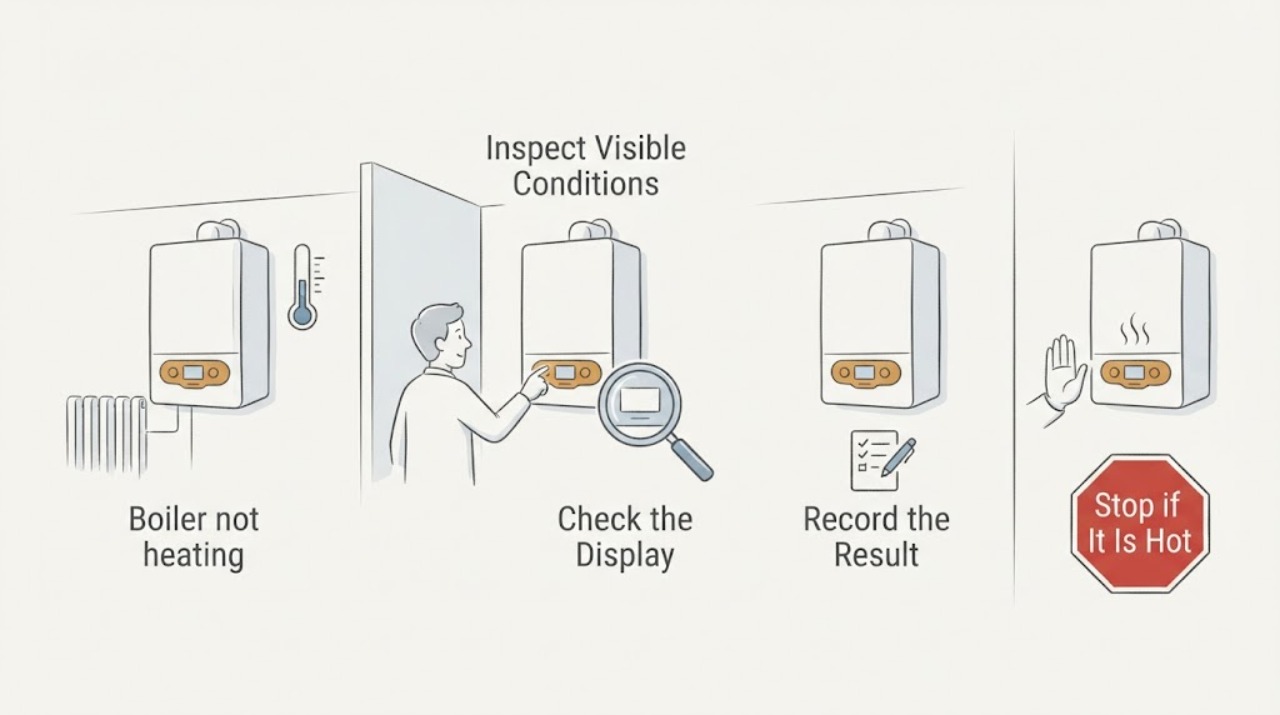
Start with observations that do not require opening the boiler: confirm the thermostat or zone control is actually calling for heat, read any visible boiler status or error message, and read the visible pressure gauge or digital pressure display against the range in your manual. Check whether the loss of heat affects every zone or only one. Do not remove the cover, work on gas or electrical parts, open a pressurized system, or repeatedly reset an unexplained lockout. If there is a gas smell, carbon-monoxide alarm, smoke, scorching, leaking water, or an unsafe pressure reading, leave the area as appropriate and call the utility, emergency service, or a qualified HVAC professional.
Work through in order
Diagnostic checks
Use only checks that match the exact appliance or system and its official guide.
-
Check 1
Look at each thermostat or zone-control display from its normal user position and set the requested temperature only according to its ordinary controls; do not remove a cover or change wiring.
Expected result: Record whether the display is blank, shows a heat-call indicator, is in a schedule or setback mode, or shows a low-battery or communication warning. Compare an affected zone with a zone that is heating if available.
Next step: Give the control state and the affected zones to the HVAC professional; if all controls are blank, report that as a possible electrical/control fault without attempting electrical work.
Stop if: Stop if the control requires wiring access, a cover removal, or an unfamiliar reset sequence.
Why this matters
Why: No heat call or a control warning points to the control or power path; a clear heat call with no boiler response points the report toward the boiler or its safety controls.
-
Check 2
Read the boiler's normal user-facing display, indicator lights, and any visible status or error code without removing the casing.
Expected result: Note whether the display is blank, idle, showing a heat request, locked out, or showing an exact code; record the code rather than guessing what it means and check only the user manual for that model.
Next step: Photograph or transcribe the display and provide the model information and timing to the technician; do not bypass a safety lockout or repeatedly reset it.
Stop if: Stop immediately if there is smoke, scorching, unusual noise, a fuel odor, a CO alarm, or any need to open the boiler.
Why this matters
Why: A repeatable fault or lockout can identify the service path, while a blank display with a thermostat call suggests a control or power issue that needs professional diagnosis.
-
Check 3
Read the visible boiler pressure gauge or digital pressure display from the normal user position, using the operating range marked in the appliance manual as the reference.
Expected result: Record whether the reading is within the manual's normal range, below it, above it, absent, or changing noticeably; do not open a valve, add water, bleed a radiator, or touch a relief device.
Next step: Send the reading and a photograph of the gauge or display to the qualified HVAC professional, especially if the boiler has stopped heating or the reading changes after a call for heat.
Stop if: Stop and arrange service if the reading is outside the marked range, water is visible, a relief discharge is suspected, or the gauge cannot be read safely.
Why this matters
Why: A low, high, absent, or rapidly changing reading can prevent heating or indicate a leak, expansion, sensor, or other system fault; a normal reading does not rule out a control, circulation, fuel, or heat-distribution problem.
-
Check 4
Compare room temperature and radiator or baseboard heat across the home's zones without opening the boiler or dismantling any heating component.
Expected result: Record whether all zones are cold, only one zone is cold, the boiler runs but emitters stay cold, or heat returns briefly and then stops; note the thermostat display for each affected zone.
Next step: Provide the zone pattern and timing to the service professional; do not bleed, loosen, or remove a radiator or valve unless the model-specific manual and a qualified professional explicitly make that safe.
Stop if: Stop if a pipe or emitter is hot enough to burn, water is leaking, or checking the zone would require tools or pressurized-system work.
Why this matters
Why: All-zone loss points toward a common call, boiler, power, fuel, or circulation issue; one-zone loss points toward that zone's control, valve, air, or distribution path and still requires a qualified diagnosis.
-
Check 5
From outside the boiler casing, look for safe-to-report signs around the appliance and visible pipework, and check the home's carbon-monoxide alarm status.
Expected result: Report water stains or dripping, soot or scorching, an unusual fuel odor, blocked-looking venting, a CO alarm, or symptoms such as headache, dizziness, nausea, or unusual fatigue; do not touch the boiler, vent, fuel line, or electrical parts.
Next step: Leave the area and follow local emergency, fire, gas, or fuel-utility guidance; once safe, arrange qualified HVAC service and report exactly what was observed.
Stop if: Stop all troubleshooting as soon as an alarm, fuel odor, smoke, suspected combustion issue, or symptoms are present.
Why this matters
Why: A fuel odor, CO alarm, smoke, suspected venting problem, or symptoms is an immediate safety issue rather than a no-heat troubleshooting branch.
Use your observations
Decision map
Find the observation that best matches what you see, then follow the next safe action.
-
PATH 01Next step
What you see
There is a gas or fuel odor, CO alarm, smoke, soot, scorching, suspected venting problem, or symptoms of exposure.
Do this next
Leave the area, do not operate switches or investigate the casing, and follow local emergency and utility guidance before arranging HVAC service.
-
PATH 02Next step
What you see
The visible pressure reading is outside the manual's range, changing rapidly, absent, or accompanied by water or relief discharge.
Do this next
Stop at the reading, keep clear of hot or pressurized parts, and call a qualified HVAC professional; do not refill, bleed, or open the system as a guess.
-
PATH 03Next step
What you see
All thermostat zones call for heat but the boiler display is blank, locked out, or does not respond.
Do this next
Record the display and leave electrical, gas, and safety-control work to a qualified professional; do not bypass or repeatedly reset the boiler.
-
PATH 04Next step
What you see
Only one zone is cold while another zone heats and the boiler appears to respond.
Do this next
Report the affected zone, its control state, and the timing to an HVAC professional for zone and circulation diagnosis without dismantling valves or radiators.
-
PATH 05Next step
What you see
The controls, display, and visible pressure reading look normal but the home remains cold.
Do this next
Arrange service for circulation, fuel, ignition, sensor, or heat-distribution diagnosis; normal readings do not authorize cover removal or component testing.
Helpful context
Understand the symptom
What the first checks can tell you
A boiler that is not heating may be receiving no heat request, showing a fault, protecting itself because pressure is outside its allowed range, or heating but failing to circulate heat to one or more zones. The safest homeowner checks are readings and observations from the normal controls and display. They can narrow the handoff without turning a gas, electrical, combustion, or pressurized-water problem into a DIY repair.
Use the pattern of the loss
If every zone is cold, focus the report on the thermostat call, boiler display, power indication, and system pressure reading. If one zone is cold while another heats, report the affected zone and compare its control display with a working zone. A low, high, or rapidly changing visible pressure reading is a reason to stop at observation and arrange service; do not guess at a refill or relief procedure.
Fuel and combustion boundaries
A gas- or oil-fired boiler can create serious combustion and carbon-monoxide hazards when it is faulty or improperly vented. Do not remove the casing, test a gas component, alter wiring, bypass a safety device, or use an appliance or oven as a substitute heater. An alarm, fuel odor, smoke, soot, or symptoms such as headache or nausea requires leaving the area and following local emergency and utility guidance rather than continued troubleshooting.
Only after diagnosis
Potential parts
- boiler circulator pump
Only consider this category after a qualified technician confirms that the boiler is producing heat but circulation is not moving heat through the system.
Confirm the boiler type, system design, electrical characteristics, and manufacturer fitment with the technician before any part is selected. - boiler thermostat
Only consider this category if the control does not issue a heat call and a qualified diagnosis rules out settings, batteries, receiver, wiring, and other causes.
Thermostat compatibility depends on the control protocol and wiring; verify the exact boiler and control system before ordering. - boiler air vent
Only consider this category if a qualified professional identifies trapped air or a failed vent as the cause of poor heat distribution.
Confirm the system type, connection, pressure rating, and manufacturer requirements with the professional; do not open a pressurized heating circuit to test it.
When checks do not resolve it
Need a professional?
Arrange qualified HVAC service when the boiler does not heat after safe control and display observations, a pressure reading is abnormal, a zone remains cold, a fault repeats, or any component diagnosis is needed.
Have this ready
- Provide the boiler make and model if available, thermostat and zone states, exact display code, visible pressure reading and whether it changes, affected rooms, timing, water or vent observations, fuel type, and recent service history.
Common questions
FAQ
Can I reset the boiler when it is not heating?
Record the display first and follow only the user-level reset instruction in the model manual, if one is clearly provided. Do not repeatedly reset a lockout or bypass a safety control; a recurring fault needs qualified service.
What pressure should the boiler show?
Use the operating range marked in your boiler manual or on the appliance. Boiler types and systems differ, so a generic number is not a safe substitute for the model-specific range. Read the gauge only; do not open valves or alter a pressurized system as a guess.
Why are only some radiators or rooms cold?
A single cold zone can point toward its control, valve, air, circulation, or distribution path, while all-zone loss points toward a common boiler, control, fuel, power, or circulation issue. Record the pattern and arrange professional diagnosis rather than dismantling the heating system.
Read the exact guide
Official sources
- No hot water? What to checkVaillant · This manufacturer troubleshooting page addresses user-visible heating and hot-water checks and points to pressure or boiler faults as service paths without authorizing internal work.
- Why is my boiler losing pressure?Vaillant · The manufacturer explains that low pressure can lead to loss of hot water or central heating, directs homeowners to the pressure gauge and manual, and warns against casing removal and untrained pipework repair.
- Carbon Monoxide Poisoning BasicsCenters for Disease Control and Prevention · The CDC explains that fuel-burning heating appliances can produce odorless, colorless carbon monoxide and recommends qualified service and proper venting.
- Carbon Monoxide Fact SheetU.S. Consumer Product Safety Commission · The CPSC describes CO as a dangerous, colorless, odorless gas and gives emergency-oriented guidance for symptoms and suspected exposure.
Community feedback
Share a repair observation
Share a plain-text repair observation. Accepted observations are published automatically; this page may take a moment to update.