
On this page
Start here
Quick answer
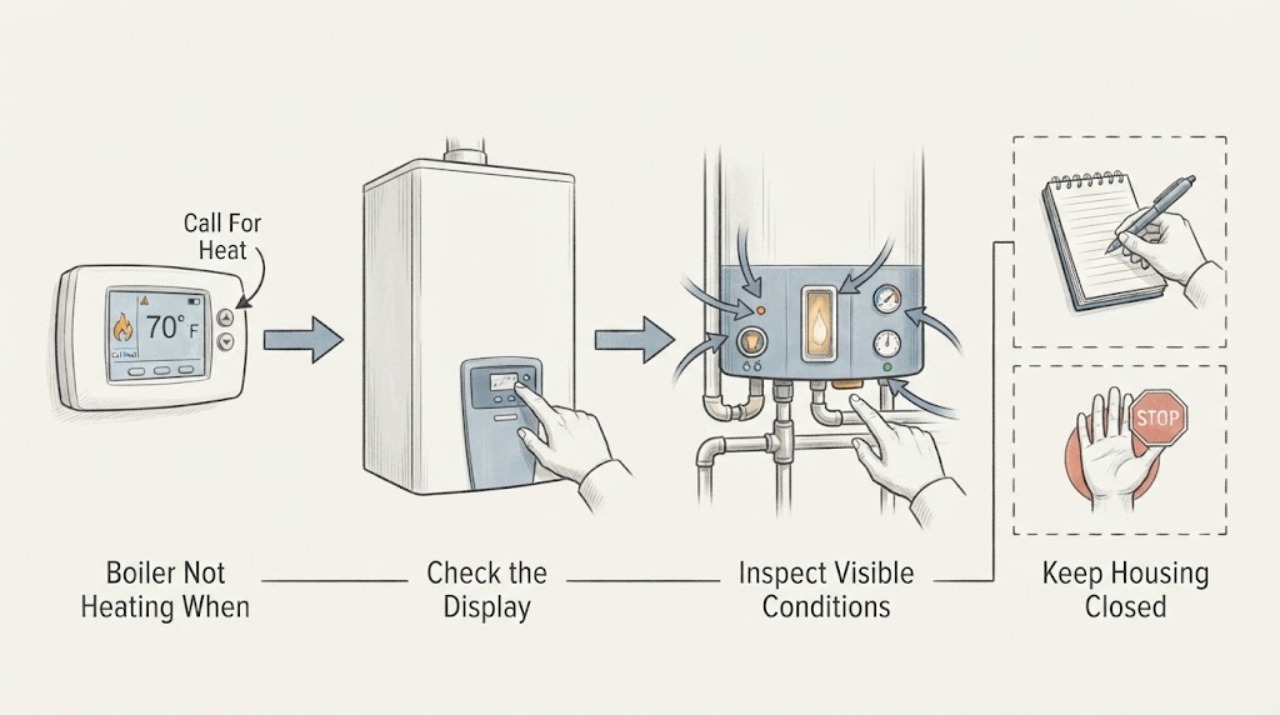
A thermostat showing Heat On, a flame icon, or another call-for-heat indicator is requesting heat; it does not prove that the boiler received the signal or accepted it. Confirm the thermostat mode, schedule and setpoint, then make only visible observations at the boiler: display or power status, fault indication, pressure indication and whether it starts during one normal call. If a valid call continues but the boiler stays idle, goes into lockout, shows an abnormal pressure or fault indication, or fires without circulating heat, stop homeowner troubleshooting and arrange a qualified heating professional. Do not remove the boiler casing, work on gas or wiring, inspect a flame, repeatedly reset the appliance, or defeat a safety control.
Work through in order
Diagnostic checks
Use only checks that match the exact appliance or system and its official guide.
-
Check 1
At the thermostat, confirm that the system is in Heat mode, the schedule is not in an off or away period, and the requested temperature is above the current room temperature. Note the exact call indicator, such as Heat On or a flame symbol, without changing wiring or removing the thermostat from its mount.
Expected result: The call indicator is absent, appears only briefly, or remains steadily displayed while the room is below the requested temperature.
Next step: Correct only the normal mode, schedule or setpoint setting described by the thermostat manual and observe one normal call. If the call remains valid and the boiler does not respond, continue with visible boiler checks rather than changing thermostat wiring.
Stop if: Stop if the thermostat, receiver or wiring is loose, wet, damaged, hot, or needs to be opened or rewired.
Why this matters
Why: No or intermittent indication makes a mode, schedule, setpoint, battery, receiver or control-path issue more likely. A persistent indication confirms that the thermostat is requesting heat but does not confirm that the boiler is receiving or accepting the request.
-
Check 2
With a valid thermostat call present, look at the boiler's accessible display, status lights and external power or isolation switch. Record whether the display is normal, blank, showing standby, or showing a fault; do not remove a cover, touch terminals, or repeatedly cycle a breaker or switch.
Expected result: The display is blank, the visible switch appears off, the boiler reports a lockout or fault, or the status looks normal but there is no response to the call.
Next step: If a clearly accessible user power switch is off, restore it only if the appliance instructions allow that normal operation; then observe once. If power is unavailable, a breaker trips again, or a fault or lockout returns, leave the boiler off and arrange qualified service.
Stop if: Stop immediately for repeated breaker trips, smoke, burning odor, exposed conductors, a hot switch, water near electrics, or any need to perform electrical testing.
Why this matters
Why: A blank display or an obvious power interruption points toward the supply or control path. A lockout or fault means the appliance has stopped its sequence for a reason that the display or manual may identify. A normal display with no response keeps external controls, interlocks and internal faults in consideration.
-
Check 3
Read the boiler's external pressure indication and any displayed fault or status code, using the exact model manual for interpretation. Record the code and whether the indication is unusually low, high or outside the manual's stated operating range; do not remove the casing or add water as a diagnostic experiment.
Expected result: The pressure indication is outside the appliance manual's normal range, a fault or lockout code is present, or no code is shown.
Next step: Record a clear photo or transcription of the display and gauge for the technician. Follow only an explicit, model-specific user instruction for a single permitted reset; if the code returns, pressure remains abnormal, or the manual calls for service, stop and arrange qualified help.
Stop if: Do not repeatedly reset, remove a safety panel, open a drain or relief device, alter pressure controls, or continue if there is a leak, steam, unusual noise or a rapidly changing indication.
Why this matters
Why: An abnormal pressure indication or lockout can inhibit firing or indicate a system fault, but the correct response is model-specific. No displayed code does not rule out a control, circulation, ignition or fuel-supply problem.
-
Check 4
During one uninterrupted call for heat, observe from a safe position whether the boiler display changes to a heating or burner state and whether radiators begin warming after the normal time stated by the manual. Do not touch hot pipes, inspect the burner, relight a pilot, or remove any combustion or service panel.
Expected result: The boiler remains silent with a valid call, starts and then stops with a fault, or appears to fire while radiators remain cold.
Next step: Write down the sequence, timing and status shown, then stop testing and arrange a qualified heating professional. Do not keep cycling the call or attempt internal ignition, gas, flue or pump work.
Stop if: Stop at once for gas or fuel odor, a carbon monoxide alarm, smoke, soot, unusual flame where visible without opening anything, loud combustion noise, a hot casing, water discharge or any sign of overheating.
Why this matters
Why: Silence with a confirmed call suggests a control, power, interlock or boiler-response problem. Starting and then locking out keeps ignition, flame-sensing, fan, flue, fuel and safety causes in consideration. Firing without radiator heat points toward circulation, zone-control or air-related system diagnosis rather than the thermostat alone.
-
Check 5
Prepare a service handoff containing the thermostat mode, setpoint and call timing; boiler make and model if safely visible; display or fault code; pressure indication; power status; whether hot water also works; and any recent outage, maintenance, control change, leak or unusual sound. Keep the boiler off if it is faulted or unsafe.
Expected result: The record shows a persistent thermostat call with no boiler response, a recurring lockout or abnormal pressure, firing without circulating heat, or a safety warning.
Next step: Give the record and photos to a qualified local heating or gas professional and follow the appliance manufacturer's service guidance. If a carbon monoxide alarm sounds or symptoms suggest exposure, leave immediately and use local emergency and medical guidance instead of scheduling routine troubleshooting.
Stop if: Stop all homeowner checks if the problem is intermittent but worsening, a safety device has operated, a breaker trips, there is a leak or odor, or any diagnostic step would require opening the appliance.
Why this matters
Why: These patterns narrow the professional diagnosis toward the control and power path, a safety or ignition sequence, pressure or circulation, or an unsafe combustion or flue condition. They do not identify a replaceable part without model-specific testing.
Use your observations
Decision map
Find the observation that best matches what you see, then follow the next safe action.
-
PATH 01Next step
What you see
The thermostat does not show a stable heat call, or the requested temperature is not above the room temperature.
Do this next
Correct the normal mode, schedule or setpoint setting once according to the thermostat instructions. If a stable call cannot be produced, arrange thermostat or control service; do not open or rewire the thermostat.
-
PATH 02Next step
What you see
The thermostat shows a valid call, but the boiler display is blank or the accessible power path is unavailable, especially if a breaker or switch will not stay on.
Do this next
Treat this as a power or control-path issue. Leave the appliance off if power is unstable and arrange qualified electrical or heating service; do not repeatedly reset the breaker or test live wiring.
-
PATH 03Next step
What you see
The thermostat call is valid and the boiler displays a recurring lockout, ignition-related fault or abnormal pressure indication.
Do this next
Record the exact code and model information, follow only the manual's permitted single user reset if applicable, and call a qualified heating professional when the fault returns or the manual directs service. Do not open the casing or attempt gas, ignition or pressure work.
-
PATH 04Next step
What you see
The boiler appears to fire during the call, but radiators remain cold or only part of the system warms.
Do this next
Have a qualified professional check circulation, zone controls and the system condition. The thermostat has demonstrated a demand, so replacing it without diagnosis may not address the no-heat condition.
-
PATH 05Next step
What you see
There is a gas or fuel odor, carbon monoxide alarm, soot or staining, unexplained symptoms, smoke, abnormal combustion noise or another immediate safety warning.
Do this next
Stop using the appliance, leave the area if carbon monoxide or combustion may be involved, and follow local emergency, utility and medical guidance. Do not return to inspect or relight the boiler until it has been declared safe by the appropriate qualified service.
Helpful context
Understand the symptom
Start by separating a thermostat demand from a boiler response. The thermostat may be in Heat mode and calling because the room is below its setpoint, yet the boiler can remain off because a schedule, zone control, power supply, safety lockout or internal sequence is preventing operation. A displayed call is useful evidence about the control, not a diagnosis of the boiler.
Keep the inspection external and observational. Read the boiler display and gauge from the front, note any code or status, and look at accessible switches without removing covers. Do not open the casing, handle wiring, adjust gas controls, investigate a burner or flue, or keep resetting a fault while the cause is unknown.
Gas or oil combustion appliances can produce carbon monoxide when combustion, ventilation, installation or maintenance is unsafe. Soot or yellow-brown staining, unusual flame appearance where visible without opening anything, a frequently extinguishing pilot, a carbon monoxide alarm, or symptoms such as headache, dizziness, nausea or breathlessness changes this from a heating diagnosis to a safety emergency. Leave the area and follow local emergency and medical guidance rather than continuing checks.
Safety boundary
Stop conditions
- Stop immediately for a carbon monoxide alarm, suspected gas or fuel leak, smoke, soot, unusual combustion noise, water near electrics, a hot casing, repeated breaker trips, or a rapidly changing pressure indication.
- Do not repeatedly reset a lockout or power supply, and do not treat a successful restart as proof that the fault is repaired.
- Stop any check that requires opening the boiler, touching terminals or wiring, handling gas or fuel controls, relighting a pilot, inspecting a flame, or entering a flue or combustion area.
Only after diagnosis
Potential parts
- thermostat receiver or heating control module
Only consider this category after a qualified professional confirms that the thermostat request is not reaching the boiler or that the receiver or control module has failed.
Confirm the exact boiler, thermostat, receiver, wiring arrangement, power requirements and manufacturer-approved replacement before selecting a part. - circulation pump or zone valve
Only consider this category after the boiler is confirmed to fire and a professional identifies a circulation or zone-control fault as the reason radiators stay cold.
Confirm the heating system type, valve or pump specification, electrical details, connections and manufacturer or installer fit information before ordering.
When checks do not resolve it
Need a professional?
Arrange qualified heating service when a stable thermostat call is present but the boiler remains idle, repeatedly locks out, shows abnormal pressure, starts and stops, or fires without delivering heat to the radiators., Use the exact boiler manual for any user reset or pressure instruction. If a fault returns, a breaker trips, a leak appears, or the manual directs service, stop and leave diagnosis to a qualified professional., Do not remove the boiler casing, alter gas or oil controls, relight or inspect a burner, open a flue or combustion panel, change wiring, bypass an interlock, or replace an internal part as a test., For a carbon monoxide alarm, suspected combustion or flue problem, soot or staining, fuel odor, or possible exposure symptoms, stop using the appliance and follow local emergency and medical guidance immediately.
Common questions
FAQ
Why does the thermostat call for heat but the boiler stay off?
The thermostat call only requests heat. A schedule or control-path issue, loss of power, lockout, pressure or circulation problem, or an internal ignition or safety fault can prevent the boiler from firing. Confirm the call and record the visible boiler status, then arrange qualified service if the call persists without a response.
Can I reset a boiler that is not heating?
Use a reset only when the exact model manual identifies it as a normal user operation, and do not keep repeating it. If the lockout returns, pressure is abnormal, a breaker trips or the manual directs service, leave the boiler off and call a qualified professional.
What should I check when the boiler display is blank?
With a thermostat call present, observe only the accessible power or isolation switch and the boiler display. A blank display can indicate a supply or control-path problem. Do not open the casing or perform live electrical tests; unstable power or a recurring trip needs qualified service.
What if the boiler fires but the radiators remain cold?
That pattern makes circulation, zone-control or system-flow problems more likely than a thermostat demand problem. Record which areas warm and the boiler status, then have a qualified heating professional assess the pump, valves and system; do not open the boiler or replace a part as a test.
When is a boiler that is not heating an emergency?
Stop using it and follow local emergency guidance for a carbon monoxide alarm, fuel odor, smoke, soot or staining, suspected flue or combustion trouble, unusual combustion noise, or possible exposure symptoms such as headache, dizziness, nausea or breathlessness. Do not relight or inspect the appliance yourself.
Read the exact guide
Official sources
- Boiler not igniting?Vaillant · Vaillant boiler ignition troubleshooting, power, controls, pressure, lockout and qualified-engineer safety boundary
- My thermostat is set to heat, but my boiler isn't coming on. Why?Honeywell Home · Honeywell Home thermostat-to-boiler troubleshooting, heat-call indication, setpoint and visible power checks
- Gas safety - Carbon monoxide awareness frequently asked questionsHealth and Safety Executive · HSE carbon monoxide warning signs, symptoms, combustion-appliance safety and emergency response
- FAULT FINDERWorcester Bosch · Worcester Bosch boiler fault-finding guidance on external controls, no-fire symptoms, lockout and service-engineer escalation
Community feedback
Share a repair observation
Share a plain-text repair observation. Accepted observations are published automatically; this page may take a moment to update.