
On this page
Start here
Quick answer
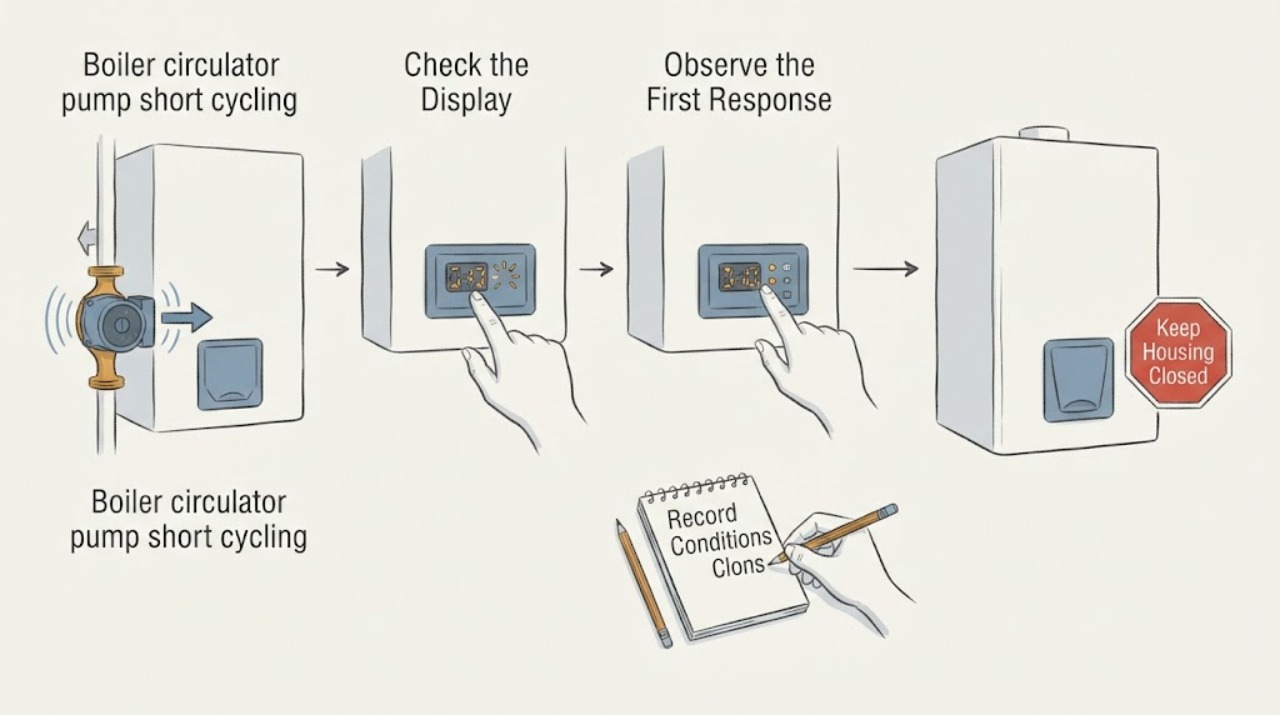
First separate a circulator-pump cycle from a burner cycle: watch and time the pump, burner indicator, thermostat or zone demand, supply temperature, and system pressure without opening the boiler or changing settings. Buderus control documents show that a heat call can energize the heating pump, while the burner responds to supply-temperature setpoint and hysteresis; they also describe model-specific pump overrun and anti-cycle functions. A pump that continues after a heat call ends may be normal post-circulation or a control state, while a pump that repeatedly starts and stops during an active demand, runs noisily, or leaves zones cold needs diagnosis of the pump, air, flow, wiring, sensor, or zone controls. Do not alter anti-cycle, minimum-power, pump, gas, pressure, or safety parameters as a trial. Record the exact Buderus model, cycle timing, display code, temperature and pressure readings, and which heat zones are calling. Stop and obtain qualified boiler service for overheating, abnormal pressure, gas odor, flue concerns, water leaks, electrical hazards, repeated lockouts, or any symptom that requires opening the boiler or testing live wiring.
Before you begin
Safety first
- Keep the boiler out of abnormal operation for hazards, loss of circulation, overheating, abnormal pressure, leaks, gas or flue concerns, electrical signs, or repeated lockouts. Do not open the casing, alter installer parameters, drain or refill, purge, or electrically test the pump yourself.
Work through in order
Diagnostic checks
Use only checks that match the exact appliance or system and its official guide.
-
Check 1
From a safe, dry position, start a short log for several events: note the thermostat or zone call, burner indicator, audible or visible pump operation, time from start to stop, time before restart, water leaks, steam, gas odor, smoke, and any electrical arcing. Do not touch hot pipework or open the boiler.
Expected result: Only the burner cycles, the pump continues after the burner stops, the pump itself repeatedly starts and stops during an active demand, or a hazard is present.
Next step: For a hazard, leave the area and obtain qualified or emergency help. Otherwise continue the log without changing controls; use the pattern to guide service rather than repeatedly resetting or forcing the boiler to run.
Why this matters
Why: A burner-only pattern can be temperature, demand, sizing, or control behavior rather than circulator short cycling. Pump cycling during a continuing demand is more consistent with pump control, feedback, flow, or electrical trouble. Any gas, flue, water, or electrical hazard changes this to a stop branch.
-
Check 2
Identify which control is requesting heat without opening any panel: note whether one thermostat, one zone relay, an outdoor-reset controller, or a domestic-hot-water call is active, and whether the pump stops when the call ends or continues briefly afterward.
Expected result: The pump follows one zone call, follows every call, runs after demand ends, runs with no visible call, or the demand source cannot be identified.
Next step: Record the controller type and event sequence. Do not bridge thermostat terminals, bypass a relay, or change heating mode; request qualified service when the pump runs without demand or the demand signal is unclear.
Why this matters
Why: A pump-overrun or a pump commanded by a zone or controller may be normal for that configuration. Running without a heat demand, or cycling despite a continuous demand, makes a wiring, relay, controller, sensor, or pump fault more plausible.
-
Check 3
Read and record the displayed heating-water or supply temperature, system pressure, and any fault or operating code without entering service or manual mode. Note whether the reading changes sharply just before the burner or pump stops and whether the pressure is stable.
Expected result: Supply temperature rises rapidly, a sensor or pressure code appears, pressure is abnormal or changing, readings appear implausible, or readings stay stable while the pump cycles.
Next step: Photograph the display and leave settings unchanged. For abnormal pressure, overheating, a lockout, or an unreadable display, stop normal operation and obtain qualified service.
Why this matters
Why: Rapid temperature rise can indicate insufficient flow or a control response; a code or implausible reading raises a sensor, pressure, or control issue. Stable readings with pump cycling keep pump command, wiring, or pump operation in question. Do not infer a generic safe pressure or temperature from another Buderus model.
-
Check 4
Check only user-accessible heating zones for an obvious closed thermostat, radiator valve, or zone isolation control, and listen for pump rattling, humming, or repeated relay clicks from a safe position. Do not turn system valves, bleed radiators, purge the pump, or remove an electrical cover as an experiment.
Expected result: All zones are calling and accessible valves appear open, one zone is closed or not calling, the pump is noisy, radiators remain cold, or a relay clicks as the pump cycles.
Next step: Restore only an obvious thermostat setting or obstruction that the owner controls explicitly identify; otherwise leave valves and controls alone and provide the observations to a heating technician. Do not purge or electrically test the pump yourself.
Why this matters
Why: A closed zone or absent demand can explain a control change; noise and cold zones during a demand make air, obstruction, insufficient flow, pump performance, or zone-valve trouble more plausible. Repeated relay clicks without a changing demand suggest controls or wiring.
-
Check 5
Collect the exact boiler and control model, pump marking, fuel type, zone count, recent service history, and whether the symptom began after pump, thermostat, valve, or control work. Include the cycle log, display photographs, temperature and pressure readings, and which rooms heat.
Expected result: The model is identifiable, the pump or controls were recently changed, the symptom is intermittent, the same fault returns after a reset, or model information is missing.
Next step: Give the complete record to qualified Buderus or hydronic-heating service. Do not order a pump, alter installer parameters, or assume that an SSB, GB162, or other manual applies to this boiler.
Why this matters
Why: Pump overrun, anti-cycle, hysteresis, minimum-power, sensor, and heating-mode behavior depends on the installed Buderus model and control. A post-service onset or repeat fault increases the value of checking configuration, wiring, pump feedback, flow, and commissioning rather than swapping a part by appearance.
-
Check 6
If the boiler remains safe and stable, compare the event log across several normal heat calls rather than forcing extra cycles. Note whether the pump runs continuously during demand, runs only after the burner, or drops out while rooms still call for heat.
Expected result: The same pattern occurs on every call, only one zone causes it, it occurs only during domestic-hot-water priority, or it cannot be reproduced safely.
Next step: Stop testing when the system becomes hot, noisy, unstable, or faulted. Arrange qualified service with the timeline and avoid manual-operation or service-mode experiments.
Why this matters
Why: A repeatable zone or operating-mode pattern points toward demand logic, zone controls, or priority sequencing. A pump drop-out during a continuing call points toward circulation control, pump feedback, flow, or a safety response. An unreproducible event still warrants the recorded evidence if comfort or equipment operation is affected.
Use your observations
Decision map
Find the observation that best matches what you see, then follow the next safe action.
-
PATH 01Next step
What you see
Only the burner turns off at a high supply temperature, while the circulator continues through the demand or a brief post-run period and no zones lose heat.
Do this next
Leave installer parameters unchanged and have a qualified technician review setpoint, hysteresis, modulation, system load, and control configuration for the exact model if the burner cycles unusually often.
Why this path and its safety boundary
Why it matters: This is less consistent with a pump motor short-cycling fault and more consistent with normal temperature control, pump overrun, heat-demand logic, or output-versus-load behavior. Buderus documents these as separate control functions.
-
PATH 02Next step
What you see
The pump repeatedly drops out and restarts while a thermostat or zone relay continues to call, especially with pump noise, cold zones, or rapid supply-temperature rise.
Do this next
Keep the boiler out of abnormal operation and request qualified service to diagnose pump activation, flow, air, valves, feedback, and wiring. Do not drain, purge, open, or live-test the boiler as a user experiment.
Why this path and its safety boundary
Why it matters: Insufficient flow, air, a blocked or contaminated pump, pump feedback or power, a zone valve, sensor, or control problem is more likely than ordinary pump overrun.
-
PATH 03Next step
What you see
The pump behavior follows one zone, a domestic-hot-water call, or a recent thermostat/relay change, while other heat calls operate normally.
Do this next
Document the affected zone and operating mode and arrange qualified control and hydronic diagnosis. Do not bridge terminals, change priority, or substitute a controller based on symptoms alone.
Why this path and its safety boundary
Why it matters: Zone-demand, priority, relay, sensor, or controller sequencing is more plausible than a pump that is mechanically failing in every mode.
-
PATH 04Next step
What you see
The boiler shows a pressure, temperature, sensor, or lockout code; pressure is abnormal, water is leaking, overheating or steam is present, or gas, flue, smoke, or electrical danger is suspected.
Do this next
Stop from a safe location, keep clear of hot, pressurized, gas, flue, and electrical components, and obtain qualified boiler service or emergency help as appropriate. Do not reset repeatedly or alter safety controls.
Why this path and its safety boundary
Why it matters: The short-cycling symptom may be a protective response or part of a hazardous boiler fault. Continued resets or operation can worsen equipment or personal risk.
-
PATH 05Next step
What you see
The exact model and controller are unknown, the pump is inaccessible, the event cannot be safely distinguished from burner cycling, or the issue returns after a prior repair or parameter change.
Do this next
Use the recorded model, timing, display, temperature, pressure, and zone information to request qualified Buderus or hydronic-heating service. Do not apply another model's settings or disassemble the pump.
Why this path and its safety boundary
Why it matters: Buderus pump, anti-cycle, hysteresis, sensor, and control behavior is model-specific; a generic adjustment or replacement could hide a flow or safety problem.
Helpful context
Understand the symptom
Confirm which component is cycling
A boiler can stop firing while its circulator continues, or the pump can run after a heat call ends. Those are not automatically pump short cycling. Stand safely beside the system and make a simple timeline: thermostat or zone call, burner-on indication, pump sound or vibration, and when each stops. Do not remove the casing or use a hand on hot piping to identify operation.
What Buderus controls reveal
Buderus documentation describes the room or zone demand energizing pump contacts, burner switching in response to supply temperature and hysteresis, and a pump-overrun period after demand ends. An SSB control guide also describes an anti-cycle wait intended to prevent fast burner on/off switching. These are useful clues, not universal settings: Buderus models and installed controls differ.
Pump symptoms need a flow diagnosis
A pump that starts and stops during a continuing demand, hums, rattles, loses circulation, or leaves one or more zones cold may have an air, blockage, contamination, electrical-feedback, valve, or control problem. The GB162 service manual lists pump purging, mechanical obstruction, contamination, power, and tachometer checks, but those procedures involve boiler access and are not a generic owner adjustment.
Do not tune a generic anti-cycling value
Short cycling can be caused by a mismatch between heat output and current demand, a high or rapidly reached supply temperature, zone controls, sensor feedback, or inadequate flow—not just a bad pump. Capture the evidence before a technician changes a control parameter. A change that suppresses cycling can conceal a flow, sensor, or safety fault.
Safety boundary
Stop conditions
- Stop immediately for gas odor, flue-gas concern, smoke, electrical arcing, water near electrical equipment, steam, scalding or rapidly rising temperature, abnormal pressure, flooding, or a lockout that returns. Leave the area as appropriate and obtain qualified or emergency help.
- Do not open the boiler, remove the pump, drain or refill the heating system, purge a pump, work on gas or flue components, bridge thermostat or relay terminals, or perform live electrical measurements as a user-level test.
- Do not change anti-cycle, hysteresis, minimum or maximum burner power, pump speed, heating mode, sensor calibration, safety limits, or pressure settings merely to suppress short cycling. Those values are model- and installation-specific.
- Stop when the pump cannot be distinguished from the burner, the demand signal is unknown, a display code is unexplained, circulation is lost, or the symptom recurs after a documented check. Arrange qualified Buderus or hydronic-heating service.
Only after diagnosis
Potential parts
- circulator pump or pump-group assembly
Consider this category only after qualified testing confirms the pump is mechanically, electrically, or feedback-faulty rather than merely being commanded by a control or restricted by system flow.
Buderus pump groups and circulators vary by boiler model, control, connection, and system. Confirm the exact model and diagnosis before selecting a replacement. - pump power lead or tachometer/feedback harness
Consider this category only when qualified diagnosis finds missing pump power or feedback, an incorrectly seated connector, or a damaged harness associated with the cycling pattern.
Connector and feedback arrangements are model-specific and involve hazardous boiler voltage. Do not select or install a harness from appearance alone. - heating-system flow, zone-valve, or air-separation component
Consider this category only if qualified flow diagnosis links the pump cycling or rapid temperature rise to a closed valve, failed zone actuator, trapped air, or a restriction.
Hydronic components depend on system layout and boiler controls. Confirm the piping design, exact model, and diagnosis before choosing a component. - supply or return temperature sensor
Consider this category only when the display, measured behavior, or qualified testing indicates an implausible or failed temperature sensor that is causing burner or pump control changes.
Sensor type, resistance curve, connector, and location vary by Buderus model and control. Do not substitute a sensor by appearance or nominal temperature range.
When checks do not resolve it
Need a professional?
Request qualified Buderus or hydronic-heating service when the circulator starts and stops during an active heat demand, leaves zones cold, runs noisily, operates without a demand, follows a control or pump change, or cannot be distinguished from burner cycling. Treat gas, flue, smoke, electrical, water, steam, overheating, abnormal-pressure, and recurring-lockout signs as urgent safety conditions.
Safety scope: Keep the boiler out of abnormal operation for hazards, loss of circulation, overheating, abnormal pressure, leaks, gas or flue concerns, electrical signs, or repeated lockouts. Do not open the casing, alter installer parameters, drain or refill, purge, or electrically test the pump yourself.
Common questions
FAQ
Is a Buderus circulator pump that runs after the burner stops short cycling?
Not necessarily. Buderus control documents describe pump operation during a heat demand and pump overrun after the demand ends. Time the pump separately from the burner and thermostat or zone call; repeated pump dropouts during an active demand, noise, or cold zones need diagnosis.
Can I increase the Buderus anti-cycle period to stop short cycling?
Do not change it as a generic fix. Anti-cycle period, temperature difference, hysteresis, pump overrun, and burner power are model- and installation-specific. A setting change can hide a flow, sensor, control, or sizing problem; have a qualified technician evaluate the exact boiler and system.
What does a noisy Buderus pump mean when it keeps cycling?
Noise with loss of circulation or cold zones makes air, a mechanical obstruction, contamination, insufficient flow, or pump feedback more plausible, but it does not identify one failed part. Buderus service procedures for purging, inspection, draining, electrical checks, and replacement are qualified work.
How can I tell whether the burner or pump is short cycling?
Log the thermostat or zone demand, burner indicator, pump sound or vibration, supply temperature, and stop-to-restart time as separate events. If only the burner cycles while the pump continues, the cause may be temperature or burner control. If the pump drops out during continuing demand, pump control, flow, wiring, feedback, or a zone valve needs service.
When is Buderus boiler short cycling an emergency?
Stop from a safe location for gas odor, flue concern, smoke, electrical arcing, water near electrical equipment, steam, overheating, abnormal pressure, flooding, loss of circulation, or a recurring lockout. Do not repeatedly reset, open the boiler, or alter safety controls; obtain qualified or emergency help as appropriate.
Read the exact guide
Official sources
- Pump group Logamax plus GB162-80 kW/100 kWBuderus / Bosch Home Comfort · Official GB162 pump-group installation instructions intended for trained installers; they are a safety boundary and model reference, not an owner repair guide.
- Technical Support ResourcesBosch Home Comfort · Official Bosch support index for locating the documentation applicable to the installed Buderus boiler and control.
- Control Operations Guide Bosch Buderus SSB800SA | SSB1000SA | SSB1000TL BoilersBosch Thermotechnology Corp. / Buderus · Official control guide for the listed SSB boiler families only; its parameter examples must not be applied to an unidentified Buderus boiler.
- Service manual - GB162-80kW/100kW - US(en)Buderus / Bosch Home Comfort · Official GB162 service manual; pump inspection and replacement require model-specific service work and must not be generalized to every Buderus boiler.
- Buderus SSB85/120/160 Service ManualBosch Home Comfort / Buderus · Official service manual for SSB85/120/160 boilers; used to explain control relationships, not as a generic setting or repair sequence for other Buderus models.
Community feedback
Share a repair observation
Share a plain-text repair observation. Accepted observations are published automatically; this page may take a moment to update.