
On this page
Start here
Quick answer
Short cycling means a Buderus boiler repeatedly starts and stops before the heating demand is satisfied. A temperature sensor that reports the wrong supply, return, outdoor, or domestic-hot-water temperature can make the control reach its limit too soon, but low water flow, air, a pump or valve problem, a small active zone, control settings, or a boiler-system fault can look the same. First record whether the burner stops while the thermostat still calls for heat, whether the boiler display shows a temperature or sensor fault, and whether the radiators or zones are actually receiving heat. Buderus service documentation identifies supply and return sensors around the heat exchanger and uses an anti-cycle period to reduce short cycling; the exact sensor test and control settings are model-specific. From ordinary safe access, read the display, note pressure and temperature behavior, inspect only visible wiring for damage, and check whether a zone is cold or circulation sounds abnormal. Do not open the cabinet, measure sensor resistance, change service parameters, adjust gas or combustion settings, or bypass a high limit. Stop for gas or oil odor, a carbon-monoxide alarm, smoke, flame irregularity, steam, a leak, severe heat, or a safety warning, and arrange qualified Buderus boiler service when the cycling persists or a sensor fault is suspected.
Before you begin
Safety first
- This article supports safe observation of burner timing, display state, zone response, visible wiring, and service history only. Do not open the cabinet, test or disconnect sensors, change installer parameters, adjust gas or combustion settings, alter valves, drain or refill the system, bypass safety devices, or continue operation with a safety or combustion symptom.
Work through in order
Diagnostic checks
Use only checks that match the exact appliance or system and its official guide.
-
Check 1
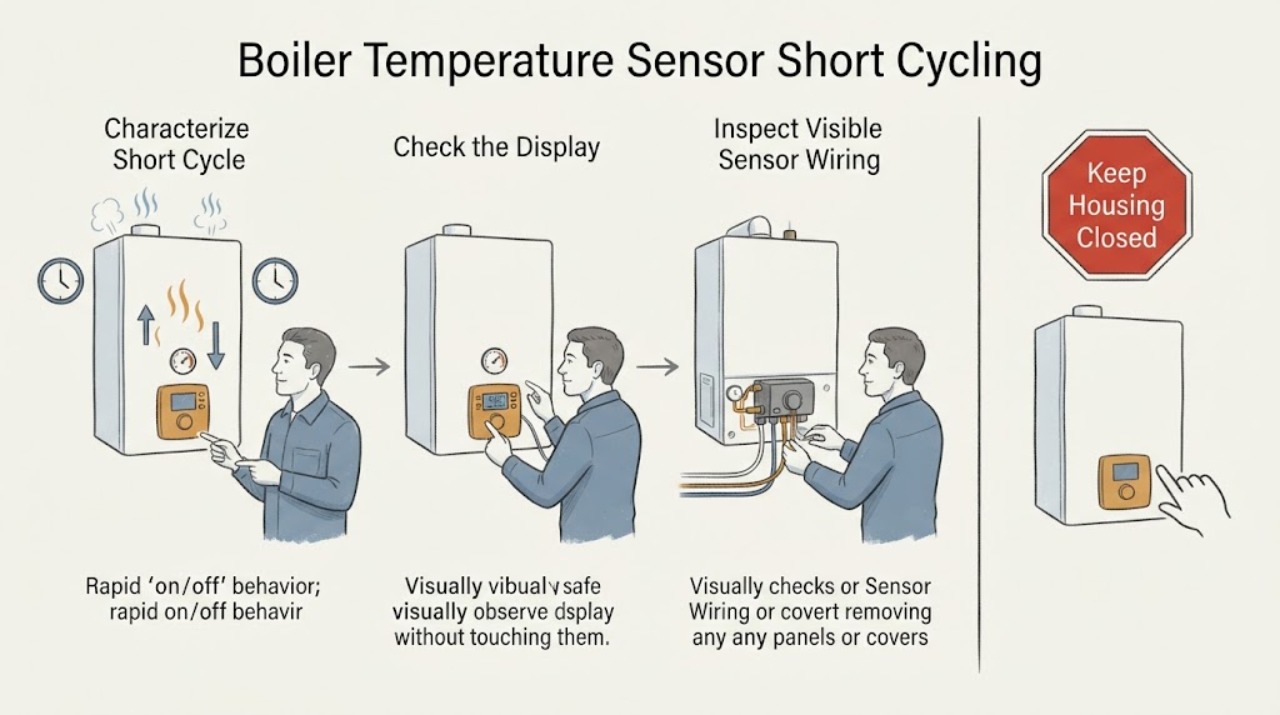
From a safe position, observe one normal call for heat and record whether the burner starts and stops repeatedly, whether the thermostat or zone still calls, how the radiators respond, and whether the cycle is a brief intentional delay or a repeated restart pattern.
Expected result: Classify the symptom as burner stops at the target with warm zones, burner stops while zones remain cold, display temperature jumps or appears implausible, a fault or high-limit code, or an unknown pattern.
Next step: Use the display and zone-flow observations below, then arrange qualified service for persistent cycling or any code instead of repeatedly resetting the boiler.
Stop if: Stop immediately for gas or oil odor, a carbon-monoxide alarm, smoke, flame irregularity, steam, active leak, severe heat, sparks, or a safety warning.
Why this matters
Why: A target reached with normal heat delivery can be a control or load condition. A stop with cold zones points toward flow, pump, valve, air, or control demand. An implausible reading or sensor code makes the temperature-sensing circuit more likely.
-
Check 2
Read the visible Buderus display, status lights, and any pressure or temperature indication without opening the cabinet or touching hot piping; record the exact model and any code only when the identification label is safely accessible.
Expected result: Record a sensor or over-temperature code, a supply or return value that changes sharply, a normal-looking reading with short cycling, a pressure warning, or no visible indication.
Next step: Use the exact Buderus manual to interpret the indication and give the technician the display, timing, and operating state; do not enter service mode or alter parameters as an owner test.
Stop if: Stop for a rapidly rising indication, steam, relief discharge, active water leak, severe heat, electrical damage, or any need to remove the cover.
Why this matters
Why: A code or implausible temperature makes the sensor, wiring, control, or limit circuit a service priority. A plausible reading with poor zone heat makes flow, pump, valve, air, load, or control demand more likely; a normal display does not rule out a drifting sensor.
-
Check 3
From ordinary safe access, look only at visible sensor cable runs and connectors for obvious cuts, crushed insulation, corrosion, or a connector hanging loose; do not disconnect a sensor, remove a panel, or touch energized wiring.
Expected result: Record no visible damage, a clearly damaged external cable, moisture or corrosion near a connector, a loose-looking accessible plug, or wiring that cannot be seen without opening the boiler.
Next step: Photograph the visible condition and arrange service for damaged or inaccessible wiring; do not reseat or repair a connector unless the exact model manual explicitly makes that an ordinary safe task.
Stop if: Stop for wet wiring, exposed conductors, a burning odor, sparks, a hot cabinet, or any need to work inside the boiler.
Why this matters
Why: Visible damage can explain an intermittent or implausible temperature signal, but a clean exterior does not prove the sensor is accurate. Internal connections, sensor resistance, grounding, and control input require a qualified technician.
-
Check 4
Without changing unknown valves, compare heat delivery across zones, note whether supply piping becomes hot while a zone remains cold, and listen from a safe distance for gurgling, a silent pump, or an unusually loud circulator.
Expected result: Record normal heat in all zones, one cold zone, several cold zones, gurgling after a refill, a pump that is unusually hot or noisy, or a boiler that reaches its target while heat does not transfer.
Next step: Leave known operating positions unchanged and arrange qualified hydronic service for air removal, pump, valve, flow, or zone diagnosis; provide the technician the affected zones and timing.
Stop if: Do not bleed hot radiators, open drains, adjust unknown valves, touch a hot pump, or open the boiler to inspect flow components.
Why this matters
Why: Poor zone heat with rapid boiler temperature rise makes air, restricted flow, pump, valve, or zone-control trouble more likely than a sensor alone. Normal circulation with a false-looking display keeps the sensor or control path in focus.
-
Check 5
Review the thermostat or zone schedule, visible outdoor or room-sensor status, and recent control or wiring changes from ordinary access; do not change installer service parameters, bypass a thermostat, or jumper a control connection.
Expected result: Record a very short heat call, a schedule or setpoint change, an outdoor or room value inconsistent with conditions, a disconnected-looking sensor wire, or no change in the demand signal.
Next step: Restore only a normal user thermostat schedule if it was accidentally changed, then observe one call; arrange service for a sensor mismatch, wiring issue, or cycling that continues with a steady call for heat.
Stop if: Stop if controls are hot, damaged, wet, sparking, or inaccessible without opening the boiler, and do not bypass safety or thermostat circuits.
Why this matters
Why: A demand signal that ends early or a misreading outdoor or room sensor can cause the boiler to stop for a valid control reason. A continuing demand with short burner restarts points more toward supply temperature, flow, sensor, limit, or boiler sizing behavior.
-
Check 6
If there is no odor, alarm, leak, overheating, unstable pressure, or electrical concern, observe one model-approved heat call after the safe checks without repeatedly resetting the boiler or changing service settings.
Expected result: Record normal completion with stable heat, repeated burner restarts, a sensor or limit code, a zone that remains cold, a pressure change, or any new safety symptom.
Next step: Stop further testing, save the cycling timeline and display notes, and arrange qualified Buderus boiler service for any recurrence or unresolved sensor concern.
Stop if: Stop immediately for gas or oil odor, carbon-monoxide alarm, smoke, flame irregularity, sparks, steam, active leak, severe heat, or a safety warning.
Why this matters
Why: A normal call after correcting a demand or obvious external issue supports that condition, but it does not prove sensor accuracy. Recurring starts, a code, poor heat transfer, or pressure change requires model-specific diagnosis.
Use your observations
Decision map
Find the observation that best matches what you see, then follow the next safe action.
-
PATH 01Safety boundary
What you see
Short cycling occurs with a sensor or over-temperature code, a temperature reading that jumps or disagrees with the operating state, or a visible sensor-wire problem.
Do this next
Leave service settings unchanged and arrange qualified Buderus diagnosis of the sensor circuit, wiring, control, and limit behavior using the exact model procedure.
Why this path and its safety boundary
Why it matters: A sensor, connection, control input, or safety-limit circuit is more likely than a simple thermostat schedule issue.
Safety stop: Do not disconnect the sensor, measure resistance, bypass the limit, or continue with an overheating, leak, odor, alarm, or electrical hazard.
-
PATH 02Safety boundary
What you see
The boiler reaches its target quickly, the burner stops while a zone still calls, and one or more radiators or circuits remain cold or circulation sounds abnormal.
Do this next
Arrange qualified hydronic service to check circulation and zone transfer before replacing a sensor or changing temperature parameters.
Why this path and its safety boundary
Why it matters: Insufficient flow, air, a pump or valve problem, zone-control trouble, or system configuration is more likely than a sensor alone.
Safety stop: Do not adjust unknown valves, bleed hot radiators, open drains, or raise the setpoint to mask a flow or overheating condition.
-
PATH 03Safety boundary
What you see
The thermostat or zone call ends quickly, an outdoor or room value does not match conditions, or a recent schedule or control change precedes the short cycling.
Do this next
Restore only ordinary user settings that were accidentally changed, then have the sensor, thermostat, wiring, and control configuration checked if the pattern continues.
Why this path and its safety boundary
Why it matters: The control may be receiving a short or incorrect demand signal; Buderus outdoor and room controls can change the boiler target based on sensed conditions.
Safety stop: Do not jumper thermostat circuits, alter installer parameters, or operate with damaged or sparking controls.
-
PATH 04Safety boundary
What you see
Short cycling begins after system filling, radiator work, pump or valve service, or a control change, and gurgling, cold zones, or pressure changes also appear.
Do this next
Leave the system in its known configuration and arrange qualified service to verify air removal, flow, valve positions, sensor placement, and control setup.
Why this path and its safety boundary
Why it matters: Air, an altered valve position, circulation problem, or incorrect setup is plausible; a newly failed temperature sensor is not established.
Safety stop: Do not drain, purge, refill, or adjust valves without the exact installation procedure and a safe system state.
-
PATH 05Safety boundary
What you see
The boiler short cycles only when one small zone calls, while the sensor readings and circulation appear normal and larger combined demand runs longer.
Do this next
Have a qualified technician review zoning, flow, control settings, anti-cycle behavior, and boiler sizing rather than changing sensor parameters yourself.
Why this path and its safety boundary
Why it matters: The active load, control differential, minimum burner output, or system configuration may be mismatched; a sensor fault is only one possibility.
Safety stop: Do not disable anti-cycle protection, force a larger demand, or raise boiler temperatures to compensate for a low-load configuration.
-
PATH 06Safety boundary
What you see
Short cycling persists with a steady heat call after safe observations, or it is accompanied by a fault, high-limit indication, leak, steam, gas or oil odor, smoke, flame irregularity, or carbon-monoxide alarm.
Do this next
Stop the boiler according to the model emergency procedure and arrange urgent qualified heating service; leave the area when combustion danger is suspected.
Why this path and its safety boundary
Why it matters: An unresolved sensor, control, flow, combustion, pressure, or safety fault is possible and continued operation may be hazardous.
Safety stop: Do not reset repeatedly, open the cabinet, relight, bypass a safety device, or continue operation while a safety symptom is present.
Helpful context
Understand the symptom
Confirm short cycling before condemning the sensor
A burner that stops because the supply reaches its target and then restarts can be responding to a real limit, a control differential, or insufficient heat transfer to the zones. A burner that stops while the demand remains and the displayed temperature is implausible makes a sensor, wiring, control, or connection problem more likely. Record the call for heat, burner state, displayed temperature, zone response, and time between starts; a brief anti-cycle delay can be intentional.
The sensor position explains why flow matters
Buderus service documentation places the supply sensor at the heat-exchanger outlet and the return sensor at its inlet. If circulation is poor, the supply can heat rapidly while the zones remain cool, which may resemble a sensor problem. Air, a pump, a closed or restricted valve, a blocked strainer, or zone-control behavior needs a hydronic technician; the homeowner should not open the cabinet or adjust unknown valves.
Outdoor and room controls can change the demand signal
Buderus Logamatic controls can use indoor and outdoor temperature information to adjust boiler temperature to actual demand. A misplaced, damaged, or misreading outdoor or room sensor, an incorrect schedule, or a thermostat or zone end-switch issue can create a short call for heat. Check only the visible control status and wiring from ordinary access; do not change installer parameters or jumper controls as a test.
Sensor testing and burner adjustments belong to service
Buderus manuals describe resistance and safety-sensor checks as part of service procedures, along with anti-cycle and supply-temperature parameters. Those checks require the exact model, a safe power state, calibrated equipment, and knowledge of the heating system. If the boiler short cycles after safe observations, provide the technician with the model, code, temperature behavior, zone response, and cycling timeline rather than ordering a sensor from a generic listing.
Safety boundary
Stop conditions
- Stop the boiler for gas or oil odor, a carbon-monoxide alarm, smoke, flame irregularity or rollout, sparks, escaping steam, active leak, severe heat, rapidly changing pressure, or a high-limit or safety warning; follow emergency and qualified-service procedures.
- Do not open the cabinet, disconnect or test temperature sensors, perform live electrical measurements, change installer parameters, alter gas or combustion settings, or bypass a limit or safety control.
- Do not adjust unknown valves, bleed hot emitters, drain or refill the system, or add chemicals as a short-cycling experiment.
- Do not repeatedly reset or relight a boiler that short cycles with a fault, overheating, combustion symptom, leak, or unstable pressure.
- Stop and arrange qualified Buderus boiler service when cycling persists with a steady heat call, the sensor reading is implausible, a zone remains cold, or diagnosis requires internal access.
Only after diagnosis
Potential parts
- boiler supply or return temperature sensor
Consider this category only when a qualified technician confirms an inaccurate, open, shorted, damaged, or out-of-range sensor after checking circulation, wiring, control behavior, and the exact model chart.
Confirm the full Buderus model, sensor position, connector, resistance curve, and approved manufacturer fit information; do not substitute a sensor or bypass the safety sensor. - outdoor or room temperature sensor
Consider this category only when the Buderus control receives an implausible outdoor or room reading and a technician confirms the sensor or its wiring is responsible for the demand or setpoint behavior.
Confirm the exact control family, sensor type, placement, wiring, and model documentation before ordering; do not change the outdoor-reset curve as a substitute for repair. - boiler control module
Consider this category only after sensors, wiring, demand, flow, and safety conditions are checked and a qualified technician confirms a control input or output fault.
Confirm the exact Buderus model, control revision, connectors, programmed configuration, and approved replacement procedure; do not replace the module based on short cycling alone. - circulator pump or flow component
Consider this category only when a technician confirms restricted circulation, a seized or underperforming pump, or a failed flow component is causing rapid supply heating and short cycling.
Confirm the hydronic-system layout, pump and flow specification, electrical requirements, and exact Buderus model before ordering; do not adjust valves or replace a pump without diagnosis.
When checks do not resolve it
Need a professional?
Arrange qualified Buderus boiler service when short cycling continues with a steady call for heat, a supply or return temperature appears implausible, a sensor or high-limit code appears, zones remain cold despite a hot boiler, cycling began after service or refill, or the control, pump, valve, or sensor requires access. Use a licensed heating or gas professional for burner, fuel, combustion, or venting symptoms. Seek urgent help for gas or oil odor, a carbon-monoxide alarm, smoke, flame irregularity, sparks, steam, severe heat, active leak, relief discharge, or unstable pressure.
Safety scope: This article supports safe observation of burner timing, display state, zone response, visible wiring, and service history only. Do not open the cabinet, test or disconnect sensors, change installer parameters, adjust gas or combustion settings, alter valves, drain or refill the system, bypass safety devices, or continue operation with a safety or combustion symptom.
Common questions
FAQ
What is short cycling on a Buderus boiler?
It is repeated burner starting and stopping before the heat demand is satisfied. Buderus service documentation includes an anti-cycle function, so a brief intentional delay is not the same as repeated cycling. Record whether the thermostat still calls, whether zones receive heat, and what the display shows.
Can a bad temperature sensor make a Buderus boiler short cycle?
It can, if the sensor or its circuit reports an incorrect supply, return, outdoor, or room temperature, but flow, pump, valves, air, controls, zoning, and load can look similar. A technician should confirm the sensor with the exact model procedure before replacement.
Where are Buderus boiler temperature sensors located?
Buderus service documentation identifies supply and return sensors around the heat exchanger on some SSB models. Locations and sensor types vary, so do not open the boiler or disconnect a sensor to find it; use the exact model manual or qualified service.
Could low water flow cause Buderus boiler short cycling?
Yes. If the supply heats rapidly while a zone remains cold, air, a pump, valve, restriction, or zone-control issue may be preventing heat transfer and causing the boiler to reach its limit quickly. Do not adjust unknown valves or bleed hot emitters; arrange hydronic service.
Should I change the Buderus anti-cycle or temperature settings?
No. Anti-cycle, supply-temperature, outdoor-reset, and differential settings are model- and system-specific installer parameters. Changing them can hide a sensor, flow, zoning, or safety problem. Record the current behavior and have a qualified technician review the configuration.
When is Buderus boiler short cycling an emergency?
Stop and seek urgent qualified help for gas or oil odor, a carbon-monoxide alarm, smoke, flame irregularity, sparks, steam, an active leak, severe heat, rapidly changing pressure, or a safety warning. Persistent cycling with a steady heat call, cold zones, a code, or an implausible temperature reading needs prompt boiler service.
Read the exact guide
Official sources
- Logamatic 2107Buderus / Bosch Home Comfort · Buderus Logamatic 2107 control information; actual functions and settings depend on the installed control and boiler configuration.
- Technical Support ResourcesBosch Home Comfort · Bosch Home Comfort's official support portal for Buderus residential products; the exact boiler model documentation controls service access and settings.
- WARNING: Improper installation, set-up, modification, operation and maintenance of this product can result in injury or property damageBuderus / Bosch Home Comfort · Buderus SSB85/120/160 service manual; other Buderus models may use different sensors, controls, and settings, so the installed model manual controls.
Community feedback
Share a repair observation
Share a plain-text repair observation. Accepted observations are published automatically; this page may take a moment to update.