
On this page
Start here
Quick answer
If a hot-water boiler reaches its supply-temperature target quickly, shuts the burner off, and repeats that pattern while the thermostat still calls for heat, the current heat load may be too small for the boiler's minimum output, the system may have too little water volume, or heat may not be moving through the zones. First document whether the thermostat call remains active, whether the circulator continues, and what the user-visible supply and return temperatures do. A burner that stops at a control set point and restarts after its differential is met may be following its control sequence; a rapid rise with cool emitters, one small zone active, abnormal flow, or a recurring fault needs a qualified boiler technician. Do not change the high limit, gas settings, wiring, or safety controls to force longer cycles.
Before you begin
Safety first
- This article supports recording user-visible operation, reading installed gauges or displays, checking thermostat and zone demand, and documenting settings. It does not authorize casing removal, combustion testing, gas or flue work, fixed-wiring changes, safety bypasses, pump or valve repair, system draining, or boiler-control adjustment.
Work through in order
Diagnostic checks
Use only checks that match the exact appliance or system and its official guide.
-
Check 1
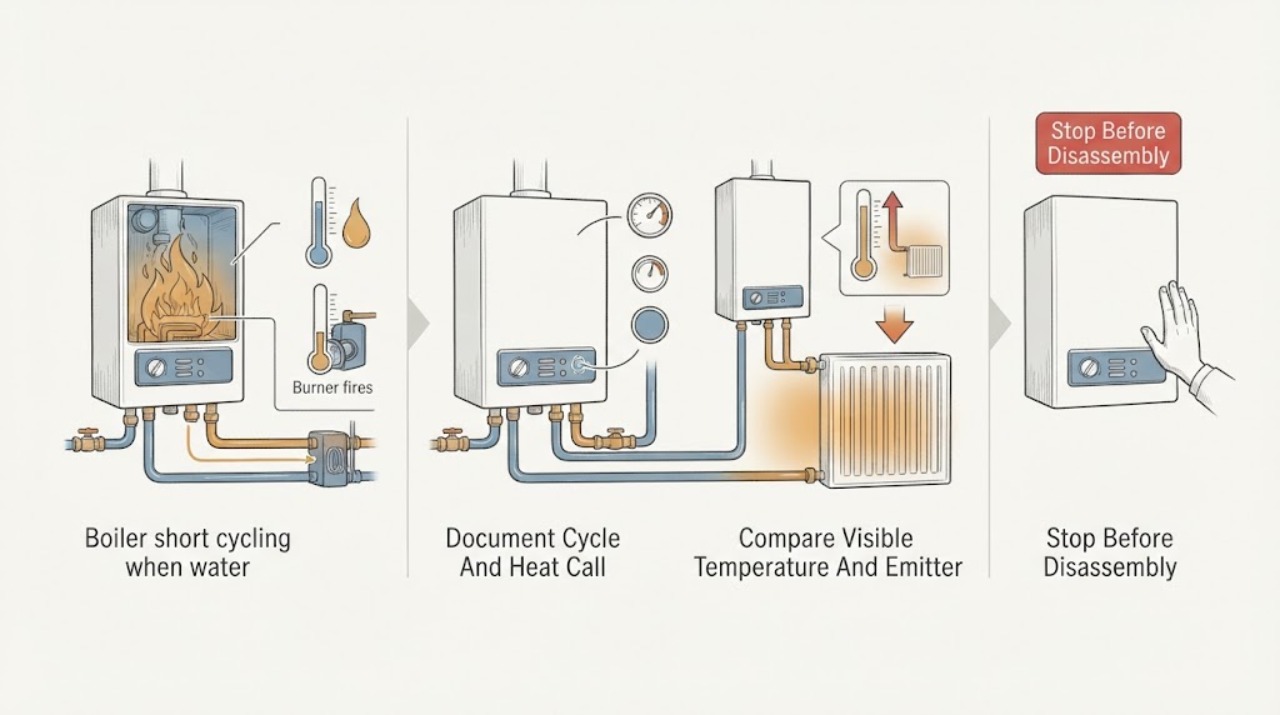
During one heating demand, use the room thermostat and normal boiler display to record when the burner starts and stops, whether the thermostat still calls for heat, and whether the circulator appears to continue after the burner stops. Do not remove a cover or touch hot components.
Expected result: Note whether the burner stops when the displayed supply temperature reaches its target, whether the pump continues, how quickly the temperature falls, whether the burner restarts after a differential or delay, and whether the thermostat call ended first.
Next step: Write down the sequence and the exact display wording, then compare it with the installed boiler manual or give the log to a qualified technician; do not change a hidden differential or high-limit setting based on this observation alone.
Stop if: Stop if the boiler locks out, makes an unusual noise, smells of gas or combustion products, leaks water, or shows an overheating or safety warning. Do not repeatedly reset it.
Why this matters
Why: A burner that stops at a control target while the pump continues and then restarts after a time or temperature differential may be following its control sequence. Repeated short burns while the heat call remains active, especially with a very fast temperature rise, make a load, water-volume, flow, or control mismatch more likely; a call that ends normally points toward thermostat or room-load behavior instead.
-
Check 2
Read only the user-accessible supply and return temperatures shown on the boiler or installed gauges, then observe whether the radiators, baseboards, radiant-floor indicators, or fan-coil air actually warm. Compare the temperature behavior with the number of emitters calling, without touching hot pipework.
Expected result: Record whether supply temperature rises to target almost immediately, whether return temperature follows closely or stays much cooler, whether emitters warm evenly, and whether the boiler is hot while one or more zones remain cool.
Next step: Provide the readings, zone status, and emitter pattern to a technician for a flow and heat-transfer check; do not drain the system, remove a pump or valve cover, or infer a universal normal temperature from another boiler model.
Stop if: Do not touch hot water or exposed metal, open the boiler casing, alter a relief or mixing device, or continue operation if pressure is abnormal, water is leaking, or a safety control has tripped.
Why this matters
Why: A rapid supply rise with only a small active load can fit an oversized boiler or a boiler whose minimum output is above the present demand. A boiler that heats rapidly while emitters stay cool makes a circulation, pump, valve, air, blockage, or zone-control issue more likely. A pattern with little supply-to-return difference can also indicate that the distribution side is not accepting heat, but temperature readings alone do not identify the failed part.
-
Check 3
List which thermostats or zones are requesting heat and whether radiator or baseboard valves appear open at the user side. Note the outdoor conditions, room temperature, and whether short cycling occurs only when one small zone is active or when several zones overlap.
Expected result: Look for a single small zone calling, many emitters turned down or closed, all zones calling, or short cycling that appears mainly during mild weather or after a large thermostat setback.
Next step: Keep the zone and weather log; ask the technician to compare the building heat load, active emitter capacity, boiler minimum output, and zone-control arrangement. Do not permanently open or close valves, combine circuits, or change thermostat cycles as a trial repair.
Stop if: Do not access zone-valve wiring, alter thermostat terminals, force a valve, or work on a pump or boiler control panel.
Why this matters
Why: A single small zone or mild-weather call can leave the boiler with a load below its minimum firing rate, making oversizing, low water volume, or insufficient emitter capacity more likely. If all zones call yet the boiler still reaches its target rapidly, a distribution or control problem becomes more important to test. A pattern tied to setback or zone overlap can involve recovery or reset logic rather than a failed burner part.
-
Check 4
Without changing installer parameters, record whether the system has outdoor-reset, boost, anti-cycling, or staged/modulating controls, the displayed target temperature, and any recent thermostat, schedule, zoning, or boiler-control change. Note whether the water-temperature swing follows outdoor temperature or a setback recovery.
Expected result: Record whether a reset control lowers the target during lighter load, whether a boost raises it after a long call, whether the burner stops while pumps continue, and whether the symptom began after a control or zoning change.
Next step: Photograph or transcribe the visible settings and have the installed manual and control configuration reviewed by a qualified heating professional. Do not lower a non-condensing boiler's limits or alter an outdoor-reset curve without confirming the required return-temperature protection.
Stop if: Do not enter a protected installer menu, change fuel, combustion, high-limit, anti-freeze, or safety parameters, or bypass a control to keep the burner on.
Why this matters
Why: Outdoor-reset and modulation can match supply temperature and firing rate to load, while a boost or setback recovery can temporarily raise supply temperature. A control setting that does not match the system, a misread outdoor condition, or a recent zoning change can therefore produce rapid target-reaching and cycling; the correct settings are boiler- and system-specific.
-
Check 5
If the log confirms repeated short burns, arrange a boiler and hydronic-system diagnostic rather than replacing a sensor or control by guesswork. Give the technician the cycle timing, heat-call state, supply and return readings, active-zone pattern, weather, displayed settings, and any fault code.
Expected result: The professional assessment should determine whether the system has adequate flow and pump operation, open valves and air management, usable emitter capacity, correct controls and sensors, a suitable boiler size or modulation range, and enough system water volume for the active load.
Next step: Use the technician's measured findings to choose the repair and verify that the boiler completes stable cycles afterward. Keep the boiler manual, model information, maintenance history, and observations available; do not order a part until the failed component and fitment are confirmed.
Stop if: Do not open the casing, test combustion, change gas pressure, alter fixed wiring, defeat a high limit or lockout, drain the system, or modify piping without qualified service and the applicable manufacturer instructions.
Why this matters
Why: A confirmed load below minimum output may call for a control or system-design remedy such as proper modulation, corrected zoning, added water volume, or a sizing decision; a confirmed flow or sensor fault requires a different repair. Short cycling that occurs with a fault, pressure problem, overheating, or combustion concern is an appliance safety issue, not an efficiency adjustment.
Use your observations
Decision map
Find the observation that best matches what you see, then follow the next safe action.
-
PATH 01Safety boundary
What you see
The thermostat continues to call, the burner stops when the displayed supply target is reached, the pump continues, and the burner restarts only after a programmed delay or temperature differential.
Do this next
Have a qualified technician verify the boiler's manual-specific differential, minimum output, pump operation, and system load before changing any setting.
Why this path and its safety boundary
Why it matters: This pattern can be the boiler's intended differential sequence rather than an immediate burner failure. If the burns are consistently very short or comfort is poor, the control sequence may be exposing a load or sizing mismatch.
Safety stop: Do not bypass the differential, force the burner on, or change the high limit or gas settings.
-
PATH 02Safety boundary
What you see
The supply temperature reaches its target quickly, only one small zone or a few emitters are active, and the symptom is strongest in mild weather or after other zones close.
Do this next
Ask the technician to compare the design or measured load with the boiler's minimum output and assess modulation, zoning, emitter capacity, and whether a properly designed buffer or other system-volume solution is appropriate.
Why this path and its safety boundary
Why it matters: The active heat load may be below the boiler's minimum firing rate, making oversizing, low system water volume, or insufficient active emitter capacity more likely than a failed temperature sensor alone.
Safety stop: Do not add or remove emitters, combine zones, or install a buffer tank based only on the cycle symptom.
-
PATH 03Safety boundary
What you see
The boiler reaches temperature rapidly but radiators, baseboards, or a fan coil remain cool, or the supply and return readings change abruptly while a zone is calling.
Do this next
Stop at user-level observation and arrange a hydronic flow and distribution inspection with the readings, zone state, and radiator pattern.
Why this path and its safety boundary
Why it matters: A circulation, pump, zone-valve, air, blockage, low-flow, or heat-emitter problem becomes more likely. The water-temperature behavior is a clue that heat may not be reaching the distribution system; it does not identify which component is at fault.
Safety stop: Do not remove pump or valve covers, bleed or drain a sealed system to chase the symptom, force valves, or open the boiler.
-
PATH 04Safety boundary
What you see
Short cycling began after a thermostat, schedule, zoning, outdoor-reset, or control change, or it occurs mainly during setback recovery or when zone calls overlap.
Do this next
Record the old and current visible settings and have the installer or qualified heating technician verify the control configuration and safe reset limits.
Why this path and its safety boundary
Why it matters: The system may be responding to a recovery or reset target that is too high for the current load, a control configuration that does not match the distribution system, or a changed zone demand. The setting is model- and system-specific.
Safety stop: Do not enter installer menus, lower a non-condensing boiler's required return-temperature protection, or disable boost, freeze, anti-cycling, or safety functions.
-
PATH 05Safety boundary
What you see
The short cycles coincide with a lockout, repeated fault, abnormal flame or soot, gas or flue odor, unusual combustion noise, water leak, pressure problem, carbon-monoxide alarm, or symptoms such as headache, dizziness, nausea, or breathlessness.
Do this next
Leave the area and follow the local gas or emergency process when gas or carbon monoxide is suspected; seek urgent medical help for symptoms. Otherwise switch the appliance off only if safe and arrange qualified service.
Why this path and its safety boundary
Why it matters: This is an appliance or life-safety concern, not a normal efficiency-tuning branch. The boiler should not be operated or repeatedly reset while the hazard is unresolved.
Safety stop: Do not relight, reset, open, inspect, or repair the boiler until the appropriate emergency responder or qualified heating professional has assessed it.
Helpful context
Understand the symptom
A fast temperature rise is a clue, not a diagnosis
In a hydronic hot-water system, the boiler heats water and a pump distributes it to radiators, baseboards, radiant loops, or a fan coil. When the active zones can accept less heat than the boiler is producing, the supply temperature can reach its target quickly and the burner can cycle off even though the room thermostat has not been satisfied. An oversized boiler, a single small zone, too little system water volume, restricted circulation, or an emitter that cannot release enough heat can all change the pattern. The exact off and restart behavior depends on the installed control and boiler type.
Separate control cycling from a heat-transfer problem
Watch the sequence using only the normal display, thermostat, and installed gauges. If the burner turns off at its target while the pump continues and the water later falls through the control differential, that may be the designed sequence, although frequent repetition can still indicate a sizing or control mismatch. If the supply temperature climbs rapidly while radiators or baseboards remain cool, or if the temperature swings are accompanied by a fault, the system needs a flow, valve, pump, air, sensor, or heat-transfer assessment rather than a guessed setting change.
Do not tune a boiler by bypassing its limits
Longer cycles can sometimes be achieved through correct sizing, burner modulation, outdoor-reset control, added system volume, or corrected distribution, but those are system-design and service decisions. Record the observed pattern and have a qualified heating professional test circulation, verify controls and combustion, and assess the load against the boiler's minimum output. Never open the casing, adjust gas or combustion settings, bridge control wiring, defeat a high-limit or anti-cycling function, or repeatedly reset a lockout as a workaround.
Safety boundary
Stop conditions
- Do not remove the boiler casing, alter gas or combustion settings, bridge thermostat or zone wiring, bypass a high limit or anti-cycling control, or work on fixed electrical connections.
- Do not repeatedly reset a lockout or continue operating when the boiler shows a fault, overheats, leaks water, loses pressure, or makes an abnormal combustion or flue sound.
- Stop for a gas or flue odor, soot, abnormal flame, carbon-monoxide alarm, or compatible illness symptoms; leave the area and follow the local emergency process.
- Do not assume a supply or return temperature, differential, pressure, or reset value from another boiler applies to this appliance; use the installed manual and qualified service measurements.
- Arrange qualified heating service when short burns persist with a heat call, the boiler gets hot while emitters remain cool, the symptom follows a control or zoning change, or diagnosis would require pump, valve, sensor, combustion, piping, or system-volume work.
Only after diagnosis
Potential parts
- hydronic system circulator pump
Consider this category only if a qualified flow test identifies inadequate pump operation or a failed circulator as the cause of the rapid temperature rise and cool emitters.
Confirm the boiler, piping arrangement, flow requirement, electrical characteristics, and pump curve before ordering; do not select a pump from temperature symptoms alone. - hydronic buffer tank
Consider this system component only after a measured load and boiler minimum-output review confirms persistent short cycling caused by low system volume or a small active zone.
Sizing, piping, controls, temperature limits, and local code must be confirmed by a qualified designer or installer for the exact boiler and distribution system. - outdoor-reset temperature sensor
Consider this category only when the installed control records an implausible outdoor reading or a qualified diagnostic identifies the sensor or its wiring as the cause of an incorrect supply target.
Confirm the exact boiler control, sensor type, wiring, and manufacturer fitment before ordering; do not substitute a sensor or alter the reset curve by guesswork.
When checks do not resolve it
Need a professional?
Arrange a qualified boiler or hydronic-heating technician when the burner repeatedly short cycles while the thermostat still calls, the water temperature reaches its target unusually quickly, emitters stay cool, a cycle pattern follows a control or zoning change, or diagnosis would require checking flow, pump or valves, sensors, combustion, sizing, minimum modulation, or system water volume. Treat gas, flue, combustion, carbon-monoxide, leak, pressure, and overheating warnings as urgent safety matters rather than routine efficiency tuning.
Safety scope: This article supports recording user-visible operation, reading installed gauges or displays, checking thermostat and zone demand, and documenting settings. It does not authorize casing removal, combustion testing, gas or flue work, fixed-wiring changes, safety bypasses, pump or valve repair, system draining, or boiler-control adjustment.
Common questions
FAQ
Is a boiler short cycle always caused by a bad temperature sensor?
No. A sensor can be wrong, but a boiler may also reach its target quickly because the active load is small, the boiler is oversized or cannot modulate low enough, system water volume is low, heat is not reaching the emitters, or the control differential is operating as designed. Document the heat call, pump behavior, supply and return readings, and active zones before a part is considered.
Why does the water temperature change quickly while the thermostat is still calling?
The burner can stop when a supply target is reached even though pumps continue to circulate, then restart after a time or temperature differential. If the target is reached unusually fast, the active zones may be accepting less heat than the boiler produces, or flow may be restricted. Frequent short burns need a system-specific load, circulation, and control assessment.
Can I lower the boiler temperature or change the anti-cycling setting?
Do not change a high limit, gas setting, installer differential, anti-cycling function, or reset curve as a trial repair. The safe range depends on boiler type, fuel, emitters, freeze protection, and return-temperature requirements. Give the visible settings and cycle log to a qualified heating professional.
Would a buffer tank stop boiler short cycling?
It can be an appropriate design option when measured demand is below the boiler's minimum output and the system has insufficient water volume, but it is not a universal fix. A qualified designer must confirm the load, boiler controls, piping, temperatures, and tank size before any installation.
When is boiler short cycling an emergency?
Treat gas or flue odor, soot or abnormal flame, a carbon-monoxide alarm or symptoms, overheating, a water leak onto electrical equipment, or a repeated safety lockout as urgent. Leave the area and follow the local emergency process when combustion or carbon monoxide is suspected; do not keep resetting or operating the boiler.
Read the exact guide
Official sources
- Purchasing Energy-Efficient BoilersU.S. Department of Energy, Federal Energy Management Program · DOE boiler efficiency and operation guidance; the page is primarily procurement-oriented, so particular residential controls and limits remain model-specific.
- Troubleshooting Guide v1.6Viessmann US · Viessmann Vitodens 200 service guide; the listed model-specific solutions must not be transferred to another boiler without its installation and service documentation.
- Building America Best Practices Series Vol. 14: Energy Renovations - HVAC: A Guide for Contractors to Share with HomeownersU.S. Department of Energy, Building America · DOE homeowner and contractor guide for residential HVAC and hydronic systems; service tasks and pressure or control settings remain specific to the installed equipment.
- Vitocrossal 300, CU3A: The Evolution of the Condensing BoilerViessmann US · Viessmann's manufacturer explanation uses the Vitocrossal 300 CU3A as an example; it illustrates mechanisms but does not establish settings or compatibility for another boiler.
- Measure Guideline: Condensing Boilers - Control Strategies for Optimizing Performance and Comfort in Residential ApplicationsU.S. Department of Energy, Building America · U.S. Department of Energy Building America guidance for residential condensing and hydronic boiler systems; exact limits, controls, and safe settings depend on the installed boiler and distribution design.
Community feedback
Share a repair observation
Share a plain-text repair observation. Accepted observations are published automatically; this page may take a moment to update.