
On this page
Start here
Quick answer
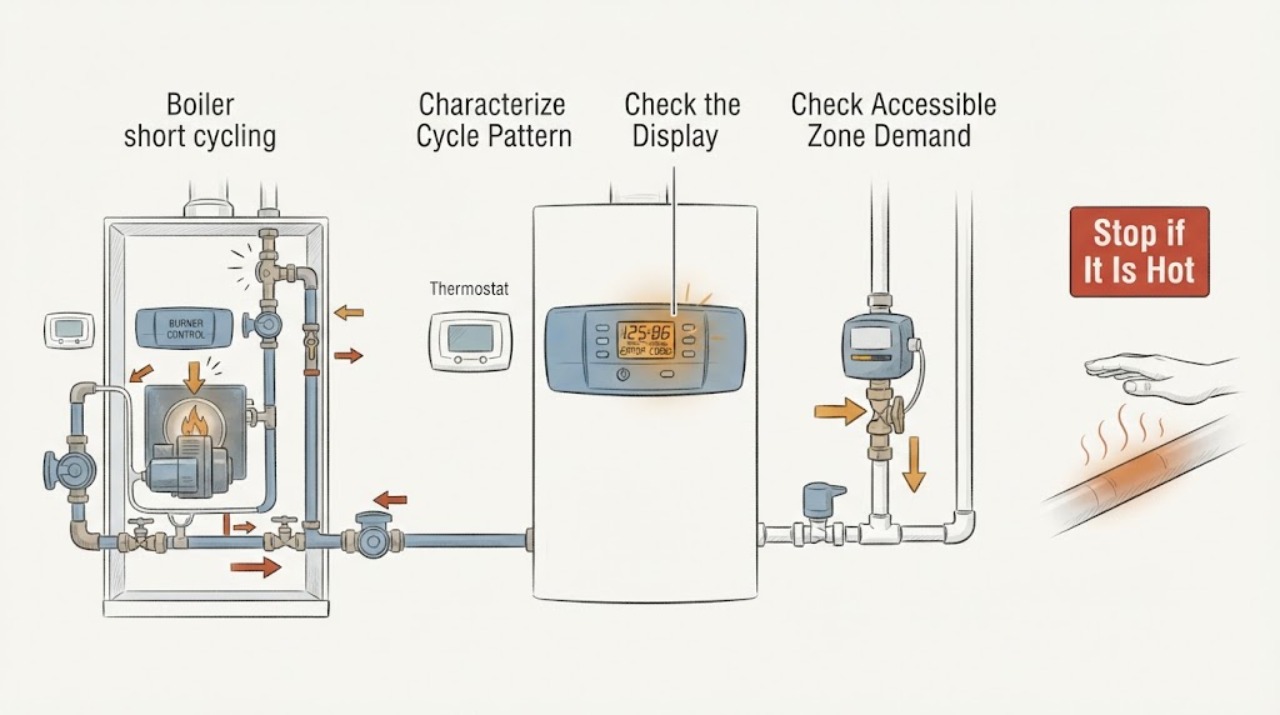
A Buderus boiler that starts and stops repeatedly before the heating demand is satisfied is short cycling. The pattern can occur when the current heat demand is below the boiler's minimum modulation, when a control reaches its supply-temperature limit too quickly, or when water flow through the system is restricted; a thermostat or zone-control problem can create a similar symptom. First document how long each firing run lasts, whether the room is still calling for heat, what the display says, and whether all accessible zones are open. Do not change installer-level burner, gas, combustion, anti-cycle, or control parameters, open the burner cabinet, test wiring, or bypass a safety. If the boiler shows a fault or lockout, has a gas odor, abnormal flame or exhaust, overheating, water leakage, unusual pressure behavior, or repeated short cycles after simple external observations, leave it off as appropriate and arrange a qualified heating technician.
Work through in order
Diagnostic checks
Use only checks that match the exact appliance or system and its official guide.
-
Check 1
From outside the closed boiler, record several normal start-to-stop events only if there is no hazard: note the approximate firing-run duration, time between starts, whether the room is still below its setpoint, and whether the behavior occurs in every heating call or only one zone or schedule.
Expected result: Record long runs that satisfy the call, repeated brief runs with an unsatisfied room, starts separated by a control delay, or cycling limited to domestic-hot-water/preheat or one heating zone if the system has those functions.
Next step: Stop repeated observation once the pattern is clear and give the timing and operating mode to a qualified technician. Do not run the boiler repeatedly to reproduce a fault.
Stop if: Stop immediately for gas odor, smoke, abnormal flame or exhaust, banging, overheating, water leakage, a lockout, or any unsafe condition.
Why this matters
Why: A call that remains unsatisfied while the burner stops supports a short-cycling investigation. A satisfied call or a deliberate control delay may be normal control behavior; a zone-specific pattern shifts attention toward that zone's thermostat, valve, or flow.
-
Check 2
Compare the room thermostat or zone controller's visible heat-call indication with the boiler display while the cycle occurs; record the exact display text or symbol without entering an installer menu or resetting an unknown fault.
Expected result: Record a continuing heat call with an anti-cycle/optimized-switching status, no heat call, a call that disappears unexpectedly, a fault or lockout, or an unreadable/unknown indication.
Next step: Photograph the display and thermostat state, then consult only the user section of the exact manual. Arrange qualified service for an unknown code, repeated lockout, or a call that does not match boiler behavior.
Stop if: Do not remove the thermostat cover, bridge terminals, change hidden parameters, or repeatedly reset a fault.
Why this matters
Why: A continuing call with an anti-cycle or high-temperature status points toward load, modulation, hysteresis, or flow behavior. A disappearing call points toward thermostat, schedule, outdoor-reset, zone relay, or wiring logic. A fault or lockout needs model-specific service diagnosis rather than repeated resets.
-
Check 3
Without opening the boiler, visually check whether the accessible radiators or radiant zones that should be heating have an obvious closed manual/thermostatic valve, and note whether multiple zones are calling or only one small zone is active; do not force a valve.
Expected result: Record all expected zones available, one zone calling with other valves closed, a valve that is stuck or uncertain, or no visible zone-control change despite a thermostat call.
Next step: Restore only an obviously user-selected thermostat/valve position that moves normally and is documented by the system instructions; otherwise leave it alone and request hydronic service with the affected zone identified.
Stop if: Do not remove actuator covers, bleed radiators, drain the system, loosen fittings, or force a thermostatic or motorized valve.
Why this matters
Why: A small active zone or closed heat emitters can leave the boiler with little heat draw and make supply temperature rise quickly. An uncertain or stuck valve can restrict flow, but this observation does not prove the valve or pump has failed.
-
Check 4
If a pressure/temperature display or gauge is clearly visible without opening the casing, record its state before, during, and after a cycle and note any pump hum, grinding, vibration, or complete absence of expected circulation sounds; do not add water or adjust a relief device.
Expected result: Record stable readings, a rapid temperature rise, an unusual pressure change, a noisy or silent circulator, a low-water indication, or no accessible gauge/display.
Next step: Send the recorded pattern to a qualified technician for pump, valve, air, water-quality, sensor, and heat-exchanger checks. Do not attempt to purge, refill, or service the hydronic circuit based on a reading alone.
Stop if: Stop if pressure changes sharply, water or steam appears, the gauge behaves erratically, the boiler overheats, or any relief discharge is visible.
Why this matters
Why: Rapid temperature rise, low-water indication, or an abnormal pump symptom is consistent with a flow or heat-transfer issue that can trigger protective shutdowns and cycling. A stable reading does not rule out a control, sizing, sensor, or intermittent circulation problem.
-
Check 5
From outside the appliance, check that the boiler room remains clear of stored combustibles and that visible air-intake or exhaust terminations are not obviously blocked by debris, snow, or an object; do not remove vent sections or inspect the burner.
Expected result: Record clear terminations and a clear area, an obstruction or damaged termination, water stains or condensate near the vent, or an exhaust/flame symptom during a short run.
Next step: Keep the boiler off if combustion or venting appears abnormal and arrange qualified gas-appliance service. Remove only loose exterior debris that can be cleared without touching the appliance or entering a hazardous area.
Stop if: Do not light the boiler, use a flame to test draft, open the combustion chamber, adjust gas pressure, or operate switches when gas odor is present.
Why this matters
Why: A vent or combustion-air problem can cause faults and repeated starts, and it is a safety/combustion diagnosis rather than a homeowner short-cycling adjustment. A clear exterior does not prove the vent, fan, gas valve, or combustion setup is sound.
-
Check 6
Prepare the service handoff with the Buderus model and control names if safely visible, cycle timing, thermostat/zone-call state, display text, accessible zone positions, gauge observations, pump/vent symptoms, recent system changes, and whether the room reaches the requested temperature.
Expected result: Confirm that the record contains external observations only and that no installer setting, burner, gas control, wiring, pump housing, vent, or hydronic fitting was disturbed.
Next step: Arrange a qualified Buderus/heating technician when the pattern recurs, the call remains unsatisfied, a fault returns, or diagnosis requires controls, combustion, gas, electrical, pump, valve, sensor, or heat-exchanger access.
Stop if: Stop all homeowner troubleshooting if the next step requires opening the cabinet, testing live wiring, changing parameters, measuring gas or combustion, draining/refilling, or removing a vent or pump.
Why this matters
Why: The record helps separate low-load/minimum-output cycling from rapid-temperature-rise flow faults, thermostat/zone logic, anti-cycle control behavior, or combustion/safety faults before a part is selected.
Use your observations
Decision map
Find the observation that best matches what you see, then follow the next safe action.
-
PATH 01Next step
What you see
The thermostat continues calling, only a small zone is open, supply temperature rises quickly, and the display shows normal or anti-cycle behavior without a safety fault.
Do this next
Have a qualified technician verify heat-load sizing, minimum output, modulation, control strategy, zone staging, and system flow before changing any parameter.
-
PATH 02Next step
What you see
A heat call remains active but the boiler reaches its temperature limit rapidly, a pump sounds abnormal, a low-flow indication appears, or several heat emitters remain cold.
Do this next
Leave hydronic components undisturbed and arrange qualified service to verify pump operation, flow, sensors, water condition, and heat exchanger condition.
-
PATH 03Next step
What you see
The thermostat call disappears while the room is still cool, the boiler starts without a matching call, or cycling occurs only in one zone or schedule.
Do this next
Record the mismatch and have a technician test the control signal and zone sequence. Do not bridge terminals, replace a thermostat, or change installer settings from the symptom alone.
-
PATH 04Next step
What you see
The boiler repeatedly reports an anti-cycle, optimized-switching, or temperature-above-setpoint status while the heat demand remains and the rooms do not recover.
Do this next
Provide the exact status, model, control configuration, and cycle pattern to qualified service; do not defeat the delay or increase limits to force longer firing.
-
PATH 05Next step
What you see
A fault or lockout returns, there is abnormal flame or exhaust, gas odor, smoke, unusual combustion noise, overheating, or a damaged vent termination.
Do this next
Stop using the boiler and leave the area for gas odor or smoke; do not operate electrical switches when gas may be present. Use the applicable emergency gas/fire response and qualified service.
-
PATH 06Next step
What you see
Short cycling is accompanied by water leakage, steam, a rapidly changing gauge, relief discharge, or a low-water condition.
Do this next
Keep clear of hot water and moving equipment, do not add water or manipulate relief devices, and arrange urgent qualified heating service.
Helpful context
Understand the symptom
Short cycling is a pattern, not a single failed part
A normal boiler can stop after the requested supply temperature is reached, and a control may impose an anti-cycle delay before another start. Short cycling means the burner repeatedly fires and stops while the heating demand remains, often without giving the rooms enough time to warm. Buderus documentation identifies low-load operation below a boiler's minimum output as one cycling mechanism, while its GB312 troubleshooting table identifies low heat draw, low flow, pump problems, and deposits as other causes of rapid temperature rise. The same observation can therefore require a control, sizing, flow, or maintenance diagnosis.
The display and the room call provide the useful split
If the room or zone is no longer calling for heat, repeated starts may be a thermostat, scheduling, outdoor-reset, or zone-control behavior rather than a burner problem. If a heat call remains but the boiler reaches its temperature limit quickly, the technician needs to investigate heat transfer and circulation. A Buderus status such as optimized switching or anti-cycle can explain why a restart is being delayed, but it does not explain why the system is unable to carry the load. Record the exact display text for the service handoff instead of changing hidden parameters.
Flow checks stop at the outside of the boiler
A closed thermostatic valve, closed zone valve, failed or noisy pump, trapped air, or deposits can leave the boiler with little heat draw or low loop flow. Buderus lists these conditions in its troubleshooting material, but checking pump operation, flow temperature, sensors, wiring, and the heat exchanger can require instruments and access. A homeowner can note visible valve positions and the display or sounds from outside the casing; a technician must confirm circulation and water-side condition before a pump or valve is selected.
Efficiency settings are commissioning decisions
The U.S. Department of Energy explains that modulating burners, load-based staging, and water-temperature reset can reduce excessive cycling, while Buderus manuals expose minimum output, hysteresis, anti-cycle, and pump-overrun settings for particular controls. Those settings are model- and system-specific. Do not copy a parameter from another Buderus model or raise a limit to mask a flow or sizing problem; give the technician the model, control, observed cycle pattern, and zone configuration.
Safety boundary
Stop conditions
- Do not open the burner or control cabinet, test live wiring, measure gas or combustion, adjust gas pressure, change installer-level modulation/hysteresis/anti-cycle settings, or bypass a safety device.
- Do not drain or refill the hydronic system, bleed radiators, remove a pump or valve, loosen fittings, manipulate a relief device, or run repeated cycles to reproduce a fault as a homeowner.
- Stop immediately for gas odor, smoke, abnormal flame or exhaust, overheating, steam, water leakage, relief discharge, rapidly changing pressure, shock, or a damaged vent; leave the area as appropriate and arrange qualified or emergency help.
Only after diagnosis
Potential parts
- boiler circulation pump
Consider this only when qualified testing confirms that the circulator is not providing the required flow and that power, controls, air, valves, and system restrictions have been checked.
Confirm the exact Buderus model, pump type, head/flow requirements, electrical characteristics, connections, and manufacturer-approved fit before selection or installation. - hydronic zone valve or actuator
Consider this only when one zone has a confirmed call/flow mismatch and qualified diagnosis identifies a failed or restricted valve or actuator.
Verify the valve body, actuator, control voltage, port arrangement, flow direction, system temperature duty, and wiring against the installed system. - thermostat, zone relay, or outdoor temperature sensor
Consider this only when measured control behavior does not match the thermostat or zone demand and the technician confirms the control component is defective.
Confirm the exact Buderus control family, communication or terminal method, sensor curve, wiring, and installer configuration before replacement. - boiler heat-exchanger or combustion-service component
Consider this only after qualified service confirms deposits, heat-transfer restriction, burner, ignition, fan, sensor, or combustion damage as the cause; short cycling alone does not justify a part.
Confirm the exact model, fuel and combustion system, service-manual procedure, safety checks, and manufacturer-approved component before any repair.
When checks do not resolve it
Need a professional?
Arrange qualified Buderus/heating service when the boiler cycles repeatedly while a heat call remains active, the room does not recover, a display fault or lockout returns, cycling is confined to one zone without an obvious user setting, or diagnosis would require changing parameters, testing controls, inspecting combustion, checking gas pressure, opening the cabinet, servicing a pump or valve, or cleaning a heat exchanger. Treat gas odor, smoke, abnormal flame or exhaust, overheating, steam, water leakage, relief discharge, rapidly changing pressure, or a damaged vent as an urgent safety condition and use the appropriate emergency response.
Have this ready
- Provide the exact Buderus model and control if safely visible, cycle timing, thermostat and zone-call state, display text, accessible valve positions, gauge observations, pump/vent symptoms, room response, and recent installation or control changes.
Common questions
FAQ
Is short cycling always a failed Buderus boiler part?
No. Buderus documentation identifies low-load operation below minimum output, anti-cycle control behavior, low heat draw, low loop flow, pump problems, and deposits as distinct possibilities. A cycle pattern alone cannot identify a failed burner or control.
Why does closing radiator or zone valves make cycling worse?
With less heat-emitter demand or circulation, the boiler can reach its supply-temperature limit quickly while the room call remains active. Buderus lists little heat draw, low boiler-loop flow, pump problems, and deposits among rapid-temperature-rise causes. Do not force valves or alter the pump as a DIY test.
Can I change the anti-cycle or minimum-output setting?
Do not change installer-level settings from the cycling symptom alone. Buderus controls expose model-specific anti-cycle, hysteresis, pump-overrun, and minimum/maximum output parameters, and the correct values depend on the boiler and hydronic system. A qualified technician should diagnose load and flow first.
What should I record before calling for boiler service?
Record the model and control, firing-run and off intervals, whether the thermostat remains in a heat call, the exact display status, which zones are active, visible gauge behavior, pump or vent sounds, and whether rooms reach the requested temperature. Do not open the boiler or disturb gas, combustion, electrical, or hydronic components.
When is short cycling an emergency?
Treat gas odor, smoke, abnormal flame or exhaust, overheating, steam, water leakage, relief discharge, rapidly changing pressure, shock, or a damaged vent as an urgent safety issue. Do not operate switches or try to relight a boiler when gas may be present; leave the area as appropriate and use qualified or emergency help.
Read the exact guide
Official sources
- Service manual - GB162-80kW/100kW - US(en)Buderus / Bosch Home Comfort · Buderus GB162 contractor service instructions used for general gas and service safety; exact appliance manual and local emergency guidance govern.
- Purchasing Energy-Efficient BoilersU.S. Department of Energy · DOE boiler efficiency guidance used for the system-level explanation; it is not a model-specific service procedure.
- Logano plus GB312 Installation & Service InstructionsBuderus / Bosch Home Comfort · Buderus GB312 service instructions used for mechanism and decision branches; codes and procedures vary by model.
- Bosch Buderus SSB800-1000-TL Control Operations GuideBuderus / Bosch Thermotechnology Corp. · Buderus SSB control guide used to explain why settings are model-specific and not homeowner adjustments.
- GB142 Applications ManualBuderus / Bosch Home Comfort · Buderus GB142 application guidance used to explain the low-load mechanism; exact boiler and control model governs.
Community feedback
Share a repair observation
Share a plain-text repair observation. Accepted observations are published automatically; this page may take a moment to update.