
On this page
Start here
Quick answer
First determine whether the thermostat or zone is still calling for heat when the burner stops. A call that ends normally can be ordinary temperature control; a burner that shuts off after a short run and repeatedly relights while the call remains active is short cycling. Common paths include a small or closed heating zone, inadequate water flow, air in the system, an oversized or poorly matched boiler, a control or sensor problem, or a fuel or venting fault. Homeowners should record the cycle pattern, thermostat or zone demand, display messages, and safe external signs, but should not adjust gas pressure, combustion, high limits, safety controls, burner settings, or pressurized components. Stop and get urgent help for a carbon-monoxide alarm, gas odor, smoke, soot, a blocked vent, a relief discharge, overheating, or a boiler that is leaking or locking out.
Before you begin
Safety first
- Do not open the cabinet, change fuel or combustion settings, bypass a lockout, adjust limits or installer parameters, alter gas or venting, purge or drain the system, or touch hot, energized, leaking, or pressurized components.
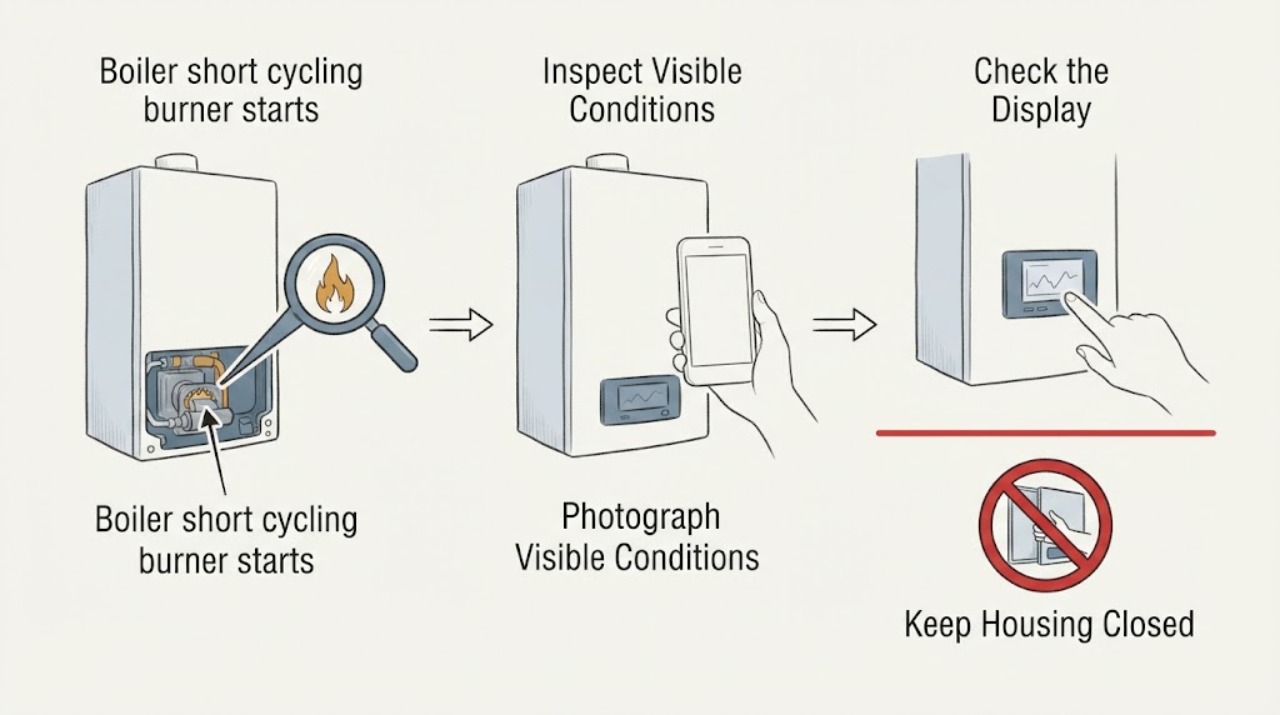
Work through in order
Diagnostic checks
Use only checks that match the exact appliance or system and its official guide.
-
Check 1
From outside the boiler cabinet, observe one or two normal heating calls and write down when the thermostat or zone begins calling, when the burner starts, how long it runs, when it stops, and whether the call for heat remains active; do not remove the jacket or service panel.
Expected result: The thermostat or zone demand ends when the burner stops, or the demand remains while the burner stops and then restarts after a short interval. Record whether the pattern repeats and whether the home or zone actually warms.
Next step: Give the timing and demand state to a heating professional. Do not change thermostat differentials, boiler limits, or burner controls merely to lengthen the cycle.
Why this matters
Why: A call that ends as the set point is reached may be ordinary control operation. Repeated burner stops while demand remains support short cycling and make a rapid temperature-limit, low-flow, control, sizing, or combustion-related path more likely.
-
Check 2
Check the thermostat or zone controller display and the boiler's user-visible display for a heat-call indicator, lockout message, warning, or fault code without repeatedly pressing reset; photograph the message and record the time.
Expected result: The control shows that the heat call is satisfied, shows a fault or lockout, shows an over-temperature or flow-related warning, or shows no message while the burner keeps stopping and restarting.
Next step: Use the exact boiler model and displayed code for the manufacturer's manual or a qualified technician. Do not bypass a lockout, alter a safety setting, or keep resetting a fault that returns.
Why this matters
Why: A satisfied call points back toward normal control timing. A lockout or warning can identify a manufacturer-specific safety response; no visible message does not rule out a sensor, flow, combustion, or control fault.
-
Check 3
From a safe position, note which heating zones are calling and whether radiators, baseboards, or air handlers in the active zone warm evenly; look only at accessible external controls for a zone valve or circulator status and do not touch hot pipes, wiring, valves, or a pressure relief device.
Expected result: Only a very small zone calls, a zone remains cold while the boiler cycles, some emitters warm and others stay cold, or all active zones warm normally while the burner still cycles.
Next step: Report the affected zone and temperature pattern for professional flow and system evaluation. Do not purge the system, adjust a bypass, change pump settings, or open a pressurized component unless the model-specific procedure is being performed by a qualified professional.
Why this matters
Why: A small or poorly flowing zone makes low system flow, air, a closed or failed zone valve, circulator trouble, or a boiler-to-load mismatch more likely. Even heating with persistent cycling keeps sizing or control behavior in question.
-
Check 4
Look from outside the equipment area for visible water leakage, a relief discharge, unusual condensate, soot, rust or water staining around venting, a damaged flue, or a blocked intake or exhaust termination; do not remove a vent cover or reach into the boiler.
Expected result: The area is dry and the vent termination is unobstructed, or there is leakage, discharge, soot, staining, damage, ice, debris, or another change from the normal appearance.
Next step: Stop the boiler and arrange qualified heating service for leakage, discharge, soot, vent damage, or a blocked termination; do not restart it repeatedly or attempt vent, gas, burner, or relief-valve repairs.
Why this matters
Why: A clean external view does not prove safe combustion or adequate flow. Leakage, relief discharge, soot, vent damage, or a blocked intake or exhaust can indicate an unsafe operating condition and takes priority over cycle optimization.
-
Check 5
Check the room for a gas odor and verify that carbon-monoxide alarms are present and operating according to their instructions; if an alarm sounds or anyone has headache, dizziness, nausea, weakness, confusion, or shortness of breath during boiler operation, leave without investigating the boiler.
Expected result: There is no gas odor or alarm, or a gas odor, carbon-monoxide alarm, combustion odor, or compatible symptoms are present.
Next step: For an alarm or symptoms, leave immediately and call emergency services from outside; for gas odor, avoid switches and flames and call the gas utility or emergency services from a safe location. Do not re-enter or reset the boiler until responders or qualified professionals say it is safe.
Why this matters
Why: A short cycle alone does not diagnose carbon monoxide, but an alarm, gas odor, or compatible symptoms make continued operation unsafe. Carbon monoxide is odorless and cannot be ruled out by smell alone.
-
Check 6
Review the boiler rating plate, fuel type, installation or service date, recent thermostat or zoning changes, and the number of active zones; compare the short-cycle pattern with mild-weather or single-zone operation without changing any settings.
Expected result: Short cycling began after a new thermostat, zone, pump, valve, or control was installed; it happens mainly during mild weather or one small zone; or it occurs in every heating condition.
Next step: Give the model, fuel, zone layout, service history, and cycle log to a qualified heating professional. Do not change installer parameters, combustion settings, gas pressure, safety limits, or pump wiring as a home fix.
Why this matters
Why: A recent system change or small-load pattern makes control setup, flow balance, boiler sizing, minimum-fire output, or an added buffer strategy worth professional review. Cycling in every condition makes a fault, sensor, flow, fuel, or venting issue more concerning.
Use your observations
Decision map
Find the observation that best matches what you see, then follow the next safe action.
-
PATH 01Next step
What you see
The thermostat or zone call ends when the burner stops, the space reaches its set point, and no warning, odor, leakage, or abnormal external sign is present.
Do this next
Monitor the cycle over a normal heating call. Request service if the run becomes unusually brief, the call remains active after shutdown, comfort falls, or any warning sign appears.
Why this path and its safety boundary
Why it matters: The observed start and stop may be normal demand control rather than short cycling.
-
PATH 02Next step
What you see
The call for heat remains active, only one small zone is open, and the boiler's burner stops and restarts while that zone remains cool or warms unevenly.
Do this next
Stop changing settings and arrange professional hydronic-flow and control evaluation. Provide the affected zone, emitter pattern, and cycle log; do not purge or open the system yourself.
Why this path and its safety boundary
Why it matters: Low flow, air, a closed or failed zone valve, circulator trouble, or a boiler-to-zone load mismatch is more likely than a thermostat that simply reached its set point.
-
PATH 03Next step
What you see
Short cycles occur mainly in mild weather or after zoning, thermostat, pump, or control changes, while all active emitters heat normally and no safety signs are visible.
Do this next
Have a heating professional review heat loss, boiler output, modulation, zone design, and control setup. Do not alter installer parameters or safety limits to force longer runs.
Why this path and its safety boundary
Why it matters: An oversized minimum output, minimum-run or control configuration, or a system-load mismatch becomes more plausible.
-
PATH 04Next step
What you see
A user-visible fault or lockout repeats, the boiler shows an over-temperature or flow warning, the vent or intake is blocked or damaged, or soot, leakage, or relief discharge is visible.
Do this next
Stop the boiler and arrange qualified heating service. Do not bypass the lockout, remove venting, adjust gas or combustion settings, or keep resetting the control.
Why this path and its safety boundary
Why it matters: The burner may be responding to a safety or combustion condition; this is not a cycle-tuning problem.
-
PATH 05Next step
What you see
A carbon-monoxide alarm sounds, gas odor is present, or occupants develop compatible symptoms while the boiler is operating.
Do this next
Leave immediately, call emergency services from outside, and follow gas-utility or responder instructions. Do not re-enter or operate the boiler until it has been cleared by qualified responders.
Why this path and its safety boundary
Why it matters: Possible combustion or fuel safety exposure takes priority over diagnosing short cycling.
-
PATH 06Next step
What you see
The burner stops and restarts while demand remains, but all zones heat normally, no fault is displayed, and no external safety signs are present.
Do this next
Give the professional the model, fuel, cycle duration, zone demand, outdoor conditions, and display observations for a model-specific assessment rather than replacing a part at random.
Why this path and its safety boundary
Why it matters: A control or sensor issue, boiler minimum output or sizing mismatch, or an intermittent flow condition remains possible; the absence of a display code does not clear the boiler.
Helpful context
Understand the symptom
Confirm that the burner is stopping during an active heat call
A boiler can start and stop as a thermostat reaches its set point. The more useful short-cycling clue is a repeating pattern in which the thermostat or heating zone still requests heat, the burner runs briefly, and then the burner restarts before the space or zone is satisfied. Record the pattern rather than assuming that every start is a fault; cycle timing and the call-for-heat state help a technician choose between a control issue, a flow problem, a small load, and a combustion or venting issue.
Hydronic flow and system size can make the burner reach a limit quickly
When only a small zone calls, a boiler can produce heat faster than the active system can carry it away. Air, a closed zone valve, an undersized or failed circulator, poor system flow, or a control and sensor issue can create the same symptom. Manufacturer troubleshooting materials treat these as service checks, not homeowner adjustments; do not purge, change limits, alter pump wiring, or open a boiler cabinet based on a generic symptom.
Fuel-burning and pressurized equipment needs a professional boundary
A gas- or oil-fired boiler combines combustion, venting, electricity, hot water, and sometimes stored pressure. A short cycle may be caused by a harmless load mismatch, but it can also accompany low flow, high temperature, ignition, gas, or vent faults. CPSC and CDC recommend professional inspection and annual service for fuel-burning heating systems. If a carbon-monoxide alarm sounds, leave the building and call emergency services from outside; do not keep resetting the boiler to make it run.
Safety boundary
Stop conditions
- Do not adjust gas pressure, combustion, burner mixture, high limits, differential settings, installer parameters, safety controls, or venting based on a generic short-cycling symptom.
- Do not open the boiler jacket, burner compartment, electrical panel, gas train, heat exchanger, pressure vessel, or relief-valve piping; do not purge, drain, or refill a pressurized system as a first-line homeowner test.
- Stop the boiler and arrange qualified service for a repeated lockout, over-temperature or flow warning, blocked or damaged vent, soot, water leak, relief discharge, unusual combustion odor, or overheating.
- For a carbon-monoxide alarm, gas odor, smoke, or compatible symptoms, leave immediately and call emergency services or the gas utility from outside; do not re-enter or repeatedly reset the boiler.
Only after diagnosis
Potential parts
- boiler thermostat
Consider a thermostat only if the cycle log and control diagnosis show that the thermostat or zone call is ending or being misread; burner short cycling alone does not identify a thermostat fault.
Match the boiler control type, voltage, heat-only or multistage requirements, zoning equipment, and manufacturer instructions; wiring changes should be performed by a qualified technician. - boiler temperature sensor
Consider this only when a model-specific diagnostic process or qualified technician identifies an inaccurate temperature reading or a failed sensor as the reason the burner stops prematurely.
Confirm the exact boiler model, sensor type, connector, resistance or control requirements, and approved installation method before ordering or fitting any sensor. - boiler circulator pump
Consider a circulator only after a qualified flow diagnosis shows inadequate circulation, and not merely because a burner starts and stops rapidly.
Pump sizing, head, electrical supply, control logic, system fluid, and boiler minimum-flow requirements must be verified for the specific system by a qualified professional.
When checks do not resolve it
Need a professional?
Call a qualified heating professional for any confirmed short cycling on a fuel-fired or pressurized boiler, especially when the call for heat remains active, the cycle follows one small zone, the system has flow or control changes, or a fault or safety sign is present. Manufacturer service material and CPSC/CDC safety guidance place combustion, venting, gas, pressure, and internal controls outside ordinary homeowner troubleshooting.
Safety scope: Do not open the cabinet, change fuel or combustion settings, bypass a lockout, adjust limits or installer parameters, alter gas or venting, purge or drain the system, or touch hot, energized, leaking, or pressurized components.
Have this ready
- Provide the boiler make and model from the rating plate, fuel type, thermostat or zone call state, burner run and off times, number of restarts, active zones, room comfort, display messages, recent installation or zoning changes, service date, and photos of safe external signs such as vent staining or leakage.
Common questions
FAQ
How can I tell whether a boiler is really short cycling?
Watch whether the thermostat or heating zone still calls for heat when the burner stops. If the call ends because the set point is reached, the cycle may be normal. Repeated brief burner runs and restarts while demand remains support short cycling; record the run and off times for a technician.
Can a small heating zone cause the boiler to short cycle?
It can make a load mismatch or low-flow condition more likely, especially when only one small zone calls. Air, a closed or failed zone valve, circulator trouble, or boiler output that exceeds the active load can look similar. Have a professional evaluate flow, controls, and sizing rather than changing limits yourself.
Should I adjust the boiler temperature or reset it to stop short cycling?
Do not change gas, combustion, high-limit, differential, installer, or safety settings from a generic symptom. You can record the display and cycle pattern, but a qualified heating professional should diagnose flow, sensors, controls, boiler output, and fuel or venting conditions.
Is short cycling dangerous on a gas or oil boiler?
The symptom does not identify the hazard by itself, but it can occur alongside flow, over-temperature, ignition, fuel, or venting faults. Stop for a lockout, leak, relief discharge, soot, blocked vent, gas odor, smoke, or unusual combustion odor. Leave immediately for a carbon-monoxide alarm or symptoms and call from outside.
What information should I give the boiler technician?
Provide the boiler model and fuel, thermostat or zone call state, burner run and off times, restart count, active zones, room comfort, display messages, service date, recent zoning or control changes, and safe photos of external vent staining, leakage, or blockage.
Read the exact guide
Official sources
- Carbon Monoxide Poisoning BasicsCenters for Disease Control and Prevention · Government health guidance used for alarm and symptom escalation, annual qualified service of fuel-burning heating systems, and the fact that carbon monoxide cannot be detected by smell.
- Troubleshooting Guide v1.6Viessmann Manufacturing Company · Manufacturer service documentation used as a model-specific example of short-cycling checks, including air, water flow, gas pressure, venting, controls, and professional service limits; it is not a universal setting guide for other boilers.
- Purchasing Energy-Efficient BoilersU.S. Department of Energy · Government boiler guidance used to explain why reduced loads and output/load mismatch can produce excessive cycling and why modulation and system-level controls are professional design considerations.
- Boiler FAQs & Common QuestionsWeil-McLain · Boiler-manufacturer guidance used to keep troubleshooting and part selection model-specific and to direct homeowners to heating professionals for faults and maintenance.
- Protect Your Family from Carbon Monoxide PoisoningUnited States Consumer Product Safety Commission · Government safety guidance used for the immediate response to a carbon-monoxide alarm or symptoms during boiler operation.
- Home Heating EquipmentUnited States Consumer Product Safety Commission · Government safety guidance used for the professional boundary around fuel-burning boilers and annual inspection of boilers, chimneys, flues, and vents.
Community feedback
Share a repair observation
Share a plain-text repair observation. Accepted observations are published automatically; this page may take a moment to update.