
On this page
Start here
Quick answer
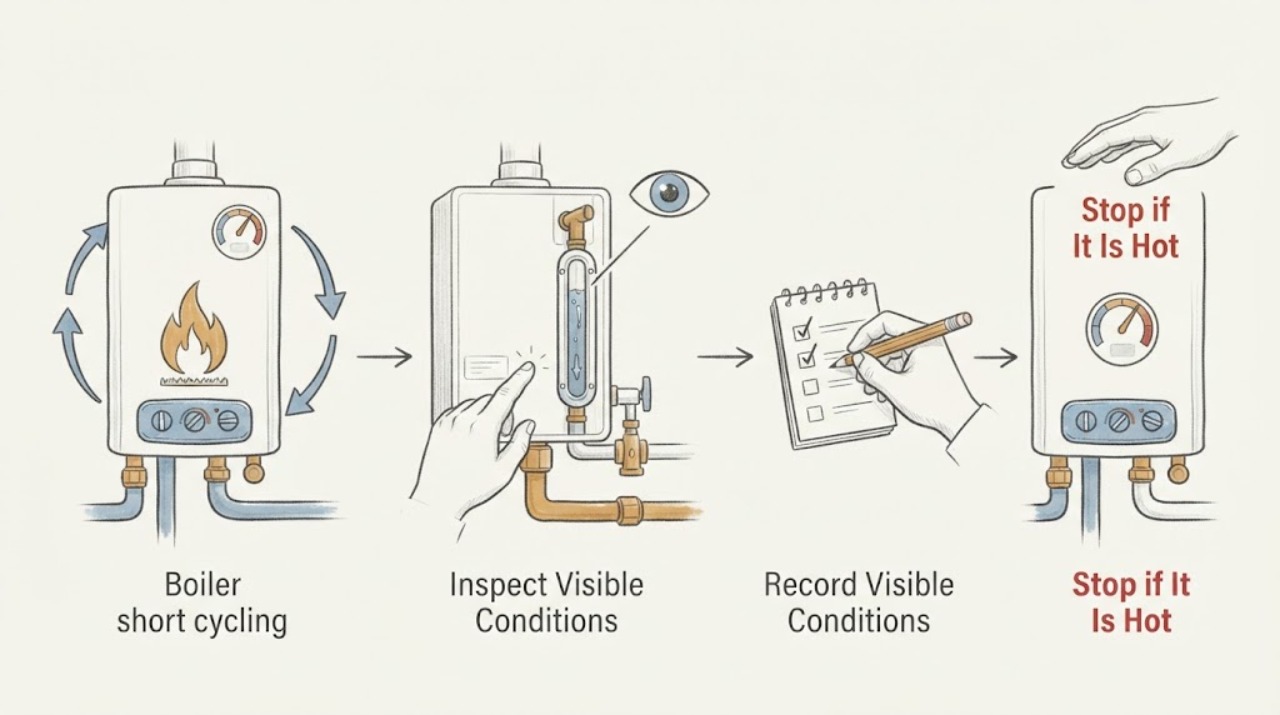
First confirm the pattern: a boiler that repeatedly fires and stops while the thermostat still calls for heat is different from normal control cycling, a scheduled change, or a model-specific anti-cycling wait. From outside the appliance, record the run and off intervals, thermostat demand, display symbols, flow or temperature reading, pressure indication, and visible leak or radiator symptoms. Do not remove the casing, adjust gas or combustion settings, change electrical wiring, open the pressure system, or repeatedly reset the boiler. A persistent short-cycle pattern needs a qualified boiler technician because circulation, sensor, control, sizing, or safety causes cannot be separated safely by observation alone.
Work through in order
Diagnostic checks
Use only checks that match the exact appliance or system and its official guide.
-
Check 1
During a normal heating demand, observe and record the time the boiler starts, the time it stops, whether the thermostat still shows a call for heat, and whether the pattern repeats. Do not increase the setpoint repeatedly or alter the boiler controls to force a cycle.
Expected result: A boiler that stops because the thermostat demand ends or the programmed period changes may be normal control behavior. Repeated starts and stops while the demand remains, especially with uneven room temperature, support a short-cycling symptom.
Next step: Keep a short log under the same normal settings and photograph any display message. Then compare the boiler status with the temperature or pressure indication.
Stop if: Stop observing if the boiler locks out, makes unusual combustion sounds, smells of fuel, vents fumes, overheats, or the front casing becomes unusually hot.
Why this matters
Why: The relationship between burner activity and thermostat demand tells the technician whether to investigate the control signal, heat transfer, circulation, or boiler operation. It does not identify a failed component.
-
Check 2
Read the boiler's front display and visible gauge without opening the casing or changing service settings. Record the exact operating symbol, fault code, anti-cycling or standby message, flow-temperature indication, and pressure zone shown for the model.
Expected result: A model-specific anti-cycling or standby message can explain a deliberate waiting period; a fault code, temperature warning, pressure warning, or contradictory display changes the issue to a service diagnosis. A blank display may be a power or control concern rather than short cycling.
Next step: Photograph the display when the boiler is running and when it stops, and note whether the thermostat still calls for heat.
Stop if: Stop if reading the display would require opening a cover, entering a protected service menu, touching a hot surface, or overriding a safety message.
Why this matters
Why: Display wording and symbols are more useful than a generic timing rule. The technician can match the code and readings to the correct manual without guessing at gas, sensor, or pressure work.
-
Check 3
From safe accessible locations, observe the radiators or heat emitters during the same demand and note whether they warm evenly, remain cold, or heat briefly before the boiler stops. Look only for visible dampness around radiator valves or pipe connections; do not bleed, loosen, or fill anything.
Expected result: Even heat with normal demand points toward a control or boiler-output question, while cold or uneven emitters, audible flow changes, or visible dampness can indicate a circulation, air, or water-loss context. These clues are not a diagnosis.
Next step: Record which rooms or emitters are affected, the boiler run pattern, and any visible water mark. Continue with the thermostat and recent-change review.
Stop if: Stop for a hot-water leak, steam, a wet electrical area, a loose fitting, or any need to bleed a radiator or alter the heating circuit.
Why this matters
Why: The distribution pattern helps the technician decide whether to assess circulation and heat transfer as well as the boiler controls. Do not operate valves or pressure components to test the theory.
-
Check 4
Review recent changes without touching the boiler internals: thermostat replacement or relocation, new controls, radiator or pipe work, a change in heating schedule, a new extension or room, weather-compensation equipment, or a recent service visit.
Expected result: A pattern that began after a control or system change gives the technician a configuration lead. A gradual onset with no visible change, repeated fault messages, or rising and falling temperature readings may point toward sensor, circulation, sizing, or maintenance causes.
Next step: Provide the change history, model information, display photos, cycle log, and affected rooms to a qualified boiler technician.
Stop if: Stop if confirming the cause would require combustion testing, gas work, electrical measurements, casing removal, pressure adjustment, or component replacement.
Why this matters
Why: Timing narrows the service conversation but does not justify changing settings or replacing a thermostat, sensor, or pump based on symptoms alone.
Use your observations
Decision map
Find the observation that best matches what you see, then follow the next safe action.
-
PATH 01Next step
What you see
The boiler repeatedly starts and stops while the thermostat still calls for heat, and the pattern is not explained by a model-specific standby or anti-cycling message.
Do this next
Leave settings unchanged and arrange qualified boiler service. Provide the cycle log, display symbols, temperature or pressure indications, and affected rooms; do not reset repeatedly or open the appliance.
-
PATH 02Next step
What you see
Radiators or heat emitters remain cold or uneven, a pressure or temperature warning appears, or visible water is present.
Do this next
Treat the pattern as a broader heating-system service issue. Keep away from hot or wet components and call a qualified technician; do not bleed, fill, drain, or adjust the system.
-
PATH 03Next step
What you see
There is a fuel odor, flue or combustion concern, electrical hazard, overheating, repeated lockout, or unusual noise.
Do this next
Stop the observation, leave the area if unsafe, and use the appropriate qualified emergency or boiler service channel. Do not operate switches, remove covers, or attempt a restart in the hazardous condition.
Helpful context
Understand the symptom
Not every stop is a fault
A thermostat can turn a boiler off as the room reaches its target, a programmer can end a scheduled demand, and some boilers display an anti-cycling or standby interval by design. Short cycling is the concerning pattern: repeated burner starts and stops while a genuine heat demand remains, often with uneven comfort or a fault/status message. The model manual and display determine what a normal wait looks like.
Keep the diagnosis outside the appliance
Use the thermostat display, boiler front display, a phone camera, and a written log from a dry standing position. Do not open the casing, touch combustion or gas parts, alter electrical connections, bleed or fill the heating circuit, change service parameters, or keep resetting a lockout. The goal is a useful pattern for a technician, not a homeowner repair.
Only after diagnosis
Potential parts
- boiler thermostat
Consider this category only if a qualified technician confirms that the thermostat or demand signal is faulty or incompatible with the boiler controls.
Match the boiler, control protocol, wiring configuration, and system design with professional confirmation; do not replace or rewire a thermostat from symptoms alone. - boiler temperature sensor
Consider this category only after professional testing confirms a failed or inaccurate temperature sensor rather than a circulation, control, or heat-transfer problem.
Confirm the exact boiler model, sensor type, connection, and installation procedure. Sensor access and testing may involve hot, gas, electrical, or pressurized components. - boiler circulator pump
Consider this category only if a qualified technician diagnoses inadequate circulation and confirms that the pump is the cause and the replacement is appropriate.
Match system design, pump curve, electrical supply, connections, and boiler requirements with the technician; do not open the heating circuit or replace a pump as a homeowner diagnosis.
When checks do not resolve it
Need a professional?
Call a qualified boiler or HVAC technician for persistent short cycling, repeated fault or anti-cycling messages, uneven heat, temperature or pressure warnings, visible leaks, or a pattern that began after control or heating-system work. Use emergency service for fuel odor, fumes, electrical danger, overheating, or unsafe combustion symptoms.
Have this ready
- Provide the boiler make and model if safely visible, cycle start and stop times, thermostat demand status, display photos and exact codes, visible gauge readings, affected rooms or radiators, leak evidence, and recent service or control changes. State that the casing was not opened and no gas, combustion, electrical, or pressure-system work was attempted.
Common questions
FAQ
Is every boiler stop short cycling?
No. A thermostat ending its demand, a programmer changing schedule, or a model-specific anti-cycling wait can be normal. Short cycling is repeated starts and stops while a genuine demand remains; record the pattern and display status for a technician.
Can I replace the thermostat to stop boiler short cycling?
Do not replace or rewire the thermostat based on the symptom alone. The cause can involve controls, temperature sensing, circulation, heat transfer, sizing, or a safety response. A qualified technician should identify the fault and confirm compatibility.
Should I reset the boiler repeatedly when it cycles?
No. Repeated resets can hide fault information and do not correct gas, combustion, electrical, circulation, or pressure-system problems. Photograph the display, stop if a fault or unsafe symptom appears, and arrange qualified service.
Read the exact guide
Official sources
- What do the error symbols mean on my boiler?Worcester Bosch · The manufacturer distinguishes normal status functions from temperature-blocking, pump, and service conditions and advises arranging an engineer when abnormal status persists; symbols remain model-specific.
- ecoTEC plus Operating InstructionsVaillant · This model-specific manual identifies display symbols for burner status, heating demand, pressure, and anti-cycling time, and directs fault conditions to a competent person; it is not a universal repair procedure.
- Boiler Controls ExplainedWorcester Bosch · The manufacturer explains that a thermostat can switch the boiler on below the target temperature and off when the room is warm, and that control systems are designed around the heating installation; this supports distinguishing demand changes from short cycling.
Community feedback
Share a repair observation
Share a plain-text repair observation. Accepted observations are published automatically; this page may take a moment to update.