
On this page
Start here
Quick answer
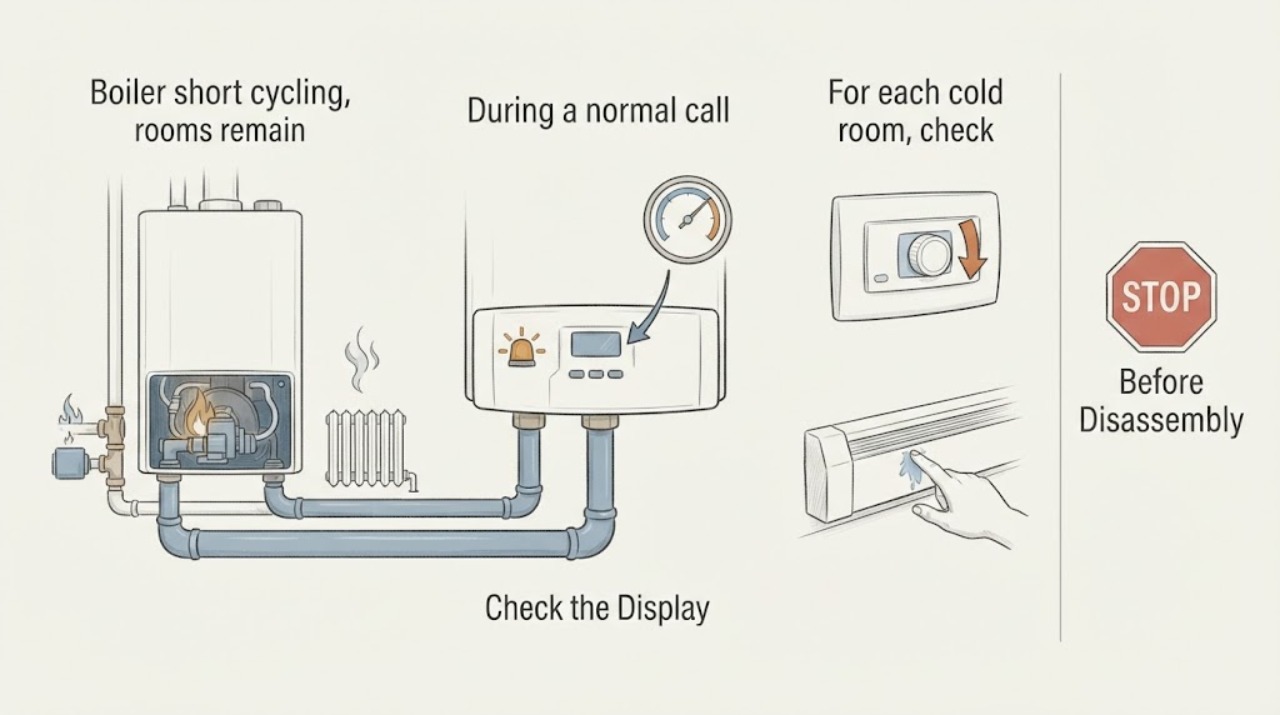
A boiler that fires briefly, shuts off, and restarts while rooms remain cold is not simply a thermostat problem. Short cycling can occur when the boiler's available output is too large for the active heating load, when a small zone reaches its boiler temperature quickly, or when circulation, zoning, sensors, controls, or a fault prevents heat from reaching the rooms. Watch the pattern without opening the boiler: confirm that the thermostat is calling, note whether all zones or one room is cold, read the pressure and display, and check only the visible radiator or zone settings. Do not change gas, combustion, pump, wiring, advanced control, or safety settings. If the boiler overheats, shows a recurring fault, smells of gas, leaks, or short-cycles with no heat delivery, stop and call a licensed heating professional.
Work through in order
Diagnostic checks
Use only checks that match the exact appliance or system and its official guide.
-
Check 1
During a normal call for heat, watch the boiler's visible status and note how long it fires before stopping, how soon it restarts, whether the circulator continues, and whether the room temperature rises at all; do not remove the casing.
Expected result: The burner or heat call ends quickly and repeats while the thermostat still calls, the boiler runs continuously, or the display shows a fault or high-temperature condition.
Next step: Record the pattern and display message for the heating professional. Do not repeatedly reset the appliance, change service parameters, or attempt to keep the burner running.
Why this matters
Why: Repeated brief firing with an ongoing call supports short cycling. Continuous operation points elsewhere, while a fault or high-temperature shutdown moves the problem into a professional safety and controls diagnosis rather than a comfort adjustment.
-
Check 2
Check the ordinary thermostat or controller settings and schedule, confirm that the affected heating zones are actually calling for heat, and note whether the problem follows one zone or occurs throughout the home.
Expected result: The schedule or mode is off, the thermostat is satisfied despite a cold room, one zone calls while others are warm, or multiple zones call while the boiler cycles.
Next step: Correct only a clearly incorrect user setting, then observe one normal heat call. If the thermostat is inaccurate, the call does not reach the boiler, or several zones remain cold, arrange professional diagnosis instead of changing wiring or advanced settings.
Why this matters
Why: A disabled schedule, wrong mode, or thermostat location can imitate a boiler fault. One-zone behavior makes a local valve, air, flow, or zone-control issue more likely. Multiple calling zones with short cycles makes boiler-to-load matching, modulation, circulation, or system control more likely.
-
Check 3
For each cold room, check only the visible radiator or baseboard user valve position and compare its temperature with a nearby warm room; do not force a stuck valve or loosen any fitting.
Expected result: One radiator is cold while others heat, the top is cooler than the bottom, an entire zone is cold, or all emitters warm briefly and then cool together.
Next step: Use the appliance or radiator manual for ordinary user adjustments only. If a valve is stuck, bleeding would lower system pressure, or a whole zone lacks flow, call a heating professional rather than opening fittings or altering the pump.
Why this matters
Why: One cold emitter points toward a local valve, air, or flow restriction. A top-cold radiator can contain air, while an entire cold zone suggests a zone valve, pump, thermostat, or distribution issue. All emitters cooling together while the boiler restarts points back toward system-level cycling or control behavior.
-
Check 4
Read the boiler's pressure gauge or digital display in the state specified by the manual and look for visible water around accessible radiator valves, exposed pipe joints, or below the appliance without opening the casing.
Expected result: Pressure is outside the manual's normal range, pressure changes sharply as the boiler heats, water or corrosion is visible, or the gauge is stable and no leak is seen.
Next step: Do not keep adding water, bleed radiators to chase a pressure reading, or tighten a heating joint as a test. Photograph the gauge and leak clues and call a licensed heating professional for an abnormal reading or any leak.
Why this matters
Why: Abnormal or unstable pressure, visible water, or corrosion can prevent reliable circulation and can cause the boiler to stop or cycle. Stable pressure with no visible leak makes sizing, controls, circulation, or local heat delivery more likely, but it does not rule out a concealed fault.
-
Check 5
Note the outdoor condition and active heating load when the cycling occurs: mild weather or one small zone, very cold weather with many zones, or every condition; record whether rooms are cold near one zone or across the whole home.
Expected result: Short cycling occurs mainly during mild weather or a small call, occurs even when many rooms call, or occurs with one persistently cold room despite other rooms heating.
Next step: Give the professional the weather, number of calling zones, cycle pattern, and room temperatures. Do not change burner input, outdoor-reset parameters, differential settings, or pump speeds unless directed through the exact service procedure by a qualified professional.
Why this matters
Why: Cycling at low demand can expose a boiler whose minimum output or water volume does not match the active load. Cycling under a large demand makes a simple oversizing explanation less complete and increases suspicion of circulation, controls, sensors, or a fault. A single cold room favors a local distribution problem.
-
Check 6
Check the boiler manual or visible rating plate for the model and record any error code, warning light, unusual noise, smell, or condensate issue; keep the appliance operating only in its normal user mode.
Expected result: The boiler has a recurring error, unusual combustion or mechanical noise, a gas smell, exhaust concern, water leak, or no visible warning and normal user controls.
Next step: For gas smell, smoke, exhaust concern, active leak, overheating, or repeated lockout, stop using the appliance and follow local emergency or gas-safety procedures. Otherwise provide the model and pattern to a licensed heating professional; do not open the casing or bypass a safety control.
Why this matters
Why: A recurring warning or safety symptom can cause cycling and cold rooms but requires appliance diagnosis. A normal display does not clear the boiler: an undersized pump, blocked flow path, sensor problem, or load mismatch can be present without a user-facing code.
Use your observations
Decision map
Find the observation that best matches what you see, then follow the next safe action.
-
PATH 01Next step
What you see
Do this next
Stop changing settings and arrange a licensed heating-system assessment that includes load matching, flow, sensors, zone controls, and boiler operating data. Do not adjust gas input, pump wiring, or service parameters yourself.
-
PATH 02Next step
What you see
Do this next
Ask a qualified heating professional to evaluate modulation, water volume, zoning, and sizing. Continue only with ordinary thermostat use; do not force longer cycles by changing high-limit or anti-cycle settings.
-
PATH 03Next step
What you see
Do this next
Check only the visible user valve and thermostat setting. If the emitter remains cold, the valve is stuck, or the whole zone is affected, arrange a heating professional to assess flow and controls rather than opening fittings.
-
PATH 04Next step
What you see
Do this next
Stop repeated resets and refills, keep clear of hot water, and call a licensed heating professional. Do not loosen fittings, bleed the system to change pressure, or open the boiler casing.
-
PATH 05Next step
What you see
Do this next
Stop using the boiler and follow local gas, fire, or emergency procedures for immediate danger. Keep people away from the appliance, do not touch wet electrical equipment, and arrange licensed professional service; do not bypass a safety control.
Helpful context
Understand the symptom
Short cycling and cold rooms are two linked clues
Short cycling is repeated firing followed by shutdown before the home has become comfortable. A boiler may satisfy its water-temperature control quickly even though the active rooms still need heat, especially when only a small zone is calling or the boiler is larger than the current load. That explains the rapid starts and stops, but it does not prove the boiler is oversized: restricted flow, a closed zone valve, trapped air, a sensor or thermostat issue, and a fault can produce a similar complaint. Diagnose both the cycle and the missing heat.
Keep user checks outside the boiler casing
The safe homeowner evidence is the thermostat call, the boiler's visible display and gauge, radiator or zone-valve positions, and the temperature pattern in each room. Boiler sizing, minimum firing rate, pump capacity, sensor calibration, combustion, and control parameters require an appropriately qualified heating professional. Repeatedly resetting the boiler or changing an advanced setting can hide the diagnostic pattern and may create a safety problem.
Only after diagnosis
Potential parts
- hydronic zone valve or circulator
Consider this part class only when a professional confirms a local zone or circulation component is failing and is the reason one or more rooms remain cold.
Confirm the system type, flow requirements, voltage, pipe connections, control sequence, and manufacturer's specifications before ordering; do not infer a replacement from appearance. - boiler temperature or outdoor sensor
Consider this only after a qualified technician confirms an inaccurate or failed sensor is causing premature shutdown or abnormal cycling.
Sensor characteristics, wiring, mounting, and controller compatibility are model-specific; installation and calibration should be performed by a qualified professional. - boiler control or modulation component
Consider this only when professional diagnosis identifies a control or modulation fault rather than a load-sizing or circulation problem.
Use the exact appliance model and approved service documentation; do not substitute a generic control or change combustion settings.
When checks do not resolve it
Need a professional?
Call a licensed heating professional when short cycling continues while the thermostat calls, rooms remain cold despite normal user settings, several zones are affected, pressure is abnormal, a valve or pump may be restricted, or the boiler needs any internal or advanced-control work. Request an assessment of boiler sizing, minimum firing rate or modulation, water volume, circulation, zone controls, sensors, and heat distribution rather than a repeated reset. Stop using the appliance and follow local emergency or gas-safety procedures for gas smell, smoke, exhaust concern, overheating, active leaks, electrical burning odor, or repeated lockout. Do not open the casing, alter gas or electrical connections, bypass safeties, or adjust service parameters.
Common questions
FAQ
What does boiler short cycling look like?
The boiler repeatedly fires and shuts down in brief intervals while a thermostat or zone still calls for heat. Record the pattern and whether the rooms warm; do not repeatedly reset the boiler or alter service settings to force a longer run.
Why can rooms stay cold if the boiler keeps cycling?
The boiler may reach its internal temperature condition before enough heat reaches the rooms, especially with a small active zone or a boiler whose minimum output exceeds the current load. A closed valve, restricted circulation, sensor, control, pressure, or other fault can also interrupt heat delivery.
Can an oversized boiler cause short cycling?
Yes, an output that is too large for the active load can satisfy the heating condition quickly and restart frequently. Confirming sizing requires a professional load and system assessment; do not change burner input or advanced controls yourself.
When is short cycling an urgent boiler problem?
Treat gas smell, smoke, exhaust concern, overheating, active leaks, electrical burning odor, or repeated lockout as urgent. Stop using the appliance, follow local emergency or gas-safety procedures, and contact a licensed heating professional; do not bypass a safety control.
Read the exact guide
Official sources
- Minimize Boiler Short Cycling LossesU.S. Department of Energy, Energy Efficiency & Renewable Energy, Advanced Manufacturing Office · Supports the definition of repeated brief firing, the oversized or low-load mechanism, and professional evaluation of load and boiler flexibility.
- Purchasing Energy-Efficient BoilersU.S. Department of Energy, Federal Energy Management Program · Supports the professional branch for boiler-to-load matching, modulation, low-load operation, and system-level control evaluation.
- Boiler Control Panels (BCP)Weil-McLain · Supports treating sensors, staged controls, purge or anti-cycling logic, and multi-zone control as model-specific professional diagnostic areas.
- HVAC High-Efficiency BoilersU.S. Department of Energy Building Science Education · Supports linking boiler operation to radiator distribution, keeping sizing and burner changes professional, and distinguishing system delivery from burner behavior.
- Operation and Maintenance Best PracticesENERGY STAR · Supports checking ordinary schedules and control behavior before attributing cold rooms solely to boiler hardware.
- Vitocrossal 300, CU3A: The Evolution of the Condensing BoilerViessmann US · Supports the low-load or small-zone branch and the distinction between short cycling from load mismatch and a repairable component fault.
Community feedback
Share a repair observation
Share a plain-text repair observation. Accepted observations are published automatically; this page may take a moment to update.