
On this page
Start here
Quick answer
Buderus boiler short cycling means the burner or boiler starts and stops repeatedly before the home has a stable heat demand. First establish whether the Buderus thermostat is actually ending the call for heat, or whether the thermostat continues calling while the boiler shuts down and restarts. A thermostat near a draft, heat source, sunlight, or another abnormal location can misread room temperature; a call that remains active while the boiler cycles points instead toward boiler limit, water flow, zone heat transfer, sizing, control, or a fault condition. From the user-accessible controls, record the thermostat setting and room temperature, burner and pump behavior, boiler display or fault code, pressure and temperature shown by the normal gauges, and whether radiators or zones are receiving heat. Do not jumper thermostat terminals, change anti-cycle service settings, open the combustion cabinet, bleed or refill a sealed system by guesswork, or work on gas, electrical, flue, or refrigerant components. Repeated rapid cycling, lockouts, overheating, unusual combustion sounds or smells, a gas odor, or a thermostat call that does not match boiler behavior needs qualified Buderus/Bosch heating service.
Before you begin
Safety first
- This article supports observing the thermostat display and call, documenting boiler status and normal gauges, noting room and zone heat transfer, and reading the model manual. Do not jumper or rewire the thermostat, access installer settings, open the boiler cabinet, perform gas, electrical, combustion, flue, or hydronic work, or bypass a safety control.
Work through in order
Diagnostic checks
Use only checks that match the exact appliance or system and its official guide.
-
Check 1
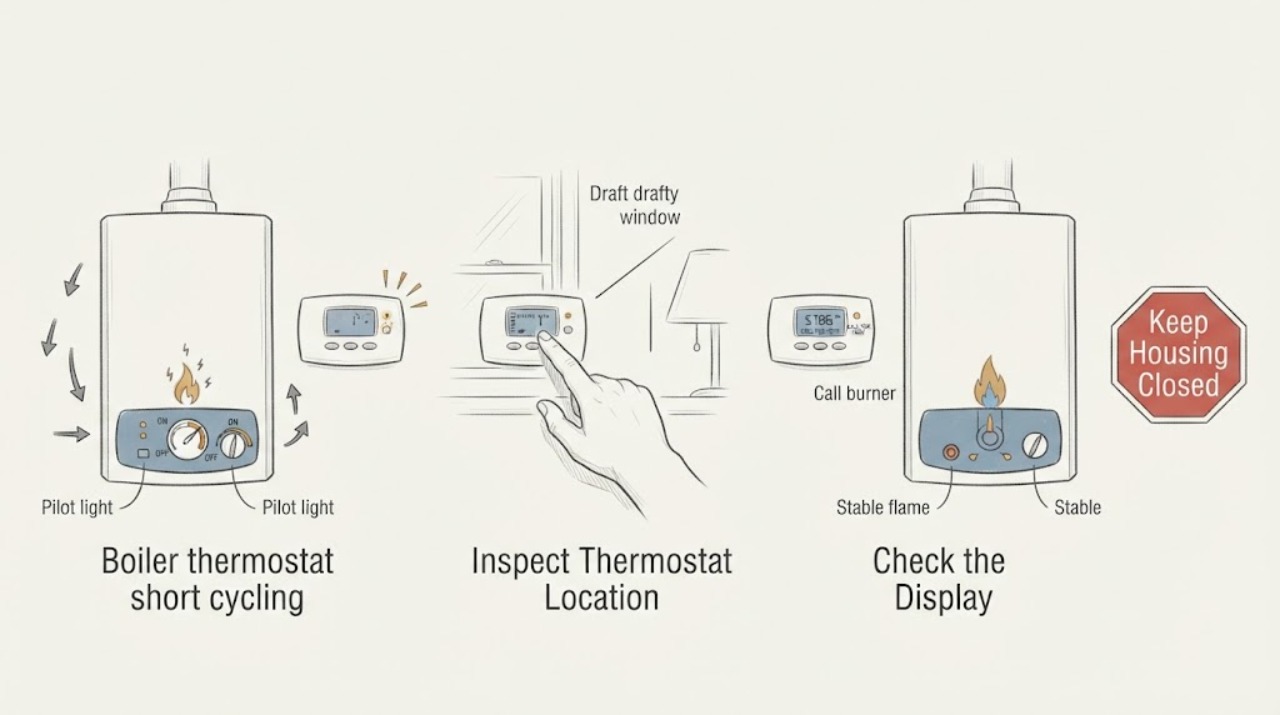
During a normal call for heat, record the Buderus thermostat's room temperature, target setting, and heat-call indication together with the boiler's burner or heat indicator, pump sound, displayed temperature, and the approximate time between burner starts and stops. Do not open the boiler or touch wiring.
Expected result: The thermostat call ends before the boiler stops, the thermostat keeps calling while the burner stops and restarts, or the boiler stops with a fault, lockout, unusual sound, smell, or high-temperature indication.
Next step: If there is a gas odor, combustion smell, smoke, unusual flame sound, overheating, or lockout, stop using the boiler and seek appropriate emergency or qualified heating help. Otherwise keep a timing record and continue with only the external thermostat and heating-zone observations.
Stop if: Do not force a heat call, jumper terminals, reset a lockout repeatedly, or continue operation after a gas odor, smoke, combustion concern, or overheating indication.
Why this matters
Why: A call that ends at the target can be normal control behavior. A continuing call with repeated burner shutdowns shifts suspicion toward boiler limit, water flow, zone transfer, anti-cycle control, sizing, or a fault; a fault or safety symptom is not ordinary cycling.
-
Check 2
From ordinary access, inspect the thermostat location and display. Note drafts, direct sunlight, a nearby radiator, appliance, supply register, door, exterior wall, blocked air openings, loose cover, low-battery indication if applicable, schedule change, or a temperature reading that does not match the room.
Expected result: The thermostat is exposed to a local heat or draft source, its reading changes when the room does not, the display or schedule is abnormal, or the location and reading appear stable.
Next step: Remove only loose objects that block the thermostat and document the reading and schedule; use the exact Buderus thermostat manual for any permitted user setting or battery step. If the thermostat remains inaccurate or toggles the call unusually, arrange control service rather than opening it or changing wiring.
Stop if: Do not relocate a wired thermostat, remove its cover, disconnect wires, or connect a jumper as a user test.
Why this matters
Why: A local condition or incorrect reading can end or reissue a heat call too early, making the thermostat side of the system more likely. A stable thermostat with a call held continuously makes a boiler, zone, control, or flow explanation more likely.
-
Check 3
Read and photograph the Buderus boiler display, normal user-facing temperature and pressure gauges, status lights, and any fault or service message without opening the cabinet. Record whether the boiler reaches a displayed target or limit before the burner stops and whether the display returns to normal afterward.
Expected result: The boiler reaches its displayed target while the thermostat still calls, pressure or temperature is outside the manual's normal band, a fault or lockout appears, or readings remain normal while cycling continues.
Next step: Record the exact code and model manual reference for service. Keep the boiler out of service for a repeated fault, abnormal pressure or temperature, or lockout; do not change installer parameters or add water based only on a generic article.
Stop if: Do not remove covers, measure sensors or terminals, alter control parameters, bypass a limit, or refill, drain, or pressurize the heating system without exact professional guidance.
Why this matters
Why: A boiler reaching its own target while the room still calls can indicate that heat is not transferring to active zones or that control and sizing need assessment. Abnormal readings or a code may indicate a limit, sensor, pressure, flow, or safety issue; normal readings do not prove the thermostat is at fault.
-
Check 4
With the boiler operating normally and without touching hot pipes or valves, note which zones or rooms are calling, whether radiators or radiant-heating areas warm evenly, and whether any thermostat calls while all associated emitters remain cool. Look only for obvious user-accessible obstructions or a visible zone status indicator.
Expected result: The calling zone receives heat normally, the boiler heats briefly but the calling zone stays cool, several zones are closed or inactive, or only one small zone is requesting heat when cycling occurs.
Next step: Record the affected rooms, zone indicators, and timing for a qualified heating technician. Do not turn service valves, bleed radiators, alter pump controls, or open the boiler unless the exact Buderus system instructions explicitly assign that task to the user.
Stop if: Do not touch hot surfaces, loosen fittings, bleed or drain the system, force a valve, or operate a zone with a leak or unusual pressure.
Why this matters
Why: Poor heat transfer can let the boiler reach its limit while the room remains below target. A low-demand zone, closed valve, pump or flow issue, air, or zone-control fault can mimic a thermostat short cycle; the user cannot identify the exact hydraulic cause from surface temperature alone.
-
Check 5
Record recent changes that alter heat demand or control logic: a thermostat replacement, schedule change, outdoor sensor change, added or removed zone, weather change, insulation work, radiator closure, boiler installation, or service visit. Compare the current thermostat and boiler settings with the exact Buderus documentation, leaving installer-only anti-cycle and differential settings unchanged.
Expected result: Short cycling began after a control, wiring, zoning, or building change, or it occurs without any recent change and across normal heating demand.
Next step: Give the timeline and unchanged settings to the installer or qualified heating technician. Do not copy anti-cycle values from another Buderus or Bosch model or make repeated setpoint changes to mask the symptom.
Stop if: Do not access installer menus, change burner, pump, outdoor-reset, anti-cycle, differential, or safety settings, or alter thermostat wiring.
Why this matters
Why: A commissioning or thermostat-control mismatch can create repeated heat calls or a boiler that is too large for the active load. A stable long-term system that suddenly short cycles makes a new fault, sensor issue, flow change, or electrical/control problem more important.
-
Check 6
Prepare a service record with the Buderus model, fuel type, thermostat model, heat-call pattern, burner and pump timing, displayed temperatures and pressures, fault codes, affected zones, recent work, and any gas, flue, electrical, water, or combustion symptom. Do not perform live or combustion testing.
Expected result: The boiler cycles repeatedly with a continuing call, the home stays cold, a fault or lockout returns, or there is a gas, flue, electrical, water, or overheating concern; alternatively, the thermostat ends the call at the target and the system heats normally.
Next step: Keep the boiler out of service for safety symptoms or recurring faults and arrange qualified Buderus/Bosch heating service. For gas odor, smoke, suspected flue spillage, or fire risk, leave the area as appropriate and contact emergency or gas assistance from a safe location.
Stop if: Do not test combustion, gas pressure, electrical terminals, flue draft, safety switches, or sealed-system components, and do not bypass a lockout or safety control.
Why this matters
Why: A continuing call plus repeated boiler shutdowns needs boiler and system diagnosis rather than a thermostat replacement by guesswork. A normal call ending at target with stable heat is less consistent with a fault, but a newly changing pattern should still be monitored.
Use your observations
Decision map
Find the observation that best matches what you see, then follow the next safe action.
-
PATH 01Safety boundary
What you see
The thermostat's heat call turns on and off rapidly while the room reading is near its target or changes when exposed to a draft, sunlight, nearby heat source, schedule change, or inaccurate sensor.
Do this next
Document the location, display, schedule, and call timing and request qualified thermostat or control diagnosis. Use only model-documented user settings and do not open or rewire the thermostat.
Why this path and its safety boundary
Why it matters: The control side is more likely to be causing repeated calls than a boiler that is independently shutting down; Buderus describes the thermostat as comparing room temperature with its target and signaling the boiler.
Safety stop: Do not relocate a wired control, jumper terminals, or use repeated setpoint changes as a wiring test.
-
PATH 02Safety boundary
What you see
The thermostat continues calling for heat, but the boiler reaches its displayed target or limit and the burner stops before the rooms reach temperature.
Do this next
Arrange qualified boiler and hydronic-system diagnosis and provide boiler readings, zone behavior, and timing. Do not raise limits or change anti-cycle settings to force longer firing.
Why this path and its safety boundary
Why it matters: Heat may not be transferring through the active zones as expected, or boiler output, flow, sensor, control, and system sizing may not match the demand. This is not proof that the thermostat is defective.
Safety stop: Do not bypass a high-limit control, alter installer parameters, drain or refill the system, or touch hot components.
-
PATH 03Safety boundary
What you see
A thermostat calls continuously while the associated radiators or radiant area stay cool, several zones are inactive, or only a small zone requests heat while the boiler cycles.
Do this next
Record the rooms, zone indicators, and safe surface observations for a qualified heating technician. Leave valves, pumps, vents, and boiler controls unchanged unless the exact system manual assigns a user check.
Why this path and its safety boundary
Why it matters: A zone valve, pump, air, flow, control, or low-demand distribution condition may be preventing heat from leaving the boiler, so the thermostat symptom can be downstream of a system problem.
Safety stop: Do not bleed, drain, loosen, force, or adjust hydronic components or touch hot pipes and fittings.
-
PATH 04Safety boundary
What you see
Short cycling began after thermostat, outdoor sensor, zoning, wiring, building-load, or boiler changes, or persists at low demand despite normal thermostat behavior and zone heat transfer.
Do this next
Have the installer or qualified heating professional review the heat load, modulation, sensor inputs, zone control, and model-specific anti-cycle configuration. Do not copy settings from another appliance.
Why this path and its safety boundary
Why it matters: A commissioning mismatch, sensor or control configuration, oversized output, or inappropriate anti-cycle behavior is possible; DOE notes that cycling losses and part-load operation are system-design concerns.
Safety stop: Do not access professional menus, change differential or anti-cycle settings, or alter burner and pump controls as an experiment.
-
PATH 05Safety boundary
What you see
A fault or lockout returns, the boiler shows abnormal temperature or pressure, the burner has an unusual combustion sound, there is a gas or flue odor, smoke, water leak, or electrical hazard.
Do this next
Stop using the boiler and arrange qualified Buderus/Bosch heating service. For gas odor, smoke, suspected flue spillage, or fire risk, leave the area as appropriate and contact the relevant emergency or gas assistance from a safe location.
Why this path and its safety boundary
Why it matters: The boiler is reporting or showing a possible safety, combustion, electrical, pressure, or component fault; repeated cycling is no longer a thermostat-only troubleshooting problem.
Safety stop: Do not reset a lockout repeatedly, open the combustion cabinet, test gas or electrical circuits, or bypass a safety control.
Helpful context
Understand the symptom
First separate a thermostat call from a boiler shutdown
The thermostat can end a heat call because the room has reached its target, while the boiler can also stop firing because its own water-temperature or protection control has been satisfied. Short cycling is more concerning when the thermostat still requests heat, the room remains cool, and the burner repeatedly stops and restarts. Note the thermostat state and boiler state at the same time rather than assuming the thermostat is the failed part.
Buderus and Bosch controls are model-specific
Buderus and Bosch Home Comfort systems share related control concepts, but the installed boiler, thermostat, outdoor sensor, zone controls, fuel, and local wiring determine the procedure. A Bosch manual's anti-cycle setting or diagnostic step is not permission to copy a setting into a Buderus control. Use the exact model manual for labels and leave installer-level settings unchanged.
Short cycling can be a distribution problem, not just a thermostat problem
If the boiler reaches its internal limit while rooms are still calling for heat, heat may not be leaving the boiler through the active zones as expected. Closed or restricted zone valves, air, a pump or flow issue, a low-demand zone, sizing, sensor behavior, or control configuration can produce similar observations. These are diagnosis and commissioning questions for a qualified heating professional, not a reason to bypass the thermostat or safety controls.
Safety boundary
Stop conditions
- Stop using the boiler for a gas odor, suspected flue-gas spillage, smoke, unusual combustion sound, fire risk, water leak near electrical parts, overheating, or a recurring safety lockout.
- Do not jumper thermostat terminals, access installer menus, change anti-cycle or differential settings, bypass a high-limit or other safety control, or copy values from another Buderus or Bosch model.
- Do not open the combustion cabinet, test live electrical or gas parts, measure combustion or flue draft, or alter gas, burner, sensor, wiring, pump, or control components.
- Do not bleed, drain, refill, pressurize, or loosen hydronic fittings as a generic response to short cycling; follow only exact model instructions or qualified service direction.
- Arrange qualified diagnosis when the thermostat continues calling while the boiler stops, rooms remain cold, zone heat transfer is poor, a fault returns, or short cycling persists after ordinary user settings and observations are documented.
Only after diagnosis
Potential parts
- Buderus thermostat or room-temperature sensor
Consider this category only if qualified testing confirms that the thermostat or sensor is misreading room temperature or issuing an unstable heat call after placement and setting checks.
Confirm the exact Buderus boiler, control family, wiring, communication protocol, and manufacturer's fit information; do not substitute or rewire a thermostat by appearance. - Buderus boiler temperature or outdoor sensor
Consider this category only after qualified diagnosis confirms that a sensor reading is inconsistent with the boiler or outdoor condition and is causing control or limit behavior.
Confirm the exact Buderus model and sensor specification; do not access live terminals or change sensor configuration as a user test. - Buderus zone valve, pump, or flow component
Consider this category only when a qualified technician confirms that heat is not transferring through an active zone or that a pump, valve, air, or flow fault is causing the boiler to reach its limit.
Confirm the exact hydronic system, zone arrangement, temperature ratings, and manufacturer's fit information; do not force a valve or alter a pump setting by guesswork. - Buderus boiler control or anti-cycle component
Consider this category only after qualified diagnosis rules out thermostat, sensor, demand, flow, and zone causes and identifies a control or protection fault.
Confirm the exact boiler model, firmware or control family, fuel configuration, and manufacturer's fit information; service settings are not interchangeable.
When checks do not resolve it
Need a professional?
Arrange qualified Buderus/Bosch heating service when the thermostat continues calling while the boiler repeatedly stops, the rooms remain cold, a fault or lockout returns, the boiler reaches a limit before heat reaches the zones, the thermostat reading or call is unstable, or cycling began after control, zoning, wiring, or installation changes. Use emergency or gas assistance from a safe location for gas odor, smoke, suspected flue spillage, or fire risk.
Safety scope: This article supports observing the thermostat display and call, documenting boiler status and normal gauges, noting room and zone heat transfer, and reading the model manual. Do not jumper or rewire the thermostat, access installer settings, open the boiler cabinet, perform gas, electrical, combustion, flue, or hydronic work, or bypass a safety control.
Common questions
FAQ
What is short cycling on a Buderus boiler?
It is repeated burner or boiler starts and stops before the home's heat demand is stable. First check whether the thermostat itself ends the heat call or whether it continues calling while the boiler stops. The second pattern points toward boiler limit, flow, zones, control, sizing, or a fault rather than proving the thermostat is bad.
Can a Buderus thermostat cause boiler short cycling?
Yes, a thermostat can issue unstable calls if its reading is affected by a local draft, heat source, sunlight, schedule, sensor, or wiring problem. Buderus describes the thermostat as measuring room temperature and signaling the boiler. Document the display and call timing, but do not open or rewire the thermostat.
Why does my Buderus boiler cycle while the thermostat is still calling?
The boiler may be reaching its own temperature limit before heat transfers through the active zones, or there may be a flow, pump, valve, sensor, control, sizing, or combustion issue. Record the boiler display, normal gauges, zone response, and timing and arrange qualified heating diagnosis.
Should I change the Buderus anti-cycle setting?
No. Bosch Home Comfort documentation treats anti-cycle behavior and related differentials as service functions, and settings vary by appliance and system. Changing them by guesswork can hide a flow, sensor, control, or safety problem. Have a qualified technician review the exact Buderus model and system.
When is boiler short cycling an emergency?
Stop using the boiler and seek appropriate help for a gas odor, suspected flue-gas spillage, smoke, unusual combustion sound, fire risk, water leaking near electrical parts, overheating, or a recurring safety lockout. Repeated cycling without those signs still needs qualified diagnosis when the home remains cold or the thermostat continues calling.
Read the exact guide
Official sources
- Condensing Gas Boilers TroubleshootingBosch Home Comfort · Official Bosch Home Comfort guidance for listed Bosch boiler models; used for related control concepts only, not as a substitute for the exact Buderus model manual.
- Purchasing Energy-Efficient BoilersU.S. Department of Energy · General boiler-system guidance used to explain why repeated cycling is a commissioning or sizing concern; the Buderus boiler and heating professional control the repair.
- untitledBosch Home Comfort · Official Bosch Greenstar manual used for the general anti-cycle safety boundary; exact Buderus model settings and qualified installer procedures differ.
- Choisir, installer et régler votre thermostatBuderus · Official Buderus thermostat guidance in French; product families and functions vary by market, so the installed model manual controls exact settings and wiring.
Community feedback
Share a repair observation
Share a plain-text repair observation. Accepted observations are published automatically; this page may take a moment to update.