
On this page
Start here
Quick answer
Treat a noisy boiler circulator pump as a diagnostic clue, not a part to open or adjust. From a dry, safe position, record whether the sound is a hum, rattle, gurgle, squeal, or water-flow noise; when it starts; and whether the boiler still heats normally. Look only at the external display, visible gauge, and visible leaks without touching hot or pressurized components. Air, low inlet pressure, restricted flow, contamination, incorrect sizing, or worn bearings can sound similar. Stop and call a qualified boiler technician for any leak, abnormal pressure indication, overheating, gas or electrical warning, loss of heat, or noise that persists.
Before you begin
Safety first
- This is an observation-only guide for a pressurized hot-water boiler. Do not open covers, touch hot or pressurized parts, open or close valves, bleed or fill the system, adjust pressure, work on gas or wiring, or disassemble the circulator.
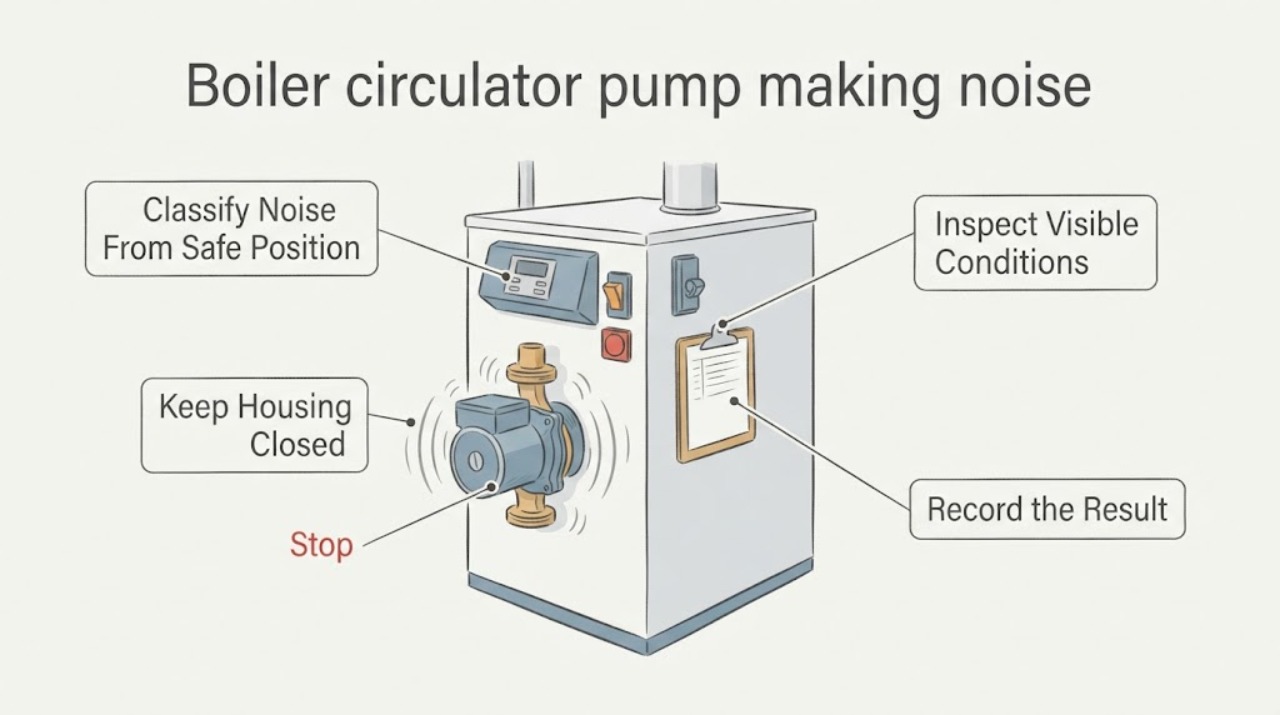
Work through in order
Diagnostic checks
Use only checks that match the exact appliance or system and its official guide.
-
Check 1
From a dry standing position away from the boiler enclosure and piping, listen only while the system is already operating normally and record the sound as hum, buzz, rattle, grinding, squeal, gurgle, or rushing water.
Expected result: Note whether the noise is continuous, starts when a heat zone calls, stops when the call ends, changes with pump speed, or comes from the pump area versus nearby pipe or radiator areas.
Next step: Make a short written description or recording from a safe distance and give the timing and apparent location to the heating technician; do not move closer to hot equipment to improve the recording.
Stop if: Stop listening and leave the area if there is a burning smell, smoke, gas odor, steam, spraying water, or a rapidly worsening mechanical sound.
Why this matters
Why: A sound tied to circulation may involve air or flow, while rattling or grinding can indicate mechanical wear or debris. A noise that is actually louder in piping or emitters may not originate in the pump.
-
Check 2
Without touching the circulator, look at its exterior and any manufacturer-provided indicator or display from a safe position; compare the visible status with the boiler's normal operating state.
Expected result: Record whether an indicator is normal, flashing, showing a fault, dark when circulation is expected, or accompanied by visible condensation, seepage, corrosion, or a loose-looking external connection.
Next step: Photograph the visible status without opening a cover and include the pump and boiler identification information only if it can be read safely from the outside.
Stop if: Stop immediately for water or steam escaping, a hot electrical smell, smoke, exposed wiring, or any need to remove a cover or touch the assembly.
Why this matters
Why: A fault indication, absent expected status, or visible leakage needs professional diagnosis. A normal indicator does not rule out air, flow, or bearing problems, but it gives the technician useful context.
-
Check 3
From outside the equipment enclosure, read the boiler's visible gauge or display as a general normal, low, high, or fault indication according to its own markings; do not adjust a valve or pressure control.
Expected result: Record the displayed condition, any warning message, and whether it changes unusually while the noise is present; also look for drips or wetness on the floor without stepping into water.
Next step: Keep the boiler untouched and provide the display or gauge description and leak location to a boiler technician.
Stop if: Stop and keep clear for a rapidly changing indication, active leak, steam, a flooded area, or water near electrical equipment.
Why this matters
Why: An abnormal pressure indication, warning, or leak can accompany air, circulation, expansion, or other system faults and cannot be safely corrected by guessing. A normal-looking display does not authorize opening or servicing the pressurized loop.
-
Check 4
Without touching radiators, baseboards, or pipes, note whether each accessible heating zone is delivering its usual heat and whether bubbling or rushing-water sounds are heard elsewhere in the system.
Expected result: Record a normal heat response, delayed or missing heat in one zone, several cold zones, or water-flow noise in a radiator or pipe rather than at the pump.
Next step: Give the technician the affected zone names, when the sound occurs, and whether the problem is new or follows recent service or refill work.
Stop if: Stop using the system and seek prompt service if heat is lost during cold conditions, pipes hammer, or the noise is accompanied by overheating or leaking.
Why this matters
Why: Uneven heat or air-like sounds can support a system circulation or air problem, while a localized pump rattle with normal heat can support a pump or mounting issue. Neither observation identifies a safe homeowner adjustment.
-
Check 5
Review recent service or refill history and compare the noise with prior normal cycles without deliberately cycling the boiler, changing settings, or repeatedly restarting it.
Expected result: Determine whether the sound began after service, a loss of water, a long shutdown, a change in heating demand, or gradually over time, and whether it occurs on every cycle or only occasionally.
Next step: Arrange professional service if the noise recurs, persists, or affects heat, and provide the timeline and any visible status information.
Stop if: Stop all observation if the boiler trips, overheats, leaks, smells of gas, shows smoke, or makes a severe grinding or banging sound.
Why this matters
Why: A new sound after system work can help a technician investigate air, flow, or installation context; a gradually worsening rattle can support wear or obstruction. Intermittence still warrants an accurate description rather than repeated testing.
Use your observations
Decision map
Find the observation that best matches what you see, then follow the next safe action.
-
PATH 01Safety boundary
What you see
The sound is gurgling or rushing, follows a heat call, or occurs with uneven heat or air-like sounds in other emitters.
Do this next
Tell a boiler technician the sound pattern and affected zones; system inspection, venting, pressure, and flow work require professional handling.
Why this path and its safety boundary
Safety stop: Do not bleed radiators, open valves, add water, or adjust pressure as a home test.
-
PATH 02Safety boundary
What you see
The sound is a persistent rattle, grinding noise, or squeal localized near the circulator.
Do this next
Stop unnecessary operation and schedule a qualified technician to inspect the pump, mounting, bearings, and system condition.
Why this path and its safety boundary
Safety stop: Do not touch, oil, open, disassemble, or try to free the circulator.
-
PATH 03Safety boundary
What you see
The visible gauge or display is abnormal, a fault appears, or water or steam is escaping.
Do this next
Keep clear, avoid valves and controls, and request prompt professional service; use emergency help if the leak or steam threatens people or the building.
Why this path and its safety boundary
Safety stop: Do not enter standing water or approach equipment with wet electrical surroundings.
-
PATH 04Safety boundary
What you see
There is gas odor, smoke, burning smell, exposed wiring, repeated electrical trips, or evidence of overheating.
Do this next
Leave the area, follow the property's emergency and utility procedures, and obtain qualified emergency service; do not operate or reset the equipment.
Why this path and its safety boundary
Safety stop: Do not open panels, test live circuits, relight equipment, or repeatedly restart it.
-
PATH 05Safety boundary
What you see
The noise is present but there is no visible leak, warning, or loss of heat.
Do this next
Keep a dated description or recording and arrange a routine heating service visit if it persists or returns.
Why this path and its safety boundary
Safety stop: Escalate promptly if the sound changes to grinding, banging, or a severe vibration, or if any warning appears.
Helpful context
Understand the symptom
Why a circulator can be noisy
A hydronic boiler circulator moves heated water through the distribution system. Manufacturer guidance lists trapped air, flow or pressure conditions, contamination, and mechanical wear among possible causes of buzzing, rattling, or water noise. The same sound can originate in nearby piping, an air separator, a valve, or a radiator rather than in the pump itself, so location and timing matter more than guessing at a replacement part.
What is safe to observe
This check is for observation only. Do not open the boiler or pump housing, touch hot piping, bleed radiators, open or close system valves, add water, adjust pressure, change wiring, remove covers, or disassemble the circulator. Pressurized hot-water systems can burn, leak, or expose live electrical parts; setup and repair belong to a qualified heating professional.
Only after diagnosis
Potential parts
- boiler circulator pump
Consider this category only if a qualified technician confirms circulator wear, obstruction, or an incorrect pump after inspecting the complete system.
Confirm the boiler system design, pump performance requirements, connection style, fluid conditions, and exact model fitment with the technician or manufacturer. - automatic air vent
Consider this category only when professional diagnosis confirms that an air-management component is faulty or unsuitable for the system.
Do not infer compatibility from thread appearance; the system design, temperature and pressure ratings, location, and manufacturer requirements must be confirmed. - boiler pressure gauge
Consider this category only if a technician confirms that the visible gauge is inaccurate or failed and is contributing to diagnosis difficulty.
A pressure gauge is part of a pressurized system; confirm the correct range, connection, temperature suitability, and installation procedure professionally.
When checks do not resolve it
Need a professional?
Have this ready
- Provide the noise type, apparent location, cycle timing, affected zones, visible status or gauge indication, leak location, recent service or refill history, and whether the sound is getting worse.
Common questions
FAQ
Can air make a boiler circulator pump noisy?
Yes. Manufacturer guidance lists air in the pump or system as one possible cause of noise. Do not bleed or refill a pressurized system as a home test; report the sound and affected zones to a boiler technician.
Does a rattling sound mean the circulator pump must be replaced?
Not necessarily. Rattling can be associated with wear, debris, mounting, or system conditions, and nearby piping can transmit sound. A technician should identify the source before selecting a replacement.
Should I open the boiler or adjust a valve to stop the noise?
No. A boiler loop can contain hot water under pressure and the equipment can include live electrical and fuel-related components. Keep the inspection external and arrange qualified service.
When is a noisy circulator an urgent problem?
Escalate promptly for gas odor, smoke, burning smell, steam, an active leak, abnormal pressure indication, overheating, exposed wiring, severe vibration, or loss of safe heat.
Read the exact guide
Official sources
- 007e-2 ECM High-Efficiency Circulator Instruction SheetTaco Comfort Solutions · Manufacturer documentation used for general safety context; model-specific values and procedures are intentionally not applied to an unknown boiler.
- Why is the circulator pump making noise (buzzing or rattling)?Grundfos · General manufacturer troubleshooting categories; no model-specific repair instruction is assumed.
- Why is the circulator pump making noise, and what can be done about it?Grundfos · General support guidance; the article preserves the professional boundary and does not prescribe pump-setting changes.
Community feedback
Share a repair observation
Share a plain-text repair observation. Accepted observations are published automatically; this page may take a moment to update.