
On this page
Start here
Quick answer
A boiler that bangs or makes a kettle-like noise needs a pattern record, not a homeowner diagnosis. From a stable position, note whether the sound occurs at startup, shutdown, heating, or pump operation; whether it comes from the boiler cabinet, nearby pipes, or radiators; and what the existing pressure or temperature gauge shows without changing it. Gurgling or rushing can be an air or flow clue, while a bang or kettle sound during heating can be consistent with restricted flow, scale, or pressure behavior, but the same sound can have another cause. Do not bleed, drain, refill, adjust valves, open the casing, or touch gas or electrical parts. A gas smell, carbon-monoxide alarm, scorch, smoke, unusual flame, or combustion-like sound means leave the area and use emergency support; otherwise arrange qualified boiler service for a recurring or unexplained noise.
Before you begin
Safety first
- This page is limited to listening, reading existing gauges or displays, and recording safe context. A qualified heating professional must inspect, vent, drain, refill, adjust, clean, test, open, repair, or replace pressurized, fuel-burning, electrical, combustion, pump, valve, heat-exchanger, or control components.
Work through in order
Diagnostic checks
Use only checks that match the exact appliance or system and its official guide.
-
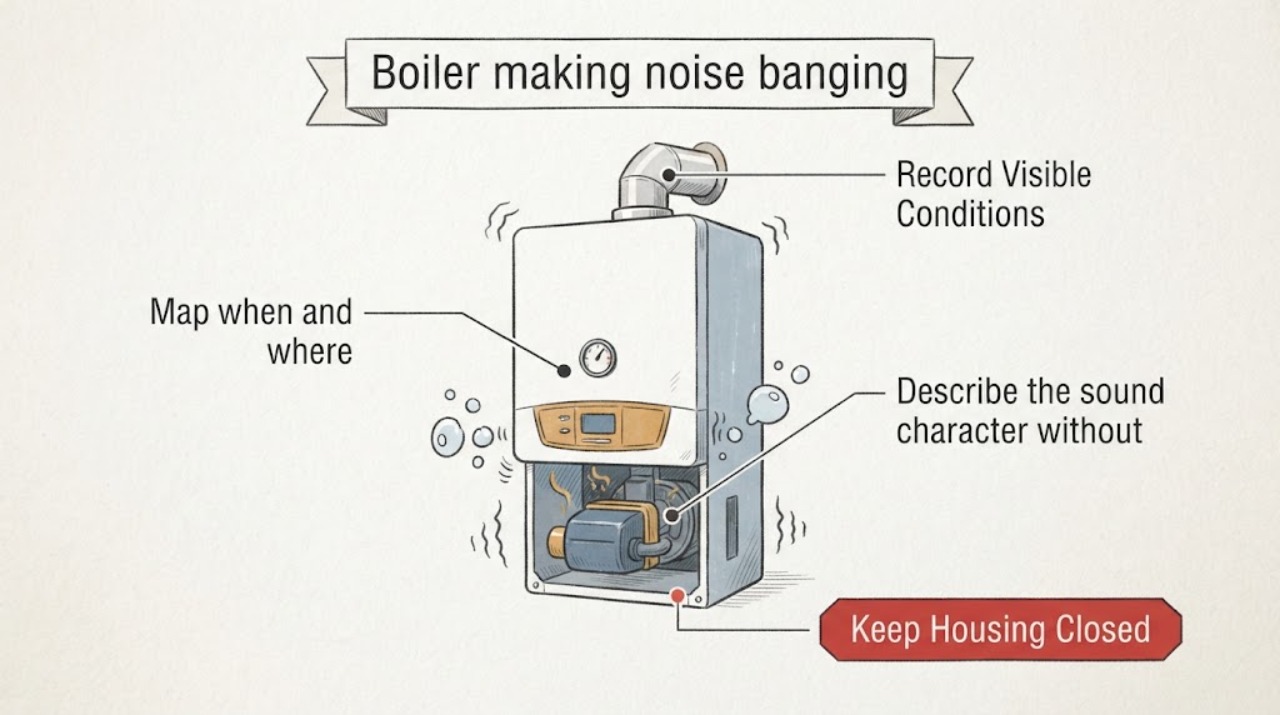
Map when and where the sound occurs
From a stable position and without touching the appliance or hot pipework, record whether the bang or kettle-like sound happens at ignition, shutdown, steady heating, pump circulation, or after a demand ends. Note whether it is loudest at the boiler cabinet, a nearby pipe, a radiator, or another room, and whether it repeats on separate ordinary heating cycles without deliberately triggering extra cycles.
Expected result: The sound is tied to ignition or shutdown, follows heating circulation, comes from pipes or radiators, occurs throughout the cycle, or cannot be located safely.
Next step: Write the timing and location in the service request and avoid repeated operation intended only to reproduce the sound.
Stop if: Stop listening and leave the area for gas odor, a carbon-monoxide alarm, smoke, scorch, unusual flame, severe vibration, or a sharp combustion-like bang.
Why this matters
Why: Ignition- or shutdown-linked noise raises a combustion or control question. A heating-cycle kettle or bang keeps flow, scale, pressure, and heat-exchanger questions open. A pipe or radiator location may indicate system flow or movement rather than a boiler-body fault; none of these observations confirms a cause.
-
Describe the sound character without opening anything
From the same safe position, describe whether the noise is a hollow gurgle, rushing or bubbling, a single knock, repeated banging, a kettle-like rumble or whistle, metallic vibration, or an ignition-like boom. Record whether it changes as the boiler warms, but do not place a hand on pipework, remove a panel, or use a tool to test vibration.
Expected result: The sound is water-like, a repeated heat-cycle bang, a metallic contact or vibration, a sharp ignition-like event, or too unclear to classify.
Next step: If safe, save a short recording from the room without approaching the boiler and send it with the timing notes to the engineer.
Stop if: Do not repeat a cycle, enter a hot or wet area, open the casing, or continue for any sound accompanied by gas, smoke, scorch, alarm, or uncontrolled movement.
Why this matters
Why: Water-like noise is compatible with air or flow disturbance; heat-cycle kettling-like noise keeps restricted flow or scale in consideration; metallic noise can involve mounting or pipe movement. An ignition-like event is a safety escalation, and an unclear sound needs professional diagnosis rather than a part guess.
-
Record existing pressure and temperature indicators
Only if they are already visible from a safe position, record the pressure gauge, temperature gauge, display message, and any warning before and after the noise. Do not adjust the thermostat or valve, add water, bleed a radiator, drain the system, reset repeatedly, or take a live electrical, gas, or combustion reading.
Expected result: The reading is steady, changes noticeably around the noise, is outside the normal marked range for that appliance, a warning is displayed, or no indicator is safely visible.
Next step: Photograph the gauge or display from the safe position, include the time, and let the qualified engineer interpret it against the boiler model.
Stop if: Stop if the gauge is behind a cover, the area is hot or wet, an electrical panel would need opening, or any control change would be required.
Why this matters
Why: A change or warning gives the engineer a useful correlation but does not prove high pressure, low flow, scale, or a failed control. A steady reading does not clear a mechanical or combustion fault, and an unreadable indicator should not be reached for or opened.
-
Check for related flow or property symptoms
Without touching pipework or controls, note whether nearby radiators heat unevenly, whether hot water or heating output changes, whether a visible leak or condensate discharge is present, and whether the sound is isolated to one room or system-wide. Observe only from a dry accessible position and do not bleed, drain, refill, or open a valve.
Expected result: Only the boiler makes noise, pipes or radiators also make noise, output is reduced, a leak or water mark is visible, or the related symptoms cannot be judged safely.
Next step: Record each affected room or fixture and provide the sequence to the engineer; keep away from hot water and wet electrical areas.
Stop if: Stop for steam, hot-water leakage, a wet electrical area, a burning smell, smoke, or any need to touch hot surfaces or operate valves.
Why this matters
Why: Noise with uneven heating or multiple pipe and radiator locations keeps air or flow issues in the service path. A leak, reduced output, or water mark raises the need for prompt professional attention. An isolated boiler noise does not establish whether the pump, heat exchanger, controls, or combustion side is responsible.
-
Choose routine service or immediate safety support
Decide from safe observation whether there is any gas smell, carbon-monoxide alarm, soot, scorch, smoke, unusual flame, headache, dizziness, nausea, sharp ignition-like bang, or rapidly worsening noise. Do not open the boiler or operate controls to investigate the answer.
Expected result: A combustion-like or health warning is present, or the sound is a recurring but non-emergency bang, kettle-like rumble, gurgle, or knock without those warnings.
Next step: For a hazard, leave and contact emergency or gas support; otherwise arrange qualified HVAC service and provide the timing, location, readings, and related symptoms.
Stop if: Do not stay to locate a gas or combustion source, restart or reset the appliance, release pressure, add water, or perform any gas or electrical test.
Why this matters
Why: A combustion-like or health warning is an immediate leave-and-call branch, not a troubleshooting task. A recurring non-emergency noise still needs qualified boiler diagnosis because sound cannot distinguish air, flow, scale, pressure, pump, control, or heat-exchanger causes by itself.
Use your observations
Decision map
Find the observation that best matches what you see, then follow the next safe action.
-
PATH 01Safety boundary
What you see
The sound is gurgling, rushing, bubbling, or intermittent and follows circulation, with no combustion-like warning.
Do this next
Request qualified boiler service to assess air, circulation, pump behavior, and related system flow using the timing and room notes.
Why this path and its safety boundary
Safety stop: Do not bleed radiators, drain or refill the system, adjust valves, or open the boiler to chase the sound.
-
PATH 02Safety boundary
What you see
A kettle-like rumble, whistle, or repeated bang grows during heating or near the boiler, with no emergency hazard visible.
Do this next
Request qualified service to assess restricted flow, scale or sludge, heat-exchanger condition, pump operation, pressure behavior, and controls; the sound alone does not choose the repair.
Why this path and its safety boundary
Safety stop: Do not add chemicals, drain, refill, release pressure, remove the casing, or order a pump or vent from the sound alone.
-
PATH 03Safety boundary
What you see
The noise changes with the existing gauge reading, occurs at pipes or radiators, or appears when heating flow changes.
Do this next
Provide the gauge timing, pipe or radiator locations, and any uneven heating or leak evidence for a professional system-flow and pressure assessment.
Why this path and its safety boundary
Safety stop: Do not adjust valves, change controls, add water, vent radiators, or take a live pressure or electrical test.
-
PATH 04Safety boundary
What you see
A carbon-monoxide alarm, gas smell, smoke, scorch, unusual flame, health symptom, sharp ignition-like bang, or rapidly worsening event is present.
Do this next
Leave the building or affected area for fresh air, keep others out, and contact emergency or gas support; do not reenter or operate the boiler until qualified responders allow it.
Why this path and its safety boundary
Safety stop: Do not search for the source, reset, relight, open, touch, or test the fuel-burning appliance.
-
PATH 05Safety boundary
What you see
The sound is recurring, worsening, isolated, or impossible to classify from safe observation and no immediate combustion warning is present.
Do this next
Arrange qualified HVAC service and provide a recording, timing, location, model information, existing readings, and related symptoms.
Why this path and its safety boundary
Safety stop: Do not keep cycling the boiler to reproduce the sound or select a replacement part without diagnosis.
Helpful context
Understand the symptom
Record the noise without changing the boiler
Listen from a stable, dry location and write down when the banging or kettle-like sound begins and ends. A sound at ignition or shutdown is a different service clue from one that follows heating circulation, and a noise at a radiator or pipe may not originate inside the boiler. Do not put a hand on hot pipework or use a tool to locate vibration.
Use sound patterns as clues, not proof
Air or flow disturbance may sound like gurgling, rushing, or intermittent movement. Kettling describes a boiling or kettle-like behavior associated with restricted flow and can be linked to scale, a pump problem, or another control issue. A bang can also be a pressure, pipe movement, ignition, or combustion concern. These are service distinctions, not instructions to bleed, drain, adjust, or open the appliance.
Read existing gauges and visible indicators only
If the boiler already has a visible pressure or temperature gauge and a display that can be read without opening anything, record the value and any existing warning before, during, or after the sound. Do not change a control, add water, release pressure, reset repeatedly, or take an electrical or combustion measurement. One ordinary reading cannot prove that the boiler is safe or identify the failed part.
Screen for combustion-like danger
A carbon-monoxide alarm, gas smell, soot, scorch, smoke, unusual flame visible through a normal indicator, headache, dizziness, nausea, or a sharp ignition-like bang is not a routine noise branch. Leave for fresh air, keep others out, and contact emergency or gas support as appropriate. Do not stay to find the source or operate the appliance while the hazard is unresolved.
Give the engineer a useful handoff
Provide the boiler make and model if visible without opening it, the exact sound description, timing, location, gauge or display readings, heat or hot-water demand, recent service, and any leak or warning. Vaillant's official boiler-noise guidance identifies air, scale, pump, pressure, and control-related possibilities and directs suspected kettling to a qualified installer; it does not make an audio description a confirmed diagnosis.
Safety boundary
Stop conditions
- Do not bleed radiators, drain or refill the system, add chemicals or water, release pressure, adjust valves, or repeatedly reset the boiler.
- Do not open the casing, remove covers, touch gas or electrical parts, take live pressure, combustion, voltage, or continuity measurements, or operate a control to test a noise.
- Leave immediately and contact emergency or gas support for a carbon-monoxide alarm, gas smell, smoke, scorch, unusual flame, health symptoms, sharp ignition-like bang, or rapidly worsening event.
- A recurring banging, kettle-like, gurgling, or knocking sound requires qualified boiler service to distinguish air, flow, scale, pressure, pump, control, heat-exchanger, or combustion causes.
Only after diagnosis
Potential parts
- boiler circulator pump
Consider only after a qualified engineer confirms a circulation or pump fault rather than air, scale, pressure, pipe movement, or a combustion issue.
Match boiler make and model, system type, pump configuration, electrical specification, connections, and approved installation requirements; do not choose from a noise description alone. - automatic air vent
Consider only after a qualified engineer confirms an air-management component fault and verifies that the system design uses this part.
Match boiler and heating-system design, connection, temperature and pressure rating, orientation, and manufacturer approval; installation belongs to the qualified provider. - boiler pressure gauge
Consider only when the provider confirms that the existing gauge is faulty or unreadable and that replacing it is part of the diagnosed scope.
Match boiler model, connection, pressure range, temperature rating, and approved service procedure; a gauge replacement does not cure the cause of banging or kettling.
When checks do not resolve it
Need a professional?
Arrange qualified boiler service for a recurring, worsening, or unexplained banging or kettle-like noise, any pressure or temperature correlation, reduced heating or hot-water output, visible leak, or noise from the boiler cabinet, pipes, or radiators. Treat gas odor, carbon-monoxide alarm, smoke, scorch, health symptoms, or ignition-like noise as an immediate emergency or gas-support call.
Safety scope: This page is limited to listening, reading existing gauges or displays, and recording safe context. A qualified heating professional must inspect, vent, drain, refill, adjust, clean, test, open, repair, or replace pressurized, fuel-burning, electrical, combustion, pump, valve, heat-exchanger, or control components.
Common questions
FAQ
What does a banging or kettle-like boiler sound usually mean?
It can be consistent with restricted flow or scale-related kettling, air or circulation disturbance, pump or control trouble, pressure behavior, pipe movement, or a combustion issue. The sound is a clue, not a diagnosis; record timing, location, and existing gauge readings and arrange qualified service.
Can I bleed a radiator or drain the boiler to stop the noise?
Not on this page. Do not bleed, drain, refill, add chemicals or water, adjust valves, or open the boiler. Those actions change a pressurized hot-water system and should be handled by a qualified heating professional after diagnosis.
Does a normal pressure reading prove the boiler is safe?
No. A steady gauge reading does not rule out scale, restricted flow, pump, control, heat-exchanger, pipe, or combustion problems. Record the reading without changing it and give it to the engineer.
When is boiler noise an emergency?
Leave for fresh air and contact emergency or gas support for a carbon-monoxide alarm, gas smell, smoke, scorch, unusual flame, headache, dizziness, nausea, sharp ignition-like bang, or rapidly worsening event. Do not search for the source or operate the boiler.
What should I tell the boiler engineer?
Give the exact sound, when it occurs, where it is loudest, existing pressure or temperature readings, display warnings, heating or hot-water changes, leaks, recent service, fuel type, model information, and any safe recording. State that no venting, draining, refilling, valve adjustment, casing opening, gas work, electrical work, or live test was performed.
Read the exact guide
Official sources
- Why is my boiler making a noise?Vaillant · Supports treating banging, whistling, gurgling, pump, pressure, and kettle-like sounds as different clues rather than a single diagnosis, and directs suspected kettling to qualified boiler service. Its model and regional instructions do not authorize the prohibited user procedures on this page.
- Carbon Monoxide Fact SheetUnited States Consumer Product Safety Commission · Supports leaving for fresh air and contacting emergency services for a carbon-monoxide alarm or suspected exposure, and keeping fuel-burning appliance servicing with qualified personnel. It does not diagnose boiler noise.
Community feedback
Share a repair observation
Share a plain-text repair observation. Accepted observations are published automatically; this page may take a moment to update.