
On this page
Start here
Quick answer
A new or unusually loud boiler noise should be treated as a diagnostic signal, not something to fix by opening the casing or adjusting a pressurized system. First identify the sound and when it happens, then read any visible display or gauge from a safe position and look for signs of leakage, overheating, fuel odor, venting trouble, or a carbon-monoxide alarm. Banging or whistling can be associated with restricted flow or kettling, gurgling with air in a hydronic circuit, and humming or droning with a pump, valve, or fan issue, but the same sound can have different causes across boiler types. Keep the boiler out of service and arrange a qualified heating professional when the noise is severe, worsening, paired with a fault or leak, or associated with fuel odor, exhaust concerns, or a CO alarm.
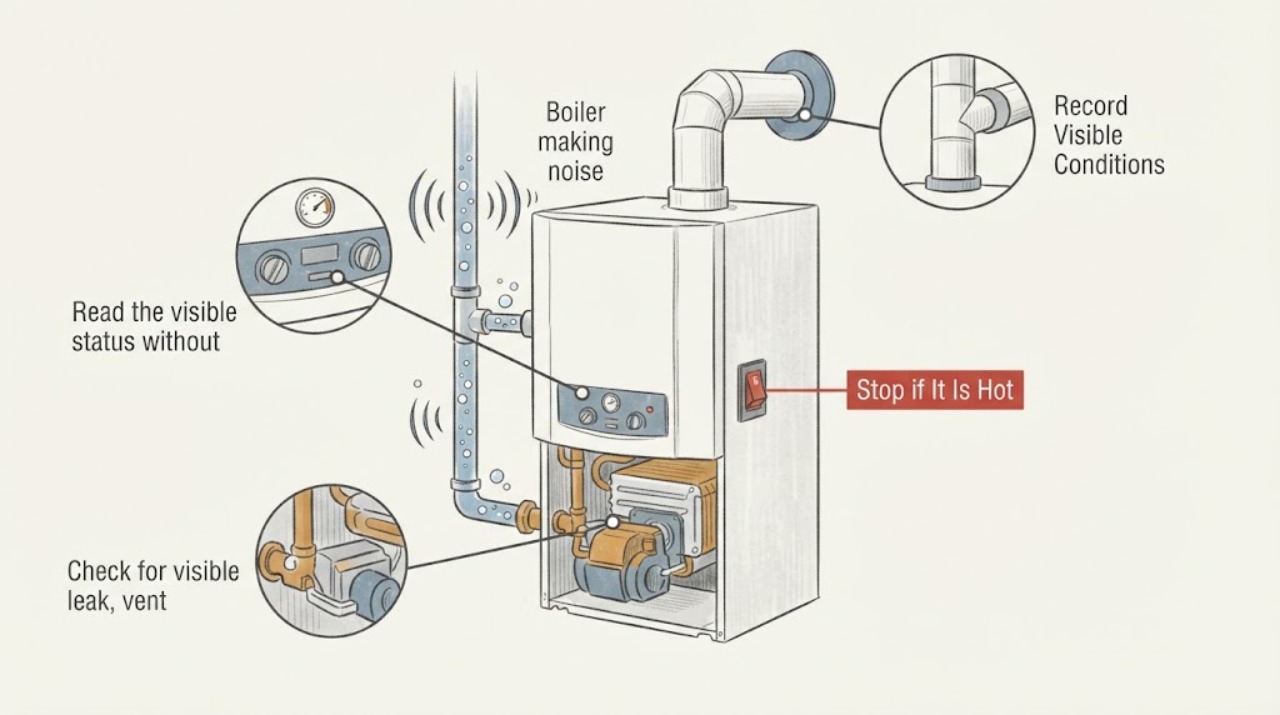
Work through in order
Diagnostic checks
Use only checks that match the exact appliance or system and its official guide.
-
1. Record the sound and its operating moment
From outside the boiler casing and away from hot pipes, listen briefly and record whether the sound is banging, whistling, gurgling, humming, droning, whooshing, or a normal ignition or circulation sound. Note whether it starts at ignition, during heating, when a pump runs, when a thermostat calls, or while the system shuts down.
Expected result: Banging or whistling, gurgling, humming or droning, and whooshing point to different diagnostic branches; a sound that occurs only at startup is different from one that persists through the heating cycle.
Next step: Make a short audio recording from a safe location if possible and give the sound, timing, fuel type, and boiler type to the heating professional.
Stop if: Stop listening and leave the area if the noise is accompanied by fuel odor, smoke, an alarm, a violent bang, or signs of overheating.
Why this matters
Why: The sound pattern narrows the professional's first checks but does not prove a part has failed. Manufacturer guidance associates kettling with banging or whistling, trapped air with gurgling, and pump or fan problems with humming or droning.
-
2. Read the visible status without changing settings
With the boiler operating normally and without removing any cover, read the accessible control display, fault code, temperature indication, and pressure gauge if the system has one. Compare the reading only with the appliance's own normal display or owner documentation; do not open valves, bleed radiators, reset repeatedly, or adjust pressure controls.
Expected result: A new fault code, an abnormal-looking gauge reading, repeated lockout, or a rapidly changing indication is different from a normal status display with an unexplained sound.
Next step: Photograph the display or gauge and write down when it appeared. Follow only the model's owner-level reset guidance, and do not keep resetting a boiler that locks out or makes a severe noise.
Stop if: Stop using the boiler and request prompt service for a fault, pressure warning, repeated lockout, leaking relief discharge, or a gauge behavior that changes rapidly.
Why this matters
Why: Visible status information can tell the professional whether the noise is occurring with a control, pressure, circulation, or ignition symptom, while avoiding unsafe work on hot or pressurized components.
-
3. Check for visible leak, vent, and combustion warning signs
From a safe standing position, look around the boiler and accessible pipe connections for active dripping, corrosion, staining, steam, unusual condensation, or water on the floor. Without climbing or opening the appliance, note whether a vent termination appears blocked and whether the room has a fuel odor. Check that a carbon-monoxide alarm is present and note any alarm indication.
Expected result: Water, steam, a blocked or damaged-looking vent, fuel odor, soot-like staining, or a CO alarm changes this from a noise-only investigation to a safety call.
Next step: If no warning sign is present, include the observations in a normal service request. If any warning sign is present, stop the appliance if the owner instructions allow a safe normal shutoff, leave the area when appropriate, and contact emergency or qualified service resources.
Stop if: Leave immediately and seek emergency help if a CO alarm sounds, anyone has headache, dizziness, nausea, confusion, or breathing symptoms, or a strong fuel odor is present.
Why this matters
Why: A boiler combines heat, fuel or electricity, water or steam, and venting. Visible leaks or combustion warnings cannot be safely resolved by tightening a fitting or opening the casing as a homeowner.
-
4. Record what the heating system is doing
Without touching hot surfaces, note whether the boiler still heats the home, whether some radiators or baseboards remain cool, whether the noise follows a specific zone or circulator, and whether the system cycles off or locks out. For a steam system, note whether the sound is at the boiler, a radiator, or the piping, but do not alter vents or valves.
Expected result: Normal heat with a new noise differs from poor heat distribution, repeated cycling, a cold zone, or a lockout paired with noise.
Next step: Give the technician the room or zone affected, the sound timing, the status reading, and whether the problem changes with a heating call.
Stop if: Do not continue operating a boiler that overheats, repeatedly locks out, leaks, emits combustion warnings, or produces a violent or rapidly worsening noise.
Why this matters
Why: Reduced circulation, trapped air, deposits, pump trouble, steam drainage, or control faults may produce different combinations of noise and heating symptoms; determining which applies requires the system type and a professional inspection.
Use your observations
Decision map
Find the observation that best matches what you see, then follow the next safe action.
-
PATH 01Safety boundary
What you see
The noise is banging or whistling, especially with a fault, overheating indication, or poor circulation.
Do this next
Keep the boiler out of service and arrange a qualified inspection for flow restriction, deposits, pump, control, and safety-device conditions.
Why this path and its safety boundary
Safety stop: Do not open the casing, chemically clean, power-flush, or adjust a pressurized circuit yourself.
-
PATH 02Safety boundary
What you see
The noise is gurgling and the system has uneven heat or visible air-related symptoms but no emergency warning.
Do this next
Record the affected radiators or zones and ask a qualified technician to assess air, pressure, expansion, and circulation for the specific system type.
Why this path and its safety boundary
Safety stop: Do not bleed, drain, refill, or change pressure controls unless the exact owner instructions and local rules clearly authorize an owner-level step.
-
PATH 03Safety boundary
What you see
The noise is humming, droning, or whooshing, or appears to come from a pump, fan, intake, or vent.
Do this next
Arrange professional service and provide the sound recording and whether heating performance changes.
Why this path and its safety boundary
Safety stop: Do not remove the casing or reach into an intake, fan, burner, or pump area.
-
PATH 04Safety boundary
What you see
Fuel odor, smoke, a CO alarm, symptoms, an active leak, steam, or a violent noise is present.
Do this next
Leave the area and follow emergency, fuel-supplier, fire-service, or qualified-boiler instructions appropriate to the hazard.
Why this path and its safety boundary
Safety stop: Do not re-enter or restart the boiler until the hazard has been assessed and the system is cleared for use.
Helpful context
Understand the symptom
Why the sound matters
Boilers move heated water or steam through a system, and the noise can come from the heat exchanger, trapped air, deposits, a circulator or fan, valves, pipe movement, or controls. A sound label is useful only when paired with timing and system behavior. Vaillant's manufacturer guidance associates banging or whistling with kettling, gurgling with air moving through water, and drone or hum with pump or fan concerns, while noting that unusual sounds should be investigated by a qualified professional.
Keep the boundary at the boiler casing
A homeowner can safely record the sound, read accessible status information, and document visible conditions. Opening a boiler, testing a relief valve, cleaning a heat exchanger, changing pressure, bleeding or draining a system, and working on fuel or venting components are professional tasks. The U.S. Department of Energy's hydronic-heating guidance places combustion, venting, heat-exchanger, pressure-relief, and circulation checks in a boiler tune-up performed by an HVAC technician.
When to stop and call
Arrange qualified service for any new or worsening boiler noise, especially when heat delivery changes or a display, gauge, leak, or lockout is involved. Treat fuel odor, smoke, suspected venting trouble, a carbon-monoxide alarm, or symptoms such as headache, dizziness, nausea, confusion, or shortness of breath as an immediate safety issue: leave for fresh air and seek emergency help.
Only after diagnosis
Potential parts
- boiler circulator pump
Only consider this part if a qualified technician identifies a pump or circulation fault that matches the recorded noise and system symptoms.
Confirm the boiler model, system type, pump specifications, electrical requirements, and installer fitment before ordering. - automatic air vent
Only consider this part if a qualified technician confirms an air-management component is leaking, blocked, or failing and connects that condition to the noise.
Confirm the exact boiler and hydronic-system configuration; do not open or replace a pressurized fitting as a homeowner. - boiler pressure gauge
Only consider this part if a qualified technician confirms that the gauge is inaccurate or failed rather than treating a gauge reading as proof of a pressure fault.
Confirm connection, temperature and pressure ratings, and model fitment with the service professional.
When checks do not resolve it
Need a professional?
Call a qualified heating or boiler professional for any new, persistent, or worsening noise, and use an urgent safety route for fuel odor, smoke, suspected venting trouble, a CO alarm, active leak, steam, repeated lockout, overheating indication, or violent noise.
Common questions
FAQ
Is a noisy boiler always dangerous?
No, but an unexpected or worsening noise should be investigated. Banging, whistling, gurgling, humming, and whooshing can have different causes, and a noise paired with a fault, leak, overheating, fuel odor, venting concern, or CO alarm needs prompt professional attention.
Can I fix boiler banging or kettling myself?
Do not open the boiler or flush, drain, refill, or adjust a pressurized system yourself. Record the sound and visible status, then have a qualified heating professional assess flow, deposits, the pump, controls, and safety devices.
What does gurgling from a boiler or radiator mean?
It can be associated with trapped air moving through a hydronic system, but the correct response depends on whether the system is hot-water or steam and what the model instructions allow. Record which rooms or radiators are affected and ask a qualified professional to assess it.
Should I keep resetting a boiler that makes noise and locks out?
No. A repeated lockout is a service signal. Photograph the display or code, keep the unit out of service if the owner instructions call for it, and contact a qualified technician rather than repeatedly restarting it.
What should I do if a boiler noise comes with a carbon-monoxide alarm?
Leave for fresh air immediately, seek medical attention for symptoms, and follow emergency guidance. Do not re-enter or restart the fuel-burning appliance until qualified responders or a certified professional have assessed it.
Read the exact guide
Official sources
- Building America Best Practices Series Vol. 14: Energy Renovations - HVAC: A Guide for Contractors to Share with HomeownersU.S. Department of Energy · General U.S. hydronic heating guidance; it is not a model-specific repair manual.
- Why is my boiler making a noise?Vaillant · Vaillant's general boiler guidance; exact causes and owner steps vary by boiler model, fuel, and jurisdiction.
- Carbon Monoxide Poisoning: Protect Your Family and Yourself FactsheetU.S. Environmental Protection Agency · General U.S. residential CO safety guidance; follow local emergency and appliance instructions.
Community feedback
Share a repair observation
Share a plain-text repair observation. Accepted observations are published automatically; this page may take a moment to update.