
On this page
Start here
Quick answer
A boiler that has become noisy while rooms or radiators heat unevenly may have trapped air, restricted circulation, a control or zone problem, a pump issue, or scale and flow trouble. First classify the sound and compare it with the cold rooms or cold sections of radiators; gurgling with a radiator cold at the top points toward air, while banging or whistling at the boiler, a new drone, repeated pressure change, leaks, or lockouts needs professional diagnosis. You may check visible gauges, accessible valves, radiators, piping, vents, and thermostat settings from a safe position, and bleed a cool radiator only if the exact system instructions permit it. Do not open the boiler casing, adjust gas or combustion controls, defeat a safety device, manipulate a relief valve, or investigate a flue yourself. Stop and obtain urgent help for a carbon monoxide alarm, gas smell, smoke, overheating, significant water, or a damaged vent.
Before you begin
Safety first
- Homeowner checks are limited to cool radiator observations, normal thermostat controls, visible labels and gauges, accessible exterior conditions, and symptom notes. Fuel, combustion, flue, electrical, pressure-control, internal pump, and sealed-system work require qualified personnel.
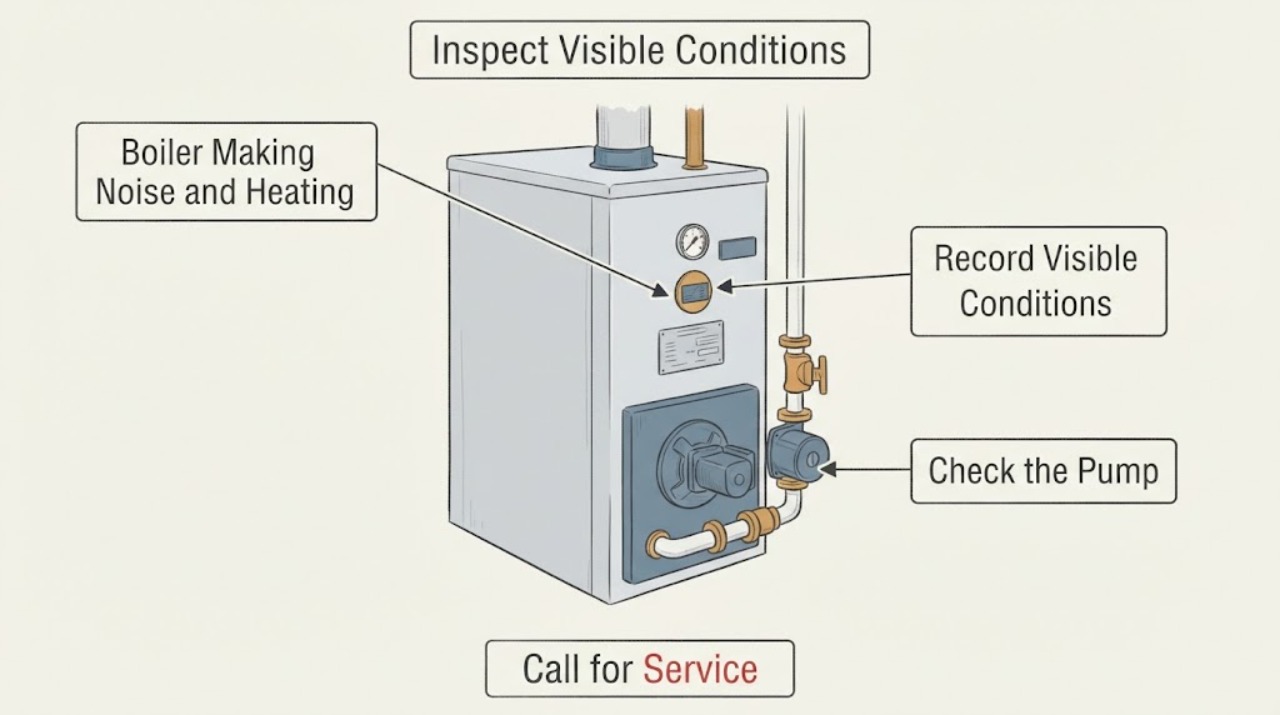
Work through in order
Diagnostic checks
Use only checks that match the exact appliance or system and its official guide.
-
Check 1
From a safe position, listen during one normal heating cycle and record where the sound starts and what it sounds like: gurgling or bubbling in pipes or radiators, banging or whistling at the boiler, a drone or hum, whooshing, or a brief normal ignition or circulation sound. Do not remove the casing or place hands on hot equipment.
Expected result: Note whether the noise is new, continuous, tied to startup or shutdown, limited to one room, or loudest at the boiler, a pipe, a radiator, a pump area, or a vent termination.
Next step: Use the sound and location to choose the matching branch, then compare it with the rooms and radiators that are not heating. If the noise is severe, rapidly worsening, or accompanied by a warning sign, stop the cycle and arrange qualified service.
Why this matters
Why: Gurgling is more consistent with trapped air; banging or whistling at the boiler can indicate restricted flow or kettling; a persistent drone or hum can involve a pump, valve, or flow problem. A sound that is brief and unchanged from normal operation is less informative than a new, worsening sound.
-
Check 2
With the heating turned off and the radiators or baseboards cool, compare the emitters in warm and cold rooms. Look for a radiator that is cold at the top but warmer below, one that is cold throughout, a single zone that does not respond, or a visible valve that is clearly closed; do not force a valve or remove a cover.
Expected result: Record which rooms, zones, radiators, or baseboard sections are affected and whether the cold area is at the top, bottom, or entire emitter.
Next step: If the radiator is cool and the owner instructions explicitly support bleeding, follow only that procedure with the heating off and equipment cool. Stop if water sprays, the valve will not close, the system is unfamiliar, or a pressure warning appears; arrange professional service instead.
Why this matters
Why: A cold top with bubbling or gurgling is a useful air clue. A cold emitter throughout, one isolated zone, or a persistent cold section can instead point toward a valve, circulation, control, or distribution problem. A cold bottom with a warmer top may have a different flow or sediment pattern and should not be treated as proof of trapped air.
-
Check 3
If the system is a water-based boiler and the model provides a visible pressure gauge, read it without touching any valve and compare it with the owner's manual's normal range. Also look around accessible boiler piping, pumps, radiators, and baseboards for fresh water, staining, corrosion, or repeated signs of leakage.
Expected result: Record a stable reading within the model's stated range, a reading that is falling, rising, or fluctuating, or any leak and deterioration. Do not add water, open a drain, or alter pressure controls based on a generic number.
Next step: Leave pressure correction and leak repair to a qualified heating professional. If water is actively leaking, reaches electrical equipment, or the pressure changes sharply, turn the heating off if that can be done safely and use the urgent service branch.
Why this matters
Why: Pressure that repeatedly changes, requires frequent attention, or appears outside the equipment's normal range can accompany a system fault. Water or corrosion can reduce circulation and distribution and needs evaluation; a normal gauge does not rule out air, a stuck valve, or a pump problem.
-
Check 4
Check the thermostat or zone controls from their normal user interface and confirm the affected zone is requesting heat. Note any lockout, warning, or error message, and visually check only accessible external vent or air-intake terminations for obvious blockage or damage; do not remove panels or inspect internal filters or flues.
Expected result: Record whether one zone fails while another heats, all zones respond slowly, the boiler shuts down or locks out, or a vent termination appears blocked, disconnected, damaged, or wet.
Next step: Do not reset repeatedly or clear a vent by reaching into it. Leave the appliance off for a lockout, damaged vent, or uncertain blockage and contact a qualified heating professional; follow the CPSC emergency branch if a carbon monoxide alarm sounds.
Why this matters
Why: A one-zone pattern makes a control, valve, air, or circulation issue more likely than a whole-boiler failure. Lockouts or damaged venting can involve combustion and safety systems, while a normal control display does not clear the pump, heat exchanger, or distribution piping.
-
Check 5
Document the sequence for the heating professional: boiler and fuel type if known, system type if known, exact sound, start and stop timing, affected rooms or zones, radiator temperature pattern, gauge behavior, visible leaks, recent service or water addition, control messages, and whether the symptom changes after the system cools.
Expected result: A time-linked record shows whether noise and uneven heating occur together, whether only one zone is affected, and whether the symptom is escalating or recurring after a temporary reset.
Next step: Give the record and photographs of exterior labels or visible gauges to a qualified heating professional. Keep the casing, flue, gas controls, pressure relief device, pump, and wiring untouched.
Why this matters
Why: This evidence helps distinguish air, distribution, pressure, circulation, control, combustion, and mechanical clues without requiring the homeowner to identify an internal component.
Use your observations
Decision map
Find the observation that best matches what you see, then follow the next safe action.
-
PATH 01Next step
What you see
Gurgling or bubbling occurs in the heating circuit, and affected radiators are cooler at the top while the lower sections warm.
Do this next
Arrange qualified service and follow the exact model guidance.
Why this path and its safety boundary
Why it matters: Trapped air is more likely and can explain both the noise and uneven heat. If the system instructions permit it, bleed only cool affected radiators as directed; stop for a stuck valve, spraying water, unfamiliar equipment, or a pressure warning, and have a heating professional correct recurring air or pressure loss.
-
PATH 02Next step
What you see
Banging or whistling is loudest at the boiler, especially as it heats, or is paired with poor circulation, a rising pressure reading, or repeated shutdowns.
Do this next
Arrange qualified service and follow the exact model guidance.
Why this path and its safety boundary
Why it matters: Restricted flow, scale, pump trouble, thermostat or control trouble, or kettling becomes more concerning than a simple radiator-air check. Stop trying to reproduce it and arrange qualified boiler service; do not open the casing or adjust combustion or pressure controls.
-
PATH 03Next step
What you see
A drone or hum comes from the boiler or pump area while one or more zones heat poorly, or the sound changes with circulation.
Do this next
Arrange qualified service and follow the exact model guidance.
Why this path and its safety boundary
Why it matters: A pump, valve, or circulation issue is possible. Record the timing and affected zones and obtain professional diagnosis; pump replacement, flushing, and internal checks are not homeowner repairs.
-
PATH 04Next step
What you see
Only one zone or a single radiator remains cold while the boiler runs and the other zones respond normally, with no leak or hazard sign.
Do this next
Arrange qualified service and follow the exact model guidance.
Why this path and its safety boundary
Why it matters: A local valve, air pocket, control, or flow restriction is more likely than a complete boiler failure. Check only the normal thermostat interface and visible valve position; do not force valves or rebalance hidden controls, and arrange service if the cool area persists.
-
PATH 05Next step
What you see
There is a carbon monoxide alarm, suspected gas smell, smoke, flame or flue abnormality, active water near electrical parts, rapidly rising pressure, or a hot or damaged boiler.
Do this next
Arrange qualified service and follow the exact model guidance.
Why this path and its safety boundary
Why it matters: Stop immediately. For a carbon monoxide alarm or suspected exposure, leave the home and call emergency services from outside; do not search for the source or re-enter until instructed. For other urgent boiler hazards, keep clear, stop operating the appliance if safe, and obtain emergency qualified help.
Helpful context
Understand the symptom
The sound and the temperature pattern belong together
A boiler noise is more useful when recorded alongside the distribution symptom. Gurgling, bubbling, or clunking with a radiator cold at the top is consistent with air in a water-based heating system. Banging or whistling close to the boiler can be consistent with restricted flow or kettling, while a drone or hum can involve the pump, valves, or flow rate. These are clues, not a remote diagnosis; a steam system, hot-water system, and fuel type can change what each sound means.
Uneven heat does not automatically mean the boiler is failed
Rooms or zones can heat differently because of air, a circulation restriction, a control setting, a closed or stuck emitter valve, a leak, or a distribution issue. Weil-McLain recommends observing radiators and baseboards, pressure behavior, leaks, and new noises while using the owner's manual for equipment-specific operating limits. Do not use a universal gauge setting or repeated resets as a substitute for the model instructions.
Keep combustion and boiler internals out of a homeowner noise check
A visual inspection can document the outside of the equipment and the heating emitters, but fuel-burning boiler service, flue inspection, combustion adjustment, pump replacement, flushing, and pressure correction belong with a qualified heating professional. A carbon monoxide alarm is an emergency signal: leave the home, call emergency services, and do not re-enter or operate the appliance until responders and trained personnel say it is safe.
Safety boundary
Stop conditions
- Stop immediately for a carbon monoxide alarm or suspected exposure, gas smell, smoke, flame or flue damage, active water near electrical parts, overheating, rapidly changing pressure, or a boiler that locks out repeatedly.
- Do not open the boiler casing, alter gas or combustion controls, inspect internal filters or flues, manipulate a pressure-relief device, bypass a safety control, remove a pump, or test energized equipment.
- Leave the heating off and arrange qualified service when new noise persists, pressure needs repeated attention, water or corrosion is visible, several zones heat unevenly, or bleeding a cool radiator does not restore normal heat.
Only after diagnosis
Potential parts
- radiator air vent or bleed valve
Consider this only when a qualified diagnosis confirms a defective vent or bleed valve after trapped air is established as the cause of uneven heating and noise.
Match the heating system type, valve connection, material, temperature and pressure requirements, and manufacturer instructions before ordering or fitting. - boiler circulator pump
Consider this only after a qualified professional confirms inadequate circulation or pump failure rather than air, a closed valve, a control issue, scale, or a distribution restriction.
Confirm the exact boiler model, system design, pump capacity, electrical arrangement, and local installation requirements with the professional.
When checks do not resolve it
Need a professional?
Safety scope: Homeowner checks are limited to cool radiator observations, normal thermostat controls, visible labels and gauges, accessible exterior conditions, and symptom notes. Fuel, combustion, flue, electrical, pressure-control, internal pump, and sealed-system work require qualified personnel.
Common questions
FAQ
Can trapped air make a boiler noisy and heat rooms unevenly?
Yes. Gurgling or bubbling with a radiator cold at the top is consistent with trapped air. With the system cool, follow the exact owner instructions if they permit bleeding; recurring air, pressure loss, leaks, or persistent cold radiators need a heating professional.
What does banging or whistling from the boiler mean?
It can be associated with restricted flow or kettling, and may involve scale, a pump, a thermostat, or another control. Do not open the boiler or adjust pressure or combustion controls; stop trying to reproduce the sound and arrange qualified service.
Should I add water when the boiler pressure looks low?
Do not use a generic pressure target or operate valves based only on this article. Compare the reading with the exact owner manual; repeated pressure loss, a leak, or an abnormal reading should be evaluated by a qualified heating professional.
Why is only one room or heating zone cold?
A local air pocket, valve, control, circulation restriction, or distribution issue may affect one zone while the boiler and other zones run. Check only the normal thermostat interface and visible conditions; do not force valves or open the boiler.
What should I do if the carbon monoxide alarm sounds near the boiler?
Leave the home immediately, call emergency services from outside, and do not search for the source or re-enter until responders say it is safe. Do not operate the boiler again until trained personnel have serviced it.
Read the exact guide
Official sources
- Carbon Monoxide Fact SheetU.S. Consumer Product Safety Commission · Fuel-burning heating appliance servicing, annual inspection, carbon monoxide alarm response, evacuation, and re-entry boundary
- Boiler Winter Maintenance ChecklistWeil-McLain · Boiler pressure and leak observations, visible vent checks, thermostat and zone response, uneven heating causes, and professional service boundaries
- Why is my boiler making noise?Vaillant · Boiler noise patterns, trapped air, kettling, flow, pump and professional service boundaries
- Why are my radiators cold ?Vaillant · Uneven radiator heating, air clues, cool-down and radiator bleeding procedure, pressure caution, and flushing escalation
Community feedback
Share a repair observation
Share a plain-text repair observation. Accepted observations are published automatically; this page may take a moment to update.