
On this page
Start here
Quick answer
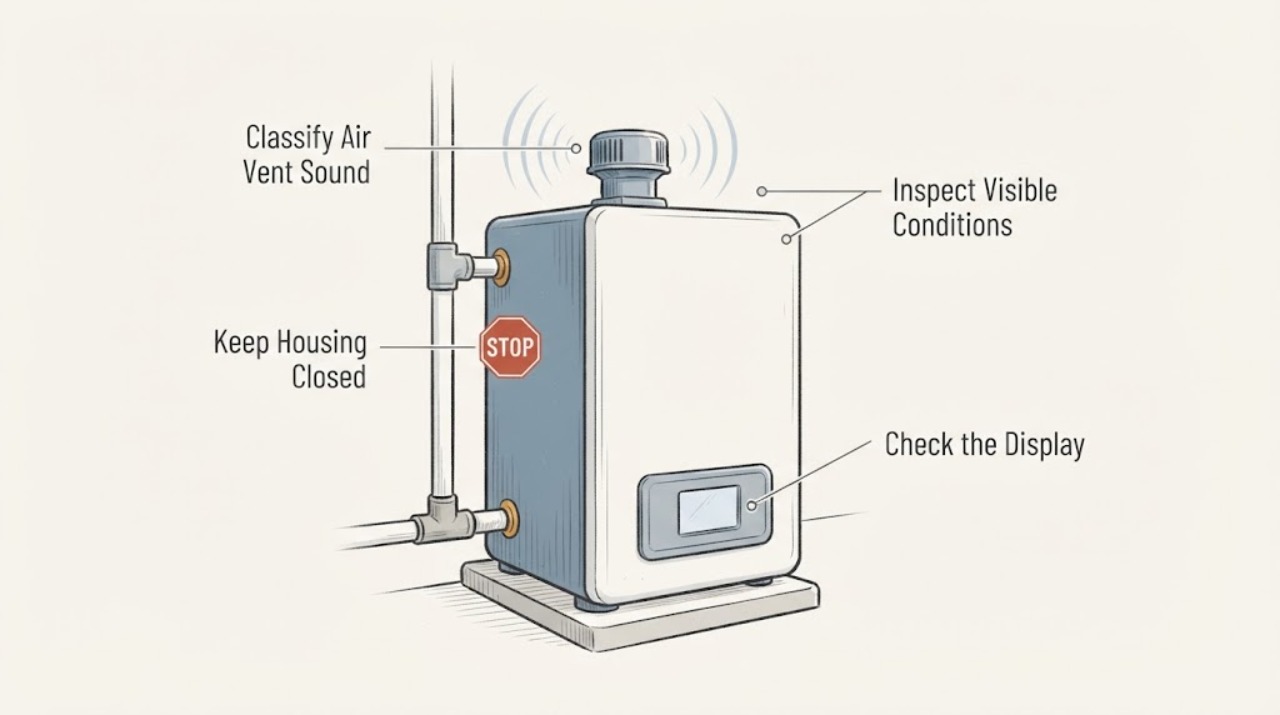
A noisy air vent on a Buderus boiler can be caused by air moving through the hydronic loop, water or pressure changes, a vent that is leaking or failing, or noise transmitted from a pump or another nearby component. From a dry, safe position, record whether the sound is a hiss, gurgle, whistle, chatter, or vibration; look for visible moisture or corrosion; and note the already-visible pressure or fault display and the effect on heating. Buderus documentation identifies automatic air vents as part of the boiler system, while Bosch/Buderus guidance connects air in the loop or boiler with circulation symptoms and places internal inspection and gas-boiler work with qualified service personnel. Do not loosen, bleed, cap, replace, or adjust the air vent or alter boiler pressure yourself. Stop immediately for steam, forceful hot water, gas odor, smoke, electrical danger, or water near electrical equipment.
Before you begin
Safety first
- The air vent is part of a pressurized hot-water or steam-related heating system and may be near gas, combustion, electrical, or very hot components. Do not bleed, loosen, cap, drain, refill, replace, or disassemble the vent; do not open the boiler, alter pressure or gas settings, or bypass safety devices.
Work through in order
Diagnostic checks
Use only checks that match the exact appliance or system and its official guide.
-
Check 1
From a safe, dry position, listen without touching the Buderus boiler or changing a control. Record whether the apparent air-vent noise is a hiss, gurgle, bubbling, whistle, chatter, tapping, hum, or vibration, and when it occurs relative to startup, circulation, a zone call, hot-water use, or shutdown.
Expected result: The sound is intermittent and water-like, continuous, sharply whistling, a repeated chatter, a mechanical hum, or accompanied by a fault display or a change in heating.
Next step: Keep a short sound-and-timing log or recording from the safe position and give it to a qualified HVAC technician. Do not reproduce the noise by cycling the boiler or changing zone settings.
Stop if: Leave the area for steam, forceful hot-water discharge, gas odor, smoke, scorching, sparking, or severe heat.
Why this matters
Why: Water-like sounds make air or flow conditions plausible; a whistle or chatter can indicate a vent, flow, or pressure issue; a mechanical hum may originate at a pump or another component. The sound location alone cannot identify the failed part.
-
Check 2
Visually inspect the air-vent body, its visible connection, nearby pipework, and the floor or wall below from outside the equipment hazard area. Do not wipe, tighten, cap, cover, or remove anything.
Expected result: The area is dry and clean, damp or stained, actively dripping, corroded, covered with mineral residue, or wet near electrical equipment.
Next step: Report the exact visible condition and sound timing to a qualified HVAC professional. Keep people away from the area and do not place a container under hot or pressurized equipment if reaching it would enter the hazard area.
Stop if: Do not touch a wet vent, hot pipe, or active discharge, and do not operate the boiler through a leak or water near electrical equipment.
Why this matters
Why: Dampness, corrosion, or residue changes a noise complaint into a possible vent or hydronic leak. Water near electrical equipment or a forceful hot discharge is an immediate safety concern, not a routine adjustment.
-
Check 3
Read only the already-visible Buderus pressure gauge, temperature or status display, fault text, and model label. Compare the gauge trend with the range in the exact model manual; do not open a panel, change a pressure setting, add water, or reset a fault.
Expected result: The gauge is stable, falling between heating cycles, rising unusually, or outside the model's stated range; the display is normal, alarmed, or repeatedly shutting the boiler down.
Next step: Photograph or write down the model, display, gauge trend, and timing, then arrange HVAC service. If pressure is rapidly changing or the boiler is repeatedly shutting down, stop using it as safely directed and request prompt evaluation.
Stop if: Do not refill, vent, bleed, reset repeatedly, or apply a generic pressure value to an unidentified Buderus model.
Why this matters
Why: A changing pressure or alarm can accompany air loss, a leak, circulation trouble, or another boiler fault. The GB162 service manual gives model-specific fill and pressure guidance, but those values must not be assumed for every Buderus boiler.
-
Check 4
Using observations that already exist, note whether radiators or zones heat evenly, whether the sound follows a particular zone or pump start, and whether heat delivery changed when the noise began. Do not create a new heat call or reach toward the circulator, valves, or boiler internals.
Expected result: Heating remains even, one zone is cooler, radiators gurgle, the noise follows circulation, the pump area seems louder than the vent, or the boiler shows a flow or temperature fault.
Next step: Give the technician the affected zone, heating response, timing, and apparent source. The professional can assess system air, circulation, pressure, and the vent without guessing from sound alone.
Stop if: Do not adjust pump settings, valves, pressure, gas, or electrical connections to silence the noise.
Why this matters
Why: Uneven heat, gurgling radiators, and a circulation-linked sound make air in the loop, a valve or pump issue, or restricted flow more likely than an isolated vent cap problem. A sound that travels through pipework may be mislocated by ear.
-
Check 5
Prepare a service handoff containing the Buderus model and serial information, sound description or recording, timing, visible moisture or corrosion, gauge and display observations, affected zones, recent filling or service, and whether the boiler is gas-fired or condensing.
Expected result: The sound persists, worsens, returns after a professional adjustment, occurs with a leak or pressure change, or disappears while the system still has abnormal heating behavior.
Next step: Arrange qualified Buderus/HVAC service; request vent or hydronic-system inspection and model-specific diagnosis. Arrange urgent help for a safety symptom and follow local emergency guidance for immediate danger.
Stop if: Do not open the cabinet, remove the vent, drain or refill the system, alter gas or combustion settings, or bypass a safety device.
Why this matters
Why: Persistence, recurrence, or a combined sound and heating or pressure symptom points to a system-level diagnosis rather than a part that can safely be selected from the noise description. Internal air-vent, pump, heat-exchanger, gas, flue, and control work is professional work.
Use your observations
Decision map
Find the observation that best matches what you see, then follow the next safe action.
-
PATH 01Next step
What you see
The vent area is dry, the noise is an intermittent hiss, gurgle, or rushing-water sound, and the gauge and boiler behavior appear stable.
Do this next
Provide the timing and recording to a qualified technician, who can identify the system type and model-specific air-management steps. Do not bleed or adjust the vent yourself.
Why this path and its safety boundary
Why it matters: Air moving through the loop or a circulation-related sound is plausible, but the vent itself has not been cleared as the source.
-
PATH 02Next step
What you see
The vent or its visible connection is wet, stained, corroded, mineral-coated, or actively dripping.
Do this next
Keep clear, stop operation when it is safe to do so, and arrange prompt HVAC service. Treat hot or forceful discharge as urgent.
Why this path and its safety boundary
Why it matters: The noise may be associated with a leaking or failing vent or a wider hydronic leak, and the pressurized system needs professional inspection.
-
PATH 03Next step
What you see
The gauge falls or rises unusually, the boiler needs repeated filling, air returns after service, or a pressure or low-water message accompanies the noise.
Do this next
Do not add water or change the pressure setting as a trial. Provide the pressure trend and message to a qualified HVAC technician for leak, expansion, circulation, and vent diagnosis.
Why this path and its safety boundary
Why it matters: A leak, expansion-vessel issue, air entering the system, or another pressure and circulation problem is more likely than a harmless vent sound.
-
PATH 04Next step
What you see
The noise follows a zone or pump start, radiators heat unevenly or gurgle, or the apparent source shifts along the pipework.
Do this next
Arrange HVAC diagnosis of the whole hydronic loop and report the affected zone and timing. Do not change pump speed or valve position yourself.
Why this path and its safety boundary
Why it matters: Air in the loop, a flow restriction, valve, pump, or another system component may be transmitting sound to the air vent.
-
PATH 05Next step
What you see
There is steam, forceful hot water, gas odor, smoke, scorching, electrical arcing, water near electrical equipment, severe overheating, or a rapidly worsening discharge.
Do this next
Leave the area, keep people away, and use local emergency or building procedures for immediate danger. After the area is safe, arrange qualified boiler service.
Why this path and its safety boundary
Why it matters: This is an immediate gas, fire, scald, pressure, or electrical safety boundary, not a vent-adjustment problem.
Helpful context
Understand the symptom
An automatic air vent releases air from a closed heating system, but hearing a sound at the vent does not prove that the vent itself has failed. Sound can travel through water-filled piping, and the actual source may be air in the loop, a pressure or circulation problem, a pump, a condensate or flue condition, or the vent body and connection. Buderus model manuals differ, so record the pattern instead of applying a generic pressure or vent adjustment.
Keep hands and tools away from the vent, hot pipework, valves, flue, burner, and controls. Bosch Home Comfort maintenance guidance says to stop the boiler and contact a qualified service person when visual inspection finds damage, discoloration, gas leaks, or water leaks.
Only after diagnosis
Potential parts
- Buderus automatic air vent
Consider this category only if a qualified technician confirms that the vent body or its seal is leaking, stuck, or otherwise causing the noise and specifies the required system rating.
Confirm the exact Buderus model, hot-water or steam application, pressure and temperature ratings, connection, orientation, and professional fitment before ordering. - Buderus boiler pressure gauge
Consider this category only when a qualified technician confirms that the visible pressure gauge is inaccurate or failed and that replacement is appropriate after checking actual system pressure.
Gauge range, connection, dial orientation, and model fit vary; confirm them with the boiler documentation and technician. - boiler circulator or air-separator component
Consider this category only if professional diagnosis identifies a circulation or air-separation component as the source of the noise or related heating symptom.
Confirm the exact boiler and hydronic-loop configuration, connection, rating, and fitment before selecting a component.
When checks do not resolve it
Need a professional?
Arrange qualified HVAC service for a new, persistent, worsening, or recurring Buderus air-vent noise, especially with visible moisture, corrosion, pressure change, low-water or fault display, uneven heating, or repeated shutdown. Request prompt service for a leak or unusual pressure behavior. Seek emergency help for gas odor, smoke, electrical arcing, steam, forceful hot water, flooding, or immediate danger.
Safety scope: The air vent is part of a pressurized hot-water or steam-related heating system and may be near gas, combustion, electrical, or very hot components. Do not bleed, loosen, cap, drain, refill, replace, or disassemble the vent; do not open the boiler, alter pressure or gas settings, or bypass safety devices.
Have this ready
- Provide the Buderus model and serial information, sound description or recording, when it occurs, apparent location, visible moisture or corrosion, gauge and display trend, heating response by zone, recent filling or service, and whether the boiler is gas-fired or condensing.
Common questions
FAQ
Why is my Buderus boiler air vent making noise?
The sound may come from air moving through the hydronic loop, water or pressure changes, a leaking or failing vent, a pump, or pipework transmitting sound from elsewhere. Record the sound and timing, inspect only for visible moisture, and arrange qualified HVAC diagnosis instead of adjusting the vent.
Can I loosen or bleed the Buderus automatic air vent?
Do not loosen, bleed, cap, or replace it as a homeowner troubleshooting step. The vent is part of a pressurized heating system, and Buderus pressure and air-purging instructions are model-specific. Give the technician the model and sound observations.
What if the noisy air vent is wet or corroded?
Treat visible moisture, mineral residue, or corrosion as a possible leak or failed component. Keep clear, do not tighten or cover the vent, and arrange prompt HVAC service. Stop and seek urgent help for hot or forceful water, flooding, or water near electrical equipment.
Does a pressure change prove the air vent is bad?
No. A pressure trend can accompany air loss, a leak, expansion-vessel trouble, circulation problems, or another boiler fault. Record the already-visible gauge trend and model, but do not refill or change pressure based on a generic value.
When is a Buderus boiler air-vent noise an emergency?
Leave the area and use local emergency procedures for gas odor, smoke, electrical arcing, steam, forceful hot-water discharge, flooding, severe overheating, or water near electrical equipment. For persistent noise without an immediate hazard, arrange qualified HVAC service and provide the sound record.
Read the exact guide
Official sources
- Service manual - GB162-80kW/100kW - US(en)Buderus · Buderus GB162 boiler heating-system pressure, automatic air vent, and air-purging service information
- Condensing Gas Boilers TroubleshootingBosch Home Comfort · Buderus/Bosch condensing-boiler troubleshooting references to air in loops or boiler, flow, pressure, pumps, and professional diagnosis
- Condensing Gas Boilers Maintenance InformationBosch Home Comfort · Buderus/Bosch condensing boiler owner observations, vent inspection, leaks, pressure, and qualified maintenance
- Gastherme macht laute Geräusche: UrsachenBosch · Manufacturer explanation of gas-boiler noise patterns, air or pressure-related sounds, and the need for maintenance
Community feedback
Share a repair observation
Share a plain-text repair observation. Accepted observations are published automatically; this page may take a moment to update.