
On this page
Start here
Quick answer
Water at a boiler expansion tank or nearby piping is a stop-and-call-professional problem. If the normal heating control is safely reachable and dry, stop the call for heat and leave the boiler out of service. From a safe distance, document whether water starts at the tank, a connection, a relief-valve discharge, or another pipe; record the visible gauge trend and whether water is near electrical equipment. Do not adjust pressure, recharge or remove the tank, operate gas controls, open the boiler, or touch wet electrical parts.
Before you begin
Safety first
- If safely reachable and dry, stop the heating call using the normal user control. Do not adjust pressure, operate gas controls, open panels, drain the system, recharge or remove the tank, or run repeated tests.
Work through in order
Diagnostic checks
Use only checks that match the exact appliance or system and its official guide.
-
Check 1
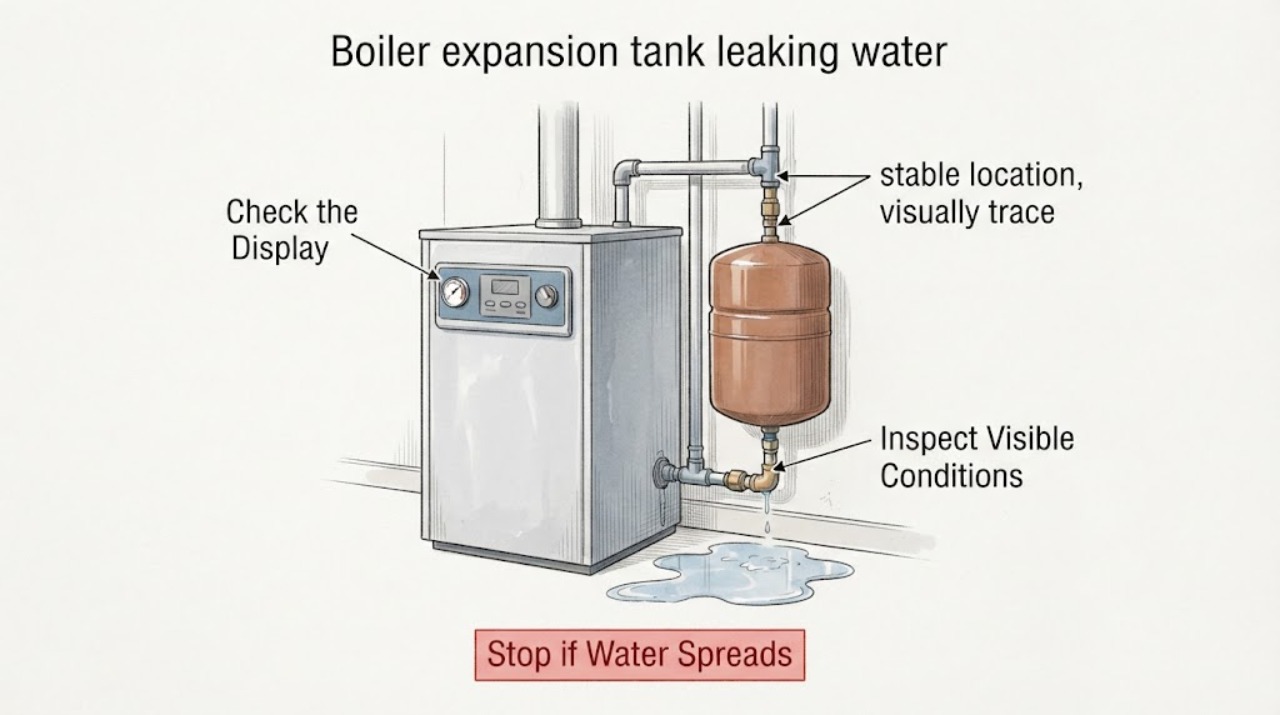
From a dry, stable location, visually trace the highest visible wet point around the expansion tank, its connection, nearby relief-valve discharge, air separator, and adjacent piping without touching any component.
Expected result: Record whether water appears at the tank shell, a threaded connection, a pipe above the tank, a relief discharge, or only on the floor; photograph the location before it dries.
Next step: Give the photo and exact location to a qualified heating professional and keep the boiler out of service; do not tighten or reseal the suspected point.
Stop if: Stop immediately for hot or forceful water, steam, a loud relief event, a slippery floor, smoke, gas odor, or water near electrical equipment.
Why this matters
Why: A tank-shell leak, a connection leak, and a relief discharge have different professional paths, and water can travel along piping before it falls.
-
Check 2
If the normal thermostat or heating control is safely reachable from a dry position, observe whether the system is calling for heat and use only the ordinary user control to stop that call; do not open a panel or approach wet equipment.
Expected result: Record whether the leak was present during a heating call, after the call ended, or continuously, without deliberately restarting the boiler or running a test cycle.
Next step: Leave the heating call stopped and arrange prompt service; use safe temporary comfort measures instead of cycling the leaking boiler.
Stop if: Do not touch any control if it, the floor, or the route to it is wet; leave for smoke, burning odor, gas odor, arcing, or a rapidly worsening leak.
Why this matters
Why: Timing can help the technician compare thermal expansion and circulation with a continuous leak, but it does not confirm the tank or make operation safe.
-
Check 3
Read the boiler pressure gauge and display only from a safe distance and only if clearly visible without touching the boiler, and note the indication without adjusting any valve or control.
Expected result: Record whether the indication is stable, changing during or after a heating call, unusually high or low for this installation, or unavailable; do not interpret a single value as a diagnosis.
Next step: Provide the display observation and timing to the heating professional; do not add water, bleed radiators, operate a fill valve, lift a relief valve, or drain the system.
Stop if: Stop for a cracked gauge, steam, rapid pressure movement, discharge, hot piping, or any need to open a cover or touch a control.
Why this matters
Why: A changing pressure indication can be useful context for a possible expansion or relief issue, but system settings vary and a homeowner should not correct pressure or recharge a tank.
-
Check 4
Inspect the surrounding floor, wall, insulation exterior, and visible boiler-room surfaces for pooling, staining, corrosion, dampness, or water reaching an outlet, switch, wiring, or another appliance without moving anything.
Expected result: Record the affected area, whether water is spreading beyond the tank, and whether damage appears new, recurring, or associated with a lower level or finished space.
Next step: Keep people and pets away, protect belongings only from a dry position, and provide dated photos to the appropriate qualified professional.
Stop if: Stop for standing water near electricity, soft or collapsing flooring, contaminated water, a sagging ceiling, smoke, fire, or an obstructed exit.
Why this matters
Why: Spread beyond the tank increases the urgency and may require building or water-damage mitigation in addition to heating service.
-
Check 5
From outside the boiler enclosure, photograph the model label and the expansion-tank location, support, and visible piping arrangement without removing covers, insulation, straps, or fittings.
Expected result: Record whether the tank is hanging, supported, corroded, dented, wet at one point, or surrounded by a relief or drain path; do not infer tank condition from touch or sound.
Next step: Send the model, photos, leak timing, gauge observation, and damage extent with the service request.
Stop if: Stop if identification requires entering a confined area, climbing, reaching over hot piping, removing a cover, or contacting wet equipment.
Why this matters
Why: Model and arrangement information help a professional identify the correct tank type and safe service procedure, while visual evidence cannot establish air-charge condition or structural support.
Use your observations
Decision map
Find the observation that best matches what you see, then follow the next safe action.
-
PATH 01Safety boundary
What you see
A slow leak is visible at the tank or connection, but the room is dry around electrical equipment and there is no steam, gas odor, or rapid discharge.
Do this next
Keep the heating call stopped if safely stopped, leave the system untouched, and arrange prompt qualified heating service with photos and timing notes.
Why this path and its safety boundary
Safety stop: Do not restart the boiler to test the leak or attempt to recharge, tighten, or remove the tank.
-
PATH 02Safety boundary
What you see
The leak changes with heating, the pressure indication changes, or a relief valve is weeping or discharging.
Do this next
Treat the situation as urgent and provide the timing and gauge observations to a qualified professional; do not adjust pressure or operate the relief valve.
Why this path and its safety boundary
Safety stop: Stop for steam, hot discharge, rapid pressure movement, or a slippery or flooded boiler room.
-
PATH 03Safety boundary
What you see
Water is near electrical equipment, the floor is flooded, or building materials are spreading wet or damaged.
Do this next
Leave the area, keep others away, and contact appropriate emergency, building-safety, water-damage, and heating professionals.
Why this path and its safety boundary
Safety stop: Do not touch switches, plugs, wiring, panels, pumps, or wet surfaces.
-
PATH 04Safety boundary
What you see
The tank shell is corroded, dented, unsupported, or the leak source cannot be seen.
Do this next
Preserve the photos and arrange professional assessment for safe repair or replacement; visual observation cannot establish pressure-vessel condition.
Why this path and its safety boundary
Safety stop: Do not remove insulation, loosen supports, open the boiler, drain the system, or test the tank.
Helpful context
Understand the symptom
Why an expansion-tank leak needs prompt service
A hydronic expansion tank gives heated system water room to expand. A leak at the tank or its connection can therefore be related to the tank, a fitting, a nearby relief valve, system pressure, or another part of the boiler piping. The lowest drip is not necessarily the source. A qualified heating professional must isolate and assess the system before any pressure, gas, electrical, or component work is attempted.
Keep the first check observation-only
Use photographs and notes from a dry, stable position. Do not touch the tank, press a valve, loosen a fitting, remove insulation, open a boiler panel, drain the system, or run the boiler to reproduce the leak. If the room is wet, hot, steamy, smoky, or near electrical equipment, leave it and request urgent help.
Only after diagnosis
Potential parts
- boiler pressure relief valve
Consider this category only if a qualified technician confirms the visible water is from the relief-valve assembly rather than the expansion tank or its piping.
Confirm the boiler model, system design, required rating, and approved discharge arrangement with the technician; do not select or operate a relief valve by appearance. - boiler circulator flange gasket
This category is relevant only if professional tracing confirms water is traveling from a circulator flange or nearby connection rather than the expansion tank.
Match the exact boiler, circulator, flange, material, and manufacturer requirements after safe isolation; a generic gasket is not assumed compatible. - boiler expansion tank
Consider this category only after a qualified heating professional confirms the tank is leaking, waterlogged, incorrectly sized, or otherwise failed and the system can be safely serviced.
Confirm tank type, connection, capacity, support, and manufacturer requirements for the installed boiler; do not remove, recharge, or replace a pressurized tank as a homeowner.
When checks do not resolve it
Need a professional?
Call a qualified heating professional promptly for any suspected boiler expansion-tank leak. Escalate urgently for hot or forceful water, steam, relief discharge, rapid pressure change, water near electricity, smoke, gas odor, flooding, or structural damage.
Safety scope: If safely reachable and dry, stop the heating call using the normal user control. Do not adjust pressure, operate gas controls, open panels, drain the system, recharge or remove the tank, or run repeated tests.
Have this ready
- Provide the boiler model visible from outside, tank location and photos, exact wet point, leak timing, visible gauge/display trend, heating-call status, and the extent of floor or wall moisture.
Common questions
FAQ
Can I recharge or remove a leaking boiler expansion tank?
No. An expansion tank is part of a hot, pressurized heating system. Recharging, removing, or replacing it requires safe isolation and professional assessment; keep the article's first pass observation-only.
Does water at the expansion tank prove the tank itself has failed?
No. Water can travel from a nearby connection, relief path, air separator, or other piping. Photograph the highest visible wet point and provide the timing to a qualified heating professional.
What does a changing boiler pressure display mean?
It is useful context but not a diagnosis. A pressure trend can accompany expansion, relief discharge, or another system issue, so do not adjust pressure or operate valves while waiting for service.
When is an expansion-tank leak urgent?
Treat hot or forceful water, steam, relief discharge, rapid pressure movement, water near electricity, smoke, gas odor, flooding, or structural damage as urgent stop conditions. Leave unsafe areas and contact qualified help.
Read the exact guide
Official sources
- Boiler FAQs and Common QuestionsWeil-McLain · General manufacturer service and safety routing; no Weil-McLain model is assumed
- SlimFit Commercial Condensing Gas BoilerWeil-McLain · Illustrates that piping and tank arrangements are model-specific; this job is not assumed to involve a SlimFit boiler
Community feedback
Share a repair observation
Share a plain-text repair observation. Accepted observations are published automatically; this page may take a moment to update.