
On this page
Start here
Quick answer
Water at a Buderus boiler circulator flange should be treated as a heating-system leak, not as a loose bolt to tighten while the boiler is running. From a safe position, switch the boiler off through its normal control if possible, keep clear of hot water, steam, gas, and electrical parts, and note whether the water is dripping from the flange face, gasket edge, pump body, valve, relief discharge, or an adjacent connection. Read and record the system pressure gauge without changing it, and note whether the boiler is hot, losing pressure, showing a fault, or unable to heat. Buderus installation documents identify the pump group, flat seals, supported and stress-free water connections, isolation and safety components, and professional leak-testing requirements; the exact model controls the repair. Do not tighten or dismantle the circulator flange, refill a leaking system, bypass a safety valve, or run the boiler to see whether the leak stops. Arrange qualified Buderus or heating-system service, and use emergency help for flooding, scalding steam, gas odor, smoke, or water reaching electrical equipment.
Before you begin
Safety first
- Keep the boiler out of normal service for water leaks, pressure changes, steam, hot water, gas or electrical signs, or water near electrics. Do not open the cabinet, alter gas or safety controls, refill the system, or dismantle the flange.
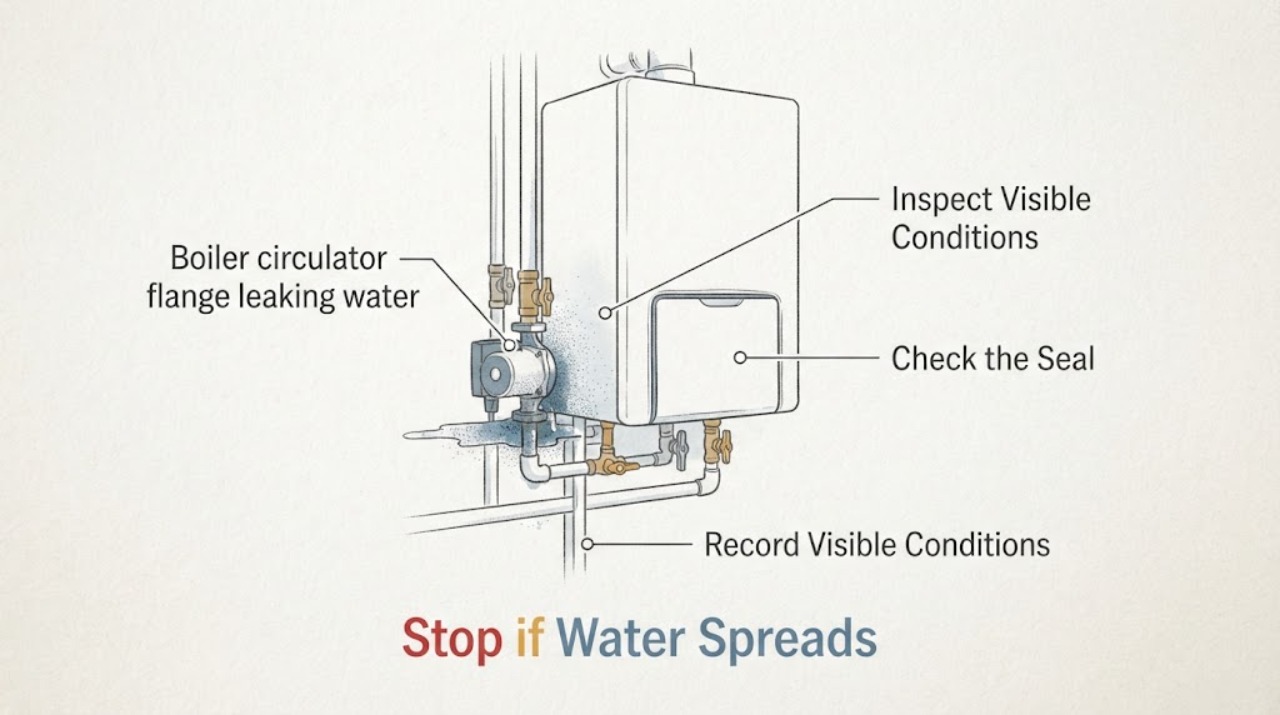
Work through in order
Diagnostic checks
Use only checks that match the exact appliance or system and its official guide.
-
Check 1
Stop the boiler through its normal control if it is safe to do so and observe from a dry, safe position. Note the leak rate, whether water is hot or steaming, whether the burner or pump is operating, and whether there is smoke, gas odor, electrical arcing, a wet electrical connection, or active flooding.
Expected result: The leak is a few drops, a steady stream, spraying, producing steam, reaching wiring, accompanied by gas odor or smoke, or occurring without an obvious hazard.
Next step: Keep clear and obtain emergency or qualified heating service as appropriate. Do not touch the flange, restart the boiler, or use towels to reach behind hot or energized components.
Why this matters
Why: Steam, rapid discharge, flooding, gas, smoke, or water at electrical equipment is an immediate safety branch. A slow visible drip still indicates loss of system water and should not be tested by continued operation.
-
Check 2
From a safe distance, use a flashlight to trace the first visible wet point without touching it: distinguish the circulator flange face or gasket edge from the pump casing, isolation valve, threaded adapter, pressure-relief discharge, drain connection, or a pipe above the flange.
Expected result: Water begins at the flange seam, emerges from the pump body, comes from a valve or relief outlet, runs down from above, or the source cannot be seen.
Next step: Photograph the dry-to-wet path and provide it to the technician. Keep the boiler off if the source is uncertain, hot, pressurized, or near electrical equipment.
Why this matters
Why: A wet flange does not prove a failed flange gasket; water can migrate from an adjacent fitting or relief path. Source uncertainty is a reason to stop rather than tighten every nearby connection.
-
Check 3
Read the installed heating-system pressure gauge without changing any valve or fill control, and record the reading, whether it is falling or rising, and whether the boiler display shows a low-water, pressure, or other fault. Do not refill, drain, bleed, or pressure-test a leaking system as a user experiment.
Expected result: Pressure is dropping, a relief path is discharging, the gauge is stable, the gauge is unreadable, or a fault appears with the leak.
Next step: Give the gauge and display history to qualified service. Leave the system isolated from normal operation according to the exact model guidance and do not adjust the fill or safety controls.
Why this matters
Why: Changing pressure can worsen a leak or mask a relief or expansion problem. A falling gauge or discharge pattern makes continued boiler operation unsafe; a stable gauge does not make a wet flange acceptable.
-
Check 4
Record the boiler model and serial information, fuel type, circulator or pump-group identity if marked, recent installation or pump work, and whether the leak began after maintenance, a pressure change, or a heating cycle. Do not infer the correct gasket, flange dimension, or pump from appearance.
Expected result: The leak followed recent work, the installation is old or corroded, the pump group is identifiable, the system has no visible model information, or the leak timing is unknown.
Next step: Send the model, service history, and photos to an authorized Buderus or qualified heating technician. Do not order parts or dismantle the flange from this information alone.
Why this matters
Why: Buderus pump groups and flange seals are model and installation dependent. Recent work raises the importance of checking gasket seating, pipe stress, and connection condition, but those checks require the proper service procedure.
-
Check 5
Inspect only the surrounding floor and visible pipe supports from a safe, cool position for pooling water, corrosion, movement, unsupported piping, or mechanical strain. Keep absorbent material away from electrical parts and do not pull on the piping or pump group.
Expected result: Piping appears to load the flange, a support is missing, corrosion surrounds the joint, water is reaching electrics, or the surrounding installation looks stable.
Next step: Keep the boiler off and have qualified service assess the pipe support, flange alignment, gasket, pump group, and nearby safety components. Escalate immediately for water near electricity or structural flooding.
Why this matters
Why: Buderus warns that connections should be free from stress and tension and that leaking connections can damage the system. A support or corrosion clue may explain recurrence but does not authorize a user repair.
-
Check 6
Prepare a service report containing the exact leak source or uncertainty, photos, pressure behavior, temperature and steam observations, fault display, model, fuel type, and whether heating was interrupted. Keep the boiler out of normal service until the leak is assessed.
Expected result: The leak persists, stops only when the boiler is off, returns when heat or circulation begins, or the boiler cannot be safely isolated by the user controls.
Next step: Request qualified Buderus or heating-system service. Do not tighten flange bolts, replace a gasket, open the boiler, adjust gas or safety controls, or perform leak tests yourself.
Why this matters
Why: A leak that follows circulation or heating may involve a gasket, flange, pump group, valve, pressure, or thermal condition. The event pattern is valuable for diagnosis, while repeated operation can cause water loss or damage.
Use your observations
Decision map
Find the observation that best matches what you see, then follow the next safe action.
-
PATH 01Next step
What you see
Water is spraying or rapidly pooling, steam is present, water reaches electrical equipment, or the boiler shows a severe pressure or low-water fault.
Do this next
Keep clear, stop operation from a safe location, and obtain emergency or qualified heating service. Do not touch the flange, fill the system, or restart it to test.
Why this path and its safety boundary
Why it matters: The system may create scalding, electrical, water-damage, or equipment hazards if it remains in operation.
-
PATH 02Next step
What you see
The first wet point is the flange seam or gasket edge, the gauge changes, and the leak increases when the pump or boiler runs.
Do this next
Keep the boiler off and request qualified service to isolate, drain, inspect, and reseal the circuit as documented for the model. Do not tighten bolts or reuse an unknown gasket.
Why this path and its safety boundary
Why it matters: A flange seal, connection alignment, pipe stress, or pump-group issue is plausible, but the exact repair depends on the Buderus model and safe isolation procedure.
-
PATH 03Next step
What you see
Water originates from the pump body, a valve, relief discharge, drain, or a pipe above the flange rather than the flange face.
Do this next
Keep the boiler off and provide the traced wet path to the technician. Do not tighten adjacent fittings or cap a relief or drain outlet.
Why this path and its safety boundary
Why it matters: The flange may only be the point where migrated water becomes visible; a pump, valve, relief, drain, or upstream connection needs separate diagnosis.
-
PATH 04Next step
What you see
The leak began after pump or piping work, the joint is corroded, or visible piping loads the circulator connection.
Do this next
Have qualified service inspect the flange, gasket, pipe supports, and pump group using the exact model documents. Do not use sealant, extra washers, or improvised supports.
Why this path and its safety boundary
Why it matters: A damaged or poorly seated gasket, connection stress, alignment problem, or corrosion may be contributing; Buderus documents require correct seals and stress-free connections.
-
PATH 05Next step
What you see
The source cannot be localized, the gauge is unreadable or abnormal, the boiler is gas-fired with a combustion concern, or the fault returns after a prior repair.
Do this next
Leave the boiler out of normal service and request authorized Buderus or qualified heating service. Gas-line, pressure, safety, and leak-testing work belongs to trained personnel.
Why this path and its safety boundary
Why it matters: An uncertain or recurring water leak can involve pressure, safety, combustion, pump, or connection conditions beyond a user-level inspection.
Helpful context
Understand the symptom
Confirm the leak without touching the flange
A circulator flange leak can actually originate at a gasket edge, pump housing, isolation valve, threaded adapter, relief discharge, or nearby pipe. Water can travel along metal and make the flange look guilty. Use a flashlight and a dry floor or tray only from a safe, cool position; do not touch hot water, loosen fasteners, or wipe around energized parts.
Buderus flange details are model-specific
Buderus documents describe pump groups, supply and return connections, flat rubber seals or flange gaskets, isolation valves, pressure-relief equipment, and pipe support. Those details vary by boiler family and installation. A gasket, flange size, pump group, torque, or isolation sequence from another model is not a safe substitute for the exact manual.
Pressure and temperature change the urgency
Record the gauge reading and whether it changes, but do not top up, drain, bleed, or pressure-test the system as a user-level experiment. A hot or pressurized system can scald, and a leak near wiring can create a shock or short-circuit risk. A falling pressure, relief discharge, steam, or water near electrics needs prompt professional attention.
Do not choose a gasket or pump before diagnosis
The visible flange may need a seal, pump-group component, valve, pipe-support correction, or another repair. Buderus documentation calls for correct seals and stress-free connections, but does not make one gasket or pump universal across its boilers. Give the technician the model, leak location, pressure behavior, and installation history.
Safety boundary
Stop conditions
- Stop immediately for rapid leakage, flooding, steam, scalding water, gas odor, smoke, electrical arcing, water at electrical equipment, a severe pressure or low-water fault, or a relief discharge that does not stop. Obtain emergency or qualified service from a safe location.
- Do not tighten or dismantle the circulator flange, replace or reuse a gasket, cap a relief or drain outlet, refill or drain the heating system, or run a pressure or leak test as a user-level experiment.
- Do not open the boiler, work on gas lines, alter safety controls, touch hot or pressurized water, perform energized electrical checks, or pull on piping and pump-group connections.
- Use the exact Buderus model documentation for pump-group, flange, gasket, isolation, pressure, and service procedures. Stop when the leak source, pressure behavior, fuel type, or model is uncertain.
Only after diagnosis
Potential parts
- circulator flange gasket or flat seal
Consider this category only after qualified inspection confirms the leak begins at the flange sealing interface and the exact model procedure identifies a failed or damaged seal.
Gasket material, dimensions, and installation method vary by Buderus model and pump group. Confirm exact model and diagnosis before selecting a seal. - circulator pump or pump-group component
Consider this category only when qualified inspection finds leakage from the pump housing or a pump-group component, or identifies a pump-group fault associated with the flange leak.
Buderus pump groups and circulators are model- and system-specific. Do not substitute a pump by appearance or nominal connection alone. - isolation valve, check valve, or threaded adapter
Consider this category only if tracing shows the water starts at an adjacent valve, adapter, or check-valve connection rather than the flange face.
Valve and adapter arrangements vary by installation. Confirm the piping layout, exact model, and professional diagnosis before selecting a component. - pressure-relief or expansion-system component
Consider this category only when qualified diagnosis links abnormal pressure or relief discharge to the water observed near the circulator connection.
Safety and expansion components must match the boiler and system design. Never cap, bypass, or replace them from a leak symptom alone.
When checks do not resolve it
Need a professional?
Request authorized Buderus or qualified heating-system service for any circulator-flange water leak, especially when it increases with heating or circulation, changes system pressure, follows prior pump work, involves corrosion or pipe strain, or cannot be localized. Treat rapid leakage, steam, flooding, gas odor, smoke, electrical contact, severe pressure or low-water faults, and uncontrolled relief discharge as immediate safety issues.
Safety scope: Keep the boiler out of normal service for water leaks, pressure changes, steam, hot water, gas or electrical signs, or water near electrics. Do not open the cabinet, alter gas or safety controls, refill the system, or dismantle the flange.
Common questions
FAQ
Can I tighten a Buderus circulator flange that is leaking water?
Do not tighten it while the boiler is hot, pressurized, or operating. Buderus documents require model-specific gaskets and stress-free connections; a leak may originate at the pump body, valve, relief path, or pipe above the flange. Keep the boiler off and arrange qualified service.
How can I tell whether the flange gasket or the circulator pump is leaking?
From a safe position, trace the first visible wet point without touching it. Water may start at the flange seam, pump housing, valve, relief discharge, or an upstream connection and travel along the metal. Photograph the path and let a technician isolate the exact source.
Should I refill a Buderus boiler that is leaking at the circulator flange?
No. Record the pressure gauge without changing the fill control. Refilling a leaking or hot system can worsen water loss, mask a pressure or relief problem, or create a scalding hazard. Have qualified service assess the leak and the system pressure.
What information should I give the Buderus technician?
Provide the exact model and serial information, fuel type, pump or pump-group marking, photos of the first wet point, leak rate, gauge behavior, temperature or steam, fault display, recent pump or piping work, and whether the leak changes when heating or circulation begins.
When is a Buderus circulator-flange leak an emergency?
Treat rapid leakage, flooding, steam, scalding water, gas odor, smoke, electrical arcing, water at electrical equipment, severe pressure or low-water faults, and uncontrolled relief discharge as immediate safety issues. Stop operation from a safe location, keep clear, and obtain emergency or qualified help.
Read the exact guide
Official sources
- Installation and maintenance instructions for Buderus Logano plus GB402Buderus / Bosch Industrial · Buderus Logano plus GB402 installation and maintenance manual; used for general flange and safety principles, not model-independent repair instructions.
- Technical Support ResourcesBosch Home Comfort / Buderus · Official Bosch Home Comfort support index for Buderus documentation; select the exact boiler model and region before using a manual or service document.
- Installation instructions for Buderus Logano G515Buderus / Bosch Home Comfort · Buderus Logano G515 installation manual; its flange and leak-test details are model-specific and are not a repair sequence for other boilers.
- Installation instructions for Buderus Logamax plus GB162Buderus / Bosch Home Comfort · Buderus GB162 installation manual; pump groups, connections, safety equipment, and procedures must not be generalized to other Buderus models.
Community feedback
Share a repair observation
Share a plain-text repair observation. Accepted observations are published automatically; this page may take a moment to update.