
On this page
Start here
Quick answer
A boiler leak that increases, starts, or stops as the system heats is a pressure-and-temperature clue, not a reason to keep cycling the boiler. Water may be coming from a pressure-relief discharge, a fitting or seal, a condensate drain on a high-efficiency unit, or a heat-exchanger or other internal fault. From a dry, safe position, note the exact source, whether the pressure gauge rises as the boiler heats, and whether the water is near electrical controls. Do not touch hot water or steam, open the jacket, operate a relief-valve lever, adjust gas controls, add or drain system water, or plug a leaking relief outlet. Stop the boiler from a normal control if safe and arrange qualified heating service; leave fuel-burning equipment off and leave the home if a carbon-monoxide alarm sounds or anyone has possible CO symptoms.
Work through in order
Diagnostic checks
Use only checks that match the exact appliance or system and its official guide.
-
Check 1
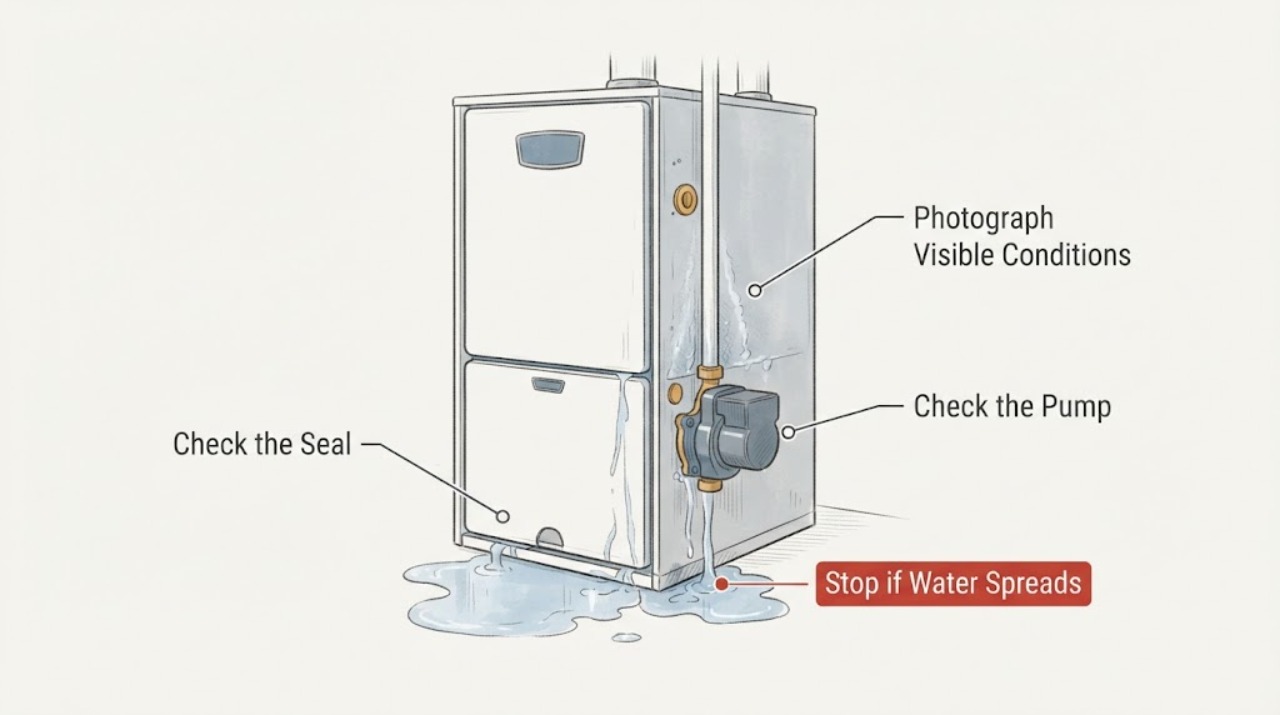
From a dry, stable position, identify the first visible wet point without touching the boiler: relief-valve discharge pipe, drain or condensate hose, threaded fitting, circulator area, pipe joint, underside of the cabinet, or floor below. Note whether the water is a drip, spray, stream, or only dampness.
Expected result: The wetness may begin at a pipe or valve, appear beneath the boiler jacket, emerge only during a heating cycle, or be impossible to trace safely.
Next step: Take a photograph and keep clear. If the source is inside the cabinet, hot, pressurized, or near electrical controls, stop and request urgent qualified service rather than opening anything.
Stop if: Do not touch hot water or steam, wipe a pressurized discharge, remove insulation, or place hands near electrical controls or gas components.
Why this matters
Why: A relief or drain path suggests a pressure or discharge issue; a joint can indicate a seal or corrosion problem; water from inside the jacket or near controls points toward concealed equipment damage. The lowest puddle is not necessarily the source.
-
Check 2
Without deliberately running the boiler to reproduce an active leak, compare the visible leak timing with an ordinary heating call: note whether it begins as the boiler warms, becomes stronger at high heat, continues after the burner or pump stops, or appears while the system is cold.
Expected result: The leak may be heating-dependent, continuous, delayed after shutdown, or present only when the system is cold.
Next step: Record the timing and stop using the boiler if the leak is active, increasing, or producing water near electrical equipment. Do not run repeated cycles for comparison.
Stop if: Stop immediately for steam, spraying water, hissing gas, smoke, burning odor, exposed wiring, or any sign of overheating or unstable pressure.
Why this matters
Why: Heating-dependent flow makes thermal expansion, pressure-relief discharge, a heat-affected seal, or condensate behavior more plausible. A cold continuous leak makes a supply connection, drain, corrosion, or failed component more plausible. These are patterns, not a confirmed diagnosis.
-
Check 3
If the boiler has a clearly visible pressure-and-temperature gauge, read and photograph it from outside the equipment at a cold or idle state and again only during normal operation if no hazard or active spray is present. Do not remove the gauge, alter a valve, or use the reading to justify a repair.
Expected result: The gauge may remain stable, rise noticeably as the boiler heats, fluctuate with the leak, or be unreadable or outside the model’s marked normal range.
Next step: Give the readings and timing to a heating technician. Do not bleed radiators, add makeup water, drain the boiler, or change the relief or fill settings unless a qualified professional directs and performs that work.
Stop if: Do not stand over a relief outlet, test its lever, or continue observing if discharge is hot, forceful, or reaching electrical equipment.
Why this matters
Why: A heating-related pressure rise together with relief-pipe wetness makes expansion-tank, fill-valve, relief-valve, or system-pressure diagnosis more likely. A stable gauge does not rule out a seal, condensate, corrosion, heat-exchanger, or concealed leak.
-
Check 4
Classify the visible water without sampling it: clear condensate from a designated drain, water at a fitting or relief discharge, rust-colored staining, or water emerging from the boiler body or controls. Note whether a condensate hose or floor drain is visibly disconnected or blocked without moving the hose or opening the boiler.
Expected result: A designated condensate path may be wet, a relief path may drip during heating, a joint may show corrosion, or water may come from an inaccessible internal area.
Next step: Photograph the path and arrange service. Do not clear a blocked condensate trap, tighten fittings, replace a relief valve, or open the cabinet as a homeowner repair.
Stop if: Do not touch water that may be hot or chemically contaminated, disturb venting, or allow water to remain around electrical controls.
Why this matters
Why: High-efficiency condensate, pressure-relief water, corroded seals, and internal heat-exchanger leaks have different service paths. Peerless notes that frequent makeup water indicates a system leak, while Viessmann identifies corrosion and heat-exchanger faults as professional diagnoses.
-
Check 5
Check the room and controls for secondary hazards from a safe position: water on electrical equipment, a carbon-monoxide alarm, gas odor, unusual flue or combustion noise, smoke, dizziness, headache, nausea, or a boiler that has been under water. Record the hazard and do not investigate inside the cabinet.
Expected result: There may be no secondary warning, or there may be water near controls, gas or combustion concern, a CO alarm, or symptoms consistent with possible CO exposure.
Next step: For a CO alarm or possible symptoms, leave immediately for fresh air and call emergency services from outside; do not re-enter or operate the boiler until cleared and serviced. For water near electrical or gas concerns without a CO alarm, stop the boiler from a safe control if possible and obtain urgent qualified help.
Stop if: Never search for the source of CO, relight a pilot, reset a safety control, or re-energize a boiler that has been wet or exposed to combustion hazards.
Why this matters
Why: A wet control area can create electrical damage; a fuel-burning or flue problem can create fire or CO risk. A CO alarm or possible symptoms is an emergency decision, not a boiler troubleshooting branch.
Use your observations
Decision map
Find the observation that best matches what you see, then follow the next safe action.
-
PATH 01Next step
What you see
Water appears at the relief discharge and the visible pressure rises as the boiler heats.
Do this next
Pressure-expansion, expansion-tank, fill-valve, or relief-valve diagnosis becomes more likely. Keep the boiler off and have a qualified heating professional correct the cause; do not plug, cap, or manually test the relief outlet.
-
PATH 02Next step
What you see
The leak is from a pipe joint or fitting and is worse when hot, with no water near electrical controls.
Do this next
A heat-affected seal, joint, or corrosion issue is possible. Do not tighten a hot or pressurized fitting; arrange prompt hydronic service and provide the exact joint and timing.
-
PATH 03Next step
What you see
Water is from the boiler body, inside the jacket, a heat-exchanger area, or an inaccessible location.
Do this next
Treat it as a concealed equipment leak and leave the boiler off. Viessmann identifies internal heat-exchanger diagnosis as contractor work; do not remove the cover or attempt a seal repair.
-
PATH 04Next step
What you see
The water is limited to a designated condensate path on a high-efficiency boiler and no electrical, gas, or CO warning is present.
Do this next
Condensate drainage is one possibility, but a blocked or disconnected path still needs model-specific guidance. Observe without moving the hose or opening the cabinet, and call service if the condensate is excessive, backs up, or reaches controls.
-
PATH 05Next step
What you see
The leak continues while cold, the system needs frequent makeup water, or the pressure reading is unstable or unreadable.
Do this next
Do not keep refilling or cycling the boiler. A system leak, fill-valve problem, corrosion, or pressure-control issue needs prompt heating service to prevent further water loss and damage.
-
PATH 06Next step
What you see
A CO alarm sounds, anyone has possible CO symptoms, there is gas odor, smoke, or water has reached electrical controls.
Do this next
Leave the area or home as appropriate, call emergency services or the gas utility from a safe location, and do not re-enter or operate the boiler until qualified responders and service personnel clear it.
Helpful context
Understand the symptom
The change with heating is diagnostically useful. In a closed hot-water system, heating can make pressure rise; a relief valve may discharge, while a weak seal or corroded fitting may leak more when hot. On a condensing boiler, some water may be normal condensate, but a leak from the boiler body, a control area, or a relief discharge cannot be diagnosed by appearance alone.
Find the first wet point rather than assuming the lowest puddle is the source. Keep the boiler and surrounding floor dry where possible without wiping hot or pressurized parts. A photo taken from a safe distance, the gauge position while cold and heating, and the exact timing are more useful than repeatedly firing the boiler to reproduce the leak.
Do not remove the boiler cover, loosen a fitting, bleed a radiator, open a drain, test or reset a relief valve, adjust the fill valve, or work on gas, flue, electrical, or pressure-loaded parts. A fuel-burning boiler also has a combustion and carbon-monoxide boundary that only qualified service should cross.
Safety boundary
Stop conditions
- Stop immediately for a CO alarm, possible CO symptoms, gas odor, smoke, fire, spraying or steaming water, abnormal heat, or water near electrical controls.
- Do not remove the boiler cover, loosen fittings, operate or plug a relief valve, bleed radiators, add or drain water, adjust fill or gas controls, or work on pressure-loaded parts.
- Do not run repeated heating cycles to reproduce a leak, relight a pilot, reset a safety control, or re-energize a boiler that has been under water.
- Keep clear of hot-water and steam discharge and arrange qualified heating service for any active, heating-dependent, internal, or unresolved leak.
- Use a qualified boiler or heating professional for relief valves, expansion tanks, fill valves, circulators, heat exchangers, seals, piping, flues, gas, electrical, and combustion work.
Only after diagnosis
Potential parts
- boiler pressure-relief valve
Consider only after a qualified technician confirms the relief valve is leaking or has opened and identifies why system pressure is reaching it.
Valve connection, discharge arrangement, and rating are model and installation specific; do not select one to stop a leak without diagnosis. - boiler expansion tank
Consider only when professional testing confirms expansion-tank sizing, charge, bladder, or waterlogging is causing heating-related pressure rise or relief discharge.
Tank capacity, connection, and system design must be confirmed by a qualified heating professional. - boiler circulator seal or flange gasket
Consider only when the leak is traced to a circulator connection and the technician confirms the correct seal or gasket for that installation.
Confirm the exact pump, flange, gasket material, temperature, and pressure requirements before selection. - boiler heat exchanger
Consider only after a qualified technician confirms an internal heat-exchanger leak or corrosion failure; a puddle alone does not justify this part.
Heat exchangers are highly model-specific and require professional installation, combustion checks, and manufacturer procedures.
When checks do not resolve it
Need a professional?
Call a qualified boiler or heating professional promptly for any leak, especially when it changes with heating, comes from a relief discharge or boiler body, accompanies pressure changes or frequent makeup water, or requires opening the cabinet. Treat a CO alarm, possible CO symptoms, gas odor, smoke, spraying or steaming water, abnormal heat, or water near electrical controls as an urgent emergency; leave and call from a safe location.
Have this ready
- Boiler brand and complete model
- First wet point and photographs from a safe position
- Whether the leak starts or increases during heating
- Gauge observations without changing any valve
- Whether the unit is gas, oil, electric, steam, or hot-water, plus any CO, gas, electrical, heat, or water hazard
Common questions
FAQ
Why does my boiler leak more when the heat is on?
Heating can change pressure and expose a weak seal or fitting. If the water is at a relief discharge and the gauge rises, pressure-expansion or relief-system issues become more likely; water from the boiler body, a joint, or a condensate path has a different service path. Do not keep cycling the boiler to test it.
Should I open the boiler cover to find the leak?
No. Viessmann says cover removal and repairs require a qualified mechanical contractor. Photograph the visible source from a safe position and arrange service, especially if water is near controls or the leak is hot or pressurized.
Can I plug a leaking pressure-relief outlet?
No. Do not plug, cap, block, or manually test a relief outlet. A discharge can indicate excessive pressure or another system fault, so leave the boiler off and have a qualified heating professional diagnose it.
Should I keep adding water to a leaking boiler?
Do not repeatedly add or drain water as a workaround. PB Heat notes that frequent makeup water indicates a system leak and can contribute to corrosion. Record the gauge and leak timing and call a heating professional.
What if the boiler leak occurs with a gas smell or CO alarm?
Leave immediately for fresh air, call emergency services or the gas utility from outside, and do not re-enter or operate the boiler until responders and qualified service personnel clear it. Never investigate the source of a CO alarm from inside the home.
Read the exact guide
Official sources
- Contractor FAQPB Heat · Peerless boiler leak, makeup-water, relief-valve, expansion-tank, and fill-valve relationships
- Carbon Monoxide Fact SheetU.S. Consumer Product Safety Commission · Fuel-burning appliance carbon-monoxide hazards, alarm response, symptoms, evacuation, and qualified-service boundary
- Boiler Leaking Water? Here’s What to CheckViessmann US · Manufacturer boiler water-leak source identification, pressure and relief-valve clues, corrosion, heat-exchanger risk, and qualified repair boundary
Community feedback
Share a repair observation
Share a plain-text repair observation. Accepted observations are published automatically; this page may take a moment to update.