
On this page
Start here
Quick answer
Water coming from a boiler pressure relief valve or its discharge pipe is a safety signal, not a routine drip to cap or test. From a dry, safe position, note where the water appears, whether it is hot or forceful, what the visible gauge is doing, and whether water is approaching electrical equipment. If the heating control can be stopped without entering a hazardous area, stop the call for heat and arrange a qualified heating professional; leave the valve and its discharge path untouched. Move away and use urgent or emergency help for steam, a forceful discharge, rapid flooding, gas odor, smoke, or water near electrical equipment.
Before you begin
Safety first
- Do not cap, plug, lift, test, adjust, or obstruct the relief valve or discharge pipe. Do not open the boiler, work on pressure, gas, electrical, or hot-water components, or restart the system to reproduce the leak.
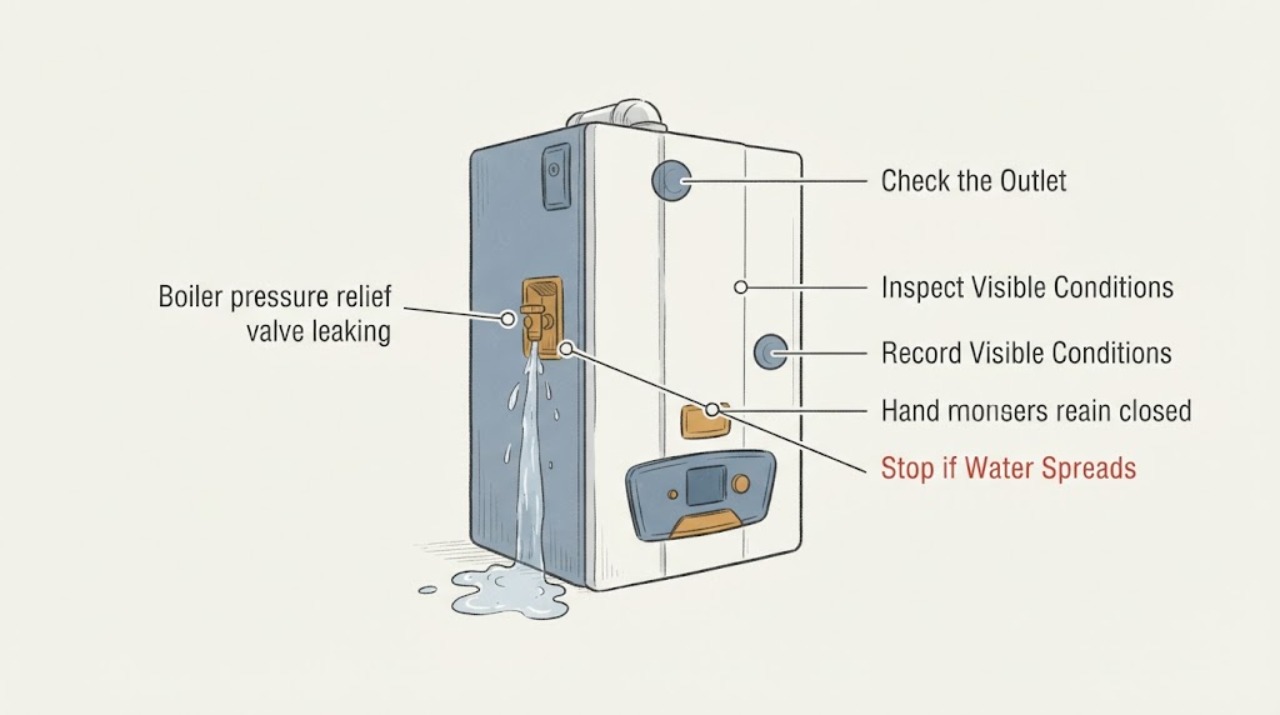
Work through in order
Diagnostic checks
Use only checks that match the exact appliance or system and its official guide.
-
Check 1
From a dry position outside the equipment area, visually trace the water without touching anything: note whether it appears at the relief-valve body, the visible discharge pipe, the discharge outlet, or a nearby boiler fitting.
Expected result: Record the apparent source, whether the flow is a drop, intermittent drip, stream, or spray, and whether the valve or pipe is visibly corroded or damaged.
Next step: Photograph the location from a safe distance and give the source description to a qualified heating professional. Do not move the discharge pipe or try to prove the source by touch.
Stop if: Stop and move away if the flow becomes forceful, hot, steamy, spraying, or difficult to observe without entering a wet or hazardous area.
Why this matters
Why: Water at the valve or outlet keeps the relief-valve path as the leading concern; water that begins at another fitting may be a different boiler leak. The exact source still needs professional confirmation.
-
Check 2
Observe the discharge area and floor from a safe location, keeping clear of the outlet and any accumulating water.
Expected result: Note whether the water looks hot or produces steam, whether it is spreading toward walls or electrical equipment, and whether the floor is becoming slippery or flooded.
Next step: For hot, forceful, steamy, rapidly spreading, or electrical-adjacent water, leave the area and contact appropriate emergency or urgent building help. Do not handle wet equipment or the valve.
Stop if: Stop observation immediately for steam, splashing pressure, smoke, gas odor, electrical arcing, a burning smell, or unsafe footing.
Why this matters
Why: Hot or forceful discharge can burn and indicates a higher-urgency condition; water approaching electrical equipment or causing flooding adds an immediate hazard regardless of the original leak source.
-
Check 3
If a boiler pressure or temperature display is already visible without opening anything or reaching through wet areas, read it once and record the displayed trend; do not change a setting.
Expected result: Record whether the display appears stable, rising, unusually high for that appliance, blank, or alarmed, without assuming a universal normal value.
Next step: Send the exact displayed text or a safe photograph to the heating professional, together with when the water was seen. Keep the boiler out of service unless a professional gives different instructions.
Stop if: Stop if reading the display would require opening a panel, touching controls near water, leaning over hot surfaces, or entering an unsafe area.
Why this matters
Why: A rising, alarmed, or unavailable reading gives the technician useful urgency context, but the display alone cannot establish the cause or make it safe to continue operating.
-
Check 4
Compare the timing of the visible leak with the ordinary heating schedule using existing observations only; do not restart the boiler or create another heating cycle.
Expected result: Note whether the leak was present while the system was idle, appeared during a normal call for heat, continued after heat stopped, or has increased over time.
Next step: Write down the time, duration, weather or heating context, and whether the flow changed, then provide that record during the service call.
Stop if: Stop tracking and leave the area if the leak accelerates, the boiler area becomes hot or smoky, or water reaches electrical equipment.
Why this matters
Why: Timing helps a professional compare heat-related expansion with a persistent leak, but it does not justify a user test or prove that the relief valve itself has failed.
-
Check 5
From outside the equipment enclosure, document visible water staining, rust, damp flooring, or damage to nearby walls and stored items without wiping, probing, or opening the boiler.
Expected result: Note the approximate spread and whether damage is confined to the boiler base or extends along the floor, wall, or nearby equipment.
Next step: Keep people away from the wet area, protect belongings only from a dry safe position, and tell the professional whether the spread is growing.
Stop if: Stop if the floor is slippery, the ceiling or wall is damaged, water contacts electrical equipment, or entering the area would require stepping through water.
Why this matters
Why: A wider wet area raises the risk of property damage and may mean the boiler should remain isolated until a professional assesses it; a dry surrounding area does not rule out a pressurized leak.
Use your observations
Decision map
Find the observation that best matches what you see, then follow the next safe action.
-
PATH 01Safety boundary
What you see
The discharge is hot, steamy, forceful, rapidly increasing, or accompanied by a rapidly changing visible gauge.
Do this next
Leave the boiler area, keep others away, and seek urgent qualified heating help; use emergency services for immediate fire, burn, flooding, or electrical danger.
Why this path and its safety boundary
Safety stop: Do not approach, touch, operate, cap, or obstruct the relief valve or discharge pipe.
-
PATH 02Safety boundary
What you see
Water is spreading toward electrical equipment, the floor is flooding, or the source cannot be observed without entering a wet or unsafe space.
Do this next
Leave the area and use urgent building or emergency help as appropriate. Tell the responder that a boiler is leaking near possible electrical or flood hazards.
Why this path and its safety boundary
Safety stop: Do not touch wet controls, wiring, appliances, or standing water.
-
PATH 03Safety boundary
What you see
The leak appears cool or slow, the area is dry and stable, and no immediate hazard is present.
Do this next
Keep the boiler out of service if its heating control can be stopped safely, document the observations, and arrange a qualified heating professional promptly.
Why this path and its safety boundary
Safety stop: Do not treat a slow leak as harmless or resume operation to see whether it returns.
-
PATH 04Safety boundary
What you see
The visible water seems to originate from a nearby fitting rather than the relief-valve body or outlet.
Do this next
Report the alternate location and timing; the professional should identify whether the source is a circulator connection, expansion component, or another boiler joint.
Why this path and its safety boundary
Safety stop: Do not loosen fittings, drain the system, adjust pressure, or operate the relief valve to investigate.
Helpful context
Understand the symptom
A relief valve is intended to discharge when boiler conditions become unsafe. A leak can also be misidentified when water is actually coming from a nearby fitting, pump connection, or expansion component. The useful first step is to document the visible pattern without touching the valve, its handle, or the discharge pipe. A professional can then distinguish the source and check the boiler's pressure-control components safely.
Do not cap, plug, hold open, lift, adjust, or otherwise operate the pressure relief valve, and do not open the boiler cabinet or perform a pressure, gas, electrical, or hot-water repair. Do not restart the system to reproduce the leak. Keep people and pets away from hot discharge water and arrange service promptly.
Only after diagnosis
Potential parts
- boiler pressure relief valve
Consider this category only if a qualified professional confirms that the relief-valve assembly is the leaking source and specifies the required rating and connection.
Confirm the boiler model, system design, valve rating, connection, and manufacturer or professional fitment before ordering. - boiler circulator flange gasket
This is relevant only when professional inspection identifies water at a nearby circulator flange rather than at the pressure relief valve.
Match the exact circulator, flange dimensions, temperature rating, and boiler system requirements; do not infer compatibility from appearance. - boiler expansion tank
Consider this category only if a professional links the relief discharge to an expansion-control problem and confirms that the tank needs service or replacement.
The professional must confirm system type, tank capacity, connection, pressure requirements, and manufacturer compatibility.
When checks do not resolve it
Need a professional?
Arrange a qualified heating professional for any confirmed or suspected pressure-relief-valve leak, even when the drip is slow. Seek urgent or emergency help for hot or forceful discharge, steam, rapid flooding, gas odor, smoke, electrical contact, or unsafe access.
Safety scope: Do not cap, plug, lift, test, adjust, or obstruct the relief valve or discharge pipe. Do not open the boiler, work on pressure, gas, electrical, or hot-water components, or restart the system to reproduce the leak.
Have this ready
- Provide the apparent source, flow pattern, hot-versus-cool observation, visible gauge text or trend, timing, spread of water, photos taken from a safe distance, and the boiler brand/model label only if it can be read without opening or approaching a hazard.
Common questions
FAQ
Can I cap or plug a leaking boiler pressure relief valve?
No. Do not obstruct or operate the valve or its discharge path. Treat the leak as a safety issue and have a qualified heating professional assess it.
Is a slow drip from the relief valve safe to ignore?
No. A slow drip still needs prompt professional assessment. Record the source and timing from a safe position, and escalate immediately if it becomes hot, forceful, steamy, or rapidly spreading.
Could the water be coming from something next to the relief valve?
Yes. Nearby boiler fittings, a circulator connection, or an expansion component can look similar from a distance. Do not disassemble anything; provide the apparent source and photos to the professional.
Read the exact guide
Official sources
- Frequently Asked QuestionsWeil-McLain · Manufacturer guidance says a leaking boiler should be referred to the installer or a professional heating contractor.
- Technical Operations and Maintenance Guidelines for Common Water EquipmentU.S. Department of Energy · The guidance recommends inspecting and reporting leaks or damaged equipment and following manufacturer instructions.
- HVAC: A Guide for Contractors to Share with HomeownersU.S. Department of Energy · The guide discusses boilers, expansion tanks, pumps, and professional checks of pressure-relief equipment in hydronic systems.
Community feedback
Share a repair observation
Share a plain-text repair observation. Accepted observations are published automatically; this page may take a moment to update.