
On this page
Start here
Quick answer
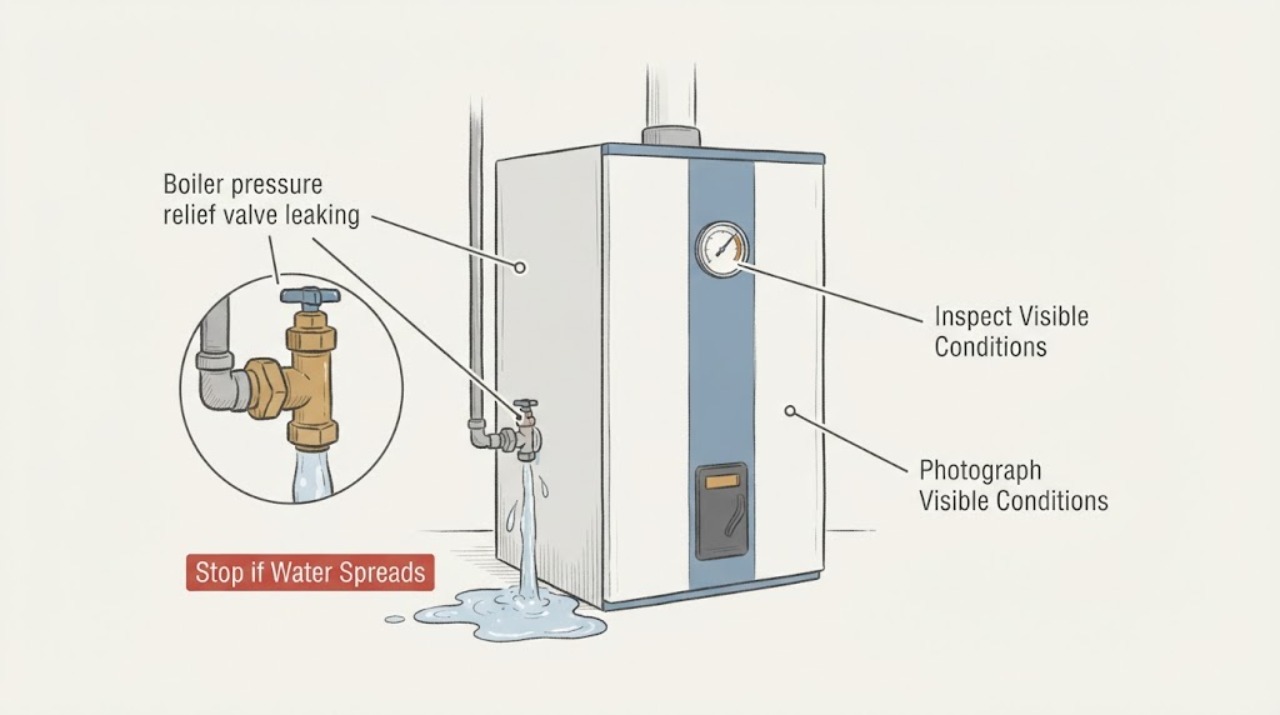
A Buderus boiler pressure relief valve that is dripping or discharging water is a safety symptom, not a valve to cap, plug, or repeatedly reset. First keep clear of hot water and identify whether water is coming from the relief-valve outlet, the valve body or threaded connection, a nearby pipe, or a condensate path. With the boiler cool, read the pressure gauge and note whether pressure rises during heating, the discharge is continuous or intermittent, and whether the system was recently filled or serviced. Buderus installation instructions require a listed relief valve, an unrestricted drainable discharge path, and an expansion vessel of sufficient capacity; they reserve installation, pressure, gas, and maintenance work for qualified personnel. Turn off the heating call and arrange qualified boiler service, urgently if water is hot, pressure is rising, discharge is forceful, the gauge is near or beyond the model limit, the burner or electrical area is wet, or the boiler has a gas or flue concern.
Before you begin
Safety first
- Keep the boiler off for hot or forceful discharge, abnormal pressure, blocked relief path, flooding, water near electrical or combustion components, gas or flue concern, or severe noise. Do not cap or test the valve, refill or pressure-test the system, open gas or electrical compartments, or restart to reproduce the leak.
Work through in order
Diagnostic checks
Use only checks that match the exact appliance or system and its official guide.
-
Check 1
Turn off the heating call from the thermostat or boiler control and keep people away from the relief-valve outlet. From a safe, dry position look for hot or forceful discharge, steam, flooding, water near electrical parts, an active burner or flue concern, gas odor, or a gauge that is rapidly rising. Do not touch the valve, discharge pipe, or hot boiler surfaces.
Expected result: The discharge is hot or forceful, water is flooding, the electrical or burner area is wet, pressure is rapidly rising, gas is smelled, or the leak is a cool slow drip with no other hazard.
Next step: For an urgent condition, leave the area as appropriate, shut down the boiler only from a safe control location, and obtain qualified or emergency help. For a cool slow drip, keep the heating call off and continue visual identification without handling the valve.
Stop if: Do not approach, catch, redirect, cap, plug, or test a hot or forceful relief discharge, and do not operate the boiler when water is reaching electrical or combustion components.
Why this matters
Why: Hot or forceful discharge, rapidly rising pressure, water near electrics, or gas/flue symptoms are urgent safety conditions. A cool slow drip still means the safety component or system needs qualified diagnosis; it is not a user-adjustable leak.
-
Check 2
With the boiler off and cool, identify where the water first appears by looking—not wiping or touching—at the relief-valve outlet, the valve body and threaded connection, the discharge-pipe joints, nearby boiler supply or return fittings, the pressure gauge, and any condensate drain. Take a photograph from a safe distance for the technician.
Expected result: Water exits the relief discharge, beads at the valve body or threaded joint, appears at another pipe or gauge, or comes from the condensate route rather than the relief outlet.
Next step: Keep the boiler off and report the first visible source and whether the discharge is continuous or intermittent. Do not tighten fittings, remove the valve, or apply sealant while the system may be hot or pressurized.
Stop if: Do not touch hot water, loosen threaded connections, place a hand under the outlet, or obstruct the discharge line while locating the leak.
Why this matters
Why: Outlet discharge points toward a pressure or valve-seat event; a body or fitting leak points toward the valve or connection; another location may be a separate boiler-water or condensate leak. A wet pipe can carry water away from its first source.
-
Check 3
Read the Buderus boiler pressure gauge visually when the system is cool and note the exact model from the rating plate or manual. If there is no active hazard, compare the gauge again during an ordinary heating call without adjusting any valve or adding water; stop observing if pressure climbs rapidly or approaches the model's stated limit.
Expected result: Pressure is stable when cool, pressure rises noticeably during heating, the gauge is near or beyond the model limit, the gauge does not move, or no reliable gauge reading is available.
Next step: Leave the heating call off and give the technician the cool and heating observations. Do not use a generic pressure target, bleed radiators, refill the system, or adjust the fill or safety valves without the exact model procedure and qualified service.
Stop if: Stop the observation immediately for rapid pressure increase, hot or forceful discharge, unusual boiler noise, steam, flooding, or water near electrical or combustion components.
Why this matters
Why: A heating-related pressure rise makes expansion, fill, isolation, or system-temperature conditions more likely than a simple external drip. A gauge near or beyond the model limit is an urgent escalation; a stuck or unreadable gauge cannot clear the pressure concern.
-
Check 4
Review whether the boiler was recently filled, bled, serviced, converted, or had plumbing work nearby. Without opening the boiler, look for a fill or makeup-water valve that appears not fully closed, a newly installed check or isolation valve, or a changed discharge pipe routing; do not operate any of them.
Expected result: The leak began after filling or service, the makeup connection appears open, a valve was added near the boiler, the discharge route is newly changed, or no recent work is known.
Next step: Photograph the visible arrangement and tell the qualified technician what changed and when. Keep the boiler off if pressure is high or water is hot; do not close a valve that might isolate the relief valve from the boiler or defeat the safety path.
Stop if: Do not manipulate a fill, isolation, gas, or relief valve, and do not perform pressure tests or leak tests as a homeowner.
Why this matters
Why: Recent filling or altered piping can explain a temporary pressure event or an incorrect safety arrangement, while no recent work does not rule out expansion-vessel, valve, corrosion, or control failure.
-
Check 5
Inspect the visible discharge line from a safe position for a cap, plug, reducer, kink, frozen section, upward trap, or obstruction, and confirm that its end is not directed at people, wiring, or combustible materials. Do not alter the line; compare only with the exact Buderus manual or installation record.
Expected result: The line is restricted, capped, damaged, frozen, unsupported, routed unsafely, or appears open and drainable.
Next step: Keep the boiler off and have a qualified installer correct the discharge arrangement and inspect the valve. If the line appears open but the valve still drips, pressure, expansion, valve-seat, or another leak path remains possible.
Stop if: Never cap or plug the discharge, add an isolation valve or reducer, direct water onto electrical equipment, or remove the line while pressurized.
Why this matters
Why: Buderus requires the relief discharge arrangement to drain completely and prohibits restrictions or a valve between the PRV and boiler. A restricted line can prevent safe discharge and cannot be corrected by capping or improvising a route.
-
Check 6
From outside the cabinet, note whether the discharge is a one-time event, repeats only during heating, continues while the boiler is idle, or follows system filling. Record boiler temperature, pressure trend, leak location, and any relief-valve noise; do not lift the manual test lever or run the burner to reproduce the leak.
Expected result: The valve discharges only as the boiler heats, drips continuously while idle, discharges after filling, or the pattern cannot be reproduced without unsafe operation.
Next step: Keep the heating call off and arrange qualified service, providing the pattern and photos. The technician should verify the expansion vessel, pressure controls, fill arrangement, valve rating, valve seat, and connected boiler piping for the exact model.
Stop if: Do not repeatedly fire the boiler, open the relief valve by hand, or refill the system to see whether the drip stops.
Why this matters
Why: Heating-only or post-fill discharge makes pressure or expansion behavior more likely; continuous idle dripping can indicate a valve-seat or connection problem. No safe reproduction does not make a leaking safety valve acceptable.
-
Check 7
Prepare the exact Buderus model, fuel type, installation year if known, pressure-gauge readings, photos, discharge timing, and recent service history for a qualified boiler technician. Leave the system in the safe shutdown state until the relief path and pressure cause have been evaluated.
Expected result: The leak is persistent, the pressure trend is abnormal, the valve or piping is corroded or damaged, the system cannot be safely shut down, or the symptom has stopped.
Next step: Arrange qualified Buderus or hydronic-boiler service and request inspection of pressure, expansion, fill, relief-valve rating and seat, discharge routing, boiler water circuit, and any wet electrical or combustion area. Do not order a replacement valve until the technician confirms the exact specification and cause.
Stop if: Do not operate the boiler unattended or return it to service merely because visible dripping pauses; keep it off for hot discharge, abnormal pressure, damage, or any gas/flue/electrical concern.
Why this matters
Why: A stopped drip does not prove that the valve reseated safely; sediment, pressure cycling, or a damaged component can recur. Persistent or damaged conditions require model-specific service, and inability to shut down safely raises urgency.
Use your observations
Decision map
Find the observation that best matches what you see, then follow the next safe action.
-
PATH 01Next step
What you see
Water is visibly leaving the relief-valve discharge, especially during heating or when the pressure gauge rises, while the valve body and nearby fittings are not the first wet point.
Do this next
Keep the heating call off and arrange qualified service to evaluate pressure, expansion-vessel capacity, fill or check-valve arrangement, boiler temperature, and the relief valve. Do not cap or test the outlet.
Why this path and its safety boundary
Why it matters: A pressure or expansion event is more likely than a simple fitting leak; a valve that has opened may also fail to reseat cleanly.
-
PATH 02Next step
What you see
The valve drips continuously while the boiler is idle, the gauge is stable, and the first wet point is the valve body or threaded connection rather than the discharge end.
Do this next
Leave the boiler off and have the exact valve and connection inspected and replaced only by a qualified technician. Keep the discharge path open and do not tighten or seal the joint yourself.
Why this path and its safety boundary
Why it matters: A valve-seat, corrosion, seal, or connection problem is more likely than a heating-only pressure excursion, but a gauge that is inaccurate or isolated cannot rule out pressure.
-
PATH 03Next step
What you see
The leak began after filling, bleeding, plumbing work, or service, or a visible makeup-water or piping change is present.
Do this next
Document what changed and keep the heating call off until a qualified technician checks the system. Never close a valve that isolates the relief valve from the boiler or alter the safety discharge route.
Why this path and its safety boundary
Why it matters: A changed fill condition, trapped pressure, altered expansion arrangement, or incorrect valve/discharge installation becomes more likely than an unrelated new leak.
-
PATH 04Next step
What you see
The discharge line is capped, restricted, damaged, frozen, or incorrectly routed, or an isolation valve appears between the relief valve and boiler.
Do this next
Do not operate the boiler; obtain qualified boiler service to restore the approved, unrestricted discharge arrangement and check the valve and system pressure.
Why this path and its safety boundary
Why it matters: The relief path may not be able to discharge safely, independent of why the valve is opening.
-
PATH 05Next step
What you see
Water is near electrical controls, the burner, or flue area; the discharge is hot or forceful; pressure is rapidly rising or beyond the model limit; or there is gas odor, steam, flooding, or severe boiler noise.
Do this next
Keep clear, shut the boiler down only from a safe control location, avoid switches or contact with wet equipment when unsafe, and obtain qualified or emergency help. Do not restart to test.
Why this path and its safety boundary
Why it matters: This is an immediate burn, fire, gas, electrical, or overpressure hazard, not a routine dripping-valve adjustment.
-
PATH 06Next step
What you see
The visible drip stops, but the pressure trend was abnormal, the valve made a discharge noise, or the boiler has not yet been inspected.
Do this next
Keep the heating call off and schedule qualified inspection before returning the boiler to normal use. Provide the timing, gauge readings, and photographs.
Why this path and its safety boundary
Why it matters: A valve can stop discharging after pressure changes or reseating without proving that the underlying pressure, expansion, debris, or valve condition is resolved.
Helpful context
Understand the symptom
A relief valve may be doing its safety job—or may be damaged
Water at the discharge tube does not by itself prove that the valve is defective. A system-pressure rise, inadequate or isolated expansion vessel, recent filling, an incorrect or damaged valve, or debris at the valve seat can all change the diagnosis. The visible source and pressure trend matter more than the fact that the valve is wet. Because this is a hydronic boiler safety component, the useful homeowner check is observation and shutdown—not lifting the test lever or attempting to rebuild the valve.
Find the exact leak path without touching hot plumbing
Buderus instructions show the pressure relief valve near the boiler water connections and require a discharge line that can drain completely without a restriction. Look from a safe position at the end of the discharge pipe and around the valve body, threaded joint, nearby supply or return fittings, gauge, and condensate route. Water from the outlet during a pressure event is a different branch from a fitting leak or a failed boiler component. Do not put a hand under a discharge, wrap the valve, or block its outlet.
Pressure and expansion evidence belongs to a qualified technician
Record the gauge while the boiler is cool and again only as a visual observation during normal operation if no hazard is present. A rise that tracks heating, repeated discharge, or pressure that does not settle points toward system pressure, expansion, fill, or control issues. Buderus specifies that the expansion vessel must have sufficient capacity and that the valve and discharge arrangement must match the boiler design. Do not bleed, refill, adjust, or replace these components from a generic pressure value.
Safety boundary
Stop conditions
- Stop and obtain urgent qualified or emergency help for hot or forceful discharge, rapidly rising or excessive pressure, steam, flooding, water near electrical or combustion components, gas odor, flue concern, severe boiler noise, or a damaged or blocked relief path.
- Turn off the heating call and keep the boiler off for a persistent drip, abnormal pressure trend, suspected expansion-vessel or fill problem, corroded valve, or leak that returns after the system cools.
- Do not cap, plug, obstruct, redirect, lift-test, remove, tighten, or replace the pressure relief valve or discharge line as a homeowner check. Do not add a valve or reducer between the relief valve and boiler.
- Do not bleed, refill, pressure-test, open the cabinet, work on gas lines, touch wet electrical equipment, or restart the boiler to reproduce a safety discharge.
Only after diagnosis
Potential parts
- boiler pressure relief valve
Consider this only after qualified diagnosis confirms the installed valve is incorrect, damaged, corroded, contaminated, or unable to reseat after the pressure cause is addressed.
Relief-valve rating, connection, discharge arrangement, and code requirements are model- and system-specific. Confirm the exact Buderus model and qualified diagnosis before selecting a replacement. - boiler circulator flange gasket
Consider this only if inspection proves that water attributed to the relief area actually originates at a nearby circulator flange or hydronic connection rather than the relief valve outlet.
Gasket dimensions and materials vary by Buderus boiler and pump arrangement. Confirm the exact model, connection, and service diagnosis before ordering. - boiler expansion tank
Consider this only when qualified pressure testing confirms inadequate, failed, waterlogged, or improperly connected expansion capacity is causing repeated relief discharge.
Expansion-vessel size, connection, precharge, and system design must be selected by the exact boiler and hydronic layout. Do not substitute a tank based only on visible valve dripping.
When checks do not resolve it
Need a professional?
Request service for a continuous or recurring drip, any discharge during heating or after filling, a valve or connection leak, abnormal gauge behavior, a restricted discharge line, or any wet electrical, gas, burner, flue, flooding, or overpressure condition.
Safety scope: Keep the boiler off for hot or forceful discharge, abnormal pressure, blocked relief path, flooding, water near electrical or combustion components, gas or flue concern, or severe noise. Do not cap or test the valve, refill or pressure-test the system, open gas or electrical compartments, or restart to reproduce the leak.
Common questions
FAQ
Why is my Buderus boiler pressure relief valve leaking water?
Water may be discharging because system pressure rises during heating, expansion capacity or fill conditions are wrong, the valve has debris or damage, or the leak is actually at a nearby connection. Identify whether water exits the discharge tube or valve body, read the gauge only visually, turn off the heating call, and arrange qualified service. Do not cap or test the valve.
Is a dripping Buderus relief valve an emergency?
Treat hot or forceful discharge, rapidly rising or excessive pressure, steam, flooding, water near electrical or combustion parts, gas odor, or a blocked discharge path as urgent. A cool slow drip still needs qualified boiler service because the relief valve is a safety component and the underlying cause may recur.
Can I cap or plug the Buderus boiler relief-valve discharge?
No. Buderus installation instructions require an unrestricted discharge path that can drain completely and prohibit a valve or restriction between the relief valve and boiler. Keep the path open and have a qualified technician correct any cap, obstruction, or unsafe routing.
What should I check on the pressure gauge?
From a safe position, record the gauge when the boiler is cool and note whether it rises during heating or is near the exact model limit. Do not use a generic pressure target, refill, bleed, or adjust valves from this observation; give the trend to a qualified technician.
Could the expansion tank cause a Buderus relief valve to discharge?
It can be part of the pressure diagnosis. Buderus states that the expansion vessel must have sufficient capacity, and pressure that rises with heating makes expansion, fill, isolation, or control conditions more likely. Have a qualified technician test the vessel and connected system rather than replacing it from the drip alone.
Should I lift the relief-valve test lever to clear a drip?
No. Do not lift-test, tap, remove, tighten, or rebuild the valve as a homeowner check. A test can release hot water and may not correct the pressure or valve-seat problem. Turn off the heating call, keep clear, and arrange qualified service.
What information should I give the Buderus boiler technician?
Provide the exact model, fuel type, photos from a safe distance, first wet point, discharge timing, cool and heating gauge observations, boiler temperature if safely visible, recent filling or service, discharge-line condition, and any steam, noise, flooding, gas, flue, electrical, or burner symptoms.
Read the exact guide
Official sources
- Gas central heating boilersBuderus / Bosch Home Comfort · Official Buderus Logano G234X installation instructions; pressure values and procedures are model-specific.
- Installation instructionsBuderus / Bosch Home Comfort · Official Buderus Logamax plus GB162 installation instructions; dimensions and limits are model-specific and must not be generalized to another Buderus boiler.
- Technical Support ResourcesBosch Home Comfort · Bosch Home Comfort support index that directs owners to Buderus residential technical documents and maintenance information.
Community feedback
Share a repair observation
Share a plain-text repair observation. Accepted observations are published automatically; this page may take a moment to update.