
On this page
Start here
Quick answer
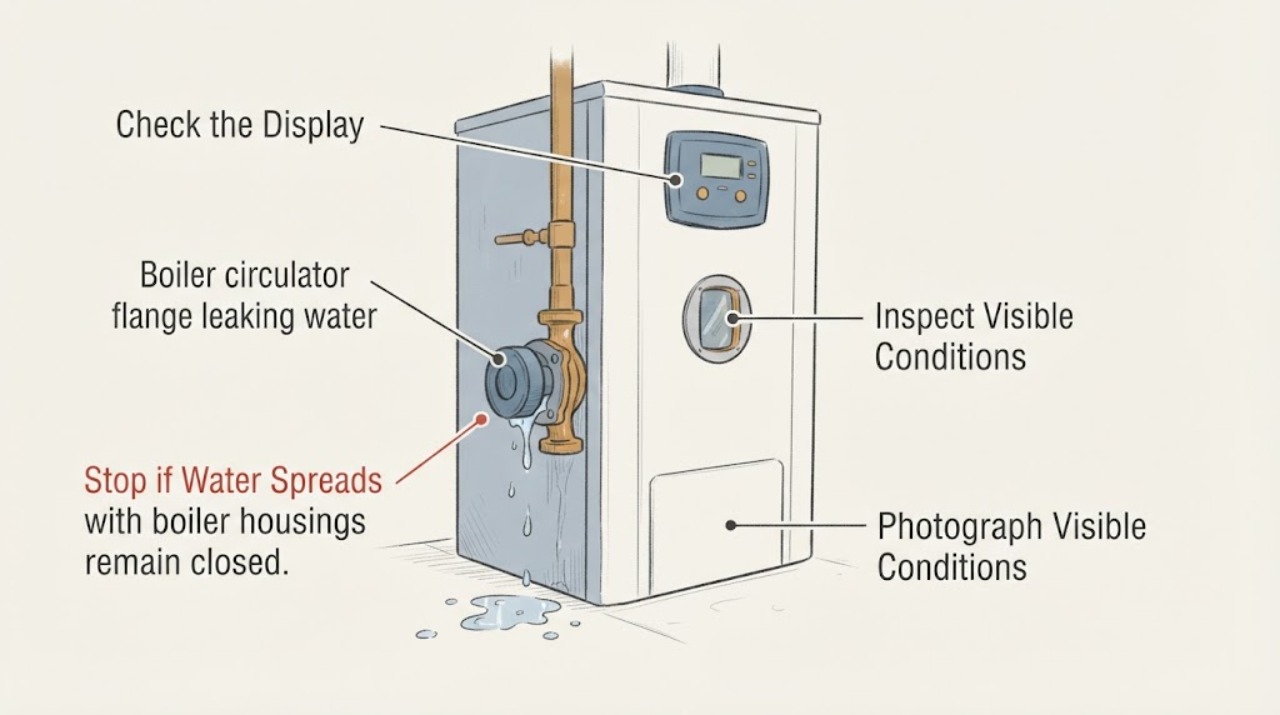
A leaking boiler circulator flange is a stop-and-call-professional problem, not a tightening or drain-down project for a homeowner. If the boiler controls are safely reachable and dry, stop the call for heat using the normal user control, keep clear of hot water and moving parts, and arrange a qualified heating professional. From a safe location, document where the water starts, whether it changes with a heating cycle, the visible gauge indication, and whether water is near electrical equipment. Do not open the boiler, loosen a flange, adjust pressure, drain a pressurized system, or touch wet electrical parts.
Before you begin
Safety first
- If safely reachable and dry, stop the heating call using the normal user control. Do not open the boiler, touch wet electrical parts, tighten or remove the flange, adjust pressure, drain a pressurized system, lift a relief valve, or run repeated tests.
Work through in order
Diagnostic checks
Use only checks that match the exact appliance or system and its official guide.
-
Check 1
From a dry, stable location, visually trace the water only as far as it can be seen without touching hot surfaces, insulation, valves, wiring, or the circulator; photograph the apparent first visible wet point.
Expected result: Note whether water appears at the circulator flange area, on a pipe above it, below a relief or drain component, or only at the floor; do not assume the lowest drip is the source.
Next step: Send the photograph and location to a qualified heating professional and keep the area clear; do not tighten fasteners, remove insulation, or wipe away evidence.
Stop if: Stop immediately if water is hot or forceful, the floor is slippery, steam is present, or water is reaching electrical equipment.
Why this matters
Why: A wet point near the flange supports an urgent circulator-area inspection, while water above or away from the flange may indicate another component or water tracking along the piping.
-
Check 2
If the normal thermostat or heating control is safely reachable from a dry position, observe whether the boiler is currently calling for heat and use only the ordinary user control to stop that call; do not open a panel or reach toward the boiler.
Expected result: Record whether the leak rate changes after the normal heating call ends, without deliberately restarting the boiler or running a test cycle.
Next step: Leave the heating call stopped and arrange professional service; use blankets or another safe temporary comfort measure rather than repeatedly cycling a leaking boiler.
Stop if: Do not touch any control if it, the floor, or the surrounding area is wet; leave the area and call for help if there is smoke, burning odor, gas odor, or electrical arcing.
Why this matters
Why: A leak that changes during heating or circulation is useful timing information, but a leak that slows does not mean the system is safe to operate or that the flange is confirmed as the cause.
-
Check 3
Read the boiler pressure gauge and temperature display only from a safe distance and only if the face is clearly visible without opening the cabinet or touching the equipment.
Expected result: Record the displayed indication and whether it is changing, unusually high or low for this installation, or unavailable; do not adjust a fill valve, relief valve, expansion tank, or pressure control.
Next step: Give the exact display observation and boiler model information to the heating professional; do not add water, bleed the system, lift a relief-valve lever, or drain it.
Stop if: Stop reading and move away for steam, rapid discharge, a loud relief event, a cracked gauge, or any sign that pressure or temperature is unsafe.
Why this matters
Why: A changing or abnormal-looking indication can help the technician assess whether the leak is affected by system pressure, but readings are model- and system-specific and cannot diagnose the flange from the display alone.
-
Check 4
Check the surrounding floor and visible equipment boundary for pooling, staining, corrosion, wet wiring, tripped protection, or water approaching an outlet, without kneeling in water or moving the boiler.
Expected result: Record the extent and whether the water is confined to the boiler-room floor or has reached walls, stored materials, electrical components, or another room.
Next step: Keep people and pets out, protect belongings only from a dry location, and call the appropriate professional; never touch wet switches, plugs, wiring, or panels.
Stop if: Stop all inspection for wet electrical equipment, standing water, smoke, fire, gas odor, a collapsing surface, or an inaccessible escape path.
Why this matters
Why: Pooling, water near electricity, or spread beyond the immediate area increases urgency and may require building or emergency response in addition to heating service.
-
Check 5
From outside the cabinet, record the boiler brand/model label if it is plainly visible and photograph the circulator area, flange shape, nearby valves, and any deposits without removing covers or labels.
Expected result: Note whether the flange area appears to have a single drip, a spray, mineral staining, corrosion, or a visibly displaced component; do not infer that a gasket, pump, or valve is the failed part.
Next step: Provide the model information, photos, leak timing, gauge observation, and whether the heating call was stopped when requesting service.
Stop if: Do not continue if getting the label requires opening the jacket, reaching over hot piping, climbing, or contacting any wet component.
Why this matters
Why: Clear identification and an undisturbed view can help the professional bring the correct diagnostic information, while a photo cannot establish compatibility or safe repair steps.
Use your observations
Decision map
Find the observation that best matches what you see, then follow the next safe action.
-
PATH 01Safety boundary
What you see
The flange-area leak is a slow visible drip, the boiler room is dry around electrical equipment, and there is no steam, gas odor, or structural water spread.
Do this next
Keep the normal heating call stopped if it was safely stopped, leave the equipment untouched, and arrange prompt qualified heating service with photos and timing notes.
Why this path and its safety boundary
Safety stop: Do not restart the boiler to test the leak or attempt to tighten the flange.
-
PATH 02Safety boundary
What you see
The leak is a stream, is rapidly worsening, changes system pressure, or is accompanied by steam or a relief discharge.
Do this next
Clear the area and obtain urgent professional help; do not approach the boiler to operate valves or drain the system.
Why this path and its safety boundary
Safety stop: Treat hot discharge, steam, rapid pressure change, or an unstable floor as an immediate stop condition.
-
PATH 03Safety boundary
What you see
Water is near wiring, controls, outlets, or other electrical equipment, or the floor is flooded.
Do this next
Do not touch switches, plugs, panels, or wet surfaces. Leave the area and contact appropriate emergency or building safety support together with heating service.
Why this path and its safety boundary
Safety stop: Keep everyone away until the electrical and water hazards have been made safe by qualified personnel.
-
PATH 04Safety boundary
What you see
The visible water does not clearly start at the circulator flange.
Do this next
Preserve the photos and have a qualified technician identify the source; the lowest drip point is not proof of a failed flange.
Why this path and its safety boundary
Safety stop: Do not remove insulation, covers, piping, or relief-valve parts to trace the leak.
Helpful context
Understand the symptom
Why a circulator-flange leak needs prompt service
The circulator is part of the boiler's hydronic piping, so a leak at a flange can involve hot water, system pressure, a gasket or connection, and nearby electrical components. The visible drip may not identify the failed part: water can travel along piping or insulation before it falls. A safe homeowner inspection should preserve the evidence and protect people and the equipment, while the qualified technician handles isolation, depressurizing, disassembly, repair, and recommissioning.
What to record before the technician arrives
Photograph the leak from a dry, stable position without touching the boiler or wiping away deposits. Record whether the system was calling for heat, whether the drip is continuous or intermittent, any visible gauge change, and whether water reached the floor, wiring, controls, or an outlet. These observations help distinguish a flange-area leak from a nearby relief, drain, or piping leak without turning the visit into a do-it-yourself repair.
Only after diagnosis
Potential parts
- boiler pressure relief valve
Consider this category only if a qualified technician confirms that the visible water originates at the relief-valve assembly rather than the circulator flange.
Confirm the boiler model, system design, required rating, and approved installation with the technician; do not choose a valve from appearance alone. - boiler circulator flange gasket
This category is relevant only if the technician confirms a failed flange seal and identifies the circulator/flange arrangement after the system is safely isolated and depressurized.
Match the exact boiler, circulator, flange dimensions, material, and manufacturer requirements; a generic-looking gasket is not assumed compatible. - boiler expansion tank
Consider this category only if professional diagnosis links abnormal system pressure or repeated relief discharge to an expansion-tank problem; it is not a default remedy for a flange leak.
Confirm system type, connection, capacity, and required precharge with a qualified heating professional; do not adjust or replace a pressurized tank as a homeowner.
When checks do not resolve it
Need a professional?
Call a qualified heating professional promptly for any boiler circulator-flange leak. Escalate urgently for a stream, hot discharge, steam, rapid worsening, pressure change, water near electricity, gas odor, smoke, or flooding.
Safety scope: If safely reachable and dry, stop the heating call using the normal user control. Do not open the boiler, touch wet electrical parts, tighten or remove the flange, adjust pressure, drain a pressurized system, lift a relief valve, or run repeated tests.
Have this ready
- Provide the boiler model visible from outside, leak location and rate, photos, whether the leak changes with a heating call, the visible gauge/display indication, and whether water reached electrical equipment or the floor beyond the boiler.
Common questions
FAQ
Can I tighten the leaking circulator flange?
Do not. A boiler flange can be hot and pressurized, and tightening or disturbing it can worsen the leak or create a new hazard. Stop the heating call if the normal control is safely reachable and arrange professional service.
Should I add water to a leaking boiler?
Not as a homeowner troubleshooting step. A visible pressure indication does not identify the cause, and adding water or adjusting system components can worsen the condition. Record the display and let a qualified technician assess it.
What if the leak appears to come from below the circulator?
The lowest drip is not necessarily the source; water can travel along piping or insulation. Photograph the highest visible wet point from a safe distance and have a professional trace it without opening the boiler yourself.
When is a boiler leak an emergency?
Leave the area and seek urgent help for hot or forceful discharge, steam, rapid worsening, smoke, gas odor, flooding, water near electrical equipment, a rapidly changing pressure indication, or an unsafe floor or escape route.
Read the exact guide
Official sources
- SlimFit Commercial Condensing Gas BoilerWeil-McLain · Illustrates that boiler piping and circulator arrangements vary by model; it is not evidence that this job uses a SlimFit boiler
- Technical Operations and Maintenance Guidelines on Common Water EquipmentU.S. Department of Energy, Federal Energy Management Program · General water-equipment O&M framing; not a boiler repair procedure or pressure specification for this topic
- Boiler FAQs and Common QuestionsWeil-McLain · General manufacturer safety and service-routing guidance; no model-specific diagnosis is assumed
Community feedback
Share a repair observation
Share a plain-text repair observation. Accepted observations are published automatically; this page may take a moment to update.