
On this page
Start here
Quick answer
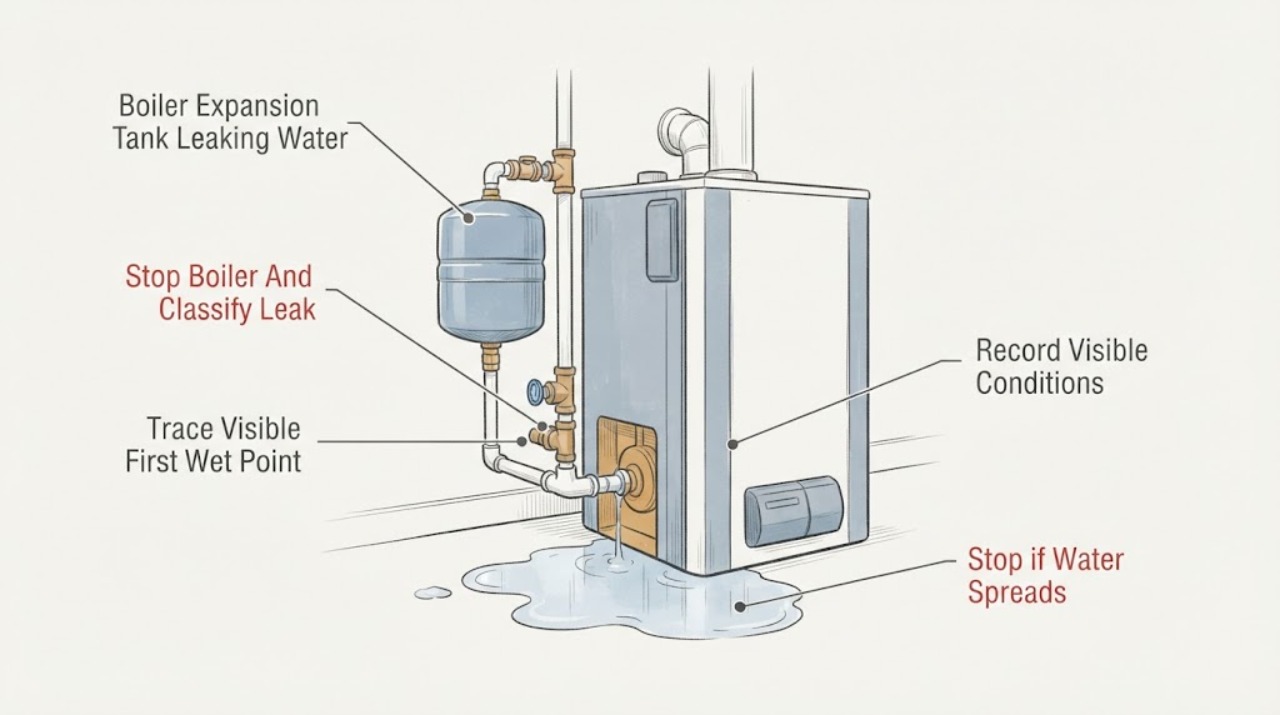
A leaking Buderus boiler expansion tank needs a safe identification check, not an immediate attempt to recharge or replace the tank. Turn the boiler off and keep people away from hot water or steam. From outside the casing, identify whether water is actually coming from the expansion tank, its connection, a pressure relief discharge, a nearby pipe, or the boiler itself, and note whether the system pressure rises when hot or falls after cooling. Do not remove the boiler casing, press the tank valve, open a relief valve, drain the system, add water, or work on gas or electrical parts. Buderus describes pressure loss and unusual pressure swings as signs of an expansion-vessel problem, while its maintenance guidance says water leaks require power, water, and gas isolation when safe and immediate qualified service. Arrange qualified boiler service for a wet or corroded tank, recurring pressure loss, relief discharge, or any continuing leak; seek urgent help for gas odor, steam, flooding, or a rapidly rising pressure indication.
Before you begin
Safety first
- This article supports only safe exterior observation, reading an accessible pressure indication, recording temperature and leak behavior, and isolating known utilities when safe. Expansion-vessel charging or replacement, system draining or filling, relief-valve work, pressure testing, and gas, electrical, or boiler-casing access require a qualified technician.
Work through in order
Diagnostic checks
Use only checks that match the exact appliance or system and its official guide.
-
Check 1
Stop the boiler's call for heat and observe from a safe distance. Note whether water is dripping, spraying, pooling, or steaming; whether the leak is from the tank shell, tank connection, relief discharge, nearby pipe, condensate area, or boiler casing; and whether there is gas odor, smoke, unusual noise, or a rapidly changing pressure indication.
Expected result: The leak is active or increasing, water is near electrical equipment, steam is present, gas odor is present, the pressure indication is abnormal, or the area is only damp with no active flow.
Next step: Keep clear and isolate the boiler's power, water, and gas supplies only if safe and the correct shutoffs are known. Otherwise leave the area and obtain qualified boiler or emergency assistance; do not restart to reproduce the leak.
Stop if: Stop immediately for gas odor, steam, spraying water, flooding, smoke, sparks, burning smell, or water contacting electrical components; do not touch switches or fittings in an unsafe area.
Why this matters
Why: An active leak, steam, gas odor, water near electrical parts, or rapidly changing pressure is a hazard requiring immediate shutdown and qualified help. A damp connection with no active flow still needs source identification, but does not prove the expansion tank has failed.
-
Check 2
When the boiler is off and cool enough to view safely, inspect only the exterior of the expansion tank, its visible connection, the pressure-relief discharge path, and adjacent water piping. Use a dry visual reference point or photograph rather than loosening insulation or fittings; do not remove the casing.
Expected result: The tank shell is wet or corroded, water begins at a threaded connection, the relief pipe is wet, a nearby pipe is the first wet point, or the source cannot be seen.
Next step: Record the first wet point, time, temperature state, and whether the leak continues while cool. Keep the boiler isolated and arrange qualified service for any wet tank, fitting, relief path, or uncertain source.
Stop if: Do not touch hot surfaces, tighten fittings, remove insulation or panels, open a drain or relief valve, or use leak-detection fluid on electrical or gas components.
Why this matters
Why: Water from the tank shell or a wet tank connection keeps tank failure or its connection in consideration; a wet relief discharge can instead reflect high system pressure or a relief-valve issue; a nearby pipe makes the expansion tank an unconfirmed suspect.
-
Check 3
If the pressure gauge or controller can be read from the normal user position, record its indication when the boiler is cool and again after normal heating only if no active leak, steam, gas odor, or other hazard is present. Do not remove a cover, connect a gauge, press a tank valve, bleed a radiator, or add water.
Expected result: Pressure rises substantially during heating, falls after cooling, remains low, remains stable despite a visible leak, or cannot be safely read.
Next step: Give the pressure trend and temperature state to the technician. Keep the boiler off when the leak or pressure behavior is abnormal; do not compensate by repeatedly topping up the system.
Stop if: Do not operate a boiler with a rapidly rising pressure indication, active discharge, low-water condition, steam, or a leak that is worsening, and never open a pressurized fitting.
Why this matters
Why: A large hot-to-cool swing or repeated low pressure is consistent with a vessel, relief, feed, or system-leak problem, but it is not a diagnosis of the tank. Stable pressure with a leak keeps a connection, vessel shell, relief path, condensate, or another pipe in consideration.
-
Check 4
Review recent boiler observations without changing the system: whether pressure has needed frequent restoration, the relief discharge has wet the floor, the boiler locks out on low water, radiators or pipes show dampness, or the leak began after service, filling, or a temperature change. Do not refill or bleed the system to see what happens.
Expected result: Water loss or low pressure recurs, a relief discharge follows heating, the problem began after filling or service, or no pressure history is available.
Next step: Write down dates, pressure indications, heating state, and visible leak points, then arrange qualified service. Do not repeatedly add water because Buderus warns that frequent topping up can damage a heating system through corrosion or scaling.
Stop if: Do not repeatedly top up, bleed, drain, or repressurize a leaking system, and do not keep operating it to collect more history.
Why this matters
Why: Recurring water loss and pressure swings support a system leak, expansion-vessel, relief, feed, or related hydraulic fault. A leak after service can also involve a connection or valve disturbed during work. No history means the source and trend need professional inspection rather than guesswork.
-
Check 5
From outside the boiler casing, check for a gas odor, flame or combustion warning, damaged wiring, discoloration, smoke, unusual heat, or water contacting controls. Do not look inside an open boiler or attempt a burner, gas, relief-valve, or electrical test.
Expected result: A gas odor, abnormal flame or combustion indication, wet control area, damaged wiring, smoke, or no such hazard is observed.
Next step: Shut down and isolate utilities only when safe, leave the boiler out of service, and arrange qualified boiler, gas, or electrical service. For strong gas odor or fire risk, leave the area and contact emergency or gas-utility help according to local guidance.
Stop if: Do not operate gas controls, light or inspect a burner manually, touch wet wiring, reset a fault repeatedly, or switch equipment in a strong gas odor.
Why this matters
Why: Gas, combustion, electrical, or water-on-controls symptoms raise the urgency beyond a tank leak and require the relevant qualified professional. The absence of those signs does not make a pressurized water leak safe to repair without training.
-
Check 6
Capture the Buderus model and serial information from an ordinary-access label without moving or opening the boiler. Record the expansion-tank location, first wet point, pressure trend, temperature state, leak frequency, relief discharge, utility shutdown, and any gas, electrical, or low-water indication for the service call.
Expected result: The tank remains wet, the leak recurs, pressure continues to fluctuate or fall, the relief path discharges, or the leak source remains uncertain.
Next step: Keep the boiler out of operation and arrange qualified Buderus boiler service. Provide the model, leak location, pressure record, heating state, and photos taken from a safe distance; do not order a tank or relief valve until compatibility and diagnosis are confirmed.
Stop if: Do not open the casing, remove the expansion tank, test its gas charge, drain the boiler, refill a hot system, or work on gas or electrical components.
Why this matters
Why: A persistent leak or pressure pattern needs model-specific inspection of the expansion vessel, vessel connection, relief valve, feed system, boiler water circuit, and adjacent piping. The tank cannot be condemned or selected for replacement from appearance or gauge movement alone.
Use your observations
Decision map
Find the observation that best matches what you see, then follow the next safe action.
-
PATH 01Safety boundary
What you see
Do this next
Keep the boiler isolated and arrange qualified service to confirm the source and determine whether the vessel or connection must be replaced.
Why this path and its safety boundary
Why it matters: A failed vessel, corroded shell, or tank connection is more likely, but a nearby leak can travel along the tank and mimic a shell leak.
Safety stop: Do not tighten, drain, remove, or repressurize the tank, and do not touch it while hot or pressurized.
-
PATH 02Safety boundary
What you see
Do this next
Do not operate or repeatedly refill the boiler. Provide the pressure trend and discharge location to qualified boiler service for inspection of the vessel, relief valve, feed, and system.
Why this path and its safety boundary
Why it matters: High pressure from an expansion-vessel, feed, or hydraulic problem is more likely than a simple tank-shell leak; a relief valve can also be involved.
Safety stop: Do not open the relief valve, block its discharge, change settings, or repressurize the system yourself.
-
PATH 03Safety boundary
What you see
Do this next
Stop normal operation and arrange qualified service to locate the leak and verify vessel function, pressure controls, and feed components.
Why this path and its safety boundary
Why it matters: A system leak, expansion-vessel fault, relief discharge, feed issue, or another hydraulic problem remains possible; repeated topping up can create additional system damage.
Safety stop: Do not keep topping up, bleed radiators, or operate a low-water or leaking boiler to maintain heat.
-
PATH 04Safety boundary
What you see
Do this next
Keep the boiler off if water is active or reaches controls, photograph the safe exterior, and arrange qualified service to trace the leak.
Why this path and its safety boundary
Why it matters: The expansion tank is not confirmed as the source; water can travel along piping and make the diagnosis misleading.
Safety stop: Do not remove insulation or casing, loosen a pipe, open a drain, or use the boiler to force the source to reveal itself.
-
PATH 05Safety boundary
What you see
Do this next
Leave the area if necessary, isolate power, water, and gas only when safe and known, and contact emergency, gas, electrical, or qualified boiler help as appropriate.
Why this path and its safety boundary
Why it matters: This is an immediate gas, electrical, hot-water, pressure, or property-damage hazard rather than a routine expansion-tank check.
Safety stop: Do not touch wet controls, switches, hot water, steam, gas fittings, or a pressurized tank, and do not restart the boiler.
Helpful context
Understand the symptom
Confirm the leak source before blaming the tank
Water near an expansion tank may come from the tank body, its threaded connection, a pressure-relief discharge pipe, an automatic vent, nearby boiler piping, or condensate rather than the tank itself. A wet surface is not enough to identify the failed component. Photograph or describe the first wet point from a safe distance, and do not wipe around hot or pressurized fittings to make the source appear dry.
Pressure behavior is a clue, not a user repair test
A functioning membrane vessel gives the heated-water volume somewhere to expand. Pressure that climbs as the boiler heats and falls after it cools, repeated low pressure, or frequent need for added water can fit a vessel, relief, feed, or system-leak problem. The pattern cannot distinguish those causes by itself. Record the gauge or controller indication only if it can be read without opening the boiler, and leave pressure testing and charging to qualified service.
Hot gas boilers need a firm service boundary
Buderus documentation treats the boiler, gas line, water system, pressure controls, and expansion vessel as professional equipment. Do not open the casing, test the vessel's air side, release system water, operate the relief valve, refill a hot system, or repair the gas or electrical side. If a leak is active, keep the area clear and isolate utilities only when you know the correct shutoffs and can do so without touching hot water, steam, gas, or damaged wiring.
Safety boundary
Stop conditions
- Stop the boiler for active or increasing water leakage, flooding, steam, rapidly changing pressure, gas odor, smoke, sparks, wet controls, damaged wiring, or any sign of fire; leave the area and obtain appropriate emergency or qualified help.
- Do not remove the boiler casing, expansion tank, relief valve, automatic vent, or insulation; do not open a drain or relief valve, press a tank valve, test charge pressure, or perform internal leak or combustion tests.
- Do not add water, bleed the system, repressurize it, or refill a hot boiler to keep it operating while the expansion tank or another leak is suspected.
- Do not block a pressure-relief discharge, alter pressure controls, touch hot water or steam, or work on gas and electrical parts as an ordinary user check.
- Keep the boiler out of service when the tank remains wet, pressure loss recurs, a relief path discharges, or the leak source is uncertain; arrange qualified Buderus service and provide the recorded observations.
Only after diagnosis
Potential parts
- boiler expansion vessel
Consider this part only when qualified diagnosis confirms a failed, waterlogged, corroded, or otherwise defective expansion vessel rather than a connection, relief, feed, or nearby piping fault.
Vessel size, connection, mounting, and system requirements vary by exact Buderus model and installation; confirm model fit and service procedure before ordering. - boiler pressure relief valve or connection seal
Consider this category only if service confirms that the wet relief path or vessel connection is the failed component after pressure and vessel function are diagnosed.
Relief-valve ratings, connections, seals, and local code requirements are installation-specific; do not substitute by appearance or pressure symptom alone. - boiler automatic feed or related water-side component
Consider this category only when qualified service finds that uncontrolled filling, a water-side valve, or another hydraulic component is driving pressure swings or repeated water loss.
Hydraulic component compatibility and adjustment are model- and installation-specific; diagnosis and installation belong to qualified boiler service.
When checks do not resolve it
Need a professional?
Arrange qualified Buderus boiler service for any wet or corroded expansion tank, leak at its connection, recurring pressure loss or pressure swing, relief discharge, frequent need to add water, or an uncertain leak source. Use urgent gas or electrical help for gas odor, combustion trouble, smoke, sparks, wet controls, damaged wiring, steam, flooding, or rapidly changing pressure. Provide the exact model and serial information if safely visible, first wet point, heating state, pressure trend, leak frequency, relief discharge, temperature, and any shutdown already made.
Safety scope: This article supports only safe exterior observation, reading an accessible pressure indication, recording temperature and leak behavior, and isolating known utilities when safe. Expansion-vessel charging or replacement, system draining or filling, relief-valve work, pressure testing, and gas, electrical, or boiler-casing access require a qualified technician.
Common questions
FAQ
How can I tell whether a Buderus boiler leak is from the expansion tank?
From a safe exterior position, identify the first wet point and distinguish the tank shell, its connection, a pressure-relief discharge, nearby piping, condensate, and the boiler casing. Water can travel along pipework, so a wet tank does not prove the tank itself has failed. Leave an active or uncertain leak to qualified service.
What pressure symptoms can a failed Buderus expansion vessel cause?
Buderus describes pressure loss, unusual pressure swings, and water loss as signs that an expansion vessel may be defective. Rising pressure during heating and falling pressure after cooling can also involve the relief valve, feed system, or another leak, so record the trend without opening or adjusting anything and arrange service.
Should I press the valve on a Buderus expansion tank to see if water comes out?
No. Do not press the vessel valve, test its gas charge, drain the system, or repressurize a leaking boiler as an ordinary user check. Expansion-vessel charge and system-pressure work require the exact model procedure and qualified service, especially while water may be hot or pressurized.
Can I keep adding water if my Buderus boiler expansion tank is leaking?
Do not repeatedly add water to keep a leaking or pressure-unstable boiler running. Buderus warns that frequent topping up can damage a heating system through corrosion or scaling. Keep the boiler out of service and have the expansion vessel, relief valve, feed, and water circuit diagnosed by a qualified technician.
When is a Buderus boiler expansion-tank leak an emergency?
Treat spraying or flooding water, steam, gas odor, smoke, sparks, wet controls, damaged wiring, rapidly changing pressure, or a strong active leak as an immediate hazard. Leave the area if needed, isolate known utilities only when safe, and contact appropriate emergency, gas, electrical, or qualified boiler help. Do not restart the boiler.
Read the exact guide
Official sources
- Condensing Gas Boilers Maintenance InformationBosch Home Comfort, including Buderus boiler support · Official Bosch Home Comfort maintenance information that directs Buderus boiler owners to model documentation and qualified service; used for exterior leak checks, expansion-vessel inspection, system pressure, and safety shutdown.
- Ausdehnungsgefäß | Praxiswissen & Tipps bei BuderusBuderus · Official Buderus technical explainer for a membrane expansion vessel; German-language source paraphrased for the pressure-swing and vessel-failure decision boundary.
- Logano plus GB312 Installation and Service InstructionsBuderus, Bosch Home Comfort · Official Buderus installation and service manual used only to establish technician-only boundaries for expansion-vessel, pressure, leak, gas, and internal boiler work; exact procedures vary by model.
Community feedback
Share a repair observation
Share a plain-text repair observation. Accepted observations are published automatically; this page may take a moment to update.