
On this page
Start here
Quick answer
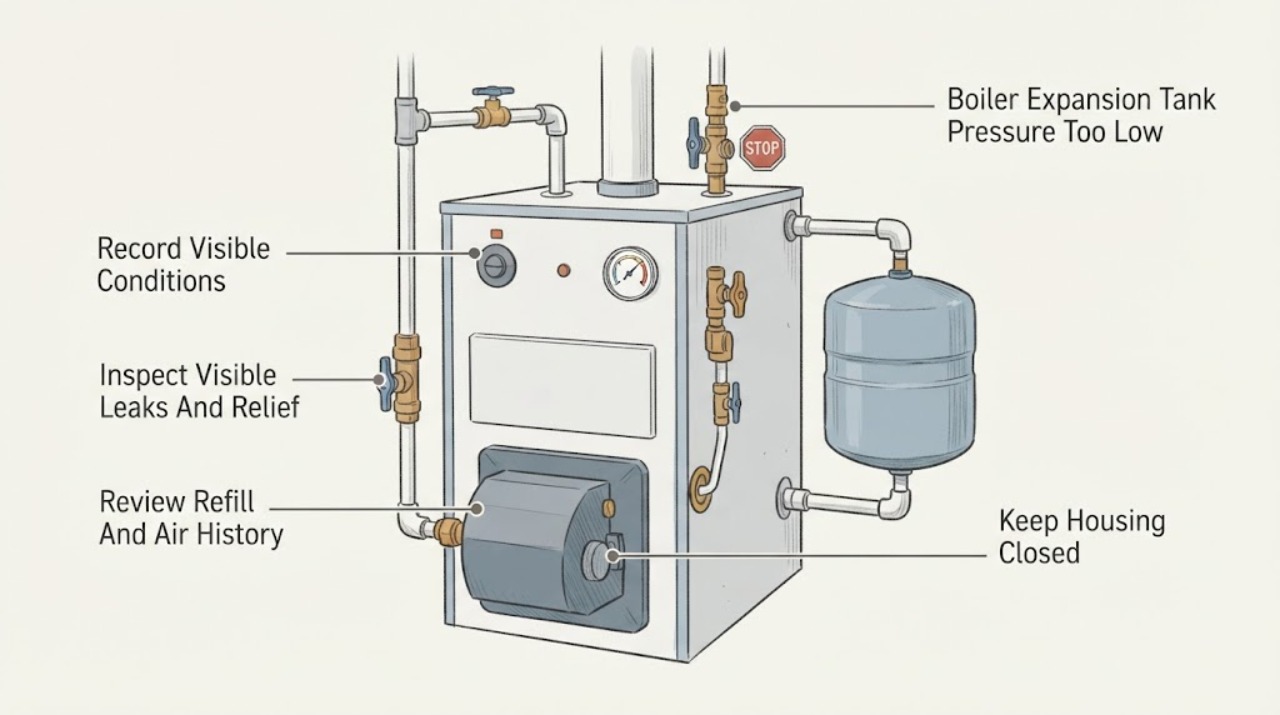
A low reading at a Buderus boiler can mean low system water, air leaving a recently filled system, a leak, a failed or waterlogged expansion tank, or a gauge or sensor problem. Read the pressure and temperature indication only from a safe position and compare it with the exact Buderus model manual; do not assume one pressure target fits every boiler. Buderus instructions say the heating system must contain enough water, that frequent refilling can cause corrosion and scale, and that the expansion vessel should be checked when water must be added repeatedly. Some Buderus manuals allow a trained owner to add make-up water through an identified fill valve, but filling a hot or pressurized system, adjusting the expansion tank pre-charge, bleeding the system, and opening valves are model- and installation-specific. Do not add water blindly, remove the tank, test its air charge, or depressurize the system. Stop for an active leak, relief discharge, rapidly changing pressure, steam, overheating, gas or oil odor, smoke, a carbon-monoxide alarm, or water near electrical parts, and arrange qualified boiler service when low pressure returns or expansion-tank failure is suspected.
Before you begin
Safety first
- This article supports safe reading of visible indications, ordinary-access leak observation, manual lookup, and review of refill history. A model-approved cold fill is the only possible owner action, and only when the manual explicitly permits it. Do not test or adjust the expansion vessel, drain or depressurize the system, open the cabinet, perform live electrical or combustion work, or operate with a leak, steam, odor, alarm, severe heat, or unstable pressure.
Work through in order
Diagnostic checks
Use only checks that match the exact appliance or system and its official guide.
-
Check 1
From a safe position, read the visible pressure and temperature indication and record whether the boiler is cold, firing, circulating, or off; do not touch hot piping, remove the cover, or reset a safety control.
Expected result: Record a low reading only when cold, a pressure drop after heating, a reading that changes rapidly, a code or low-water warning, or a gauge that appears stuck or inconsistent with the system's behavior.
Next step: Compare the observation with the exact Buderus manual and proceed to the leak and refill-history checks; arrange service promptly for a rapid change, code, or unstable reading.
Stop if: Stop for steam, an active leak, relief discharge, rapidly rising indication, severe heat, smoke, gas or oil odor, a carbon-monoxide alarm, or water near electrical parts.
Why this matters
Why: A cold low reading can indicate insufficient fill or water loss, while a large heat-related change can point toward expansion-tank, relief, air, or circulation issues. A stuck indication or code may be a gauge, sensor, or control problem rather than a tank diagnosis.
-
Check 2
With the boiler off only as the model instructions permit and accessible surfaces cool enough to approach, look for drips, corrosion, staining, wet insulation, or discharge at visible connections and the relief outlet; do not tighten, cap, or patch a pressurized fitting.
Expected result: Record no visible water, a recurring drip, a wet or corroded connection, water at the relief discharge, water inside the cabinet, or a leak that appears only when the system heats.
Next step: Keep the boiler off if water reaches electrical components or the leak is active, photograph the area from a safe distance, and arrange qualified boiler service to locate and correct the water loss.
Stop if: Stop for active leaking, steam, a relief discharge, hot wet surfaces, a concealed leak, or any need to drain or depressurize the system.
Why this matters
Why: A leak or relief discharge can explain falling pressure and may be the reason an expansion vessel appears low. Water inside the cabinet or a heat-related leak requires professional inspection; a dry exterior does not rule out concealed loss.
-
Check 3
Review whether the system was recently filled, radiators were purged, plumbing work occurred, or make-up water has been added repeatedly; do not bleed hot emitters or open a fill or drain valve whose purpose is uncertain.
Expected result: Record a recent refill with a short-lived pressure drop, air or gurgling after filling, repeated need to top up, no refill history, or no known reason for the low reading.
Next step: Give the history to a heating professional; if the manual explicitly authorizes a user fill and the system is cold and safe, follow only that model procedure, then monitor whether pressure holds rather than refilling repeatedly.
Stop if: Stop if the system is hot, pressure is unstable, a valve is unlabeled, water treatment is unknown, or filling or bleeding would require opening the boiler or removing a cover.
Why this matters
Why: Recently added water can release gases and create air pockets, while repeated topping up points toward a leak or expansion-vessel problem and increases corrosion and scale risk. An unexplained low reading needs system diagnosis.
-
Check 4
Locate the exact Buderus model manual and identify the approved cold-system fill procedure and the known fill valve only; do not use a generic pressure target, open an unknown valve, or fill a hot boiler.
Expected result: Record whether the manual identifies a user-operable fill procedure, requires a heating contractor, specifies a design pressure or gauge condition, or gives no safe owner procedure for this installation.
Next step: If and only if the manual permits it and the system is cold and leak-free, follow its fill steps once and recheck as instructed; otherwise arrange qualified service to restore pressure and investigate the cause.
Stop if: Do not fill against a closed or unknown valve, exceed the model's design guidance, bypass the relief device, or continue when pressure falls again.
Why this matters
Why: Buderus models differ in controls, expansion-vessel arrangement, pressure requirements, and service access. A procedure that is valid for one model or heating layout can overfill another or mask a leak.
-
Check 5
Do not remove, isolate, drain, or test the expansion vessel yourself; instead record its visible location, any corrosion or leakage, and whether the system pressure changes sharply between cold and hot states for the service technician.
Expected result: Record a vessel that is wet, corroded, disconnected, inaccessible, or of unknown type, along with persistent low pressure, frequent relief discharge, or a strong hot-to-cold pressure swing.
Next step: Arrange qualified boiler service for expansion-vessel pre-charge, diaphragm, connection, relief, leak, and system-pressure assessment; provide the exact model and recorded readings.
Stop if: Do not press the vessel air valve, use a tire gauge, vent system water, close unknown isolation valves, or work on a pressurized or hot vessel.
Why this matters
Why: A waterlogged or failed diaphragm, incorrect pre-charge, isolation issue, or an unrelated leak may cause the symptom, but confirming it requires the system to be made safe and tested in the correct state.
-
Check 6
If there is no leak, odor, alarm, overheating, unstable pressure, or other hazard, observe one normal heat call from a safe position after any model-approved fill; do not repeatedly refill or reset the boiler.
Expected result: Record whether pressure remains stable, drops again, rises sharply, the relief outlet discharges, the boiler locks out, or heating remains normal but the low reading returns later.
Next step: Stop testing and arrange qualified service for any recurrence, lockout, relief discharge, or abnormal pressure change; provide the full timeline and observations.
Stop if: Stop immediately for steam, active water loss, smoke, gas or oil odor, a carbon-monoxide alarm, severe heat, a rapidly changing gauge, or electrical contact with water.
Why this matters
Why: Stable pressure after an approved fill supports a recent air-release or fill-state issue, but falling pressure or a sharp heat-related swing makes a leak, relief, expansion-vessel, or control problem more likely. Normal heat does not prove the vessel is healthy.
Use your observations
Decision map
Find the observation that best matches what you see, then follow the next safe action.
-
PATH 01Safety boundary
What you see
Pressure became low shortly after a refill or radiator purge, the system is otherwise dry, and the reading stabilizes after the exact model's approved cold fill procedure.
Do this next
Follow the manual's recheck interval and have the technician verify air removal and expansion-vessel operation if pressure does not hold.
Why this path and its safety boundary
Why it matters: Air released from newly added water or purging may account for the temporary drop, but the system still needs monitoring for recurrence.
Safety stop: Do not normalize repeated topping up, and stop for a leak, relief discharge, rapid pressure change, or overheating.
-
PATH 02Safety boundary
What you see
The boiler repeatedly needs water after a permitted fill, even when no obvious leak is visible.
Do this next
Leave the history recorded and arrange qualified service to locate the water loss and assess the expansion vessel, relief path, connections, and system.
Why this path and its safety boundary
Why it matters: A concealed leak, relief-valve discharge, air-purging loss, defective expansion vessel, or another water-loss path is more likely than a one-time low reading.
Safety stop: Do not keep refilling as a workaround or open drains, panels, or pressurized vessel connections.
-
PATH 03Safety boundary
What you see
The visible pressure changes sharply as the boiler heats or cools, the relief outlet discharges, or the system alternates between low and high readings.
Do this next
Stop repeated heating tests and arrange qualified service for expansion-vessel and pressure-safety diagnosis using the exact model procedure.
Why this path and its safety boundary
Why it matters: Expansion-vessel pre-charge or diaphragm trouble, a relief issue, a filling error, or a gauge problem is possible; pressure swing is not proof of one failed part.
Safety stop: Stop immediately for a relief discharge, steam, a rapidly rising reading, active leak, or severe heat; do not operate the relief or vessel valve yourself.
-
PATH 04Safety boundary
What you see
Water, corrosion, staining, wet insulation, or a discharge is visible at the boiler, pipework, relief outlet, or vessel connection.
Do this next
Keep the boiler off when safe or when the manual directs, protect the area from water, and arrange qualified heating service to repair and test the system.
Why this path and its safety boundary
Why it matters: The pressure loss has an observable water path that must be corrected; the expansion tank may be involved but should not be replaced by assumption.
Safety stop: Do not cap a relief outlet, tighten hot or pressurized fittings, patch the vessel, or touch water near electrical parts.
-
PATH 05Safety boundary
What you see
The display or gauge remains at an implausible low value while heating delivery is normal, no water loss is found, or the reading disagrees with another approved indication.
Do this next
Have a technician verify the reading with calibrated equipment and inspect the sensor, gauge, wiring, and control before any tank adjustment or replacement.
Why this path and its safety boundary
Why it matters: A gauge, pressure sensor, wiring, or control interpretation problem is possible; the expansion tank has not been shown to be low.
Safety stop: Do not use a generic gauge as a reason to fill, bypass a sensor, or open the cabinet for live testing.
-
PATH 06Safety boundary
What you see
Low pressure occurs with no heat, lockout, steam, gas or oil odor, a carbon-monoxide alarm, smoke, flame irregularity, or water near electrical components.
Do this next
Stop the boiler according to the model emergency procedure, leave the area when combustion danger is suspected, and obtain urgent qualified heating or emergency help.
Why this path and its safety boundary
Why it matters: A safety or combustion condition may coexist with the pressure problem and takes priority over filling or expansion-tank diagnosis.
Safety stop: Do not refill, reset, relight, or open the boiler while a safety, combustion, steam, or electrical hazard is present.
Helpful context
Understand the symptom
Low system pressure is not automatically a bad expansion tank
The expansion vessel cushions pressure changes as heating water warms and cools, but a low boiler reading can originate elsewhere. Air released after a refill, a visible or concealed leak, a relief discharge, a filling problem, a faulty gauge or sensor, and an expansion-vessel problem can overlap. Start by recording whether pressure is low only when cold, drops after the boiler heats, or keeps falling over days; use the exact Buderus model documentation for interpretation.
Frequent topping up is a diagnostic clue
Buderus instructions warn that frequent refilling can contribute to corrosion and scale depending on water quality, and they direct the operator to check for leaks and correct expansion-vessel operation. A refill can also release gases and create air pockets. Do not normalize repeated topping up: it can hide water loss and leave the heat exchanger or circulation system vulnerable to noise, poor heat transfer, and damage.
The fill and pre-charge procedures are model-specific
Some Buderus operating manuals describe observing a pressure gauge while slowly adding make-up water, while installation instructions describe the expansion vessel's pre-pressure as an installer or service measurement. A household owner should not infer that a generic tire-pump reading, pressure target, or valve sequence applies to the installed boiler. Filling hot equipment, testing a tank with water pressure present, or opening the wrong isolation valve can cause burns, leaks, or system damage.
Know when the system needs a heating professional
A low reading that returns after a permitted, model-approved fill is more important than a single low reading after maintenance. Expansion-tank diaphragm failure, a relief valve that passes water, a leaking connection, air in the loop, a pressure sensor, or a control fault requires qualified diagnosis. Keep the boiler off when the manual directs it or when there is active leaking, overheating, steam, combustion danger, or water near electrical components.
Safety boundary
Stop conditions
- Stop the boiler for gas or oil odor, a carbon-monoxide alarm, smoke, flame irregularity, sparks, escaping steam, severe heat, an active leak, relief discharge, rapidly changing pressure, or water near electrical parts; follow emergency and qualified-service procedures.
- Do not remove, isolate, drain, depressurize, or test the expansion tank, pressure-relief device, boiler cover, or heating circuit as a sound or pressure experiment.
- Do not fill a hot boiler, open an unknown valve, exceed the model's design guidance, cap a relief outlet, or repeatedly reset or refill to hide a returning low reading.
- Do not pressurize an expansion vessel with a generic pump or gauge, add chemicals, bleed hot emitters, or perform live electrical, gas, combustion, or pressure testing.
- Stop and arrange qualified boiler service when pressure falls again, a leak is suspected, a gauge or sensor is unreliable, an expansion-vessel fault is possible, or the model-specific procedure is unavailable.
Only after diagnosis
Potential parts
- expansion vessel
Consider this category only when a qualified technician confirms a failed diaphragm, incorrect vessel capacity or pre-charge, corrosion, or leakage after the system is made safe and other water-loss causes are assessed.
Confirm the exact Buderus model, vessel size, connection, temperature and pressure ratings, and approved manufacturer fit; do not select a vessel from a generic pressure reading. - pressure-relief valve
Consider this category only if inspection and qualified testing confirm that the relief device is passing water or failing after the system pressure and expansion vessel are correctly assessed.
Confirm the exact model, relief setting, connection, certification, and local installation requirements; never cap, bypass, or substitute a relief device. - pressure gauge or sensor
Consider this category only when a calibrated comparison shows the visible gauge or pressure sensor is inaccurate or defective and actual system pressure is otherwise safe.
Confirm the exact Buderus model, sensor or gauge type, connection, electrical interface, and manufacturer fit information before ordering. - automatic air vent or air separator
Consider this category only when recurring air, pressure loss, or circulation symptoms lead a qualified technician to confirm a failed air-removal component after leak and filling causes are checked.
Confirm the exact system connection, temperature and pressure rating, model procedure, and installation requirements; do not open a pressurized air-removal component yourself.
When checks do not resolve it
Need a professional?
Arrange qualified Buderus boiler service when pressure remains low after an explicitly model-approved cold fill, falls again, changes sharply between cold and hot, a relief outlet discharges, water or corrosion is visible, the gauge or sensor is suspect, or expansion-vessel testing or system filling requires access beyond ordinary safe observation. Use a licensed heating or gas professional for burner, fuel, venting, combustion, or flame symptoms. Seek urgent help for gas or oil odor, a carbon-monoxide alarm, smoke, sparks, escaping steam, severe heat, an active leak, relief discharge, or water near electrical components.
Safety scope: This article supports safe reading of visible indications, ordinary-access leak observation, manual lookup, and review of refill history. A model-approved cold fill is the only possible owner action, and only when the manual explicitly permits it. Do not test or adjust the expansion vessel, drain or depressurize the system, open the cabinet, perform live electrical or combustion work, or operate with a leak, steam, odor, alarm, severe heat, or unstable pressure.
Common questions
FAQ
Does low boiler pressure always mean the Buderus expansion tank is bad?
No. Low pressure can come from air released after filling, a leak, relief discharge, a filling problem, a gauge or sensor fault, or an expansion-vessel issue. Record when the reading is low and whether it changes with heating, then use the exact Buderus model procedure or qualified service.
Why does Buderus warn about frequent boiler refilling?
Frequent make-up water can indicate a leak or defective expansion vessel, and Buderus warns that repeated refilling can contribute to corrosion and scale depending on water quality. Do not treat topping up as a permanent fix; arrange service to locate the water loss.
Can air in the heating system make boiler pressure read low?
Yes. Buderus notes that newly added water can release gases and form air pockets, and pressure may drop after bleeding. Follow only the installed model's cold-system instructions and arrange service when air or pressure loss keeps returning.
Can I refill a Buderus boiler myself when pressure is low?
Only if the exact model manual explicitly permits an owner fill, the system is cold and leak-free, and you can identify the correct fill valve and procedure. Do not use a generic pressure target, fill a hot boiler, open an unknown valve, or refill repeatedly when the reading falls again.
How is a Buderus expansion tank checked?
Expansion-vessel pre-charge, diaphragm condition, isolation, and system pressure are checked by a qualified technician in the correct safe state. Do not press the vessel valve, attach a pump or gauge, drain the system, or remove the vessel as a troubleshooting experiment.
When is low Buderus boiler pressure an emergency?
Stop and seek urgent qualified help for an active leak, relief discharge, steam, rapidly changing pressure, severe heat, gas or oil odor, smoke, flame irregularity, a carbon-monoxide alarm, sparks, or water near electrical components. Persistent low pressure without those signs still needs prompt boiler service.
Read the exact guide
Official sources
- Buderus GB162Bosch Home Comfort · Official Buderus GB162 product-support page; documentation and procedures vary by Buderus model and system configuration.
- Record book of water quality requirementsBuderus / Bosch Home Comfort · Buderus GB162 water-quality record book; other models may have different water-quality requirements, so no generic treatment should be inferred.
- Installation, Operation, and Maintenance InstructionsBuderus / Bosch Home Comfort · Buderus SB625WS/SB745WS operating manual; other models may have different pressure targets and owner procedures, so the installed model documentation controls.
- Service manual - GB162-80kW/100kW - US(en)Buderus / Bosch Home Comfort · Buderus GB162 service manual; it supports the leak and expansion-vessel decision but is not a universal pressure target for every Buderus model.
Community feedback
Share a repair observation
Share a plain-text repair observation. Accepted observations are published automatically; this page may take a moment to update.