
On this page
Start here
Quick answer
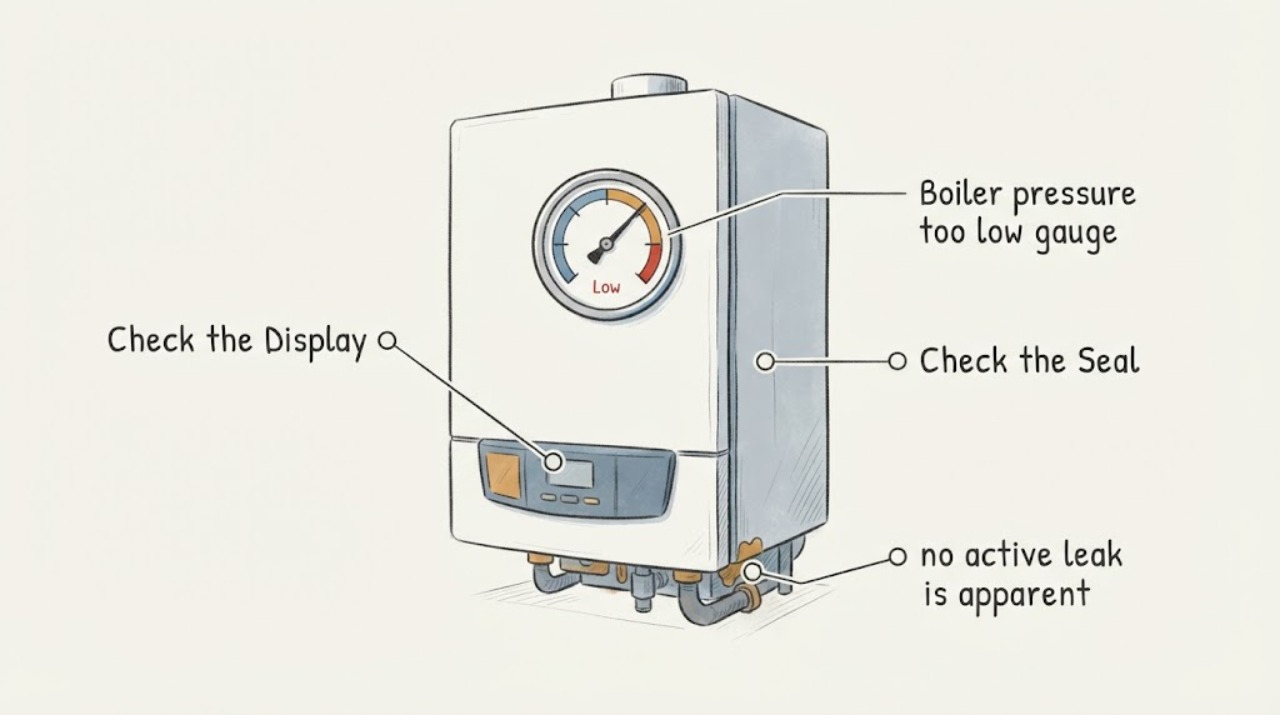
A low boiler pressure reading usually means water has left a sealed heating system, often through a visible or hidden leak, but a reading can also be affected by whether the system is hot or cold or by a faulty gauge or sensor. Let the system cool, check the boiler manual for its own pressure range, and look for dampness or staining around radiators, valves, pipes, and the appliance. If the manual identifies a filling loop or filling key and no leak is apparent, a competent homeowner may follow that model-specific top-up procedure once, stopping at the specified range and fully closing the valves. If pressure falls again, will not rise, or rises sharply while heating, stop and call a qualified heating engineer.
Before you begin
Safety first
- A professional should handle internal boiler work, gas components, pressure sensors, expansion vessels, pressure-relief devices, concealed leaks, and any unsafe water or electrical condition.
Work through in order
Diagnostic checks
Use only checks that match the exact appliance or system and its official guide.
-
Check 1
Let the heating system cool if it has been running, then read the physical gauge and any digital pressure display and compare both with the pressure range in the boiler manual.
Expected result: The cold reading is below the manual's lower range, the reading changes only when the system heats, or the physical and digital readings disagree.
Next step: Record the readings and operating condition. Continue with the external leak check; if the indicators disagree or the manual's range is unclear, arrange model-specific service instead of guessing a target pressure.
Why this matters
Why: A low cold reading supports water loss from the heating circuit. A hot-versus-cold difference can be normal, while a disagreement between indicators keeps a gauge or pressure-sensor fault in consideration.
-
Check 2
Inspect accessible radiator valves, exposed pipe connections, the floor beneath the boiler, and nearby walls or ceilings for dampness, rust marks, discolored paint, flaking finish, or a slow drip; do not loosen or tighten heating joints.
Expected result: Water marks or a drip are present at a radiator, pipe, or appliance, or all accessible areas are dry.
Next step: If water is actively escaping, protect the area from further damage and arrange a qualified heating professional. If no leak is visible, continue only with the manual's filling guidance and monitor whether the pressure holds.
Why this matters
Why: A wet mark or drip identifies a likely external water-loss path. Dry accessible surfaces do not rule out a concealed pipe leak, pressure-relief discharge, or an internal boiler leak.
-
Check 3
If the boiler manual identifies a compatible filling loop or filling key, and no active leak is apparent, follow that manual's cool-system top-up procedure slowly while watching the gauge; stop at the specified range and close every valve or key exactly as instructed.
Expected result: The pressure rises and remains in the manual's range after the filling device is closed, or it will not rise, overshoots, or falls again immediately.
Next step: Do not keep opening the filling device or repeatedly topping up. Stop and arrange qualified service if the reading will not stabilize, the correct device is uncertain, or the pressure exceeds the manual's range.
Why this matters
Why: A stable rise can indicate a gradual loss that has been temporarily restored. Failure to rise or immediate loss points toward a significant leak, filling-device problem, pressure-relief issue, or another fault rather than a need for more water.
-
Check 4
After a successful model-approved top-up, run the heating normally and recheck the gauge under the same hot or cold condition used for the first reading; note whether the pressure changes gradually or sharply.
Expected result: Pressure stays near the specified range, slowly falls over the next heating periods, or rises sharply as the system heats.
Next step: Arrange an engineer for any repeated fall or sharp rise; do not compensate by repeated topping up or by bleeding radiators unless the manual and professional diagnosis specifically call for it.
Why this matters
Why: A stable reading suggests the immediate low-pressure symptom has cleared. A continuing fall supports water loss, while a sharp rise can indicate expansion-vessel, overfill, or pressure-control trouble.
-
Check 5
Check the boiler's status display for a low-pressure fault and compare it with the physical gauge after the system has cooled, without removing the boiler casing or resetting a fault repeatedly.
Expected result: The display and gauge agree on low pressure, the display reports a fault while the gauge looks normal, or the gauge looks low while the display does not.
Next step: Use the exact model manual and arrange qualified service for a persistent disagreement or recurring fault. Do not bridge a sensor, adjust controls, or open the appliance to test wiring.
Why this matters
Why: Agreement supports genuinely low system pressure. A disagreement makes a pressure sensor, gauge, wiring, or model-specific interpretation issue more likely than simply needing more water.
Use your observations
Decision map
Find the observation that best matches what you see, then follow the next safe action.
-
PATH 01Next step
What you see
The cooled-system gauge is low and a radiator valve, exposed pipe, or area below the boiler shows dampness, rust, staining, or an active drip.
Do this next
Arrange a qualified heating engineer to repair and verify the leak before relying on a top-up. Do not loosen fittings or remove the boiler casing.
Why this path and its safety boundary
Why it matters: An external leak is more likely than a simple gauge fluctuation.
-
PATH 02Next step
What you see
The pressure rises to the model's specified range using the correct filling procedure, then stays stable when checked under comparable conditions.
Do this next
Record the final reading and monitor it. If the gauge drops again, identify the recurrence pattern and arrange service rather than repeatedly topping up.
Why this path and its safety boundary
Why it matters: A gradual one-time loss or water released during prior radiator work is more plausible, although the system still needs observation for recurrence.
-
PATH 03Next step
What you see
The pressure falls again as soon as the filling device is closed, or frequent top-ups are needed.
Do this next
Stop repeated repressurising and arrange qualified heating service. Keep the filling device closed and document when the pressure falls.
Why this path and its safety boundary
Why it matters: A significant leak, pressure-relief problem, filling-device fault, or concealed system fault is more likely than normal pressure variation.
-
PATH 04Next step
What you see
Pressure rises sharply during heating, exceeds the manual's range, or the gauge and digital display disagree.
Do this next
Stop adjusting the filling device and arrange a qualified boiler engineer. Do not remove the casing, bleed radiators to chase a reading, or alter safety controls without model-specific instruction.
Why this path and its safety boundary
Why it matters: Expansion-vessel, overfill, pressure-control, gauge, or sensor trouble is more likely; the correct repair cannot be selected from the needle alone.
Helpful context
Understand the symptom
Read the gauge under the right conditions
Pressure changes as heating water warms and cools, so compare readings at a similar condition and use the range printed in the manual. For many sealed residential systems, the cold reading is around 1 to 1.5 bar, but this is not a universal setting. An analog needle and a digital display can also disagree if a gauge or pressure sensor has a fault.
Low pressure is a symptom, not the repair
Water can leave through radiator valves, pipe joints, pressure-relief discharge, or an internal boiler leak. Air released while bleeding radiators can also lower the reading. Topping up may restore operation temporarily, but repeated topping up without finding the cause can hide a leak and should not become the routine fix.
Keep gas and boiler work professional
The accessible checks are limited to reading the display, looking for external signs of water, and following a model-specific filling procedure if the manual permits it. Never remove the boiler casing, adjust gas controls, loosen heating joints, or attempt to repair an internal vessel, pump, valve, or pressure sensor as an ordinary user.
Safety boundary
Stop conditions
- Stop and arrange qualified service if pressure falls immediately after topping up, drops repeatedly, will not rise, rises sharply during heating, or exceeds the range in the manual.
- Do not remove the boiler casing, adjust gas controls, loosen heating joints, repair internal parts, or bridge a pressure sensor as an ordinary user task.
- If there is active water near electrical equipment, a suspected internal boiler leak, a gas smell, smoke, or a carbon-monoxide alarm, leave the area as appropriate and use emergency or qualified professional help.
When checks do not resolve it
Need a professional?
Safety scope: A professional should handle internal boiler work, gas components, pressure sensors, expansion vessels, pressure-relief devices, concealed leaks, and any unsafe water or electrical condition.
Common questions
FAQ
What pressure should a boiler gauge read when the system is cold?
Many sealed residential systems are around 1 to 1.5 bar when cold, but the correct range is model-specific. Use the manual and the gauge's marked range rather than treating a generic number as a universal target.
Can I top up low boiler pressure myself?
Only if your boiler manual identifies the filling loop or filling key and gives a homeowner procedure you can follow safely. The system should be cool, the device must be closed at the specified reading, and repeated or unsuccessful top-ups require qualified service.
Why does boiler pressure keep dropping after I refill it?
A recurring drop can indicate a radiator or pipe leak, a pressure-relief or filling-device problem, a concealed leak, or an internal boiler fault. Stop repeatedly adding water and arrange a qualified inspection.
Why does the pressure rise when the heating turns on?
Heating water expands, so some rise is expected. A sharp rise, a reading outside the manual's range, or a large repeated change needs professional assessment for overfill, expansion-vessel, pressure-control, gauge, or related faults.
Read the exact guide
Official sources
- Why is my boiler losing pressure?Vaillant · Low or falling pressure in a residential central-heating system
- How to repressurise a boilerVaillant · Homeowner-facing guidance for compatible Vaillant sealed boiler systems; other models require their own instructions
- What pressure should my boiler be?Vaillant · Sealed residential boiler systems with a low gauge reading
- How often should I need to top up the pressure in the heating system?Worcester Bosch · Worcester Bosch sealed heating systems; other systems require their own manual range
Community feedback
Share a repair observation
Share a plain-text repair observation. Accepted observations are published automatically; this page may take a moment to update.