
On this page
Start here
Quick answer
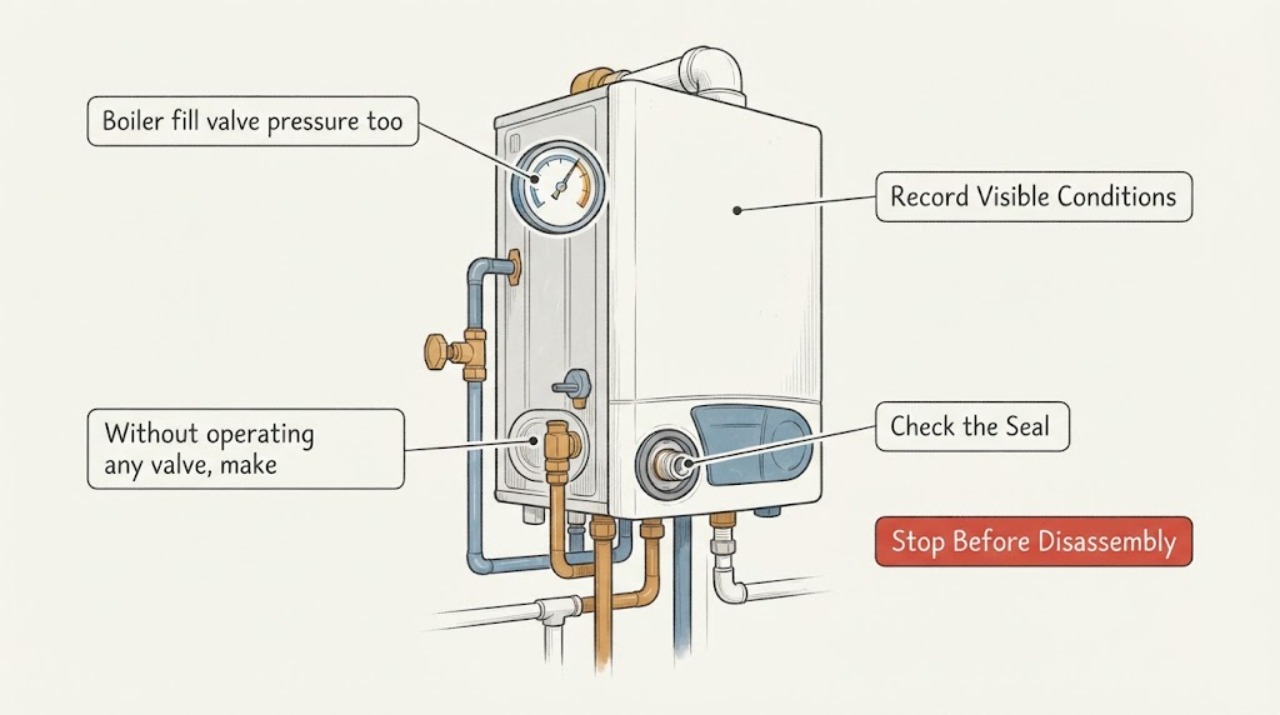
A low boiler-pressure reading does not prove that the fill valve itself has failed. With the boiler cool and from a safe external position, record the gauge or display against the range in the model manual, note whether the reading falls again, and look for visible water or discharge around accessible heating-system connections. Do not open or operate the fill valve, remove the boiler casing, adjust pressure, bleed a radiator, or test pressurized or hot components. A persistent low reading can reflect a leak, a faulty pressure sensor, an expansion-vessel problem, or a fill-valve fault; have a qualified heating professional diagnose it. Stop immediately for gas odor, carbon-monoxide alarm, steam, hot water, active spray, or water near electrical equipment.
Work through in order
Diagnostic checks
Use only checks that match the exact appliance or system and its official guide.
-
Check 1
When the heating system is cool, read the external pressure gauge or user-facing display without removing a cover. Record the value or the low-pressure message, compare it with the operating range printed in the exact manual, and note whether the boiler still provides heat or hot water.
Expected result: The reading is below the manual's range, fluctuates, is unreadable, or the boiler shows a low-pressure fault or loss of heating/hot water.
Next step: Photograph the gauge or display and manual model information from a safe position, keep the appliance in its current state, and arrange qualified heating service rather than adjusting the fill valve.
Stop if: Stop immediately for gas odor, a carbon-monoxide alarm, smoke, steam, hot-water release, electrical contact with water, or an appliance that appears damaged. Leave for an emergency hazard and seek appropriate emergency help.
Why this matters
Why: A low reading confirms a pressure indication but does not identify whether water was lost, the sensor is wrong, or the fill valve cannot admit water. A missing display, a conflicting gauge, or a fault message increases the need for model-specific diagnosis.
-
Check 2
Without operating any valve, make a dated log of the cold pressure reading before normal heating and again at later cold checks. Note whether the reading returns to the same low point, slowly declines, or changes sharply after the system heats and cools. Do not create extra heating cycles just to test it.
Expected result: The cold reading stays stable, gradually declines, or rises substantially when hot and returns low when cool.
Next step: Give the dated readings and heating context to a qualified heating professional. Do not compensate for a declining reading by repeatedly topping up or manipulating the fill valve.
Stop if: Stop logging and keep clear if pressure changes rapidly, the gauge approaches a high zone, water appears, the relief discharge activates, or the appliance becomes hot, noisy, or unsafe.
Why this matters
Why: A stable low reading may reflect an existing low fill or a reading issue; a continuing decline is consistent with water loss or a system fault. A large heat-related swing can implicate expansion behavior, but the pattern alone cannot identify the expansion vessel or fill valve.
-
Check 3
From a dry, safe position, visually inspect only accessible external pipe joints, radiator valves, visible heating-system components, and the relief-discharge route for dampness, drops, rust marks, staining, or a wet floor. Do not touch hot pipework, remove insulation, open the casing, or repair a joint.
Expected result: There is no visible moisture, or there is a damp patch, active drip, discharge, corrosion mark, or water stain.
Next step: Photograph the location without touching it and keep people away from hot water or slippery flooring. Arrange heating service; do not tighten fittings or open a drain to investigate.
Stop if: Stop for active spray, hot water, steam, a rapidly spreading puddle, a softened ceiling or floor, or water approaching electrical equipment.
Why this matters
Why: No visible leak does not rule out a concealed or internal fault. A wet connection or discharge route supports water loss as a possible cause and should be assessed before any refill decision.
-
Check 4
Look at the external fill-valve or filling-loop area only if it is visible without opening a panel. Note whether the valve body, hose, cap, and nearby joints appear intact, dry, corroded, loose, or wet, and whether any handle is missing or visibly damaged. Do not turn, loosen, remove, or test the valve.
Expected result: The fill-valve area is dry and intact, or a valve, hose, cap, or joint is wet, corroded, damaged, or disconnected-looking.
Next step: Keep the boiler off any unsafe area and provide the close-up observation and appliance model to a qualified heating professional. Do not open the fill valve or attempt to restore pressure.
Stop if: Stop for a leak, spray, damaged flexible hose, a seized or broken handle, hot surfaces, or any need to open the boiler or work on a pressurized connection.
Why this matters
Why: A dry external appearance does not prove that the valve functions. Visible moisture or damage can be the source of water loss or a hazard and requires professional isolation and repair.
-
Check 5
Record every visible fault code, warning symbol, lockout, unusual boiler noise, and the timing of any loss of heat or hot water. Check only the normal user display and controls; do not clear the fault repeatedly or remove a cover to inspect a sensor, burner, pump, wiring, or expansion component.
Expected result: The display identifies low pressure, shows another fault, remains blank, or the boiler operates normally despite a low gauge.
Next step: Provide the code, display reading, cold-pressure log, visible-leak result, and model to a qualified heating professional. Leave the casing closed and avoid further resets.
Stop if: Stop and seek urgent help for gas odor, carbon-monoxide alarm, smoke, flame or flue concern, steam, sudden water release, or any electrical hazard.
Why this matters
Why: A matching low-pressure message supports a pressure-related service call but does not name the fill valve. A different message or disagreement between gauge and display may indicate a sensor, control, or other boiler fault.
Use your observations
Decision map
Find the observation that best matches what you see, then follow the next safe action.
-
PATH 01Next step
What you see
The cold pressure is below the manual range but remains stable, with no visible leak or hazardous symptom.
Do this next
Arrange a qualified heating assessment of the reading and fill-valve system. Do not open the fill valve or assume a refill is safe for this model.
-
PATH 02Next step
What you see
The pressure declines again, visible water or discharge is present, or a heating-system connection is damp.
Do this next
Keep the appliance in a safe state, do not repeatedly top it up, and request prompt diagnosis of the leak, relief path, and system components.
-
PATH 03Next step
What you see
The fill-valve body, hose, cap, or nearby joint is corroded, wet, damaged, or cannot be operated normally.
Do this next
Do not touch or force the valve. Keep clear of hot or pressurized water and call a qualified heating professional to isolate and repair it.
-
PATH 04Next step
What you see
The gauge and display disagree, the display is blank, or another fault code appears.
Do this next
Keep the boiler casing closed and give the professional the model, display message, gauge reading, and timeline for electrical or sensor diagnosis.
-
PATH 05Next step
What you see
There is gas odor, a carbon-monoxide alarm, smoke, steam, sudden hot-water release, or water near electrical equipment.
Do this next
Stop the inspection, leave the hazard area, and seek emergency help or qualified service as appropriate. Do not reset, relight, open, or refill the boiler.
Helpful context
Understand the symptom
Why low pressure needs diagnosis
A sealed heating system loses pressure when water or air leaves the system, but a low display can also involve sensing or expansion components. The filling valve is only one possible point in that chain. A short record of the cold reading, trend, visible moisture, and boiler messages helps a professional separate a leak from a valve or control fault.
Safe boundary
These checks are observations only. Keep the boiler casing closed and do not turn a filling handle, open a drain or radiator valve, remove a panel, change a pressure setting, or repeatedly reset the appliance. Do not approach a hot, wet, gas-burning, or electrically compromised boiler.
Only after diagnosis
Potential parts
- boiler pressure gauge
Only consider a gauge category after a professional confirms that the external gauge or pressure indication is inaccurate or defective.
Confirm the boiler and heating-system model, connection, scale, and approved replacement before ordering; do not use a gauge reading to justify unsafe pressure adjustment. - boiler fill valve
Only consider a fill-valve category if professional diagnosis finds that the valve cannot admit or isolate water and replacement is appropriate.
Verify the exact boiler/system configuration and approved valve specification with the technician or manufacturer; do not infer fit from the valve's appearance. - boiler expansion tank
Only consider an expansion-vessel category if the pressure trend and professional tests identify expansion behavior or vessel failure as the cause.
Confirm system type, capacity, connection, and manufacturer requirements before selection; expansion-vessel work is not a homeowner pressure adjustment.
When checks do not resolve it
Need a professional?
Call for persistent low pressure, repeated pressure loss, visible leaks or discharge, a damaged or uncertain fill valve, conflicting gauge and display readings, or any boiler fault that does not clear safely.
Have this ready
- Provide the boiler model, cold gauge or display reading relative to its manual, dated pressure trend, warning or fault code, visible leak locations, fill-valve condition, heating and hot-water symptoms, and any gas, carbon-monoxide, heat, or electrical warning.
Common questions
FAQ
Does low boiler pressure prove the fill valve is bad?
No. Low pressure can reflect water loss, a visible or concealed leak, a pressure sensor issue, expansion behavior, or a fill-valve fault. Record the cold reading and visible clues, then have the system diagnosed.
Can I open the boiler fill valve to raise pressure?
This article uses observation only: do not operate the fill valve or adjust pressure. Filling systems differ by model and an active leak, failed valve, or wrong reading can make adjustment unsafe. Ask a qualified heating professional.
What if pressure keeps falling after service or a previous refill?
A recurring decline needs investigation for water loss, relief discharge, expansion behavior, sensor error, or another system fault. Do not repeatedly top up or open components; provide the dated pressure log to the professional.
When is low boiler pressure an emergency?
Leave and seek appropriate emergency help for gas odor, a carbon-monoxide alarm, smoke, steam, sudden hot-water release, or water near electrical equipment. Keep the boiler off and do not reset, relight, open, or refill it.
Read the exact guide
Official sources
- Why is my boiler losing pressure?Vaillant · Used to structure external observations of pressure trends, damp patches, stains, and the boundary against removing a boiler casing; actual diagnosis remains model- and system-specific.
- What do I do if my boiler had no pressure?Vaillant · Used for general pressure-gauge and visible-leak observations; the article's safety boundary is stricter than the source's optional refill guidance and does not provide a model-specific refill procedure.
- Boiler PressureWorcester Bosch · Used to support recording cold readings and recurring pressure changes; the page's values are not treated as universal for every boiler.
Community feedback
Share a repair observation
Share a plain-text repair observation. Accepted observations are published automatically; this page may take a moment to update.