
On this page
Start here
Quick answer
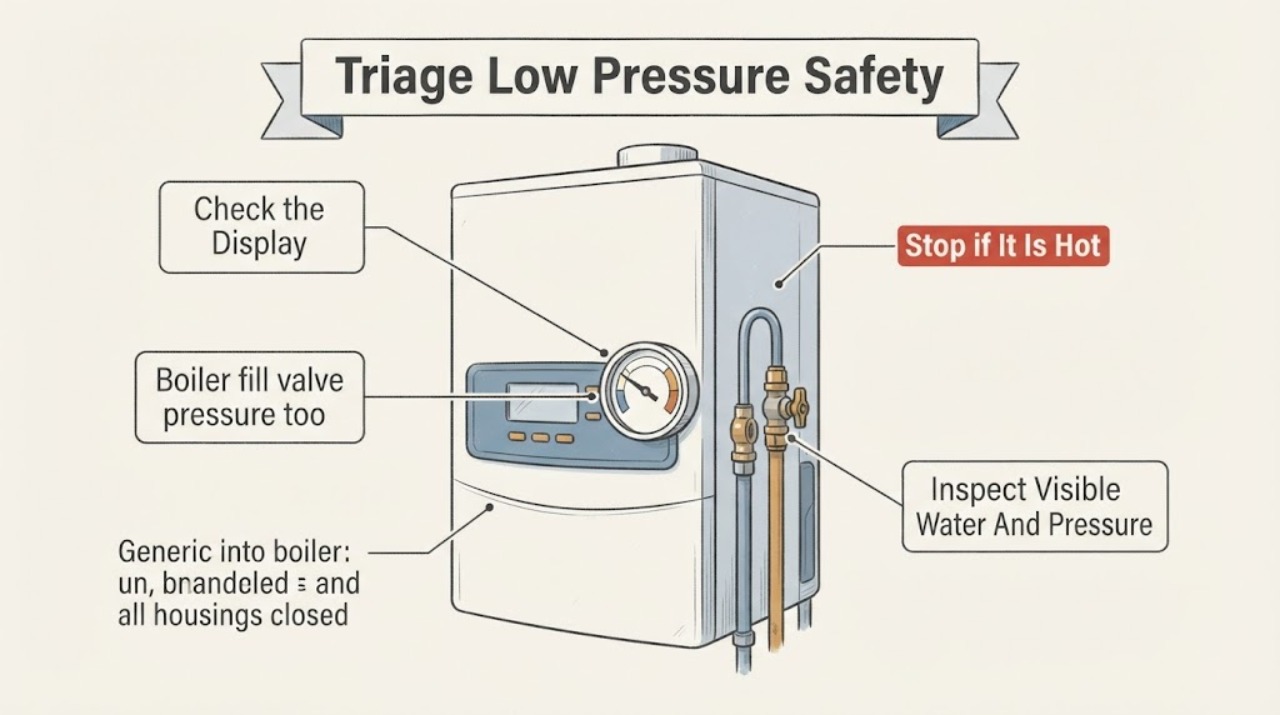
A low-pressure reading does not prove that the Buderus fill valve is the failed part. The pressure can be low because water is leaking, air was removed, an expansion vessel or relief valve is faulty, a pressure sensor is inaccurate, the system is not fully filled, or a low-water safety has stopped the boiler. Read the visible pressure gauge or display only when the boiler is safe and cool, and compare it with the exact model manual; do not open a fill valve, remove a relief valve, bleed radiators, or add water by guesswork. Buderus documentation says frequent refilling can damage a heating system and assigns pressure, gas, water, burner, and safety checks to qualified service. If pressure is falling, a leak or discharge is visible, the boiler is locked out, water is on controls, or the boiler is hot or making unusual sounds, keep it off and call a qualified Buderus technician.
Before you begin
Safety first
- Owner checks end at hazard triage, visible gauge or display observation, thermostat and fault observation, and external visual inspection of accessible piping, vent termination, boiler exterior, and surrounding area. A qualified professional must handle filling, bleeding, pressure testing, fill valve, relief valve, expansion vessel, low-water cutoff, burner, fuel, combustion, electrical, and safety-device work.
Work through in order
Diagnostic checks
Use only checks that match the exact appliance or system and its official guide.
-
Check 1
From outside the boiler cabinet, stop and observe without touching the fill valve, relief valve, gas controls, wiring, or hot pipes. Look for water on or under the boiler, a relief discharge, gas or oil odor, smoke, soot, exposed wiring, a hot or damaged vent, or a carbon-monoxide alarm.
Expected result: The boiler is cool with no visible leak or hazard; pressure is low but the exterior is dry; or a water, fuel, fire, electrical, vent, or carbon-monoxide hazard is present.
Next step: For fire, fuel, smoke, or carbon-monoxide danger, leave and contact emergency help from a safe location. For a water or electrical hazard, keep the boiler off and arrange qualified heating service; do not operate the fill valve to compensate.
Stop if: Stop immediately for gas or oil odor, smoke, soot, flames, water on controls, a ruptured pipe, relief discharge, exposed wiring, hot venting, or carbon-monoxide alarm.
Why this matters
Why: A dry exterior permits only limited gauge and control observation. A leak, relief discharge, fuel odor, soot, smoke, hot vent, or carbon-monoxide alarm can make continued operation unsafe and may explain pressure loss without a failed fill valve.
-
Check 2
When the boiler is safe and the gauge or display is visible without opening a panel, record the pressure indication, boiler temperature indication, low-water or pressure code, and whether the reading changes while the system is at rest. Compare only with the exact Buderus model manual; do not infer a target from another model or test a gauge by tapping it.
Expected result: The reading is below the model's stated operating range; the display shows a low-water or pressure fault; the reading fluctuates sharply; or the reading appears normal while the low-pressure fault remains.
Next step: Record the exact value or code and keep the boiler off if the pressure is below the manual's permitted range or the fault returns. Arrange qualified service to verify pressure with proper instruments and inspect the fill valve, sensor, low-water cutoff, leaks, and expansion vessel.
Stop if: Stop if the gauge is damaged, the reading is rapidly falling or oscillating, a fault returns, the boiler is hot, or any check requires opening the control or service panel.
Why this matters
Why: A low reading or matching low-pressure code can prevent the boiler or pump from starting on some Buderus models. A normal reading with a fault can indicate a sensor, control, wiring, or model-specific interpretation issue; gauge behavior alone cannot identify the fill valve.
-
Check 3
With the boiler off and cool, visually inspect accessible water piping, radiator or zone connections, the pressure-relief discharge route, condensate area if present, and the floor for fresh water, staining, corrosion, or repeated discharge. Do not tighten fittings, operate relief hardware, remove insulation, or open the boiler to trace a hidden leak.
Expected result: A leak, stain, relief discharge, corrosion, condensate issue, or wet floor is present; or all visible connections are dry.
Next step: Keep the boiler off and arrange qualified service for any leak, discharge, corrosion, or wet area. If visible areas are dry but pressure remains low, do not refill by guesswork; have the system pressure and concealed components diagnosed.
Stop if: Stop for active leakage, relief discharge, corrosion, water near electrical parts, a hot pipe, a damaged fitting, or any need to remove covers or operate a relief device.
Why this matters
Why: A visible water loss can account for low pressure and may indicate a failed fitting, relief valve, expansion vessel, heat exchanger, or other system fault. A dry exterior does not rule out a concealed leak or internal discharge.
-
Check 4
Use the exact Buderus installation diagram or a contractor's prior labeling to identify which external valve is the heating-system fill valve. Observe whether it is visibly damaged, leaking, or incorrectly labeled, but do not turn it, remove a cap, disconnect a backflow device, or attach a hose or gauge.
Expected result: The valve cannot be confidently identified; it is leaking or damaged; the valve is identified but pressure remains low; or a different nearby valve appears to be the water-supply or drain connection.
Next step: Leave an uncertain, leaking, or damaged valve untouched and arrange qualified service. Give the technician the model manual and location record; do not open the valve to see whether the gauge rises.
Stop if: Stop for an unidentified valve, leak, missing handle, damaged piping, a backflow or relief concern, or any need to operate or dismantle the valve.
Why this matters
Why: Several nearby valves can look similar, and operating the wrong one can drain, overfill, contaminate, or damage the heating system. A fill valve that is open or closed does not prove it passes or regulates water correctly.
-
Check 5
Observe the thermostat or heating control and boiler display from outside the cabinet. Note whether there is a heat demand, whether a low-water or pressure lockout is shown, whether the pump or burner attempts to start, and whether radiators or zones remain cold. Do not reset a recurring lockout or open the burner or control compartment.
Expected result: There is no heat demand; a low-water or pressure lockout is displayed; the boiler attempts to start then stops; or the burner and pump run while zones remain cold.
Next step: Correct only an obvious thermostat setting according to the exact manual. For a low-pressure lockout, failed start, repeated reset, or cold zones with a running boiler, keep it off as appropriate and arrange qualified HVAC service.
Stop if: Stop for a recurring lockout, failed ignition, unusual combustion sound, hot-water leak, or any need to reset an internal safety or open the service panel.
Why this matters
Why: No demand can explain no heating, while a low-water lockout can prevent burner or pump operation on applicable models. Start-and-stop behavior may involve pressure sensing, low-water protection, ignition, fuel, or control; cold zones with a running burner may be a circulation problem.
-
Check 6
Prepare the complete Buderus model and serial information, fuel type, pressure gauge or display reading and trend, temperature state, fault code, fill-valve identification, visible leak or discharge findings, recent bleeding or maintenance, and which heating zones are affected. Do not add make-up water or repeatedly reset the boiler to improve the record.
Expected result: Pressure remains low after a known service event; the pressure falls again; the low-pressure code returns; or pressure appears normal but heating does not recover.
Next step: Keep the boiler off when pressure is below the manual's safe range, a leak exists, or a lockout returns, and provide the record to a qualified Buderus technician. Request a system-pressure, fill-valve, expansion, relief, low-water, burner, and circulation assessment as applicable.
Stop if: End owner troubleshooting when diagnosis requires filling, bleeding, pressure testing, valve work, burner access, electrical testing, gas or oil work, or safety-device access.
Why this matters
Why: A repeat pressure drop suggests leakage, relief or expansion trouble, or a fill or sensor fault rather than a one-time reading. Normal pressure with no heat shifts attention toward controls, burner, circulation, or another fault.
Use your observations
Decision map
Find the observation that best matches what you see, then follow the next safe action.
-
PATH 01Next step
What you see
The visible pressure appears within the exact model's stated range, there is no leak or hazard, but the boiler still shows a fault or fails to heat a requested zone.
Do this next
Do not open the burner or reset internal safety devices. Record the code and arrange qualified Buderus service for pressure verification and heating-system diagnosis.
Why this path and its safety boundary
Why it matters: A fill-valve problem is less likely than a sensor, control, low-water cutoff, burner, ignition, pump, zone, or other HVAC issue. A normal gauge cannot prove flow or combustion operation.
-
PATH 02Next step
What you see
The reading or low-pressure code is present and the owner sees water, relief discharge, staining, corrosion, or repeated pressure loss.
Do this next
Keep the boiler off and arrange qualified service; do not operate the fill valve, relief valve, or drain. Treat water near electrical parts or an active fuel or fire concern as urgent.
Why this path and its safety boundary
Why it matters: A leak, relief, expansion, heat-exchanger, or piping problem is more likely than an isolated fill-valve setting. Continued filling can hide the loss and introduce system damage.
-
PATH 03Next step
What you see
The gauge or display indicates pressure below the model's permitted range, no visible leak is found, and the boiler is dry and otherwise quiet.
Do this next
Keep the boiler off or follow only a clearly owner-approved exact-model instruction, and prefer qualified service to verify the pressure and fill path. Do not refill by a generic target or repeatedly top up the system.
Why this path and its safety boundary
Why it matters: A fill-valve, pressure sensor, expansion, air, concealed leak, or low-water safety condition remains possible. A dry exterior does not make opening the fill valve a safe universal fix.
-
PATH 04Next step
What you see
A low-water or pressure lockout returns, the boiler attempts to start and stops, or the pressure falls again after a prior refill or service event.
Do this next
Stop resetting or adding water and arrange qualified Buderus service. Provide the pressure trend and all displayed codes; do not bypass the low-water cutoff or other safety.
Why this path and its safety boundary
Why it matters: A recurring system, sensor, safety, fill, expansion, leak, burner, or control fault is more likely than a one-time low reading. Repeated resetting or refilling can worsen damage.
-
PATH 05Next step
What you see
Low pressure is accompanied by gas or oil odor, smoke, soot, flames, water on controls, exposed wiring, a hot vent, or a carbon-monoxide alarm.
Do this next
Leave and seek emergency or fuel-provider assistance from a safe location for an active fuel, smoke, fire, or carbon-monoxide danger. Otherwise keep the boiler off and call qualified HVAC service before operation.
Why this path and its safety boundary
Why it matters: Fuel, combustion, fire, electrical, water, or carbon-monoxide safety takes priority over restoring pressure.
Helpful context
Understand the symptom
Low pressure is a system symptom, not a fill-valve diagnosis
The gauge or display reports the heating-system condition, while the fill valve is only one possible cause. A leak, relief discharge, expansion-vessel problem, air in the system, sensor error, or low-water cutoff can produce the same symptom. Because this is a fuel-fired boiler, do not use the pressure reading as permission to open a valve or work inside the appliance.
Model and temperature change the safe procedure
Buderus publishes separate manuals for many gas, oil, cast-iron, and condensing boiler families. Some manuals describe filling steps, but the valve location, pressure range, low-water protection, expansion vessel, and temperature conditions are model-specific. A current manual and a qualified contractor should determine whether any filling task is owner-approved; this page does not substitute for that procedure.
Frequent refilling is a stop signal
Buderus warns that needing make-up water frequently can cause corrosion and scale, and says the system should be checked for leaks and expansion-vessel operation. Repeatedly opening the fill valve can temporarily raise a gauge while leaving the underlying leak or safety problem unresolved. Record the trend and arrange service instead.
Safety boundary
Stop conditions
- Stop immediately for gas or oil odor, smoke, soot, flames, a carbon-monoxide alarm, water on controls, exposed wiring, a ruptured pipe, relief discharge, or a hot or blocked vent; leave and seek emergency help from a safe location as appropriate.
- Never open the fill valve by guesswork, remove a relief valve, bleed radiators, attach a hose, add make-up water, test live wiring, open the burner or control panel, adjust fuel controls, or bypass a low-water or other safety device.
- Do not repeatedly reset a low-pressure lockout, repeatedly top up a falling system, operate the boiler with a leak, or use a generic pressure target from another Buderus model.
- Use the exact Buderus model and fuel-specific manual for gauge interpretation, permitted pressure, temperature conditions, fill-valve location, and any owner-approved filling procedure. Pressure, expansion, relief, burner, combustion, and safety work belongs to qualified service.
- Call qualified Buderus/Bosch heating service when pressure is below the model range, falls again, a low-water code returns, heating does not recover, the fill valve is uncertain or damaged, or diagnosis requires pressure testing, filling, bleeding, valve, expansion, burner, electrical, fuel, or safety-device access.
Only after diagnosis
Potential parts
- Buderus heating-system fill valve or backflow assembly
Consider this only when qualified testing confirms that the identified fill path cannot admit or regulate water correctly after leaks, pressure sensing, expansion, and relief conditions are checked.
Verify exact Buderus model, fuel and hydronic configuration, valve type, backflow protection, connection size, and manufacturer service documentation; do not operate or replace by appearance. - Buderus boiler pressure gauge or pressure sensor
Consider this only when qualified comparison with a calibrated instrument shows the gauge or sensor is inaccurate or causing a false low-pressure lockout.
Confirm exact model, sensor or gauge range, connection, control compatibility, and installation procedure; do not remove a pressure component from a pressurized or hot system. - Buderus expansion vessel or pressure-relief valve
Consider this only when qualified diagnosis finds pressure swings, relief discharge, failed expansion function, or a relief valve that does not protect the system correctly.
Verify exact model, system volume, pressure rating, location, and manufacturer specifications; relief and expansion work is not an owner adjustment. - Buderus low-water cutoff or boiler control component
Consider this only when qualified testing confirms a false or persistent low-water lockout after actual pressure, water loss, fill path, and hydronic conditions are addressed.
Confirm exact model, control revision, safety rating, wiring, and reset procedure; never bypass or substitute a low-water safety device.
When checks do not resolve it
Need a professional?
Arrange qualified Buderus/Bosch heating service when the pressure is below the exact model's permitted range, falls again after service, a low-water or pressure lockout returns, the boiler will not heat, the fill valve is leaking or cannot be identified, or any filling, bleeding, pressure, expansion, relief, burner, electrical, fuel, or safety-device work is needed. Treat fuel odor, smoke, soot, flames, water on controls, a blocked vent, and carbon-monoxide alarm as urgent safety conditions.
Safety scope: Owner checks end at hazard triage, visible gauge or display observation, thermostat and fault observation, and external visual inspection of accessible piping, vent termination, boiler exterior, and surrounding area. A qualified professional must handle filling, bleeding, pressure testing, fill valve, relief valve, expansion vessel, low-water cutoff, burner, fuel, combustion, electrical, and safety-device work.
Common questions
FAQ
Why is my Buderus boiler pressure too low?
Possible causes include a leak, relief discharge, expansion-vessel problem, air removal, inaccurate gauge or sensor, low-water protection, or a fill-valve problem. The reading alone cannot identify the failed part, so keep owner checks external and arrange qualified diagnosis.
Can I open the Buderus fill valve to raise pressure?
Do not open it by guesswork. Nearby valves may be drains, isolation valves, or relief-related components, and the safe pressure and temperature conditions vary by model. Use the exact manual and a qualified heating professional; do not repeatedly top up the system.
What pressure should a Buderus boiler have?
There is no single safe target for every Buderus boiler. Model, system design, temperature, expansion vessel, and relief protection matter. Read the exact manual and have a qualified technician verify the gauge and pressure rather than using a generic value.
Can a leak cause low Buderus boiler pressure?
Yes. Water can leave through a pipe, fitting, relief path, condensate or internal component, causing pressure to fall. Look only for accessible external water, staining, or discharge when the boiler is cool; do not tighten or dismantle fittings.
Why does my Buderus low-pressure code keep returning?
A returning code can indicate real water loss, a fill or expansion problem, pressure-sensor error, low-water cutoff, air, or another system fault. Stop repeated resets and refills and give the pressure trend and code to qualified service.
Can a faulty pressure sensor make a Buderus boiler show low pressure?
It can be one possibility, but a sensor should only be considered after qualified comparison with the actual system pressure and inspection for water loss. Do not remove or bypass the sensor.
Does low pressure stop a Buderus boiler from heating?
On applicable Buderus models, low water pressure can limit or prevent boiler and pump operation. If the boiler still does not heat after a normal pressure indication, the fault may be control, burner, ignition, circulation, or another issue; arrange service rather than overriding protection.
Should I bleed radiators when Buderus pressure is low?
Do not bleed radiators as a first-line response to low pressure. Bleeding can lower pressure further and may require refilling, while the cause could be a leak or safety fault. Have a qualified technician assess the system.
Why is the pressure low after the boiler was serviced?
Air release, incomplete filling, a leak, relief discharge, expansion issue, or a gauge or sensor condition may be involved. Record when the pressure changed and contact the service provider; do not add water repeatedly without diagnosis.
When should I call a technician for a Buderus low-pressure boiler?
Call when pressure is below the model's permitted range, falls again, a low-water code returns, the boiler will not heat, a leak or relief discharge is visible, or any fill, bleed, pressure, expansion, burner, electrical, fuel, or safety work is needed. Treat fuel odor, smoke, soot, water on controls, and carbon-monoxide alarms as urgent.
Read the exact guide
Official sources
- Condensing Gas Boilers Maintenance InformationBosch Home Comfort / Buderus · Official Bosch Home Comfort maintenance information for Buderus boiler families; exact model and fuel type control procedures.
- Gas & Oil Boilers and FurnacesBosch Home Comfort · Official Bosch Home Comfort technical-documentation hub; select the exact Buderus model before applying any pressure or fill instruction.
- Buderus GB162 Service InstructionsBosch Home Comfort / Buderus · Opened official Buderus service manual for GB162; used to explain why a low-pressure code can inhibit operation, not to provide a generic pressure value or owner repair procedure.
- Buderus SB625WS/SB745WS Installation, Operation & Maintenance ManualBosch Home Comfort / Buderus · Opened official Buderus manual for the SB625WS/SB745WS family; use the exact model and fuel-specific manual before any filling or pressure action.
- Buderus GC 124 II User ManualBosch Home Comfort / Buderus · Opened official Buderus owner manual for GC 124 II; used for fuel-fired safety boundaries and not as a pressure procedure for another model.
Community feedback
Share a repair observation
Share a plain-text repair observation. Accepted observations are published automatically; this page may take a moment to update.