
On this page
Start here
Quick answer
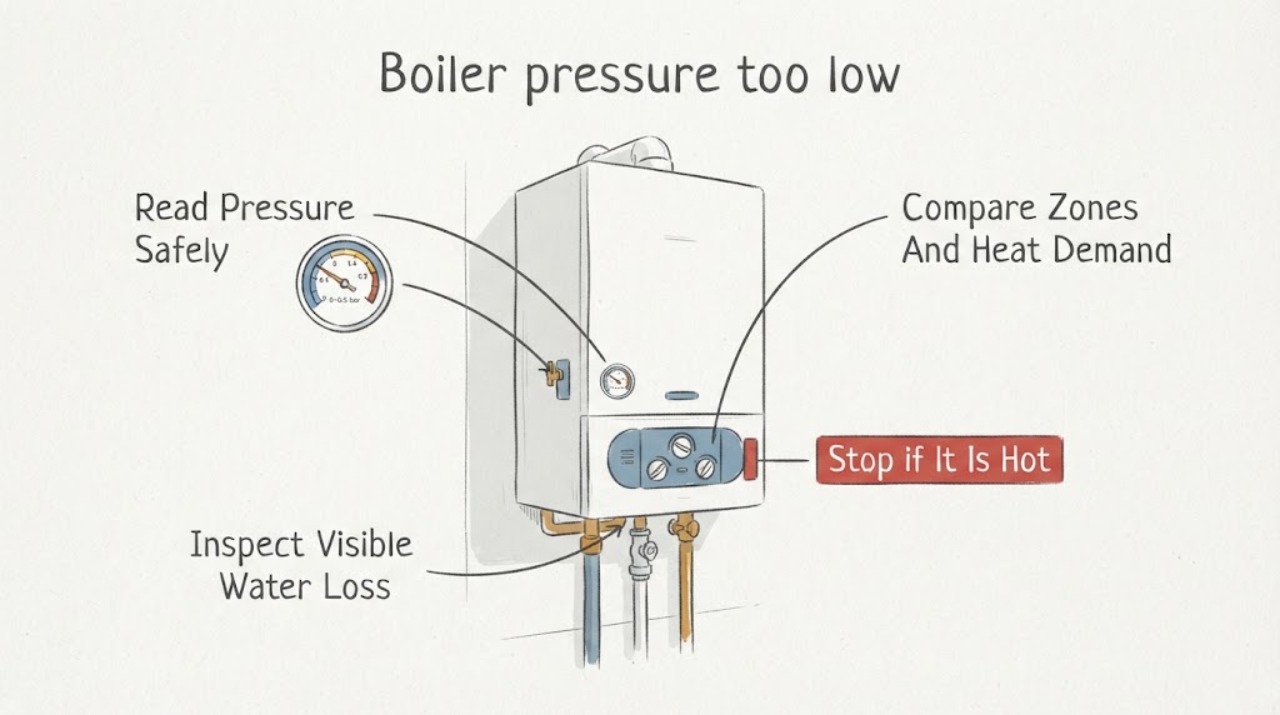
Read the Buderus system-pressure indication only from a safe position and compare it with the exact model manual; do not use a generic target because Buderus boiler families and installations differ. Low pressure can limit or stop heating and may result from air removal, a leak, a relief path, an expansion-vessel problem, or insufficient system water. Look for visible moisture or corrosion around accessible piping, radiators, valves, relief discharge, and the boiler, and record whether the pressure falls again after the system is cool or after heating. If the manual explicitly describes a homeowner filling procedure, follow that procedure only with the system in the stated safe condition and stop before the model's limit; otherwise leave the fill hardware alone. Never open the combustion cabinet, operate a relief valve, or adjust gas, electrical, pressure, or expansion components. Repeated pressure loss, a leak, a pressure that will not hold, an alarm, or no heat requires a qualified Buderus or hydronic technician.
Work through in order
Diagnostic checks
Use only checks that match the exact appliance or system and its official guide.
-
Check 1
From a safe position, read the Buderus pressure gauge or display when the system is cool and note the reading again after a normal heating period if no hazard is present.
Expected result: Record a low but stable reading, a reading that falls over time, a reading that changes sharply with heating, no readable indication, or a warning or lockout.
Next step: Compare the observation with the exact model manual and preserve any display message. Do not use a generic pressure target or adjust a valve without model-specific instructions.
Stop if: Stop for steam, hot discharge, active water, gas odor, smoke, electrical exposure, or an alarm that requires service.
Why this matters
Why: A stable low reading may indicate insufficient system water or a model-specific operating state; falling or sharply changing pressure makes a leak, relief path, expansion vessel, or sensor issue more relevant.
-
Check 2
Inspect only accessible boiler joints, heating pipes, radiator or baseboard valves, air vents, relief discharge piping, and the floor for moisture, staining, corrosion, or a water trail.
Expected result: Record no visible moisture, a wet connection, moisture at a relief discharge, radiator or valve leakage, corrosion, or water from behind the cabinet or wall.
Next step: Keep the boiler off for active or recurring leakage and arrange hydronic service. Photograph the first wet point without touching hot pipes or discharge.
Stop if: Do not tighten pressurized fittings, operate a relief valve, remove insulation, open the cabinet, or touch hot water.
Why this matters
Why: A visible leak can explain falling pressure; relief moisture may indicate a pressure or valve issue; a concealed or internal source cannot be safely identified from outside.
-
Check 3
Confirm the thermostat or zone control is calling for heat and compare the affected radiator, baseboard, radiant zone, or air handler with another zone if available.
Expected result: Record no heat call, all zones cold, one zone cold, uneven radiator warmth, or heating that returns briefly after a pressure change.
Next step: Document the zone pattern and arrange qualified hydronic service when heat does not return under the manual's normal operating conditions. Do not purge, bleed, or adjust valves as a diagnosis.
Stop if: Do not touch hot surfaces, force zone valves, run the boiler unattended, or bypass a low-water safety.
Why this matters
Why: No demand points toward controls; all zones cold with low pressure makes a boiler safety or water-state issue relevant; one cold zone makes flow, air, valve, or zone-pump issues more likely.
-
Check 4
Record the Buderus model, serial information if safely visible, display symbols or error text, fuel type if known, and locate the matching user or installation document in the manufacturer documentation area.
Expected result: Record a normal display, low-pressure warning, lockout, sensor or pump message, blank display, or no matching manual for the installed model.
Next step: Use the exact user manual only for permitted owner checks and provide the display text to a qualified Buderus or Bosch Home Comfort technician when the manual is missing or the warning returns.
Stop if: Do not open the control compartment, test wiring, reset repeatedly, or guess the meaning of a code from another Buderus model.
Why this matters
Why: The code and model determine whether a user pressure procedure exists; a blank display or recurring warning needs electrical or control diagnosis rather than a pressure adjustment.
-
Check 5
If and only if the exact installed manual explicitly permits homeowner filling, follow its stated safe sequence while watching the pressure indication and accessible joints; otherwise leave the filling hardware untouched.
Expected result: Record pressure that reaches and holds the manual's permitted range, pressure that rises unexpectedly, water at a connection or relief path, pressure that falls again, or no safe way to fill.
Next step: Stop at the manual's limit and check for leaks only from a safe position. Leave the boiler off and call service for unexpected pressure, visible water, no hold, or any procedure not clearly assigned to the owner.
Stop if: Do not overfill, drain, bleed, add treatment, operate a relief valve, or continue filling a hot, leaking, or alarmed boiler.
Why this matters
Why: A pressure that holds after a documented permitted fill may indicate a one-time low-water condition; a rise, leak, or repeat loss makes a system leak, relief, expansion, or filling-control issue more likely.
-
Check 6
Prepare a technician handoff with the pressure readings and timing, visible leak points, heating zones affected, thermostat demand, display status, recent filling or bleeding, recent service, and the exact Buderus model.
Expected result: Confirm that the record contains external observations only, with no opened cabinet, relief-valve operation, gas adjustment, electrical test, or unapproved pressure change.
Next step: Contact a qualified Buderus boiler or hydronic technician and provide the record, photos, model documentation, and any safety warning.
Stop if: Stop homeowner troubleshooting when the pressure will not hold, a leak is concealed, an alarm recurs, or diagnosis requires gas, electrical, combustion, pressure, or sealed-component access.
Why this matters
Why: The trend and zone pattern help separate a gauge or sensor issue from water loss, expansion behavior, circulation, controls, or a low-water safety state.
Use your observations
Decision map
Find the observation that best matches what you see, then follow the next safe action.
-
PATH 01Next step
What you see
The pressure is low but stable, no visible leak is found, the system is cool, and the exact manual documents a safe owner filling procedure.
Do this next
Follow only the exact manual's filling sequence and stop at its stated limit; arrange service if the pressure does not hold or heat remains absent.
Why this path and its safety boundary
Why it matters: A one-time low-water condition or air removal may be possible, but a stable gauge reading does not prove the system is sound.
-
PATH 02Next step
What you see
The pressure falls again after a permitted fill or over successive heating cycles, even when no obvious external leak is visible.
Do this next
Keep the boiler off if the loss is active or heat is unavailable and call a qualified Buderus or hydronic technician. Do not keep topping up as a routine workaround.
Why this path and its safety boundary
Why it matters: A concealed leak, relief discharge, expansion-vessel problem, air-removal loss, or pressure-sensing issue is more likely than a one-time low reading.
-
PATH 03Safety boundary
What you see
Moisture appears at boiler or system piping, a radiator or valve, or the pressure-relief discharge path.
Do this next
Leave the boiler off, keep clear of hot water, and arrange qualified boiler or plumbing service. Photograph the first wet point without operating the relief valve.
Why this path and its safety boundary
Why it matters: Water loss is a leading explanation for low pressure; relief moisture can also signal over-pressure, expansion, or valve trouble that requires professional assessment.
Safety stop: Do not tighten fittings, close unknown isolation valves, catch hot discharge, or open the boiler.
-
PATH 04Next step
What you see
The boiler responds to a heat demand but one radiator, baseboard, radiant zone, or air handler stays cold while another zone heats.
Do this next
Record the affected zone and pressure trend and arrange qualified hydronic service. Do not bleed, purge, or force a valve unless the exact manual clearly assigns that check to the owner.
Why this path and its safety boundary
Why it matters: Zone flow, air, a valve, a zone pump, or a local control issue is more likely than a complete boiler heat-source failure; low pressure may still contribute.
-
PATH 05Safety boundary
What you see
The display shows a recurring lockout or safety warning, the boiler has no heat with all zones cold, there is gas odor, smoke, a carbon-monoxide alarm, hot discharge, flooding, or water near electrical equipment.
Do this next
Leave the area or keep clear, turn the boiler off when safe, and use appropriate emergency, gas, electrical, plumbing, or qualified boiler help from a safe location.
Why this path and its safety boundary
Why it matters: The immediate risk is combustion, electric shock, scalding, pressure, or property damage rather than selecting a fill-valve or expansion-vessel part.
Safety stop: Do not touch the boiler, gas piping, wiring, relief discharge, hot water, or wet equipment, and do not restore operation to reproduce the symptom.
Helpful context
Understand the symptom
Confirm the reading before changing anything
Note the pressure shown on the Buderus gauge or display while the system is cool and again after a normal heating period, if it is safe to observe. Use the installed model's manual to interpret the reading; older Buderus oil, gas, condensing, and combi systems do not necessarily share the same controls or filling procedure. A low reading with no heat, a reading that fluctuates, and a reading that falls steadily are different clues. Do not adjust the fill valve simply because the gauge looks low.
Look for where system water may be going
From a safe, dry position, inspect accessible boiler connections, heating pipes, radiator valves, air vents, relief discharge piping, and the floor for moisture, staining, corrosion, or a fresh water trail. A pressure that drops again after a permitted fill or after heating makes a leak, relief path, or expansion-vessel issue more likely than a one-time gauge-reading error. Do not touch hot discharge or remove covers to find a hidden leak.
Connect pressure to the heating symptom
Check whether all radiators or zones are cold, or whether only one area is affected. Air in a circuit, a closed or failed zone component, poor circulation, or a low-water safety state can create uneven heat; low pressure alone does not identify which one is responsible. Record boiler display messages, thermostat demand, pump sounds from a distance, and which zones still warm. Leave bleeding, purging, pump work, and valve adjustment to qualified service unless the exact manual clearly assigns a safe user check.
Use only the installed model's filling instructions
Some Buderus systems describe a user-accessible filling method, while others require installer or service work. Find the model and serial information and read the matching user manual before touching any filling hardware. If the manual permits a top-up, follow only its sequence and stop at its stated cold-system range; if the pressure rises unusually, water appears, or the pressure does not hold, stop and arrange service. Do not improvise a filling loop, add chemicals, drain the system, or bleed radiators to chase a number.
Treat repeated low pressure as a fault, not maintenance
A pressure that needs frequent topping up is not a normal reset routine. Buderus guidance links persistent pressure loss with leaks and expansion-vessel or relief-valve problems, while Bosch Home Comfort provides model-specific Buderus documentation for diagnosis. Keep a record of the reading, top-up history if any, visible water, heating response, and display status so a technician can distinguish water loss from a gauge or control problem.
Safety boundary
Stop conditions
- Stop immediately for gas odor, carbon-monoxide alarm, smoke, scorching, hot discharge, flooding, water near electrical equipment, or an uncontrolled leak.
- Leave the Buderus boiler off for pressure that repeatedly falls, a visible leak, relief moisture, a recurring alarm or lockout, no heat after a confirmed demand, or pressure that will not hold after an approved model-specific check.
- Do not open the combustion or control cabinet, adjust gas or electrical components, operate a relief valve, drain or overfill the system, alter expansion-vessel pressure, bleed or purge as an improvised diagnosis, or bypass a low-water safety.
Only after diagnosis
Potential parts
- expansion vessel or expansion-tank component
Consider this only after a qualified technician confirms repeated pressure change or loss is related to expansion-vessel performance and rules out leaks, relief discharge, filling controls, and gauge or sensor faults.
Match the exact Buderus model, system design, connection, and approved pressure or capacity requirements; do not adjust or replace an expansion component as a homeowner diagnosis. - pressure sensor or gauge
Consider this only when professional testing shows the displayed or gauge pressure is inaccurate or the pressure sensor is faulty after the system water state is verified.
Confirm the exact model, control interface, connection, and manufacturer-approved part. A low reading can reflect real water loss and is not proof of a failed sensor. - filling valve or pressure-relief component
Consider this only after a qualified technician identifies a leaking filling valve, relief path, or valve that cannot maintain the documented system condition.
Use the exact Buderus model and approved pressure-relief or filling arrangement; never substitute a valve or cap to silence a leak or defeat protection.
When checks do not resolve it
Need a professional?
Call a qualified Buderus boiler or hydronic technician for repeated low pressure, pressure that will not hold, visible or concealed leakage, relief discharge, an expansion-vessel or sensor concern, one or more cold zones, a recurring warning or lockout, or any diagnosis requiring filling hardware, bleeding, purging, gas, electrical, combustion, pressure, or internal access. Use emergency, gas, carbon-monoxide, electrical, or plumbing help for odor, alarm, smoke, fire, flooding, hot discharge, or water near energized equipment.
Have this ready
- Provide the Buderus model and serial information if safely visible, pressure readings and whether the system was cool or heating, display or error text, thermostat and zone behavior, visible leak or corrosion points, relief and condensate observations, filling or bleeding history, recent service, photos, and any gas, carbon-monoxide, electrical, smoke, hot-water, or flooding warning.
Common questions
FAQ
Why is my Buderus boiler pressure too low?
Possible causes include a system leak, water loss after air removal or service, relief discharge, an expansion-vessel problem, a filling issue, or an inaccurate gauge or sensor. Check only for visible moisture and the model-specific display information; repeated pressure loss needs qualified service.
Can low Buderus boiler pressure stop the heating?
It can limit or stop safe heating on some models, but the exact behavior and allowable range are model-specific. Confirm the heat demand and display, compare pressure with the exact manual, and do not bypass a low-water safety or guess a universal target.
Should I add water to a Buderus boiler with low pressure?
Only if the exact installed model's user manual explicitly describes a safe owner filling procedure and the system is in the stated condition. Stop for a leak, hot system, abnormal rise, pressure that will not hold, or any procedure that requires professional access.
When does low Buderus boiler pressure require a technician?
Call a qualified Buderus or hydronic technician for repeated pressure loss, visible or concealed leaks, relief moisture, a stuck or recurring alarm, one cold zone, no heat after a confirmed demand, or pressure that does not hold after a permitted model-specific check. Use emergency help for gas odor, a carbon-monoxide alarm, smoke, flooding, or water near electrical equipment.
Read the exact guide
Official sources
- Non-Condensing BoilersBosch Home Comfort · The official Bosch Home Comfort page identifies Buderus boiler products and the combustion-to-water-to-home-heating path; it supports keeping gas, flue, and internal work outside homeowner troubleshooting.
- Kombinin Su Basıncı Neden Düşer?Buderus Türkiye · This is an official Buderus regional guidance page; it supports general pressure-loss reasoning, while the installed Buderus model's local manual controls language, limits, and filling procedure.
- Technical Support ResourcesBosch Home Comfort · Bosch Home Comfort is the official U.S. support channel that exposes Buderus residential boiler documentation; it supports directing owners to exact model materials rather than a universal pressure instruction.
- Ремонт котлов: как устранить поломкиBuderus · This official Buderus regional article provides additional manufacturer context; because it is not an English or exact-model manual, it is used only for broad symptom-to-service boundaries.
- Discontinued Buderus ProductsBosch Home Comfort · The official documentation index demonstrates that Buderus instructions vary by model and provides model-specific documents for older products; it does not authorize a generic fill or pressure adjustment.
Community feedback
Share a repair observation
Share a plain-text repair observation. Accepted observations are published automatically; this page may take a moment to update.