
On this page
Start here
Quick answer
A low boiler-pressure reading does not prove that the expansion tank itself has failed. The reading can reflect a leak, a relief or air-vent discharge, a fill or gauge problem, an incorrectly sized or failed expansion tank, or normal pressure behavior that is being misread. Observe the gauge only when the system is cool, note whether the reading is stable or falling, and look from a safe, dry position for visible leaks or discharge. Do not open the fill valve, adjust system pressure, charge the expansion tank, cap a relief valve, or open the boiler. Persistent low pressure, repeated pressure swings, a relief discharge, loss of heat, or any gas, fuel, steam, hot-water, or electrical hazard needs qualified HVAC service.
Before you begin
Safety first
- Do not open the fill valve, adjust system pressure, charge the tank, drain or purge the system, cap or plug the pressure-relief path, open the boiler, or work on gas, fuel, combustion, electrical, hot-water, or pressurized components.
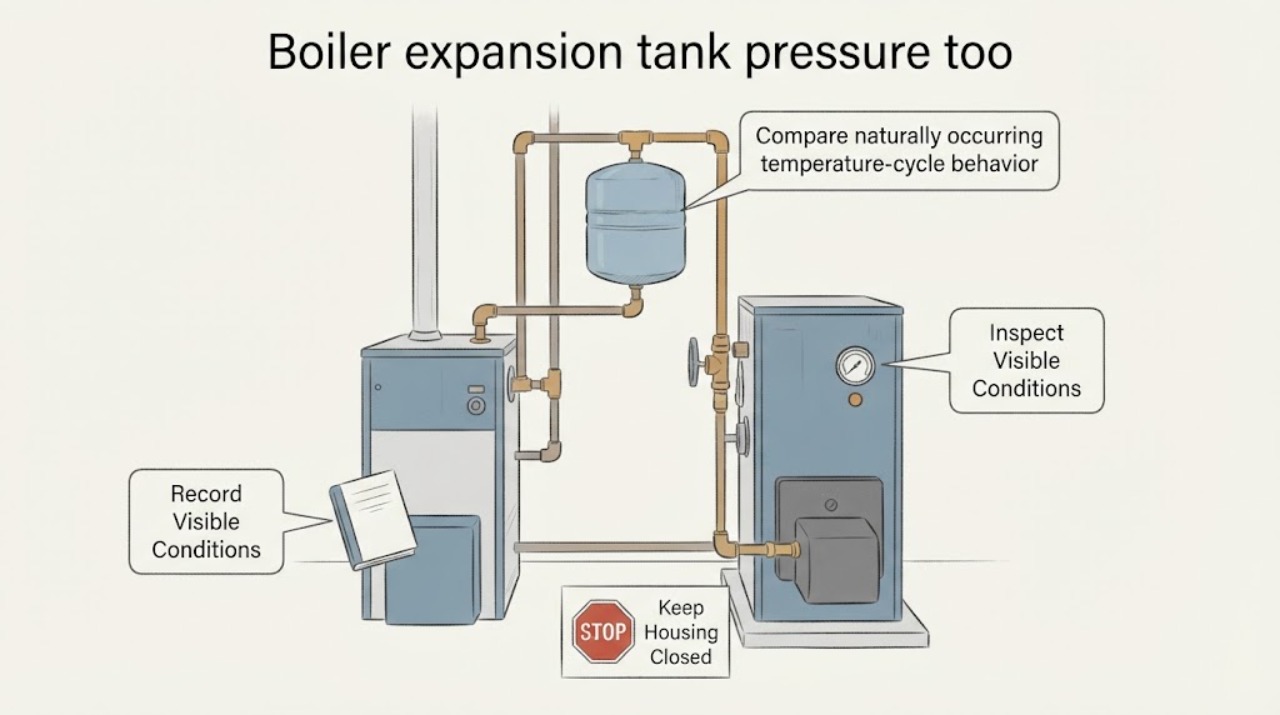
Work through in order
Diagnostic checks
Use only checks that match the exact appliance or system and its official guide.
-
Record the gauge when the boiler is cool
From a dry, stable position, read the boiler pressure gauge only when the system is cool and the gauge is plainly visible. Record the displayed value, the gauge scale, the date, and whether the reading is steady or changing; do not turn any valve or remove a cover.
Expected result: Note a stable low reading, a reading that is falling between observations, a gauge that sticks or is hard to read, or a pointer that moves unusually during a naturally occurring heating cycle.
Next step: Keep the observation for the HVAC technician and compare it only with later cool-system readings. Do not open the fill valve or attempt to set a generic pressure target.
Stop if: Stop if the gauge is damaged, the boiler is hot, water or steam is present, the pressure is rapidly changing, or reading it would require entering an unsafe area.
Why this matters
Why: A stable but low reading can reflect the system's fill condition, a gauge issue, or a pressure loss. A falling or erratic reading makes leakage, discharge, air removal, fill-control, or expansion-tank performance more important to investigate professionally.
-
Look for visible water or relief discharge
Without touching hot piping or the relief outlet, look around the boiler, expansion-tank connection, air vents, drain points, floor, and nearby wall for visible water, mineral traces, dampness, or a discharge path.
Expected result: Record whether the area is dry, has an old stain, shows a fresh drip, has a wet or corroded fitting, or has water coming from a relief or drain outlet.
Next step: Keep people away from hot, wet, or pressurized areas and give the technician photos and the location of any discharge. Do not tighten fittings, cap an outlet, or mop up near energized equipment.
Stop if: Stop use and arrange prompt professional help for active leaking, steam, a strong hot-water discharge, a saturated floor, a damaged tank, or water near electrical components.
Why this matters
Why: Visible loss can explain a low reading and may involve more than the expansion tank. A relief discharge can also indicate an over-pressure or control problem at another point in the heating system; it is not a reason to block the outlet.
-
Compare naturally occurring temperature-cycle behavior
Use existing household observations to compare the gauge and heating response when the system is cool versus after it has completed a normal heating period. Do not force a cycle, repeatedly call for heat, touch hot pipes, or run the boiler as a test.
Expected result: Note whether the pressure remains near its cool reading, rises noticeably during normal heating, drops again after cooling, or coincides with relief discharge, loss of heat, noise, or a lockout.
Next step: Provide the cool and naturally observed warm-state pattern to a qualified HVAC professional. Do not charge the tank, add water, or adjust the boiler to make the readings look normal.
Stop if: Stop operating the system for a pressure surge, relief discharge, overheating, steam, unusual banging, gas or fuel odor, smoke, or carbon-monoxide alarm.
Why this matters
Why: A large or repeated pressure swing can point to expansion-tank sizing or performance, air, circulation, fill-control, or another system issue. A low reading that does not change may instead reflect a persistent loss or gauge problem. The pattern is a service clue, not a diagnosis.
-
Check external boiler and control indications
From a safe position, read any external boiler display, indicator light, thermostat call, or control message without removing a panel or touching electrical, fuel, combustion, or hot-water components.
Expected result: Record the exact error or lockout text, whether heat is being requested, whether the boiler appears to run, and whether the low-pressure indication appears with another warning.
Next step: Use the exact boiler make and model and the unedited message in the service request. Do not reset repeatedly, bypass a safety control, or interpret a code from another model.
Stop if: Leave the area and seek emergency or qualified help for gas or fuel odor, carbon-monoxide alarm, smoke, unusual combustion, overheating, steam, or a significant water leak.
Why this matters
Why: A low-pressure message paired with a lockout or loss of heat needs professional diagnosis of the complete boiler and hydronic circuit. A normal-looking external display does not rule out a failed expansion tank, leak, gauge, or fill assembly.
-
Prepare a pressure-history handoff
Gather the boiler and expansion-tank make or model if already visible, fuel type if known, cool-system gauge readings, natural temperature-cycle pattern, visible leak or discharge locations, thermostat and heat response, error messages, and any recent service or refill history.
Expected result: A clear history may show a one-time reading, a slow loss, repeated refill or discharge behavior, pressure swings with heating, or a broader boiler fault. Mark unknown details as unknown rather than estimating them.
Next step: Request qualified HVAC service and keep the system in its existing safe state while waiting. Do not drain, fill, purge, or charge any component yourself.
Stop if: Stop all user troubleshooting if the system becomes hot, wet, noisy, unstable, damaged, or unsafe, or if professional-only gas, fuel, combustion, electrical, or pressurized work would be required.
Why this matters
Why: The professional can decide whether to test the tank, gauge, fill assembly, relief protection, air vents, piping, or another boiler component. The gauge alone cannot identify which part should be replaced.
Use your observations
Decision map
Find the observation that best matches what you see, then follow the next safe action.
-
PATH 01Next step
What you see
The cool-system reading is low but stable, with no visible leak, discharge, heat loss, or safety warning.
Do this next
Document the reading and arrange a qualified HVAC assessment rather than opening the fill valve. The correct condition depends on the system design and gauge location.
-
PATH 02Next step
What you see
The reading falls between cool-system observations or water, mineral traces, dampness, or discharge are visible.
Do this next
Treat pressure loss as a professional service issue. Keep away from hot or pressurized parts, do not cap a relief outlet, and provide photos and locations to the technician.
-
PATH 03Next step
What you see
Pressure rises and falls markedly during naturally occurring heating and cooling, or a relief outlet discharges.
Do this next
Request prompt HVAC diagnosis of the expansion tank, system sizing, fill control, relief protection, gauge, and circulation path. Do not charge the tank or adjust system pressure.
-
PATH 04Next step
What you see
The boiler shows a low-pressure lockout, fails to heat, or displays another error with the low reading.
Do this next
Stop user troubleshooting and give the exact message and pressure history to a qualified HVAC professional. Do not repeatedly reset or bypass the control.
-
PATH 05Next step
What you see
The gauge is unreadable, sticks, disagrees with other indications, or may be damaged.
Do this next
Have the gauge and system checked together. Do not replace or recalibrate it based only on a generic pressure reading.
-
PATH 06Next step
What you see
There is steam, rapid discharge, significant leakage, overheating, gas or fuel odor, smoke, carbon-monoxide alarm, or water near electrical equipment.
Do this next
Leave or isolate the area when safe, keep people away, and use appropriate emergency or qualified professional service. Do not operate, fill, drain, or touch the boiler.
Helpful context
Understand the symptom
Why the expansion tank matters
In a closed hydronic system, the expansion tank provides an air cushion as system water warms and cools. The tank, circulator, fill assembly, gauge, relief protection, air vents, and piping work as one pressure system. A low reading can therefore be a symptom elsewhere, and a replacement tank should not be selected from the gauge reading alone.
Read the gauge without changing the system
Pressure changes with temperature and with the location of the gauge in the system. Use the gauge's normal scale and the boiler's own documentation, but record the observed trend rather than applying a generic target. The safe homeowner task is documentation; filling, draining, charging, purging, and component adjustment belong to a qualified professional.
When to stop
Do not continue operating or investigating a system with active discharge, a significant leak, steam, a hot or damaged component, gas or fuel odor, smoke, carbon-monoxide alarm, or water near electrical equipment. Leave the area when necessary and obtain emergency or qualified service. Never block or cap a pressure-relief path.
Only after diagnosis
Potential parts
- boiler pressure gauge
Consider this only if a qualified diagnosis confirms that the gauge is inaccurate or failed and the underlying pressure condition has also been assessed.
Gauge range, connection, temperature rating, and boiler design must match; confirm fitment with the boiler manufacturer or qualified HVAC professional. - boiler fill valve
Consider this only if professional testing identifies the fill or pressure-reducing assembly as the source of inadequate or unstable system pressure.
Fill-valve settings, backflow protection, connection, and code requirements are system-specific; do not select or adjust one from a low gauge reading alone. - boiler expansion tank
Consider this only if a qualified technician confirms a failed, undersized, incorrectly configured, or otherwise unsuitable expansion tank after checking the rest of the pressure system.
Tank type, volume, orientation, connection, system fluid, and design pressure must be confirmed for the installed boiler and hydronic circuit.
When checks do not resolve it
Need a professional?
Call a qualified HVAC professional for persistent or falling low pressure, repeated pressure swings, relief discharge, visible leakage, a low-pressure lockout, loss of heat, or any need to inspect, fill, drain, purge, charge, replace, or adjust the expansion tank or boiler pressure components.
Safety scope: Do not open the fill valve, adjust system pressure, charge the tank, drain or purge the system, cap or plug the pressure-relief path, open the boiler, or work on gas, fuel, combustion, electrical, hot-water, or pressurized components.
Have this ready
- Provide the boiler and tank make/model if visible, fuel type, cool-system gauge readings and dates, naturally observed warm-state behavior, visible leak or discharge locations, external error text, heat response, and recent service or refill history.
Common questions
FAQ
Does low boiler pressure prove the expansion tank is bad?
No. A low reading can also reflect a leak, relief or air-vent discharge, fill-control problem, gauge fault, or another system condition. Record cool-system readings and visible evidence and have the complete hydronic circuit assessed.
Should I open the boiler fill valve when the pressure is low?
Not without qualified, system-specific guidance. Adding water can mask a leak or create an unsafe pressure condition. Do not adjust the fill valve; provide the pressure history to an HVAC professional.
Why does pressure change when a boiler heats up?
Water expands as it warms, and the expansion tank provides an air cushion in a closed hydronic system. An unusually large or repeated swing can involve tank sizing or performance, filling, air, circulation, the gauge, or another fault and needs professional diagnosis.
Can I add air to the expansion tank myself?
Do not charge or adjust the tank yourself. The tank and water side must be assessed together, and the work involves a pressurized heating system and model-specific isolation and measurement procedures.
When is low boiler pressure urgent?
Escalate promptly for falling pressure, repeated relief discharge, active leakage, loss of heat, steam, overheating, unusual noise, gas or fuel odor, smoke, a carbon-monoxide alarm, or water near electrical equipment. Keep away and obtain qualified help.
Read the exact guide
Official sources
- 2. Basic Concepts & DetailingCaleffi · Manufacturer technical education about hydronic pressure distribution and expansion tanks; actual readings and service requirements depend on the installed boiler and system design.
- 4. The Basic Hydronic CircuitCaleffi · Manufacturer educational guidance for closed-loop hydronic systems; it explains system relationships but is not permission for an unqualified person to adjust a boiler or pressure component.
Community feedback
Share a repair observation
Share a plain-text repair observation. Accepted observations are published automatically; this page may take a moment to update.