
On this page
Start here
Quick answer
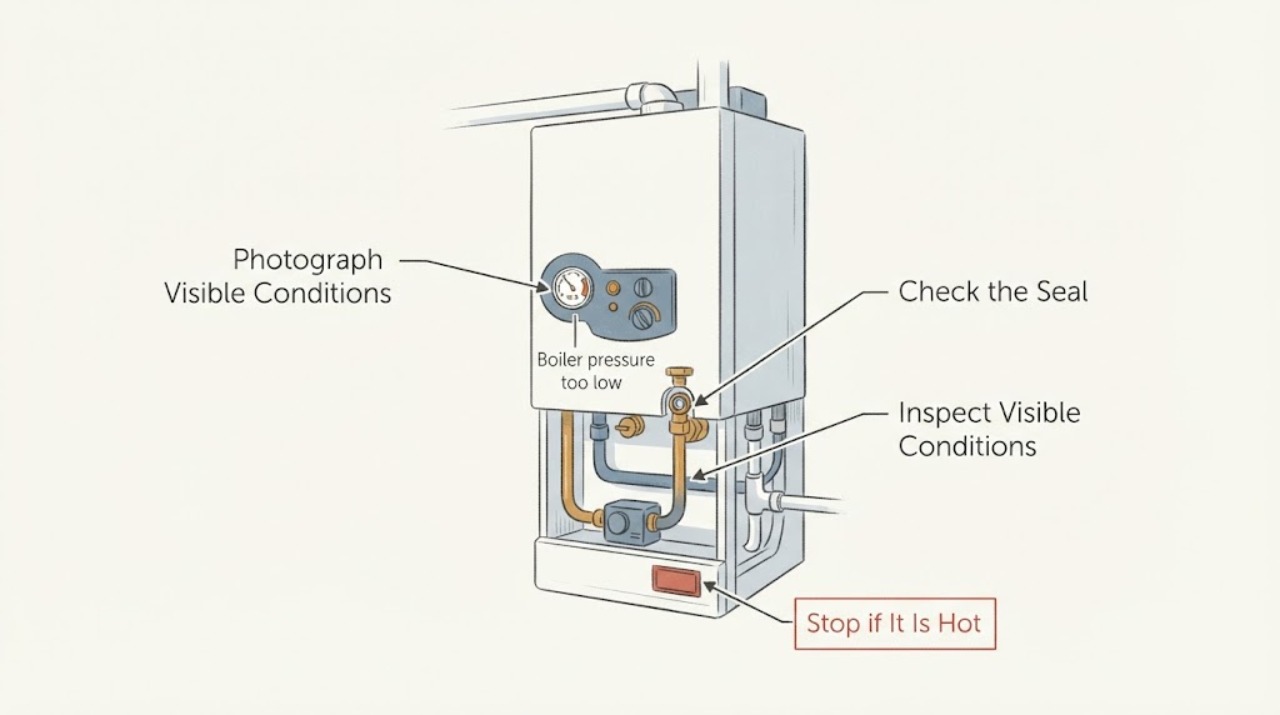
Treat a low boiler-pressure reading as a symptom, not a cue to open a filling valve. From outside the appliance, photograph the gauge or display and compare it with the normal zone in the boiler manual. Check whether the reading changes with heat demand, look for visible drips or water marks around accessible radiator and boiler connections, and note whether radiators or hot water are also affected. Repeated pressure loss, an external discharge, a fault message, or any sign of gas, electrical, hot-surface, or pressurized-water danger needs a qualified boiler technician; do not remove the casing, fill, bleed, or adjust the system yourself under this observation-only scope.
Work through in order
Diagnostic checks
Use only checks that match the exact appliance or system and its official guide.
-
Check 1
With the boiler in its normal installed state, photograph the pressure gauge or digital pressure screen and record the displayed zone, warning symbol, or fault message. Compare it with the normal range shown in the appliance's own manual rather than using a generic number.
Expected result: A needle or indicator below the model's stated normal zone confirms a low-reading symptom; a blank, flickering, contradictory, or rapidly changing display may point toward a sensor, power, or control issue instead. A normal-looking gauge does not rule out a heating fault.
Next step: Record whether the reading was taken while the system was cool, heating, or idle, then inspect accessible connections for leak traces.
Stop if: Stop if the display indicates an emergency, the gauge glass is cracked, the appliance is hot or leaking, or the observation would require removing a cover.
Why this matters
Why: The exact display and model identity determine what a technician should check. Do not turn a low reading into a filling or reset procedure without model-specific professional direction.
-
Check 2
From a safe, dry position, inspect visible radiator valves, accessible pipe connections, the floor beneath the boiler, and any visible discharge pipe termination for dampness, droplets, staining, corrosion, flaking paint, or a fresh water mark. Do not touch a hot pipe or loosen any joint.
Expected result: A localized wet mark or repeated drip supports a water-loss lead; a dry exterior does not rule out a hidden leak or an internal boiler fault. Condensation can look like a leak, so the technician should distinguish the source.
Next step: Photograph the location and note whether the mark is below a radiator, boiler, relief discharge, or hidden wall route. Continue by observing heat demand without manipulating controls beyond normal use.
Stop if: Stop for active dripping, pooling water, water near electrics, steam, a hot surface, a strong fuel odor, or any sign of a pressurized discharge.
Why this matters
Why: Visible water evidence makes repeated pressure loss a service issue rather than a maintenance setting. Do not seal, tighten, drain, or refill the system based on a photograph.
-
Check 3
Observe the boiler's normal response when the thermostat or heating control makes a routine heat demand, without entering the service menu or resetting repeatedly. Note whether the boiler fires, locks out, displays a pressure warning, or leaves some radiators or hot water unavailable.
Expected result: A pressure warning that appears with cold radiators or no hot water makes the low-reading symptom operationally significant. A normal heat response with a stable low-looking gauge may indicate a model-specific gauge or reading issue that still needs confirmation.
Next step: Record the message exactly, the time it appeared, and which heating function was affected. Do not repeatedly reset the appliance to force operation.
Stop if: Stop if the boiler makes unusual combustion sounds, smells of fuel, vents fumes, overheats, repeatedly locks out, or shows an emergency warning.
Why this matters
Why: The relationship between the reading and heat demand helps a technician separate a pressure-related shutdown from a broader control or heating fault. It does not justify opening the boiler or changing settings.
-
Check 4
Review recent events without touching the system: radiator bleeding or service, a power interruption, a new fault code, a temperature change, visible maintenance, or a prior pressure drop. Compare today's reading with any earlier photo or manual record.
Expected result: A pressure change after service or radiator work is useful context; a gradual fall that returns repeatedly, especially with no visible leak, points toward hidden water loss or a component issue. One isolated reading may be a measurement or operating-state difference.
Next step: Prepare the model, display photo, pressure trend, leak observations, and heating symptoms for the service call.
Stop if: Stop if determining the cause would require bleeding, filling, draining, opening the casing, testing gas or electrics, or working on pressurized components.
Why this matters
Why: The trend and timing help determine urgency, but only a qualified technician can test the expansion vessel, filling components, sensor, relief path, or internal circuit. Do not attempt those checks yourself.
Use your observations
Decision map
Find the observation that best matches what you see, then follow the next safe action.
-
PATH 01Next step
What you see
The gauge or display is below the normal zone in the model manual and the boiler also shows a pressure warning or loses heat or hot water.
Do this next
Leave the boiler untouched and arrange a qualified boiler technician. Provide the exact message, model information, operating state, and any visible leak evidence; do not open the filling valve under this observation-only guidance.
-
PATH 02Next step
What you see
A visible drip, water mark, discharge, or repeated pressure fall is present.
Do this next
Treat it as a service issue and keep people away from hot, wet, electrical, or pressurized areas. Call a qualified boiler or HVAC technician; do not tighten joints, drain, fill, or bleed the system.
-
PATH 03Next step
What you see
There is a fuel odor, flue or combustion concern, electrical hazard, steam, hot-surface risk, or an emergency lockout.
Do this next
Stop observing, leave the area if unsafe, and use the appropriate qualified emergency or boiler service channel. Do not operate switches, remove covers, or attempt a restart in the hazardous area.
Helpful context
Understand the symptom
What a low reading tells you
A boiler gauge or digital display reports the condition of the heating circuit, but the correct range depends on the system and model. Low pressure can accompany a leak, recent radiator work, a faulty component, or a sensor or display issue. A single reading does not identify the cause, and a pressure value copied from another boiler can be misleading.
Keep the check outside the appliance
Use the manual, a flashlight, and a phone camera from a dry floor position. Do not open the boiler cover, touch gas or electrical components, open a filling valve, bleed a radiator, loosen a fitting, or handle hot or pressurized parts. The useful handoff is a clear reading, timing, visible leak evidence, and the effect on heating demand.
Only after diagnosis
Potential parts
- boiler pressure gauge
Consider this category only if a qualified technician confirms that the gauge or sensor is inaccurate or failed rather than the heating circuit actually losing water.
Match the exact boiler model, gauge connection, scale, sensor arrangement, and manufacturer requirements; a generic gauge is not a safe fit assumption. - boiler fill valve
Consider this category only after a qualified technician diagnoses a failed filling component and confirms that replacement is appropriate; a low reading alone does not prove a fill-valve failure.
Do not open, adjust, or replace a filling valve as a homeowner under this guidance. Confirm system type, connection, pressure-control design, and local professional requirements. - boiler expansion tank
Consider this category only if a qualified technician confirms an expansion-vessel fault or pressure swing after inspecting the complete heating system.
Confirm boiler system design, tank volume, connection, pre-charge specification, and installation requirements with the technician; do not treat a generic tank as interchangeable.
When checks do not resolve it
Need a professional?
Call a qualified boiler or HVAC technician for a low reading below the model's normal zone, a pressure warning, repeated pressure loss, visible water, an external discharge, or heat and hot-water failure. Seek the appropriate emergency service for fuel odor, fumes, electrical danger, steam, or a hot pressurized leak.
Have this ready
- Provide the boiler make and model if safely visible, a photo of the gauge or display, the exact warning text, whether the system was cool or heating, the pressure trend, visible leak locations, recent service history, and which radiators or hot-water functions are affected. State that you did not open the casing, fill, bleed, or adjust the system.
Common questions
FAQ
Should I open the filling valve when the boiler pressure is low?
Not under this observation-only guidance. A low reading can reflect a leak, sensor issue, system type, or component fault. Compare the gauge with the model manual and have a qualified technician decide whether and how pressure should be changed.
Can low boiler pressure mean there is a leak?
It can. Look only for accessible dampness, drips, stains, or discharge evidence around radiator connections and beneath the boiler. A dry exterior does not rule out a hidden or internal leak, so repeated pressure loss needs professional diagnosis.
Is one pressure number correct for every boiler?
No. The correct zone depends on the boiler and heating-system design and should come from the appliance manual or qualified technician. Do not use a pressure value from another model to fill, bleed, or adjust your system.
Read the exact guide
Official sources
- How often should I need to top up the pressure in the heating system?Worcester Bosch · The FAQ illustrates that pressure zones and service thresholds are model/system guidance and that frequent pressure loss or large operating changes warrant an engineer; no values are generalized in this article.
- Why is my boiler losing pressure?Vaillant · The manufacturer explains how its homeowners can read the gauge or display, lists leaks and system events as possible causes, and recommends professional inspection for internal boiler faults; pressure ranges and actions remain model/system-specific.
- Greenstar i TroubleshootingWorcester Bosch · This product-specific page identifies the front gauge, visible radiator and relief-path leak clues, and professional escalation for persistent pressure loss; it is not a universal procedure for other boiler systems.
Community feedback
Share a repair observation
Share a plain-text repair observation. Accepted observations are published automatically; this page may take a moment to update.