
On this page
Start here
Quick answer
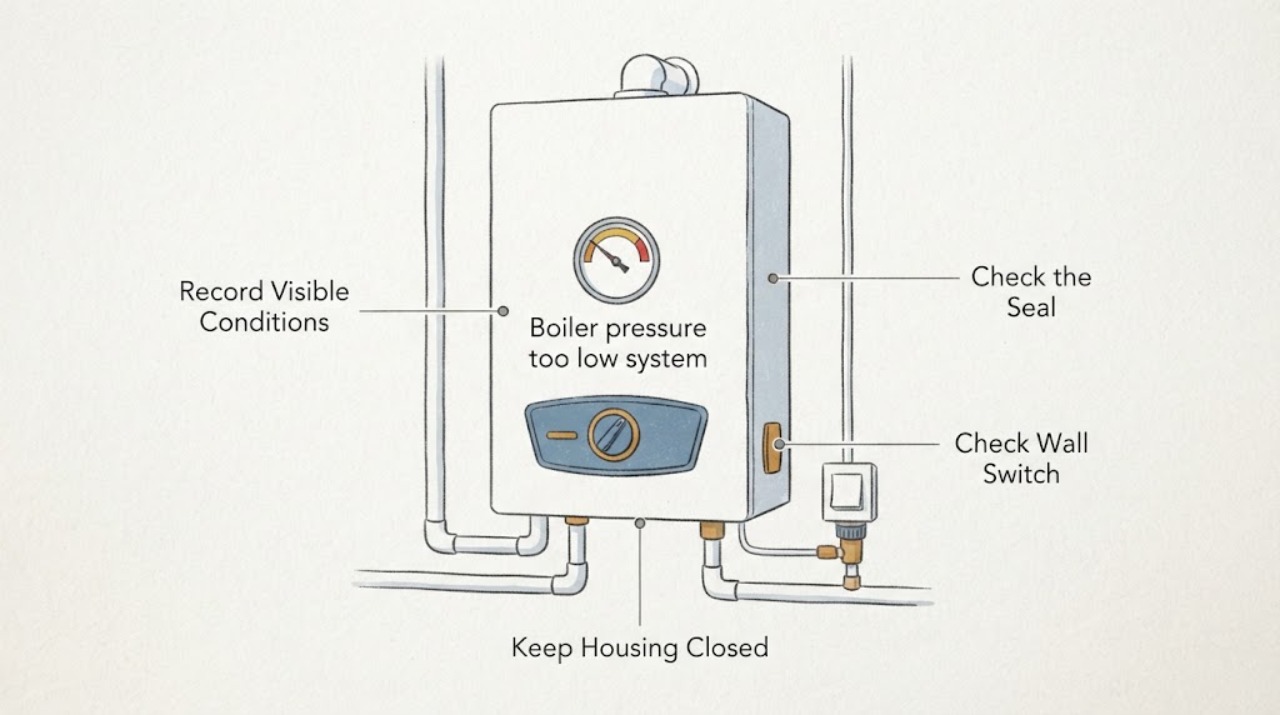
Check boiler pressure against the exact appliance manual and note whether the heating system is cool or hot. A low reading on a cool system can follow a leak, radiator bleeding, or gradual water loss; it can stop the boiler from providing heat or hot water. If the manual identifies a user-accessible filling loop or filling key, turn the boiler off, let the system cool, and follow that model-specific procedure once while watching the gauge. If pressure will not rise, drops again quickly, a leak is visible, pressure becomes high when the heating runs, or you need to top up repeatedly, stop and arrange qualified heating service. Do not open the boiler casing, guess a target pressure, repeatedly refill, or work on gas, electrical, expansion-vessel, or safety components.
Before you begin
Safety first
- The homeowner scope is limited to reading the display, inspecting accessible surfaces, and performing one manual-directed refill only when the appliance is cool and the filling device is clearly identified. Do not open the casing, guess pressure targets, repeatedly top up, adjust expansion vessels or safety valves, work on gas or electrical parts, or drain the heating system.
Work through in order
Diagnostic checks
Use only checks that match the exact appliance or system and its official guide.
-
Check 1
Read the boiler's physical gauge or user-facing digital pressure display without removing the casing. Record the reading, whether the heating system is cool or hot, whether the boiler is showing a pressure fault, and whether the manual marks a normal range for that state.
Expected result: The cool-system reading is below the manual range, the reading changes substantially between cool and hot, the display is normal, or the gauge cannot be read reliably.
Next step: Photograph the display and compare it with the exact manual. If the reading is low and no emergency condition is present, continue to a safe leak check before considering the manual-directed filling procedure.
Stop if: Stop for a damaged gauge, active water leak, steam, a rapidly changing reading, an error that returns, or any need to open the boiler.
Why this matters
Why: A low cool reading supports water loss or a refill need; a large hot-to-cool change points toward a pressure-control or expansion issue; a normal or unreliable reading means the cold-house symptom needs broader diagnosis rather than a guessed refill.
-
Check 2
Inspect accessible radiator valves, exposed pipe joints, beneath the boiler, and nearby flooring or skirting for dampness, rust, staining, bubbling paint, or water. Check whether the pressure loss began after a radiator was bled or a heating component was serviced; do not remove panels or insulation to chase a hidden leak.
Expected result: Water or damage is visible, the pressure fell suddenly, only a slow gradual drop is known, or no visible leak is found.
Next step: Keep the boiler off if water is escaping, protect nearby surfaces, and arrange qualified inspection. If no leak is visible, do not assume repeated topping up is a repair; provide the pressure history to the engineer.
Stop if: Stop for active leakage, water near electrical parts, hot surfaces, a ceiling or wall stain, or any need to dismantle the boiler or building.
Why this matters
Why: Visible water or a sudden fall makes a leak or escape of system water more likely; no visible leak does not rule out hidden pipework or a boiler fault.
-
Check 3
Only if the exact manual identifies the filling loop or filling key as a user procedure, switch the boiler off and allow the heating system to cool. Follow the manual slowly while watching the gauge, then close the filling device in the order specified; do not guess which valve is the filling control.
Expected result: The pressure rises smoothly to the manual's recommended range, does not rise, rises too far, or falls again as soon as the device is closed.
Next step: Close the filling device and return the boiler to normal only as the manual directs. If the pressure will not rise, becomes high, or falls again, stop refilling and arrange qualified service.
Stop if: Stop immediately if water escapes, the filling control is unidentified, the manual does not authorize the procedure, the boiler is hot, or the casing must be removed.
Why this matters
Why: A controlled rise suggests a temporary loss may have been restored; no rise can indicate a closed or faulty filling device, while overshoot or immediate loss points toward a leak, valve, sensor, or other system fault.
-
Check 4
After a permitted one-time refill, observe the pressure during one normal heating cycle without repeatedly adjusting the filling device. Note whether it stays within the manual range, rises markedly when hot, drops again when cool, or triggers a relief or fault indication.
Expected result: Pressure remains stable, rises significantly with heating, falls again after cooling, or the boiler repeatedly shuts down or requires topping up.
Next step: Record the cool and hot readings and arrange qualified heating service for a significant swing, recurring loss, relief discharge, or repeat shutdown. Do not compensate by adding water over and over.
Stop if: Stop for high pressure, hot water discharge, a leak, unusual noise, a gas smell, smoke, or any attempt to adjust an expansion vessel or safety valve.
Why this matters
Why: Stable pressure makes a simple recent loss more plausible; repeated hot rise and cool fall suggests expansion-vessel or pressure-control trouble; recurring top-ups point toward a leak or unresolved fault.
-
Check 5
Once pressure is within the manual range, check whether the thermostat and heating controls call for heat, whether the boiler display clears its low-pressure fault, and whether radiators and hot water recover. Use only normal user controls and do not repeatedly reset a returning fault.
Expected result: Heating and hot water return, only one radiator remains cold, the boiler stays locked out, or the system remains cold despite a normal pressure reading.
Next step: Arrange qualified diagnosis for persistent coldness or a returning fault and provide the exact display, pressure history, and whether hot water works. Do not open the casing or replace an internal part from the symptom alone.
Stop if: Stop for gas smell, carbon-monoxide concern, smoke, burning odor, abnormal flame, electrical hazard, or water entering electrical components.
Why this matters
Why: Recovery after pressure correction supports low pressure as the immediate cause; persistent coldness or a returning fault indicates another control, circulation, sensor, or boiler issue.
Use your observations
Decision map
Find the observation that best matches what you see, then follow the next safe action.
-
PATH 01Safety boundary
What you see
The system is cool, pressure is below the exact manual range, no leak is visible, and this is an isolated or infrequent event.
Do this next
Follow the manual's one-time filling-loop or filling-key procedure with the boiler off and cool, then record the pressure and monitor for recurrence.
Why this path and its safety boundary
Safety stop: Do not guess the filling device or continue if the pressure does not rise smoothly.
-
PATH 02Safety boundary
What you see
Pressure fell suddenly, water is visible around a radiator, valve, pipe, or boiler, or pressure falls again immediately after a permitted refill.
Do this next
Keep the system off if water is escaping and arrange qualified inspection to find and correct the leak before repeated operation or refilling.
Why this path and its safety boundary
Safety stop: Do not keep topping up, open the boiler, or dismantle a radiator or pipe connection.
-
PATH 03Safety boundary
What you see
The gauge does not rise while the manual-directed filling procedure is used, or the filling device is unknown, inaccessible, or leaking.
Do this next
Close the filling device if possible without force and arrange qualified service to inspect the filling path, isolation, pressure sensor, and system for leaks.
Why this path and its safety boundary
Safety stop: Do not force a valve, remove a boiler cover, or improvise a connection to add water.
-
PATH 04Safety boundary
What you see
Pressure is acceptable when cool but rises markedly while heating, then drops again as the system cools or repeatedly causes shutdowns.
Do this next
Have a qualified heating engineer assess the expansion vessel, pressure-relief path, and related controls; do not attempt to repressurise the vessel yourself.
Why this path and its safety boundary
Safety stop: Stop for high pressure, hot discharge, a relief-valve leak, or any need to work inside the boiler.
-
PATH 05Safety boundary
What you see
Pressure returns to the manual range, but the house remains cold, hot water is absent, or a boiler fault or lockout returns.
Do this next
Arrange qualified boiler diagnosis for controls, circulation, sensors, or another fault and provide the exact display and pressure readings.
Why this path and its safety boundary
Safety stop: Do not repeatedly reset the boiler or substitute an internal part based on low pressure alone.
-
PATH 06Safety boundary
What you see
There is a gas smell, carbon-monoxide alarm or symptom, smoke, burning odor, unusual flame, or water near electrical components.
Do this next
Leave the affected area and follow local gas, emergency, and medical guidance; do not return to adjust pressure or relight the appliance until qualified service confirms it is safe.
Why this path and its safety boundary
Safety stop: Do not open the boiler, operate electrical switches near a gas smell or water, or keep testing the appliance.
Helpful context
Understand the symptom
Cold and hot readings are not the same clue
Read the gauge or display with the system cool, then note what happens as the heating runs. The cool-system reading is the useful comparison point for the manual. A pressure rise while hot can be normal within the appliance's specified range, but a large or repeated swing can point to an expansion-vessel or other system problem. A low reading does not identify a specific boiler part by itself.
Look for lost water before adding more
Leaks can occur at radiator valves, visible pipe joints, or hidden pipework, and low pressure may also follow bleeding a radiator. Check accessible areas for dampness, rust marks, flaking paint, or bubbling skirting without removing covers or opening the boiler. If pressure dropped suddenly, treat a leak as more important than restoring the gauge temporarily.
Refill only within the manual's boundary
Filling loops and filling keys differ between boilers. Manufacturer guidance says to use the exact manual, switch the boiler off, let the system cool, monitor the gauge while adding water, and stop at the model's recommended level. If the gauge does not rise or falls as soon as the filling device is closed, close the device and arrange service rather than repeating the refill.
Only after diagnosis
Potential parts
- boiler expansion vessel
Consider this category only after a qualified engineer confirms a repeated hot-to-cool pressure swing and identifies the vessel as the cause.
Match the exact boiler model, vessel capacity, connection, pressure rating, and installation requirements; do not infer a vessel fault from one low gauge reading. - boiler filling loop or filling device
Consider this category only when the installed filling device is leaking, cannot admit water, or is confirmed faulty after the system and manual are identified.
Filling loops, keys, and internal links are model- and installation-specific; confirm the connection, isolation arrangement, and local requirements before replacement. - boiler pressure relief or pressure-sensing component
Consider this category only when a qualified engineer confirms a relief, sensor, or pressure-control fault after checking for leaks and correct system pressure.
Match the exact appliance approval, pressure rating, connection, electrical specification, and safety requirements; never substitute by appearance or symptom.
When checks do not resolve it
Need a professional?
Escalate for visible or suspected leaks, no pressure increase, immediate pressure loss, repeated refilling, high pressure when hot, relief discharge, recurring lockout, or any gas, combustion, electrical, expansion-vessel, or internal boiler concern.
Safety scope: The homeowner scope is limited to reading the display, inspecting accessible surfaces, and performing one manual-directed refill only when the appliance is cool and the filling device is clearly identified. Do not open the casing, guess pressure targets, repeatedly top up, adjust expansion vessels or safety valves, work on gas or electrical parts, or drain the heating system.
Have this ready
- Provide the boiler make and model if available, pressure readings when cool and hot, exact display or fault code, timing of the pressure drop, visible leak locations, recent radiator bleeding or repairs, filling-loop or filling-key type, whether hot water works, and any unusual sound, odor, smoke, or discharge.
Common questions
FAQ
Why is my boiler pressure too low when the system is cold?
A low cool-system reading can follow water loss, a leak, or radiator bleeding and may stop heating or hot water. Compare the gauge with the exact manual, inspect accessible areas for leaks, and use a manual-directed refill only once if your model permits it.
Can I repressurise a boiler myself?
Some boilers have a user-accessible filling loop or key, but the method differs. Turn the boiler off and let the system cool, follow the exact manual, watch the gauge, and close the filling device when the manual's range is reached. Stop if pressure will not rise or falls again.
Why does boiler pressure drop again after I top it up?
A returning drop can indicate a visible or hidden leak, a filling-device issue, or another system fault. Do not keep adding water; record the cool and hot readings and arrange qualified inspection.
Why does boiler pressure rise when the heating is on?
Pressure can change as the system heats, but a marked or repeated rise followed by a low cool reading can indicate an expansion-vessel or pressure-control problem. Have a qualified engineer assess it rather than adjusting the vessel or safety valve yourself.
When is low boiler pressure an emergency?
Low pressure itself often indicates water loss or a fault, but leave and follow local emergency guidance for gas smell, carbon-monoxide concern, smoke, burning odor, unusual flame, or water near electrical components. Do not open or relight the boiler until qualified service confirms it is safe.
Read the exact guide
Official sources
- How often should I need to top up the pressure in the heating system?Worcester Bosch · Worcester Bosch homeowner guidance; compare readings with the exact boiler manual and installation.
- How to repressurise a boilerVaillant · Vaillant homeowner guidance; filling devices and user permissions differ between boiler models.
- Boiler services explainedEnergy Saving Trust · Independent UK guidance for domestic gas central heating; users elsewhere should follow local qualifications and emergency requirements.
- What do I do if my boiler had no pressureVaillant · Vaillant homeowner guidance for domestic heating systems; exact pressure ranges and procedures vary by model and installation.
Community feedback
Share a repair observation
Share a plain-text repair observation. Accepted observations are published automatically; this page may take a moment to update.