
On this page
Start here
Quick answer
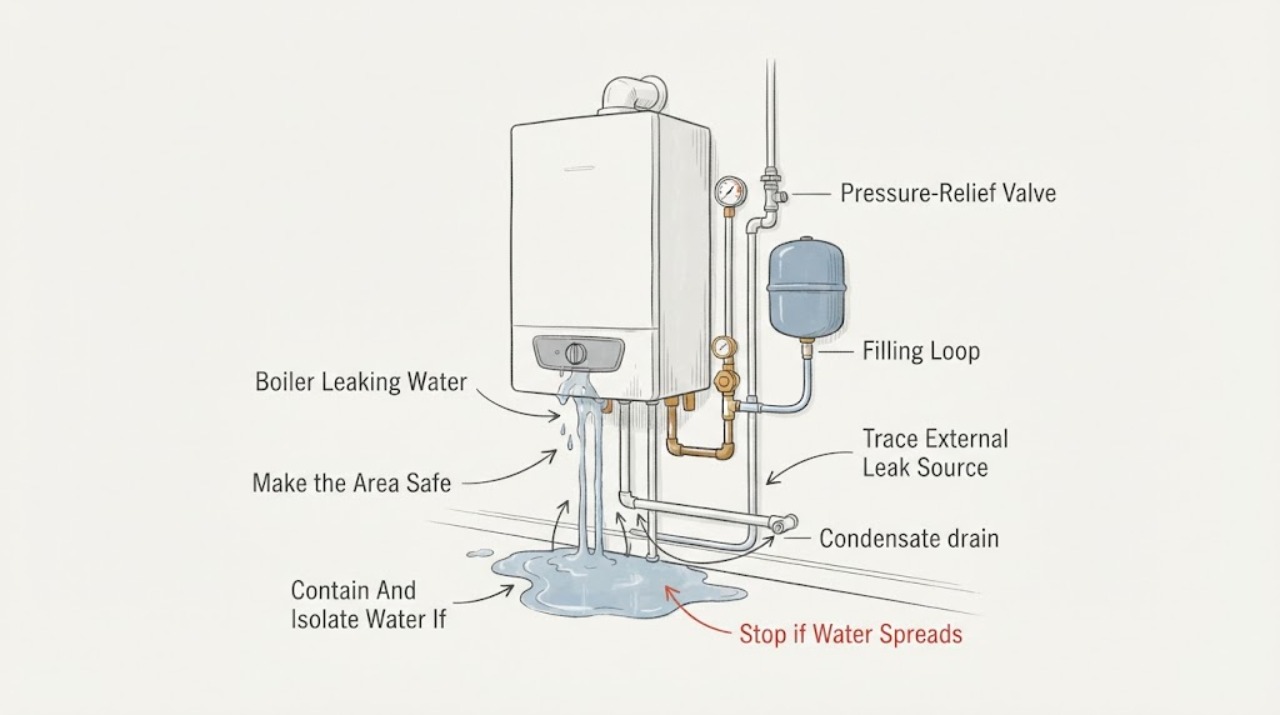
If a Buderus boiler is leaking water, stop the heating and contain the water only if the area is dry and the controls are safely reachable. Do not remove the boiler casing, reset a pressure-relief valve, or repeatedly refill the heating circuit. Note whether the water is coming from an external pipe or fitting, a relief discharge, the condensate route, a radiator circuit, or inside the casing, and check the pressure gauge without changing it. A falling pressure, pressure that rises and then discharges water, or a leak that continues after the boiler is off needs a qualified heating professional; wet electrics, hot water, steam, a gas smell, a major leak, or spreading water require immediate isolation from a safe location and urgent help.
Work through in order
Diagnostic checks
Use only checks that match the exact appliance or system and its official guide.
-
Check 1
Stop calling for heat and, only if the floor and controls are dry and safely reachable, switch the boiler off using its normal control. Keep people away from hot water, steam, and spreading water; if there is a gas smell, leave without operating electrical switches and contact the local gas emergency service from outside.
Expected result: The leak is minor and cool, the water is hot or steaming, water is spreading toward electrics, the boiler area is wet, or gas is suspected.
Next step: For a stable dry area, continue with external observation only. For gas, steam, wet electrics, a major flow, or unsafe access, leave the area, isolate utilities only from a safe location, and obtain urgent qualified help.
Stop if: Do not touch wet electrical equipment, open the casing, relight a boiler after a gas odor, or continue if hot water or steam can burn you.
Why this matters
Why: A cool, contained drip still indicates a boiler or system fault, but hot water, steam, wet electrics, or suspected gas changes this from a routine observation to an urgent safety event.
-
Check 2
Place a container or absorbent material below a safe, visible drip without reaching behind the appliance. If the leak is substantial and the stop tap or an identified isolation valve is accessible from a dry location, close the relevant water supply; do not disconnect a pipe or loosen a fitting.
Expected result: The flow slows after water is isolated, the container fills quickly, water continues from the heating circuit, or the source cannot be reached safely.
Next step: Keep the boiler off, protect the floor, and arrange prompt heating service. For a major or uncontrolled leak, leave isolation to a qualified professional and contact emergency repair support.
Stop if: Do not remove the boiler cover, dismantle pipework, drain a sealed system, or handle water near energized equipment.
Why this matters
Why: A slower flow after isolation suggests the affected supply was identified, but continued flow can come from stored or pressurized heating water or a different circuit. A rapidly filling container or inaccessible source raises property-damage and safety risk.
-
Check 3
With the boiler off and the area dry, use a flashlight to observe only exposed pipe joints, valves, the pressure-relief discharge route, the condensate route, radiator connections, and the floor beneath the unit. Do not remove panels or wipe inside the casing.
Expected result: Water appears at an exposed joint, at a relief discharge, along the condensate route, near a radiator or heating pipe, below the casing, or nowhere visible while the pressure changes.
Next step: Photograph the location from a dry position and give it to the technician. Keep the boiler isolated when the source is inside the casing, the discharge continues, or the leak cannot be located.
Stop if: Do not tighten fittings by force, cap a safety discharge, block a condensate route, or open the appliance to search for the source.
Why this matters
Why: An exposed joint or radiator pipe points to connected system pipework; discharge at a relief route can follow excessive pressure or a relief-valve fault; water below or inside the casing can involve an internal boiler component. No visible source does not make the leak safe.
-
Check 4
Once the boiler is off and stable, read the pressure gauge or displayed pressure without opening the filling loop, bleeding radiators, or operating a relief valve. Record the reading, whether it changes while the boiler is off, and whether water was seen at a safety discharge.
Expected result: Pressure is below the model manual's stated operating range, pressure rises during heating and then falls, pressure changes while off, or the pressure reading is normal despite visible water.
Next step: Use the exact Buderus model manual to identify the gauge and components for the service visit, but arrange a qualified technician for any leak, repeated pressure change, or pressure outside the manual's stated range.
Stop if: Do not add water just to restore pressure, reset the pressure-relief valve, or infer a safe operating limit from another Buderus model.
Why this matters
Why: Low pressure can be consistent with water loss; repeated rise-and-fall can indicate expansion, overfilling, or safety discharge; pressure changing while off suggests ongoing loss or a valve issue. A normal gauge does not rule out a pipe, condensate, or internal leak.
-
Check 5
Check from dry, accessible locations whether radiators, heating pipes, the domestic hot-water circuit, or a nearby drain show water, pressure loss, unusual gurgling, or loss of heat. Do not run the boiler to reproduce the leak.
Expected result: Only the boiler area is wet, one radiator or exposed pipe is wet, hot water is leaking at a tap or cylinder connection, several heating points are losing pressure, or water is reaching a ceiling, wall, or electrical area.
Next step: Keep the system off and report the observed pattern, pressure behavior, and affected fixtures to a heating professional. Escalate promptly for structural damage, spreading water, or wet electrical equipment.
Stop if: Do not bleed radiators, open a drain or relief valve, repeatedly refill the system, or touch wet electrics.
Why this matters
Why: A single exposed connection may be isolated by a technician; several points or recurring pressure loss suggest a system-wide fault; a domestic-water leak may need a different isolation point than a sealed heating leak. Water near structure or electrics increases damage and shock risk.
-
Check 6
Record the Buderus model and serial information from the dry exterior label, the leak location and rate, gauge behavior, any fault code, whether heating or hot water was running, and the date the leak began. Retrieve the matching Buderus operating manual without relying on a different model's pressure or repair instructions.
Expected result: The model is known, the model is unknown, a fault code is shown, the leak stops when the boiler is off, or the leak continues while isolated.
Next step: Give the record, photos, and manual reference to a qualified Buderus heating technician. Keep the appliance out of service until the leak source and safe operation have been confirmed.
Stop if: Do not substitute a generic part, bypass a fault code, restart the boiler to test an unresolved leak, or perform internal service work without the required qualifications.
Why this matters
Why: Model-specific documentation can identify user-accessible controls and the intended pressure indication, but it cannot make an active leak safe. A leak that continues while off or isolated needs professional inspection of stored water, safety components, and pipework.
Use your observations
Decision map
Find the observation that best matches what you see, then follow the next safe action.
-
PATH 01Next step
What you see
A small, cool drip is visible at an external connection and slows after the relevant water supply or heating call is safely isolated.
Do this next
Leave the boiler off, contain the remaining water, and arrange a heating professional to inspect and repair the connection before restarting.
Why this path and its safety boundary
Why it matters: The leak may be limited to exposed system pipework or a valve, but isolation does not prove that the fitting is safe to retighten or reuse.
-
PATH 02Next step
What you see
Water appears at the pressure-relief discharge, or the gauge repeatedly rises during heating and falls after water is discharged.
Do this next
Do not refill, cap, or manually operate the relief assembly. Keep the boiler off and call a qualified heating technician with the pressure observations and model information.
Why this path and its safety boundary
Why it matters: The system may be exceeding its permitted pressure, or the relief valve, expansion vessel, filling control, or another component may be faulty. The exact cause cannot be selected from the drip alone.
-
PATH 03Next step
What you see
Water is below or inside the boiler casing, the source cannot be seen externally, or the leak continues after the boiler and accessible water supply are off.
Do this next
Keep the appliance isolated, do not remove the cover, and arrange urgent professional diagnosis. Escalate immediately if water reaches electrics, the flow is large, or steam or gas is present.
Why this path and its safety boundary
Why it matters: Stored heating water or an internal boiler component may still be leaking. The casing, combustion path, electrical parts, and heat exchanger are not safe user-service areas.
-
PATH 04Next step
What you see
Several radiators or heating points lose pressure, water is spreading into walls or ceilings, or the leak is affecting electrical equipment.
Do this next
Stop using the boiler and water source from a safe location, keep people away from wet electrics, and contact urgent plumbing/heating support or the responsible property service.
Why this path and its safety boundary
Why it matters: A larger heating-system or building-water problem is more likely than a single harmless drip, and continued operation can increase water and electrical damage.
-
PATH 05Next step
What you see
A gas odor is suspected, the leak produces steam or very hot water, or the boiler area is unsafe to enter.
Do this next
Leave the area, avoid flames and electrical switches, and contact the local gas emergency service or emergency responders from a safe location. Do not return until cleared.
Why this path and its safety boundary
Why it matters: This is an immediate safety situation rather than a troubleshooting visit. Operating switches, relighting, or opening the boiler can increase risk.
Helpful context
Understand the symptom
Treat a boiler leak as a fault, not a pressure-adjustment routine
A Buderus boiler may be connected to a sealed heating circuit, a domestic hot-water circuit, or both, and the correct pressure and isolation points depend on the exact model and installation. A visible drip can come from a connection, safety discharge, condensate route, or a failed internal component. The useful first task is to make the area safe and locate the water without opening the appliance.
The pressure gauge is evidence, not a repair control
Read the gauge while the system is stable and compare it with the value stated in the specific Buderus operating manual. Low pressure can accompany water loss; pressure that changes repeatedly or rises enough to discharge through a safety valve needs professional diagnosis. Do not use the filling loop, bleed a radiator, or operate a relief valve simply to make the reading look normal unless the exact manual and a qualified professional support that step.
Do not open the casing or keep running a leaking boiler
A leaking boiler can expose hot water, combustion components, electrical connections, or a damaged heat exchanger. Keep the boiler off and arrange service when the source is inside the casing, the leak persists, the pressure falls, or the system repeatedly discharges water. If water reaches electrical equipment, do not touch the wet equipment or nearby switches; isolate power only from a dry, safe location and obtain urgent help.
Safety boundary
Stop conditions
- Stop operating the boiler and arrange qualified service for any active leak, falling or repeatedly changing pressure, water from the casing or relief discharge, a fault code with a leak, or a leak that continues while the boiler is off. Seek urgent help for gas odor, steam, hot water burns, a large or spreading leak, water near electrics, structural damage, or an unsafe area. Do not open the casing, bypass controls, cap or reset a relief valve, use a generic pressure limit, bleed or refill a sealed circuit to hide the leak, or restart the boiler to test an unresolved fault.
Only after diagnosis
Potential parts
- pressure-relief valve
Consider this only if a qualified technician confirms that water is discharging through the relief path and the valve itself is faulty after checking system pressure and related controls.
Confirm the exact Buderus model, system type, valve specification, and local requirements before any replacement; do not cap or bypass a safety valve. - expansion vessel
Consider this only when professional testing links repeated pressure rise-and-fall or safety discharge to an expansion-vessel fault.
The vessel size, connection, pre-charge, and system design are model- and installation-dependent; a technician must verify fit and commissioning requirements. - filling loop or filling valve
Consider this only when inspection shows an incorrectly closed or leaking filling control is contributing to pressure rise or water loss.
Confirm the exact installation and Buderus model before selecting a component; do not use a replacement part to compensate for an undiagnosed leak. - boiler seal or heat-exchanger assembly
Consider this only after a qualified technician confirms an internal casing leak and identifies the failed seal or heat-exchanger component.
Internal gas, combustion, hot-water, and electrical components require model-specific service procedures and qualified installation; no generic part is assumed to fit.
When checks do not resolve it
Need a professional?
Call a qualified heating professional as soon as a Buderus boiler leaks water. Do not delay when the source is internal or unknown, the pressure changes, the relief discharge drips, the leak continues after shutdown, the boiler loses heat or hot water, a fault code appears, or a connected radiator or pipe is also leaking. Use urgent emergency support for gas odor, steam, hot water, wet electrics, major flow, or spreading structural damage.
Have this ready
- Provide the Buderus model and serial information if safely visible, leak location and rate, pressure-gauge behavior, any displayed fault code, whether heat or hot water was running, which valves or supplies were isolated, photos from a dry position, and whether water reached the floor, wall, ceiling, or electrical equipment.
Common questions
FAQ
What should I do first if my Buderus boiler is leaking water?
Stop the heating and keep the area clear. If the floor and controls are dry, switch the boiler off normally and place a container under a safe external drip. Isolate the relevant water supply only if it is accessible from a dry location. Do not open the casing or restart the boiler to test the leak; arrange qualified service.
Can I keep using a Buderus boiler that is only dripping?
Do not keep running a boiler with an active leak. A small drip can become a pressure, hot-water, electrical, or internal-component failure, and the source may not be visible. Keep it off and have a qualified heating professional identify the cause before restarting.
What does low boiler pressure mean when water is leaking?
Water loss can lower the pressure, but a low reading does not identify the failed part. Read the gauge without changing it and compare it with the exact Buderus model manual. Do not repeatedly refill a leaking system; pressure loss needs professional diagnosis.
Why is water coming from the boiler pressure-relief discharge?
A relief valve can discharge when system pressure exceeds its set limit, and persistent dripping below the valve can indicate a system or valve fault. Do not cap, reset, or repeatedly refill the system. Keep the boiler off and have a qualified technician test the pressure, expansion, filling, and safety components.
Should I open the Buderus boiler cover to find the leak?
No. A leak inside or below the casing can involve hot water, combustion components, gas, or electrical parts. Observe only exposed, dry areas and provide photos and model information to a qualified technician. Do not remove panels or work inside the appliance.
What if water reaches an electrical outlet or the boiler wiring?
Do not touch wet equipment or nearby switches. Leave the area and isolate power only from a dry, safe location if that can be done without contact with water; obtain urgent qualified help. Keep the boiler off and do not re-enter an unsafe area.
When should I call a boiler technician rather than adjust the pressure myself?
Call a qualified technician for any active leak, repeated pressure change, relief discharge, internal or unknown source, leak that continues after shutdown, fault code, or connected-pipe leak. Do not adjust pressure or use the filling loop to hide a leak; the correct setting and procedure depend on the exact installation and Buderus manual.
Read the exact guide
Official sources
- Handleidingen van Buderus-productenBuderus · Buderus documentation page directing users to search by product name or model number and distinguishing operating documentation from detailed service manuals.
- Heating and hot water troubleshootingSouthwark Council · Public housing guidance advising users to turn off heating and the cold-water stop tap to limit central-heating leak damage and book an engineer.
- Heating and hot water adviceCity of York Council · Public housing guidance advising prompt reporting of boiler leaks, using a container, isolating the cold-water supply and boiler electricity when safe, and not repressurizing a leaking combination system.
- Poistný ventilBuderus · Buderus glossary explaining why a relief valve opens above its set pressure and why drops below the valve can indicate a device fault.
- Pressione caldaia: come impostarla correttamenteBuderus · Buderus consumer guidance explaining that the model manual governs pressure, water loss can lower pressure, and frequent pressure variation should be checked by a specialized technician.
- What to do if you have a frozen or burst pipeMet Office · National public guidance recommending water and boiler isolation for a burst pipe, safe cleanup, qualified plumbing help, and avoidance of wet electrical equipment.
Community feedback
Share a repair observation
Share a plain-text repair observation. Accepted observations are published automatically; this page may take a moment to update.