
On this page
Start here
Quick answer
Treat a leaking boiler as a shut-down-and-assess problem, not an internal DIY repair. If it is safe to reach, turn the heating off with the normal user control, keep clear of hot or pressurized water, and trace only accessible exterior surfaces. Water near electrical controls, a spray or rapidly worsening leak, a pressure gauge in the red zone or rising quickly, a relief discharge, a gas odor, or a carbon-monoxide alarm calls for urgent professional help. Do not remove the boiler cover, repeatedly refill the system, or assume a small drip will cure itself.
Before you begin
Safety first
- Shut off heating and call a professional; no internal repair or casing removal is included.
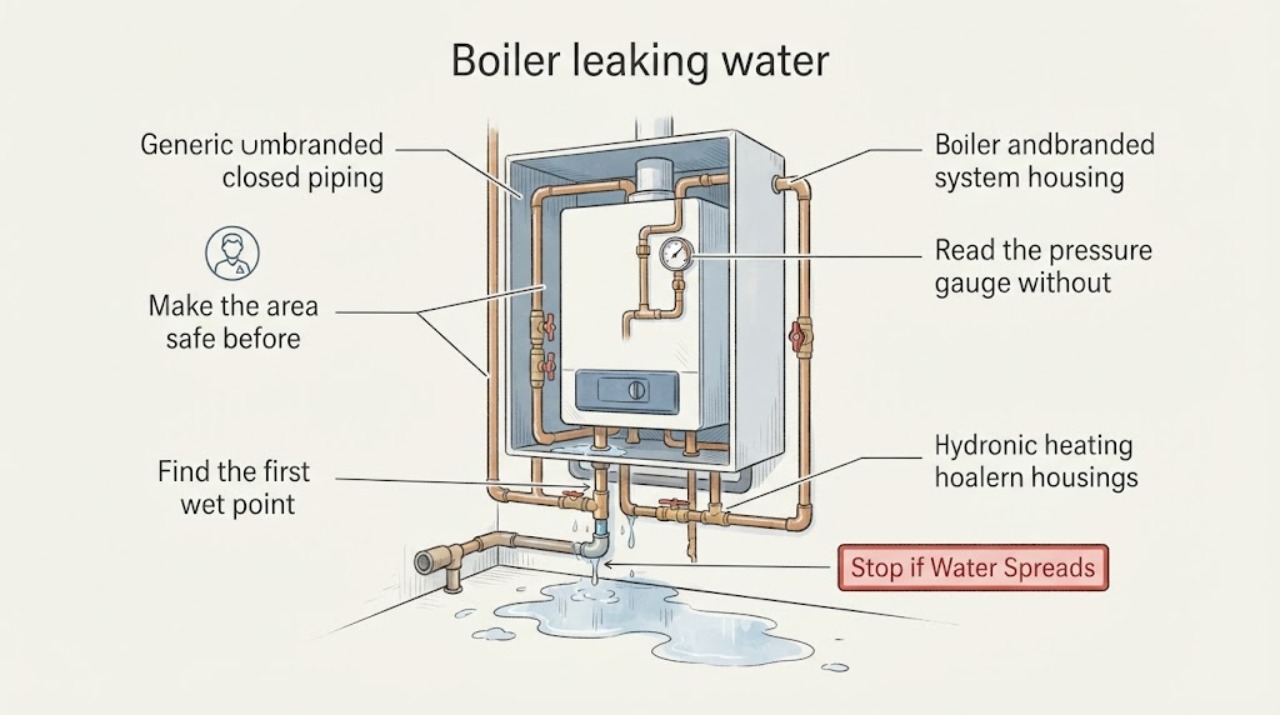
Work through in order
Diagnostic checks
Use only checks that match the exact appliance or system and its official guide.
-
Make the area safe before tracing the leak
Use the normal heating control to turn the boiler off if it is safe to reach, and keep people and pets away from the wet area.
Expected result: Look for pooling, spraying, steam or very hot water, water reaching electrical controls, or a gas odor or carbon-monoxide alarm.
Next step: Keep the boiler off, leave the area if gas or combustion danger is suspected, and contact the appropriate emergency or qualified HVAC service. If the leak is a cool, slow drip away from electrics, continue only after accessible surfaces are safe to touch.
Stop if: Do not remove the casing or reach into the boiler.
Why this matters
Why: A spray, hot discharge, water near electrics, gas odor, alarm, or fast increase in water requires urgent escalation rather than further diagnosis.
-
Find the first wet point
Once the boiler and nearby pipework are cool enough to approach, dab accessible exterior joints and the floor beneath the boiler dry with a paper towel, then watch where moisture returns first.
Expected result: Check the visible supply and return connections, circulator or pump flange, automatic air-vent area, pressure-relief discharge pipe, condensate drain if the boiler has one, and the underside without opening the cabinet.
Next step: Record the exact first wet point and take a photo for the technician. If the source cannot be isolated externally, stop tracing and arrange professional service.
Stop if: Do not loosen, tighten, or disconnect a hot or pressurized fitting.
Why this matters
Why: Moisture returning at one exposed joint points to a connection or seal; water appearing from the casing underside or an unseen route points to an internal component or concealed pipework.
-
Read the pressure gauge without adjusting the system
Read the boiler pressure gauge while the system is cool, then note whether the reading rises materially when the boiler runs; compare it with the normal range marked on that boiler or in its own manual.
Expected result: The reading may be within the marked range and stable, below the marked range, above it, or climbing toward the red/high-pressure area during a heat cycle.
Next step: If the gauge is high, falling repeatedly, or changing sharply, stop repeated refilling and give those observations to a qualified technician. Do not borrow a pressure target from another boiler model.
Stop if: Do not adjust the fill valve or bleed radiators as a generic fix unless the boiler manual and a qualified professional specifically direct it.
Why this matters
Why: A high or fast-rising reading can make the relief valve discharge and may indicate an expansion-tank, fill-control, or other system-pressure problem. A falling or low reading can accompany a continuing leak. A stable reading does not rule out a local seal or pipe leak.
-
Check whether the relief discharge is the source
Look at the end of the visible pressure-relief discharge pipe, if your installation has one, without touching its lever or dismantling the valve.
Expected result: Note whether the pipe is wet only after the boiler heats, is continuously dripping, or is dry while another point leaks.
Next step: Keep clear of any hot discharge and call a qualified HVAC professional for pressure, expansion-tank, fill-control, and relief-valve diagnosis. Never cap or block the discharge route.
Stop if: Do not operate the relief-valve lever yourself.
Why this matters
Why: A discharge that tracks heating or a high gauge suggests pressure expansion or a relief-valve/system fault; a persistent drip can also mean the valve is no longer seating. A dry discharge shifts attention to external joints, drains, or an internal leak.
-
Check for a leak that changes with heating
After documenting the leak, observe whether a dry external fitting becomes wet only while the boiler heats, or whether the leak continues while the system is off and cool.
Expected result: A heat-cycle-only drip, a steady drip, or a leak that stops when the system cools are different patterns; do not run repeated cycles just to test them.
Next step: Leave the boiler off if the leak is active or worsening, and tell the technician which pattern you observed, the gauge behavior, and the first wet point.
Stop if: Do not continue operating a leaking boiler merely to collect more observations.
Why this matters
Why: A heat-cycle pattern is consistent with thermal expansion, a pressure-relief event, or a seal that opens when hot. A steady leak can be a failed fitting, gasket, valve, drain, or internal component.
Use your observations
Decision map
Find the observation that best matches what you see, then follow the next safe action.
-
PATH 01Next step
What you see
Water is spraying, very hot, near electrical controls, or accompanied by gas odor or a carbon-monoxide alarm.
Do this next
Keep clear, leave if combustion danger is suspected, and use the appropriate emergency gas or HVAC service route. Do not continue the checks.
-
PATH 02Next step
What you see
The gauge is high or rises sharply as the boiler heats, especially when the relief discharge is wet.
Do this next
Stop repeated refilling and arrange urgent qualified service for pressure control, expansion tank, fill valve, and relief-valve diagnosis.
-
PATH 03Next step
What you see
The first wet point is an accessible external joint or circulator connection and the system is not hot or spraying.
Do this next
Do not work on the pressurized fitting; document it and have a qualified technician replace or reseal the appropriate component.
-
PATH 04Next step
What you see
The gauge is stable but water appears from the casing underside or no exterior source can be found.
Do this next
Treat it as a possible internal seal, heat-exchanger, or concealed-pipe problem and stop the boiler until a qualified professional inspects it.
Helpful context
Understand the symptom
What a boiler leak usually means
Water can escape from an external joint, circulator connection, automatic air vent, pressure-relief discharge, or a failed seal inside the boiler. A high or rapidly changing system pressure can make a relief valve discharge; corrosion can also damage seals or a heat exchanger. The useful first distinction is the first wet point and whether the gauge changes as the system heats. The checks below are for observation only and do not require removing the casing.
Only after diagnosis
Potential parts
- Boiler pressure relief valve
Only when a qualified technician confirms the relief valve is leaking or not seating, and also checks why system pressure is causing discharge.
- Boiler circulator flange gasket
Only when the first wet point is a compatible circulator flange and the technician identifies the correct gasket for the exact boiler and pump assembly.
- Boiler expansion tank
Only when pressure rises during heating and a qualified technician confirms a waterlogged, failed, undersized, or otherwise unsuitable expansion tank; do not select one by appearance alone.
When checks do not resolve it
Need a professional?
Call a qualified HVAC or heating professional immediately for a spray, hot discharge, water near electrical controls, gas odor, carbon-monoxide alarm, high or rapidly rising pressure, or a relief pipe that keeps discharging. For a cool slow drip, arrange service promptly rather than continuing to run or refill the boiler.
Safety scope: Shut off heating and call a professional; no internal repair or casing removal is included.
Have this ready
- Boiler brand and model, if visible without removing the cover
- First wet point and a photo of the exterior area
- Whether the leak is hot or cool and whether it changes during heating
- Gauge behavior while cool and during a normal heat cycle
- Any pressure-loss, lockout, heating, or hot-water symptoms
Common questions
FAQ
Can I keep using a boiler that is dripping water?
It is safer to turn the heating off and arrange qualified service. Continued operation can worsen water damage or cause a relief discharge; an active, hot, electrical, or fast-growing leak needs urgent attention.
Why does a boiler leak from the pressure-relief pipe?
High or rising system pressure can make the relief valve discharge, and a valve that keeps dripping may also have a seating fault. The pressure cause and the valve both need professional diagnosis rather than capping the pipe.
What if the boiler pressure looks normal but water is underneath it?
A stable gauge does not rule out a joint, gasket, drain, internal seal, heat exchanger, or concealed pipe leak. Trace only accessible exterior surfaces; if the first wet point is inside the casing or remains unclear, keep the boiler off and call a professional.
Should I refill a boiler that has lost pressure?
Do not repeatedly refill a leaking system as a workaround. Record the pressure change and have a qualified technician find and correct the leak and confirm the correct fill procedure for that model.
Is a leaking boiler always dangerous?
A small cool drip may not be an immediate emergency, but it can damage the boiler and nearby structures. Hot water, spraying water, water near electrics, gas odor, a carbon-monoxide alarm, or rapidly changing pressure should be treated as urgent.
Read the exact guide
Official sources
- Boiler FAQs & Common QuestionsWeil-McLain · General boiler-owner escalation guidance; the manufacturer directs homeowners to an installer or professional heating contractor for leaks.
- Boiler Leaking Water? Here's What to CheckViessmann US · General hydronic boiler troubleshooting; non-model-specific guidance and not a substitute for the appliance manual.
Community feedback
Share a repair observation
Share a plain-text repair observation. Accepted observations are published automatically; this page may take a moment to update.