
On this page
Start here
Quick answer
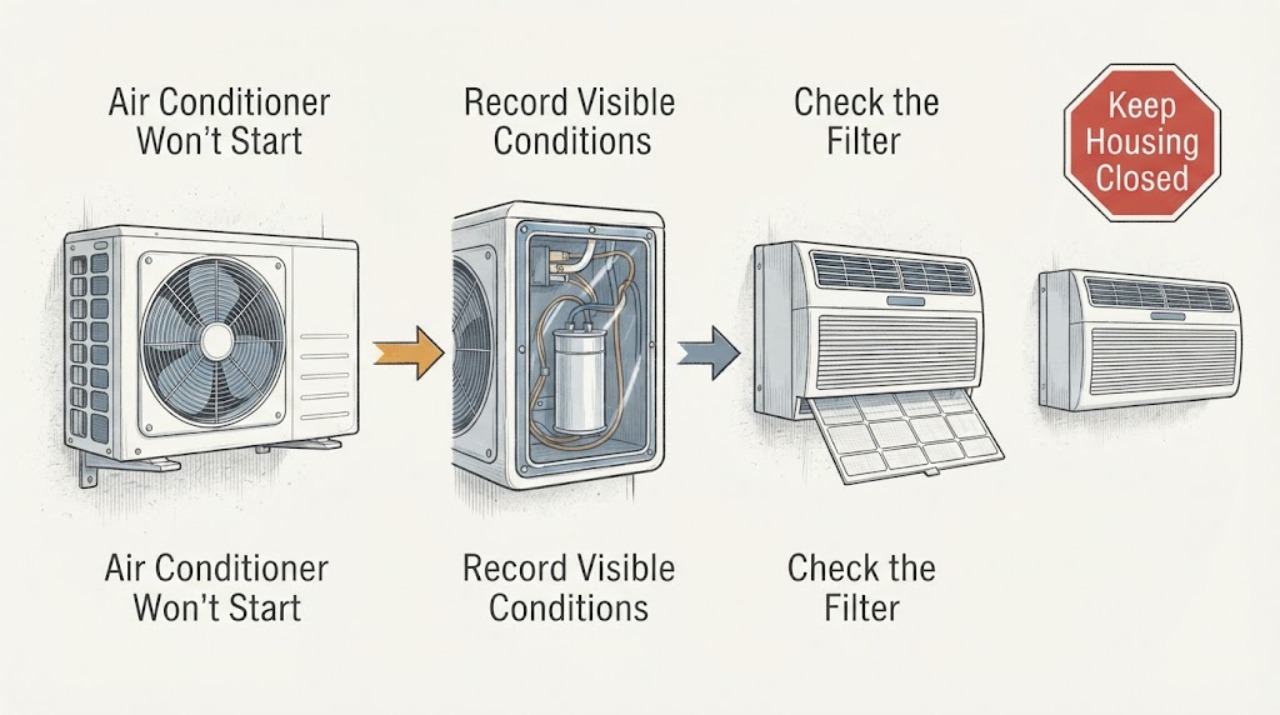
A failed run or start capacitor can keep an air conditioner's outdoor fan or compressor from starting, but a no-start symptom does not prove the capacitor is bad. Check only the thermostat mode and setpoint, the accessible filter, indoor airflow, visible ice or water, and the outdoor unit's response from a safe distance. Do not remove a panel, touch wiring, reach through a grille, test or discharge a capacitor, measure voltage, or handle refrigerant. If the outdoor unit hums, clicks and stops, remains silent while the indoor blower runs, or trips a protective device, leave it off and call a qualified HVAC technician. Smoke, burning odor, arcing, hot electrical parts, water near equipment, or a repeated breaker trip is an immediate stop condition.
Before you begin
Safety first
- Keep the system off for ice with water, smoke, arcing, burning odor, hot or damaged electrical parts, exposed wiring, shock, refrigerant release, or repeated breaker trips. Do not open cabinets, touch wiring, reach into fans, test or discharge capacitors, measure live circuits, or handle refrigerant.
Work through in order
Diagnostic checks
Use only checks that match the exact appliance or system and its official guide.
-
Check 1
At the thermostat, record whether the display is on, Cooling is selected, the setpoint is below room temperature, the fan setting is intended, and any alert or schedule is visible. Do not remove the thermostat cover or touch its wiring.
Expected result: The display is blank, Cooling is not selected, the setpoint is too high, an alert is shown, or a valid cooling call is present.
Next step: Correct only an obvious user setting and observe one normal call. If the display stays blank or the system does not respond, leave the wiring untouched and arrange qualified HVAC or electrical service.
Why this matters
Why: A display or setting issue can prevent a start. A valid call with no response moves the investigation toward airflow, power, controls, the blower, or the outdoor unit rather than proving a capacitor fault.
-
Check 2
With the cooling call ended and the equipment cabinet closed, inspect the accessible air filter and visible return grille and supply registers. Clean or change the filter only as the equipment instructions allow; keep registers open and unobstructed.
Expected result: The filter is visibly loaded, the return is blocked, airflow was weak, or the filter and registers look clear.
Next step: Correct an obvious filter or register issue and make one supervised call only if there is no ice, water, odor, or electrical warning. If airflow remains absent or weak, stop and request HVAC service.
Why this matters
Why: Restricted airflow can cause poor operation or a frozen coil and can make a start problem appear worse. A clear filter does not confirm or rule out a capacitor, blower, compressor, or control fault.
-
Check 3
During one ordinary cooling call, observe the indoor supply airflow and the outdoor unit from a safe distance. Keep hands, tools, and clothing away from the grille and leave all panels closed.
Expected result: The blower is silent, the blower supplies weak air, indoor airflow is normal but the outdoor unit is silent, or the outdoor unit hums, clicks and stops, starts and stops rapidly, or runs normally.
Next step: Turn the call off for a hum, click-and-stop, rapid cycling, harsh noise, or any safety sign. Leave the system off and arrange qualified HVAC service; do not reach into the outdoor unit or test a capacitor.
Why this matters
Why: No or weak indoor airflow can involve the blower, filter, ice, or control. Normal indoor airflow with an outdoor no-start or hum makes the capacitor one possible service clue, alongside power, controls, fan, compressor, and wiring.
-
Check 4
Look from a safe position for frost or ice on visible tubing, water or excess condensate near the indoor unit, a wet equipment area, smoke, a burning odor, or a hot or discolored electrical part. Do not remove a cover to improve the view.
Expected result: Ice, water, smoke, odor, heat, discoloration, arcing, or none of these visible signs is present.
Next step: For ice or water, turn cooling off and request HVAC diagnosis. For smoke, odor, heat, arcing, or a wet electrical area, keep clear and obtain emergency or qualified electrical help. Otherwise continue only with the service record.
Why this matters
Why: Ice or water can indicate a frozen coil or condensate issue; smoke, odor, heat, and arcing are electrical or fire hazards. No visible sign does not establish that the capacitor is safe or functional.
-
Check 5
Note the visible breaker or disconnect state only if it can be seen without opening a panel or touching a wet or hot surface. Record whether the system lost power, whether a protective device opened again, and whether other home circuits are affected.
Expected result: A device appears interrupted, the whole home has an outage, the system trips again, or the visible power state looks normal while the unit remains dead.
Next step: Do not repeatedly reset or bypass protection. Leave the system off and call a qualified HVAC technician or electrician; contact the utility for a confirmed broader outage.
Why this matters
Why: A supply or protective-device event can mimic a capacitor fault. A repeat trip is a fault signal, and a normal-looking handle does not prove a safe or complete supply to the equipment.
-
Check 6
Prepare a service record with the model if safely visible, thermostat state, filter condition, indoor airflow, outdoor response, start and stop sound, ice or water, breaker or disconnect observation, recent maintenance, and the exact moment the no-start began.
Expected result: The failure is limited to the outdoor unit, follows a power event, follows maintenance, affects both indoor and outdoor sections, or includes a safety warning.
Next step: Leave the system off for a returning or abnormal fault and request qualified HVAC service. Report any safety warning immediately rather than making another start attempt.
Why this matters
Why: A clear pattern helps the technician distinguish thermostat, airflow, blower, capacitor, compressor, control, and power paths without homeowner testing of high-voltage parts.
Use your observations
Decision map
Find the observation that best matches what you see, then follow the next safe action.
-
PATH 01Next step
What you see
The thermostat display is blank or does not issue a cooling call.
Do this next
Check only the user setting and visible home power status. Leave thermostat wiring closed and request HVAC or electrical service if the display remains blank.
Why this path and its safety boundary
Why it matters: The no-start condition begins at the control or its power path, so a capacitor is not established as the cause.
-
PATH 02Next step
What you see
A valid cooling call is present but the indoor blower is silent or weak.
Do this next
Turn the call off for no or abnormal airflow and arrange qualified HVAC service. Do not open the air handler or reach into the blower.
Why this path and its safety boundary
Why it matters: The blower, filter, ice, air path, power, or control side needs attention before the outdoor capacitor can be blamed.
-
PATH 03Next step
What you see
Indoor airflow is normal but the outdoor unit is silent, hums, clicks and stops, or starts and stops rapidly.
Do this next
Leave the system off and request qualified HVAC diagnosis. Do not remove the panel, test or discharge a capacitor, touch the fan, or repeat start attempts.
Why this path and its safety boundary
Why it matters: A capacitor is one possible service-level cause, along with the outdoor power, controls, fan motor, compressor, wiring, or refrigerant protection.
-
PATH 04Next step
What you see
Ice is visible, airflow falls, or water appears near the indoor equipment.
Do this next
Turn cooling off and allow natural thaw if ice is present. Arrange HVAC service to identify the cause before resuming normal cooling.
Why this path and its safety boundary
Why it matters: A frozen coil, restricted airflow, low refrigerant, or condensate issue can stop safe operation and is not a capacitor confirmation.
-
PATH 05Next step
What you see
A breaker or disconnect opens again, or the system is hot, wet, discolored, or damaged.
Do this next
Do not reset repeatedly or approach wet or hot equipment. Leave it off and call a qualified electrician or HVAC technician; use emergency help for smoke, arcing, or fire.
Why this path and its safety boundary
Why it matters: A supply, wiring, moisture, or equipment safety fault may be present.
-
PATH 06Next step
What you see
The blower and outdoor unit appear to run, but the home is not cooling or the system cycles rapidly.
Do this next
Request qualified HVAC service for system measurements. Do not open the unit or handle refrigerant based on the symptom.
Why this path and its safety boundary
Why it matters: Thermostat control, airflow, refrigerant, coil, compressor performance, or another system fault remains possible even if the capacitor is not visibly abnormal.
-
PATH 07Next step
What you see
Smoke, arcing, burning odor, a hot electrical part, exposed wiring, water near equipment, or a shock occurs.
Do this next
Stop immediately, keep clear, do not operate or reset the equipment, and obtain emergency or qualified electrical and HVAC help as appropriate.
Why this path and its safety boundary
Why it matters: The no-start problem is an immediate fire, shock, or moisture hazard.
Helpful context
Understand the symptom
A capacitor is a service clue, not a homeowner diagnosis
The outdoor condensing unit includes a compressor, condenser fan, and electronic controls. Carrier lists a failing run capacitor among several professional causes of a unit that will not turn on, but the same symptom can come from a thermostat, power, wiring, control, motor, compressor, or refrigerant problem. A bulged or leaking capacitor is not required for failure, and a normal-looking part is not proof of health. Keep the equipment closed.
First identify which side does not respond
A blank thermostat or an absent cooling call is a control path. A valid call with no indoor airflow points toward the air handler, blower, filter, ice, or controls. Normal indoor airflow with a silent, humming, or clicking outdoor unit points toward the outdoor power, fan, compressor, capacitor, or control path. This observation narrows the service request without exposing a live circuit.
Ice and water change the safe response
Carrier connects inadequate cooling, weak airflow, excessive condensate, and frost or ice with a frozen evaporator coil and says continued operation can damage the system. ENERGY STAR also lists condensate drainage and controls as service checks. End the cooling call for visible ice or water and arrange professional diagnosis; do not chip ice, heat the coil, or open the air handler to reach the capacitor.
Leave electrical and refrigerant work to HVAC service
ENERGY STAR includes tightening electrical connections and measuring motor voltage and current in a contractor check-up. Carrier likewise directs homeowners to professional help for electrical and refrigerant issues. Do not try to prove a capacitor fault with a meter, discharge it with a tool, swap it by appearance, or keep restarting an outdoor unit that only hums or trips.
Safety boundary
Stop conditions
- Stop immediately for smoke, flame, arcing, burning odor, a hot or discolored disconnect or electrical part, exposed wiring, a shock, or a repeated breaker trip. Keep clear and obtain emergency or qualified service.
- Stop for visible ice, water near the air handler or outdoor equipment, a full condensate area, or falling airflow. Turn cooling off, allow natural thaw only, and arrange HVAC diagnosis.
- Do not open the indoor or outdoor cabinet, touch wiring, reach into a fan, test or discharge a capacitor, measure voltage or current, handle refrigerant, loosen connections, or substitute a component by appearance.
- Stop after thermostat, filter, airflow, and safe visible-response checks do not restore a normal start. Leave the system off and have a qualified HVAC professional diagnose the capacitor, blower, compressor, controls, and power path.
Only after diagnosis
Potential parts
- air-conditioner run or start capacitor
Consider this only after a qualified HVAC diagnosis confirms that the capacitor is defective and identifies the correct system-specific rating and type.
Capacitors are not interchangeable by appearance. The technician must identify the equipment, electrical requirements, and safe installation method. - condenser fan motor or compressor start component
Consider this only if diagnosis shows that the outdoor motor, compressor, or start path—not the capacitor alone—is responsible for the no-start.
Outdoor components vary by system and require qualified installation. Do not order from a hum or click symptom alone. - thermostat or control component
Consider this only after service confirms that the thermostat or control does not issue or pass a valid cooling demand.
Control compatibility depends on system type and wiring. Have a qualified technician identify the correct component.
When checks do not resolve it
Need a professional?
Request HVAC service for a suspected capacitor fault, outdoor no-start, humming or click-and-stop, rapid cycling, weak or absent blower, ice, water, or persistent no-start. Call an electrician for a supply, disconnect, or breaker symptom. Escalate immediately for smoke, arcing, burning odor, hot or wet electrical parts, exposed wiring, or shock.
Safety scope: Keep the system off for ice with water, smoke, arcing, burning odor, hot or damaged electrical parts, exposed wiring, shock, refrigerant release, or repeated breaker trips. Do not open cabinets, touch wiring, reach into fans, test or discharge capacitors, measure live circuits, or handle refrigerant.
Common questions
FAQ
How do I know whether the air conditioner capacitor is bad?
A silent, humming, or click-and-stop outdoor unit with a valid thermostat call can make a capacitor one possible cause, but it can also involve power, controls, the fan motor, compressor, wiring, or refrigerant protection. Do not test or discharge the capacitor; have a qualified HVAC technician diagnose it.
What can I safely check before calling HVAC service?
Check the thermostat mode and setpoint, the accessible filter, indoor airflow, visible ice or water, and the outdoor unit's response from a safe distance. Keep panels closed and leave wiring, capacitors, motors, compressors, and refrigerant to a professional.
Should I keep restarting an outdoor unit that hums?
No. A hum, click-and-stop, rapid cycling, or repeated protective interruption needs diagnosis. Turn the call off, leave the system off, and request HVAC service rather than testing the capacitor or repeatedly restarting the unit.
Can a dirty filter look like a capacitor problem?
Yes. A loaded filter can reduce airflow, worsen cooling, and contribute to a frozen coil, while a no-air symptom can also come from the blower or control path. Inspect only the accessible filter and arrange service if airflow remains weak or ice appears.
When is an air conditioner no-start condition urgent?
Treat smoke, arcing, burning odor, a hot or discolored electrical part, exposed wiring, water near equipment, shock, or a repeated breaker trip as urgent. Keep clear, do not reset or open the equipment, and obtain emergency or qualified service.
Read the exact guide
Official sources
- Troubleshooting an AC Not WorkingCarrier · Carrier homeowner guidance used for general symptom categories; exact equipment procedures vary by model.
- Maintenance ChecklistENERGY STAR · General residential checklist; model manuals and qualified service determine access and repair procedure.
Community feedback
Share a repair observation
Share a plain-text repair observation. Accepted observations are published automatically; this page may take a moment to update.