
On this page
Start here
Quick answer
Set the thermostat to Heat with a target above the room temperature, then note whether the thermostat is powered, the furnace's accessible service switch is on, and the air filter is blocked. A furnace can fail to start because of settings, loss of power, restricted airflow, ignition or flame-sensing faults, or a fuel-supply issue, but the internal diagnosis is not a homeowner repair. If the breaker trips, the furnace repeatedly locks out, the blower or inducer runs without ignition, you hear banging or grinding, or the system still will not start after these accessible checks, turn it off and arrange qualified HVAC service. If you smell gas or sulfur/rotten eggs, hear hissing, see smoke or sparks, or a carbon-monoxide alarm sounds, leave immediately, avoid switches, flames, and other ignition sources, and contact the gas utility or emergency services from outside. Never open the burner cabinet, relight a pilot, adjust gas controls, clean a flame sensor, test live wiring, or inspect a heat exchanger yourself.
Before you begin
Safety first
- User checks are limited to thermostat settings, one safe visible power-state check, normal filter access, accessible vent observation, and listening from outside closed panels. Do not open burner/blower cabinets, relight pilots, turn gas or oil controls, clean burners or flame sensors, test live wiring, bypass safety switches, adjust combustion, inspect heat exchangers, or repeatedly restart after failed ignition. For gas odor or a CO alarm, evacuate immediately, avoid switches and flames, and contact the gas utility/emergency services from outside.
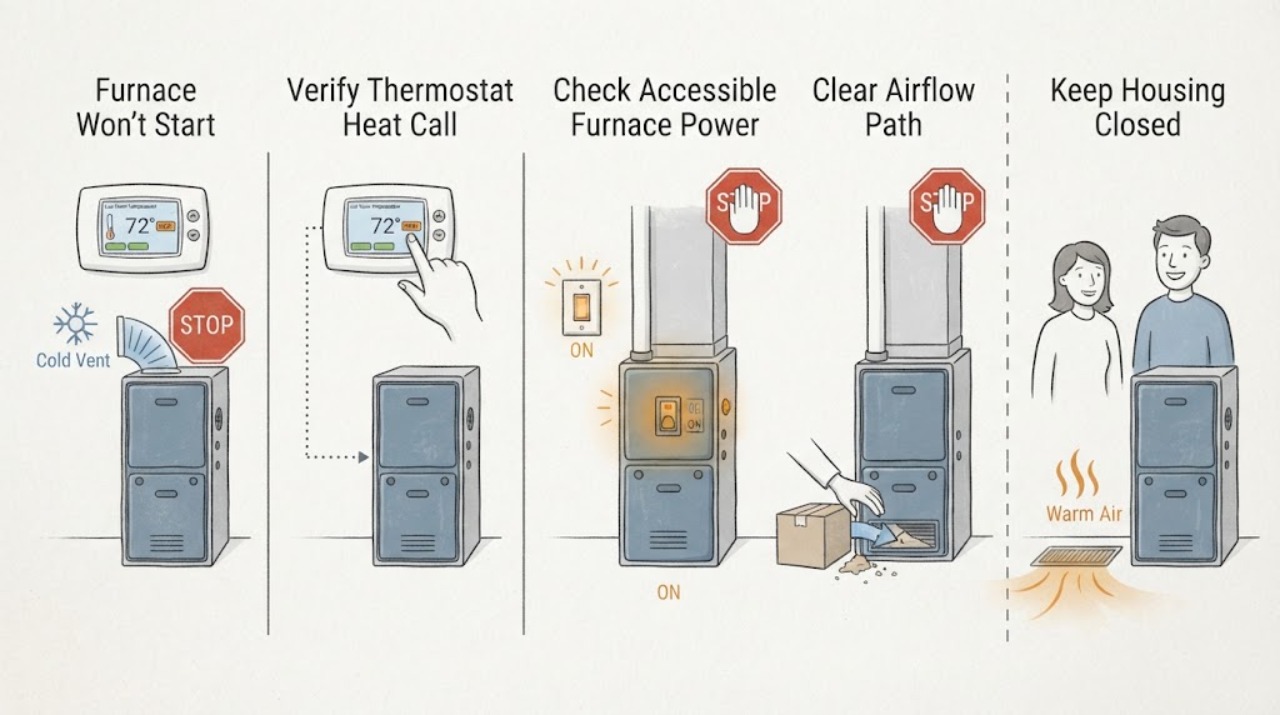
Work through in order
Diagnostic checks
Use only checks that match the exact appliance or system and its official guide.
-
Check 1
Check the thermostat without opening its base: confirm it is powered, set to Heat, and requesting a temperature above the current room temperature. Confirm the fan mode and schedule are not preventing a call, then wait through the normal startup delay while observing the furnace from a safe location.
Expected result: The display is blank; the thermostat was Off or in another mode; the target is not above room temperature; the thermostat shows a heat call but the furnace is silent; or the blower starts without heat.
Next step: Correct only the thermostat setting or its user-replaceable batteries as the thermostat manual permits, then observe one normal call. If the furnace remains silent or does not ignite, continue with accessible power and filter observations; do not remove thermostat wires or jumper terminals.
Stop if: Stop for gas odor, hissing, smoke, sparks, a carbon-monoxide alarm, abnormal combustion, damaged wiring, or any need to open the thermostat or furnace cabinet.
Why this matters
Why: A blank display or incorrect mode can prevent a heat call. A powered thermostat calling for heat with no response shifts attention to furnace power, controls, or a safety lockout. A blower without heat suggests the ignition or fuel sequence rather than a thermostat setting.
-
Check 2
From outside the furnace cabinet, look at the nearby service switch and the labeled furnace/heat circuit at the electrical panel. If the switch or breaker is visibly off and there are no hazard signs, restore it once only using its normal handle; do not open the panel, remove a fuse, touch wiring, or reset a breaker that is hot, wet, damaged, or sparking.
Expected result: The service switch is off; the breaker is tripped; power appears normal; the breaker trips again; or the switch/panel shows heat, odor, water, arcing, or damage.
Next step: If one safe restoration does not produce a normal startup, leave the furnace off and arrange HVAC service. If the breaker trips again, do not reset it; have a qualified HVAC professional or electrician identify the cause.
Stop if: Do not reset repeatedly, replace a fuse, change breaker size, remove an electrical cover, touch conductors, or continue after a trip, smell, spark, heat, or visible damage.
Why this matters
Why: A simple power interruption can leave the furnace unresponsive, but a repeat trip or visible panel hazard indicates an electrical or equipment fault. Restoring power does not diagnose a control board, motor, igniter, or safety-switch problem.
-
Check 3
Turn the thermostat Off and inspect the furnace filter only at its normal user-accessible slot or return grille. If it is visibly dirty or loaded, replace it with the specified size and airflow direction, close the filter access fully, and check that supply and return vents are not plainly blocked. Do not operate the furnace with a missing filter or removed access panel.
Expected result: The filter is clogged; airflow at registers was weak; vents or returns are blocked; the filter and airflow look normal; or the filter door will not close correctly.
Next step: Correct only the accessible filter or vent obstruction, then make one normal heat call. If the furnace still does not start, short-cycles, or locks out, leave it off and arrange service; do not bypass an access-door switch.
Stop if: Stop for soot, yellow or unstable flame, smoke, burning odor, gas odor, a cracked heat-exchanger concern, water near electrical parts, or any need to reach inside the furnace.
Why this matters
Why: Restricted airflow can stress the heat exchanger/blower and trigger an automatic safety shutdown. A normal filter does not rule out an ignition, gas, motor, control, or limit-switch fault. An access door that cannot close may prevent a safety interlock from allowing operation.
-
Check 4
After the thermostat and accessible maintenance checks, make one normal heat call while standing away from the furnace and keeping all panels closed. Note whether the inducer or blower starts, whether ignition is attempted, whether heat reaches the registers, whether the unit stops after a few seconds, and whether any code or unusual noise appears. Do not look through an opened burner panel or attempt to relight anything.
Expected result: There is no sound; a motor runs but burners never light; ignition occurs then stops; the blower runs cold; the unit short-cycles; or banging, grinding, squealing, gas odor, smoke, or a code appears.
Next step: Stop the heat call and record the sequence, code, sound, and temperature symptom. Arrange qualified HVAC service for any failed ignition, short cycle, cold blower, unusual noise, or repeated lockout; do not run repeated startup tests.
Stop if: Stop immediately for gas or sulfur odor, hissing, smoke, sparks, yellow/unstable flame, a carbon-monoxide alarm, or any need to remove a panel or handle a gas/ignition component.
Why this matters
Why: The sequence helps a technician distinguish a missing call or power issue from ignition, flame-sensing, airflow, motor, pressure-proving, or control trouble. Repeated clicking or failed ignition can leave an unsafe fuel sequence; a bang or unusual combustion noise is not a DIY adjustment cue.
-
Check 5
Identify whether the furnace is gas, propane, oil, or electric from the normal equipment documentation and record whether other fuel appliances are also unavailable, without opening the furnace or touching a gas/oil valve, pilot, burner, or fuel line. If a normal utility display or household observation shows an outage, document it for the utility or technician.
Expected result: The furnace uses fuel and other appliances are also unavailable; only the furnace is affected; the fuel type is unclear; or gas odor, hissing, smoke, or a carbon-monoxide alarm is present.
Next step: For a suspected utility outage without odor, contact the utility through its normal channel and do not alter the furnace. For any gas or combustion warning, leave immediately, avoid switches/flames, and contact the gas utility or emergency services from outside.
Stop if: Never relight a pilot, turn a gas/oil valve, adjust pressure, clean burners, open the combustion chamber, or keep troubleshooting after gas odor, hissing, smoke, sparks, or a CO alarm.
Why this matters
Why: A broader utility outage can explain a no-start, but a furnace-only failure can involve ignition, flame sensing, pressure, controls, or the appliance fuel path. Gas odor or combustion warning signs override all diagnosis and require evacuation and urgent professional response.
-
Check 6
Decide whether the furnace completes a normal heating cycle after the thermostat, one safe visible power-state check, and filter/vent check. Record the model, fuel type, thermostat state, service-switch/breaker result, filter condition, startup sequence, code, sound, odor, flame symptom, and any recent outage or maintenance for the technician.
Expected result: The furnace starts and heats normally; or it remains silent, fails ignition, runs cold, short-cycles, locks out, trips power, shows an error, or has any gas/combustion warning.
Next step: For a persistent or hazardous symptom, turn the furnace off and arrange qualified HVAC service. If gas odor, hissing, smoke, sparks, or a CO alarm occurred, leave immediately and contact the gas utility or emergency services from outside; do not re-enter until cleared.
Stop if: Do not open the burner or blower cabinet, bypass a safety switch, test live wiring, clean a flame sensor, adjust gas/oil controls, relight repeatedly, or inspect/repair a heat exchanger.
Why this matters
Why: A single correction may restore a normal call, but it does not prove the igniter, flame sensor, limit or pressure switch, blower, control, gas valve, or heat exchanger is healthy. Persistent or hazardous symptoms require measurements and combustion/electrical diagnosis beyond homeowner checks.
Use your observations
Decision map
Find the observation that best matches what you see, then follow the next safe action.
-
PATH 01Next step
What you see
The thermostat is blank, Off, not in Heat, or set below the room temperature.
Do this next
Restore only the thermostat setting or permitted user battery, then observe one normal call. If the display remains blank or the furnace does not respond, arrange HVAC service without opening the thermostat base.
-
PATH 02Next step
What you see
The nearby furnace switch is off, the furnace breaker is tripped, or power trips again after one safe restoration.
Do this next
Restore a plainly off switch or breaker once only if safe and accessible. For a repeat trip, hot/damaged panel, or no response, leave the furnace off and obtain qualified HVAC/electrical service; do not reset again.
-
PATH 03Next step
What you see
The filter is visibly clogged, airflow is weak, or vents/returns are blocked.
Do this next
Replace the accessible filter with the specified type and restore the access door; clear only plainly accessible vent obstructions. If no-start or short-cycling persists, arrange service and do not bypass a panel interlock.
-
PATH 04Next step
What you see
The inducer or blower runs but burners do not light, ignition occurs then stops, or the furnace locks out.
Do this next
Stop repeated startup attempts and arrange qualified HVAC service for the igniter, flame sensor, pressure proving, gas control, burner, or control diagnosis. Do not clean, replace, or adjust these parts yourself.
-
PATH 05Next step
What you see
Other fuel appliances are also unavailable, or there is gas/sulfur odor, hissing, smoke, sparks, abnormal flame, or a carbon-monoxide alarm.
Do this next
For an apparent utility outage without odor, contact the utility and leave furnace controls unchanged. For gas or combustion warnings, evacuate immediately, avoid switches/flames, and contact the gas utility or emergency services from outside; do not perform furnace troubleshooting.
-
PATH 06Next step
What you see
The thermostat, accessible power state, filter, and vents look normal but the furnace remains silent, runs cold, makes unusual noises, or repeatedly fails.
Do this next
Leave the furnace off and arrange qualified HVAC service. Provide the observed startup sequence, codes, sounds, odors, filter condition, and recent outage or maintenance; do not open panels or test internal components.
Helpful context
Understand the symptom
Separate a missing heat call from a failed ignition
A blank thermostat or a thermostat in the wrong mode is different from a furnace that starts a blower or inducer but never lights. Listen only from a safe position and record the sequence without repeatedly cycling the system. Settings, power, and filter checks are accessible; ignition, flame sensing, pressure proving, gas controls, combustion, and heat-exchanger work require a qualified HVAC professional.
The filter is a maintenance check, not a diagnosis
A clogged filter restricts airflow and can cause an overheating safety shutdown, but a clean filter does not prove the furnace is safe or identify an ignition fault. Replace it only at its normal user access point with the type specified by the equipment documentation. Do not run a furnace without its filter or with a panel removed.
Gas and carbon monoxide symptoms override troubleshooting
Gas odor, hissing, smoke, sparks, unusual combustion, or a carbon-monoxide alarm is not a reason to inspect the furnace. Leave the building immediately, do not operate switches or flames, and contact the gas utility or emergency services from outside. Keep the furnace off until a qualified professional clears it; never perform repeated relight attempts or gas-component adjustments.
Only after diagnosis
Potential parts
- furnace igniter or flame-sensing component
Consider a replacement only after a qualified technician confirms an ignition or flame-sensing fault; a similar no-start sequence can result from airflow, pressure, gas control, wiring, or the control board.
Confirm the exact furnace model, fuel type, diagnostic result, and manufacturer specification with the technician before ordering; do not install or clean the component yourself.
When checks do not resolve it
Need a professional?
Arrange qualified HVAC service for a furnace that remains off after accessible checks, fails ignition, locks out, short-cycles, runs cold, makes banging/grinding/squealing noises, trips power, shows a fault code, or has a damaged filter door, wiring, burner, or vent. Treat gas/sulfur odor, hissing, smoke, sparks, abnormal flame, or a carbon-monoxide alarm as an immediate evacuation and gas-utility/emergency-services situation.
Safety scope: User checks are limited to thermostat settings, one safe visible power-state check, normal filter access, accessible vent observation, and listening from outside closed panels. Do not open burner/blower cabinets, relight pilots, turn gas or oil controls, clean burners or flame sensors, test live wiring, bypass safety switches, adjust combustion, inspect heat exchangers, or repeatedly restart after failed ignition. For gas odor or a CO alarm, evacuate immediately, avoid switches and flames, and contact the gas utility/emergency services from outside.
Have this ready
- Provide the furnace model and fuel type from normal documentation, thermostat call, service-switch and breaker observations, filter/vent condition, startup sequence, fault code, sounds, odors, flame symptom, recent outage, and maintenance history. Do not remove panels to obtain details.
Common questions
FAQ
What should I check first when my furnace will not start?
Check that the thermostat is powered and calling for Heat, then note the accessible furnace switch, labeled breaker, filter, and blocked vents. If the furnace still does not start, or if a breaker trips, arrange qualified HVAC service rather than opening the cabinet.
Can a dirty filter keep a furnace from starting?
Yes. Restricted airflow can contribute to overheating and an automatic safety shutdown. Replace a dirty filter only at its normal user access point and close the access door; a clean filter does not rule out ignition, electrical, gas, or control faults.
What if the furnace blower runs but there is no heat?
That can indicate an ignition, flame-sensing, fuel, pressure, control, or airflow problem. Record the sequence and stop repeated attempts; do not open the burner cabinet, clean a flame sensor, or adjust gas controls. Arrange qualified HVAC service.
Should I reset the furnace breaker if it will not start?
Only a single normal restoration of a visibly tripped breaker is within a cautious accessible check when there are no hazard signs. If it trips again, is hot or damaged, or the furnace remains off, do not reset it again; obtain qualified HVAC or electrical service.
What do I do if I smell gas near a furnace?
Leave immediately, avoid switches, flames, and other ignition sources, and contact the gas utility or emergency services from outside. Do not relight a pilot, operate gas controls, or re-enter until qualified responders say it is safe.
Read the exact guide
Official sources
- Furnace Not Turning On? Troubleshooting & Repair GuideCarrier · General Carrier residential furnace guidance; exact model manual and local fuel/electrical requirements control.
- Find Reliable Furnace Repair Service Near YouCarrier · General Carrier residential furnace repair guidance; model and local utility instructions control.
- Furnace Not Igniting? Find Out Why and What to DoTrane · General Trane gas-furnace guidance; exact appliance manual controls fuel and ignition instructions.
- Home Energy ChecklistU.S. Department of Energy, Federal Energy Management Program · General U.S. homeowner energy and furnace-maintenance guidance.
Community feedback
Share a repair observation
Share a plain-text repair observation. Accepted observations are published automatically; this page may take a moment to update.