
On this page
Start here
Quick answer
An Amana furnace that will not start may have no valid thermostat call, no power, an airflow or venting safety interruption, an ignition or flame-sensing problem, a gas-supply issue, or a failed ignition control. Confirm the thermostat is calling for heat, the nearby furnace switch and labeled breaker are on, and the accessible filter and registers are not blocked. From outside the cabinet, record whether the inducer or blower starts, whether the igniter glows or clicks without ignition, whether burners light and then go out, and whether a code is visible without removing a panel. The sequence can narrow the service diagnosis but cannot prove that the ignition control is the failed part. Do not open the furnace, measure live voltage, jumper thermostat or safety terminals, adjust gas controls, relight a pilot without the exact model manual, bypass a safety, or repeatedly reset a lockout. A gas odor, carbon-monoxide alarm, smoke, sparking, abnormal flame, or blocked vent requires immediate safety action and qualified help.
Before you begin
Safety first
- This article supports ordinary thermostat and external power checks, an accessible filter and register inspection, a ground-level visual vent check, and listening to one startup attempt from outside the cabinet. Electrical measurements, gas-valve or pressure tests, ignition-control replacement, burner and flame-sensor work, venting, combustion, and safety-control diagnosis require qualified personnel.
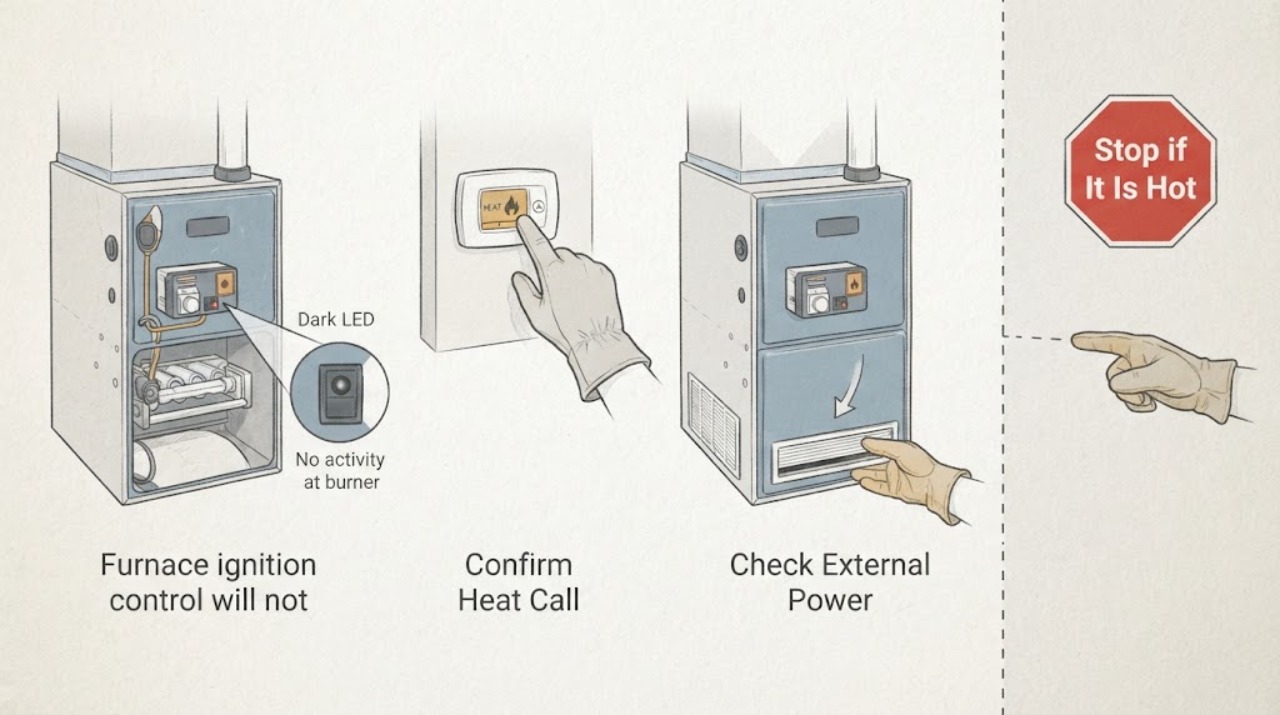
Work through in order
Diagnostic checks
Use only checks that match the exact appliance or system and its official guide.
-
Check 1
Verify at the thermostat that the mode is Heat, the setpoint is above the room temperature, the display is active, and any battery or error indication is addressed only as the thermostat manual allows; do not remove the thermostat or touch its wiring.
Expected result: The thermostat is not in Heat, is not calling above room temperature, has a blank or error display, shows a low-battery indication, or clearly calls for heat while the furnace does not respond.
Next step: Correct only the ordinary setting or battery condition allowed by the thermostat manual. If a confirmed call still produces no response, continue with external power and airflow checks and arrange HVAC service if the condition persists.
Stop if: Do not jumper terminals, pull the thermostat from its base, or change wiring as a test.
Why this matters
Why: A missing call, thermostat power issue, setting, or control fault can prevent the furnace sequence from beginning. A confirmed call makes furnace power, airflow, lockout, ignition, or control causes more likely, but does not identify the ignition control.
-
Check 2
With dry hands and no smoke, sparking, water, or gas odor, check that the nearby furnace service switch is on and that the labeled furnace breaker is not tripped; do not open the cabinet or repeatedly reset a breaker.
Expected result: The switch is off, the breaker is tripped or will not stay on, power appears normal but the furnace is silent, or the external controls remain on without a startup.
Next step: Restore an accidentally switched-off control only when the area is dry and safe. If the breaker trips, will not remain on, or the furnace remains silent, leave it off and arrange qualified HVAC or electrical diagnosis.
Stop if: Stop immediately for heat, burning odor, buzzing with visible damage, smoke, sparking, water near electrical parts, or a breaker that trips again.
Why this matters
Why: An off switch or tripped breaker can stop the ignition sequence before it reaches the control. A breaker that trips again indicates an electrical or equipment fault; apparent external power with no response keeps the door interlock, internal supply, lockout, or control fault in consideration.
-
Check 3
With the furnace fully off, inspect the accessible air filter and make sure return grilles and supply registers are not covered or blocked; replace a visibly dirty filter only with the exact type specified by the model manual.
Expected result: The filter is dirty, a return or register is blocked, airflow was weak before the no-start symptom, or the accessible filter and air paths are clear.
Next step: Install the specified filter before operating the furnace and leave room air paths open. If the furnace still does not start or immediately shuts down after the safe airflow check, stop cycling it and arrange HVAC service.
Stop if: Do not operate the furnace without its filter or remove a furnace door to improve airflow.
Why this matters
Why: Restricted airflow can cause overheating and a safety shutdown, which may prevent a normal restart or create a start-then-stop pattern. Clear external airflow makes that cause less likely but does not rule out an internal blower, limit, ignition, or control fault.
-
Check 4
During one confirmed heat call, listen from outside the furnace cabinet and note whether there is no response, an inducer or motor sound, a click or glow without ignition, a burner start followed by shutdown, or a blower-only response; record any code visible through a normal display or designed viewing window without removing panels.
Expected result: The furnace is silent, a motor runs but there is no flame, the igniter clicks or glows without ignition, the burners light and go out, or the blower runs without heat.
Next step: Record the order and duration of sounds, the visible code, and whether heat or airflow followed. Keep the furnace off and arrange qualified HVAC diagnosis for an incomplete ignition sequence rather than repeating the call.
Stop if: Do not remove access panels, look into a burner compartment, touch the igniter or controls, or repeat cycles to force ignition.
Why this matters
Why: Silence keeps power, control, interlock, and lockout causes in consideration. A motor without ignition can involve the igniter, gas supply, venting, pressure sequence, flame sensing, or ignition control. Flame followed by shutdown can involve flame proving or a safety response. A sound or code alone cannot prove which part failed.
-
Check 5
From ground level and without moving covers, look for an obviously blocked or disconnected outdoor intake or exhaust termination, snow, leaves, nests, or renovation debris; also check that visible furnace-room combustion-air openings are not covered.
Expected result: An intake or exhaust looks blocked or disconnected, room air openings are covered, the termination is clear, or the vent cannot be safely viewed.
Next step: Do not climb, reach into the vent, dismantle piping, or remove furnace panels. Leave the furnace off and arrange qualified HVAC service for any suspected vent restriction, repeated ignition failure, or combustion concern.
Stop if: Stop for exhaust entering the home, a damaged vent, a carbon-monoxide alarm, gas odor, smoke, or any unsafe access condition.
Why this matters
Why: A blocked or disconnected vent or inadequate combustion air can stop a protected ignition sequence and can create a combustion or carbon-monoxide risk. A clear visible termination does not prove that the vent, pressure switch, heat exchanger, or internal passage is safe.
-
Check 6
From a safe location, check for gas odor, a carbon-monoxide alarm, smoke, sparking, unusual flame visible only through a designed viewing area, severe overheating, water near the furnace, or a repeated lockout; do not rely on smell alone and do not inspect internal wiring or gas controls.
Expected result: A gas odor, carbon-monoxide alarm, smoke, spark, abnormal flame, severe heat, water near electrical parts, or recurring lockout is present, or none of those hazards is present but the furnace still will not start.
Next step: For a carbon-monoxide alarm, strong gas odor, smoke, or fire, leave immediately and contact emergency or gas-utility assistance from outside. For other safety symptoms or a persistent no-start, keep the furnace off and arrange qualified HVAC service.
Stop if: Do not reset a safety control, bypass a lockout, relight a pilot without exact model instructions, or continue operating a furnace with a safety symptom.
Why this matters
Why: A fuel, combustion, venting, electrical, water, overheating, or safety-control problem may be present and is beyond a homeowner ignition-control test. No odor does not exclude carbon monoxide, and a reset does not establish safe operation.
Use your observations
Decision map
Find the observation that best matches what you see, then follow the next safe action.
-
PATH 01Next step
What you see
The thermostat is blank or not calling, or the furnace switch or breaker is off; a breaker trips again when heat is requested.
Do this next
Correct only a normal setting or accidentally switched-off control when safe. Leave a tripped or recurring breaker off and arrange qualified HVAC or electrical diagnosis without opening the furnace.
Why this path and its safety boundary
Why it matters: A thermostat, power, wiring, or electrical protection issue is more likely than an ignition-control failure. A repeated breaker trip is an equipment or electrical fault, not a setting to keep resetting.
-
PATH 02Next step
What you see
A valid thermostat call is present, the external switch and breaker appear on, the accessible filter and registers are clear, but the furnace is completely silent.
Do this next
Keep the furnace off and provide the model, code display, and one-call symptom record to a qualified HVAC technician. Do not jumper the call for heat or replace a board based only on silence.
Why this path and its safety boundary
Why it matters: An internal power path, door interlock, control board or ignition-control command, lockout, or other control fault is more likely than a thermostat setting or simple airflow restriction. The silence does not prove the ignition control is bad.
-
PATH 03Next step
What you see
The inducer or another motor starts, but the igniter does not visibly begin its sequence, the furnace clicks without flame, or the burners never establish heat.
Do this next
Stop additional attempts and arrange qualified HVAC diagnosis. Tell the technician whether the igniter glowed, whether any code appeared, and whether the symptom is on every call; do not measure live voltage or apply power to a gas valve.
Why this path and its safety boundary
Why it matters: Ignition, gas delivery, venting or pressure proving, flame sensing, wiring, or the model-specific ignition control may be involved. The safety sequence may intentionally withhold gas; a homeowner should not select or test the part from the sound.
-
PATH 04Next step
What you see
The burners light briefly and then go out, or the blower starts but the furnace does not continue heating, especially with a dirty filter, blocked vent, or repeated code.
Do this next
Leave the furnace off after recording the sequence and code. Arrange qualified service to inspect the ignition sequence, combustion safety, airflow, and model-specific controls; do not bypass a sensor or repeatedly reset lockout.
Why this path and its safety boundary
Why it matters: Flame proving, airflow, limit, venting, gas-supply, or another safety response is more likely than a control board alone. A no-light improvement bulletin for specified older Amana Distinctions models does not establish compatibility with this furnace.
-
PATH 05Next step
What you see
A carbon-monoxide alarm, gas odor, smoke, fire, sparking, unusual flame, damaged vent, severe overheating, or water near electrical equipment occurs during the no-start attempt.
Do this next
Leave immediately for a carbon-monoxide alarm, strong gas odor, smoke, or fire and call emergency or gas-utility assistance from outside. Do not re-enter or operate the furnace until responders or trained personnel authorize it; arrange qualified HVAC inspection for other hazards.
Why this path and its safety boundary
Why it matters: A combustion, fuel, electrical, fire, water, or carbon-monoxide hazard takes priority over identifying the ignition-control fault. The absence of a gas smell cannot rule out carbon monoxide.
Helpful context
Understand the symptom
The ignition control is one step in a protected sequence
A thermostat call does not make the ignition control start by itself. The control board, inducer, pressure and limit safeties, igniter, gas valve, flame sensor, and blower must follow the model-specific sequence. A completely silent furnace points toward the call, power, control, or lockout path; a motor that runs without a flame points toward ignition, gas, venting, or flame-sensing paths. The same symptom can have different causes, so use timing and visible indicators for a service description rather than naming a board prematurely.
Use only external, low-risk checks
Check normal thermostat settings, the furnace switch and breaker, the accessible filter, and unobstructed room air paths without removing the furnace cabinet. A filter change or power correction can remove a simple cause, but it does not prove that an ignition control, igniter, gas valve, pressure switch, flame sensor, or limit is good. If the breaker trips again, the furnace stays locked out, or the startup sequence remains incomplete, stop cycling the equipment and arrange qualified HVAC diagnosis.
Older Amana ignition-control bulletins are model-specific
The Goodman/Amana service bulletin about an ignition-control improvement applies to named Amana Distinctions and Goodman single-stage models, not every Amana furnace. It describes a no-light symptom and tells service personnel to rule out grounding and a sticking gas valve before replacing the control. Do not use the bulletin's part numbers, electrical tests, or gas-valve procedure as a homeowner repair recipe; provide the exact model and serial information to the technician instead.
Safety symptoms override troubleshooting
Natural gas and carbon monoxide are not made safe by the absence of a smell. A carbon-monoxide alarm, gas odor, smoke, sparking, unusual flame, water near electrical equipment, or a blocked or damaged flue needs the furnace left off and immediate safety action. Leave for an alarm, strong gas odor, smoke, or fire, call emergency or gas-utility assistance from outside, and do not re-enter or operate the furnace until responders or trained personnel say it is safe.
Safety boundary
Stop conditions
- Stop and leave for fresh air when a carbon-monoxide alarm, smoke, fire, or strong gas odor occurs; contact emergency or gas-utility assistance from outside.
- Do not open the furnace cabinet, jumper thermostat or safety terminals, measure live voltage, apply power to a gas valve, or touch the igniter, flame sensor, wiring, or control board.
- Do not bypass a limit, pressure, flame, door, or other safety control, repeatedly reset a lockout or breaker, or relight a pilot without the exact model instructions and appropriate qualification.
- Do not operate the furnace with a blocked or damaged vent, abnormal flame, smoke, severe overheating, water near electrical equipment, or a panel that cannot close correctly.
- Arrange qualified HVAC service for an incomplete ignition sequence, a persistent no-start after safe external checks, recurring lockout, a damaged control or igniter, or any suspected gas, combustion, venting, or electrical fault.
Only after diagnosis
Potential parts
- Amana furnace ignition control or control board
Consider this category only when qualified diagnosis shows the model-specific control is not issuing or completing the ignition sequence after power, grounding, gas, venting, igniter, and safety causes are checked.
Confirm the exact Amana model, revision, wiring, and manufacturer's fit information; the official bulletin's older Amana Distinctions examples do not establish compatibility with other Amana furnaces. - Amana furnace hot-surface igniter
Consider this category only if qualified testing shows the igniter is cracked, not heating, or outside the model's specified operating condition and the control and safety sequence are otherwise correct.
Confirm the exact model and manufacturer's fit information; do not touch, test live, or substitute an igniter based on appearance alone. - Amana furnace flame-sensing or safety-control component
Consider this category only when the furnace lights and then drops out or a qualified diagnostic identifies a flame-proving, limit, pressure, or related safety-control fault.
Confirm the exact Amana model and diagnostic result before ordering; do not bypass or replace a safety component as a trial.
When checks do not resolve it
Need a professional?
Arrange qualified HVAC service when a valid thermostat call and accessible power and airflow checks do not restore the Amana furnace, when the sequence stops before ignition or shuts down after lighting, when a code repeats, or when an ignition control, igniter, flame sensor, pressure control, gas valve, vent, or wiring fault is suspected. Use emergency or gas-utility assistance for a carbon-monoxide alarm, smoke, fire, or strong gas odor.
Safety scope: This article supports ordinary thermostat and external power checks, an accessible filter and register inspection, a ground-level visual vent check, and listening to one startup attempt from outside the cabinet. Electrical measurements, gas-valve or pressure tests, ignition-control replacement, burner and flame-sensor work, venting, combustion, and safety-control diagnosis require qualified personnel.
Common questions
FAQ
Does an Amana furnace that will not start always need a new ignition control?
No. The thermostat call, furnace power, door interlock, airflow, venting, igniter, gas supply, flame sensing, and safety controls can all stop the sequence. The ignition-control bulletin for specified older Amana Distinctions models specifically says other causes should be ruled out before a control change. A qualified technician should use the exact model sequence before selecting a part.
What can I safely check when my Amana furnace is silent?
Check the thermostat's normal Heat call, the nearby furnace switch and labeled breaker, and the accessible filter, return grille, and supply registers. From outside the cabinet, record one startup attempt and any visible code. Do not open the furnace, jumper wiring, measure live voltage, or repeatedly reset a breaker or lockout.
What does it mean if the Amana furnace inducer runs but the burners do not light?
The sequence has progressed beyond a completely silent condition, but the cause may be an igniter, gas delivery, vent or pressure proving, flame sensing, wiring, or ignition-control issue. Do not apply power to a gas valve or test live terminals. Record whether the igniter glowed, any code, and whether the furnace tried again, then arrange qualified HVAC diagnosis.
Why does the furnace light and then shut off?
A flame-proving, airflow, limit, venting, gas-supply, or other safety response may be ending the cycle. A dirty filter or blocked vent can contribute, but a short run does not identify one failed part. Keep the furnace off after recording the pattern and have a qualified technician inspect the model-specific ignition and safety sequence.
What should I do if an Amana furnace problem occurs with a carbon-monoxide alarm or gas odor?
Leave immediately for fresh air for a carbon-monoxide alarm, strong gas odor, smoke, or fire, and contact emergency or gas-utility assistance from outside. Do not search for the source, re-enter, reset the furnace, or operate it again until responders or trained personnel say it is safe.
Read the exact guide
Official sources
- Carbon Monoxide Fact SheetU.S. Consumer Product Safety Commission · General safety guidance for homes using gas furnaces and other fuel-burning appliances.
- Heating and Cooling Basics | Learn about HVACAmana brand · Amana general gas-furnace operating sequence; exact ignition controls and timings vary by model.
- Service Bulletin SF-012: New Ignition Control Board 0130F00005SGoodman Technical Services / Amana brand · Only the named older models in the bulletin; it is not a general Amana control-board compatibility or homeowner repair guide.
- HVAC MaintenanceAmana brand · Amana HVAC maintenance guidance; homeowner checks remain limited to manual-approved accessible items.
Community feedback
Share a repair observation
Share a plain-text repair observation. Accepted observations are published automatically; this page may take a moment to update.