
On this page
Start here
Quick answer
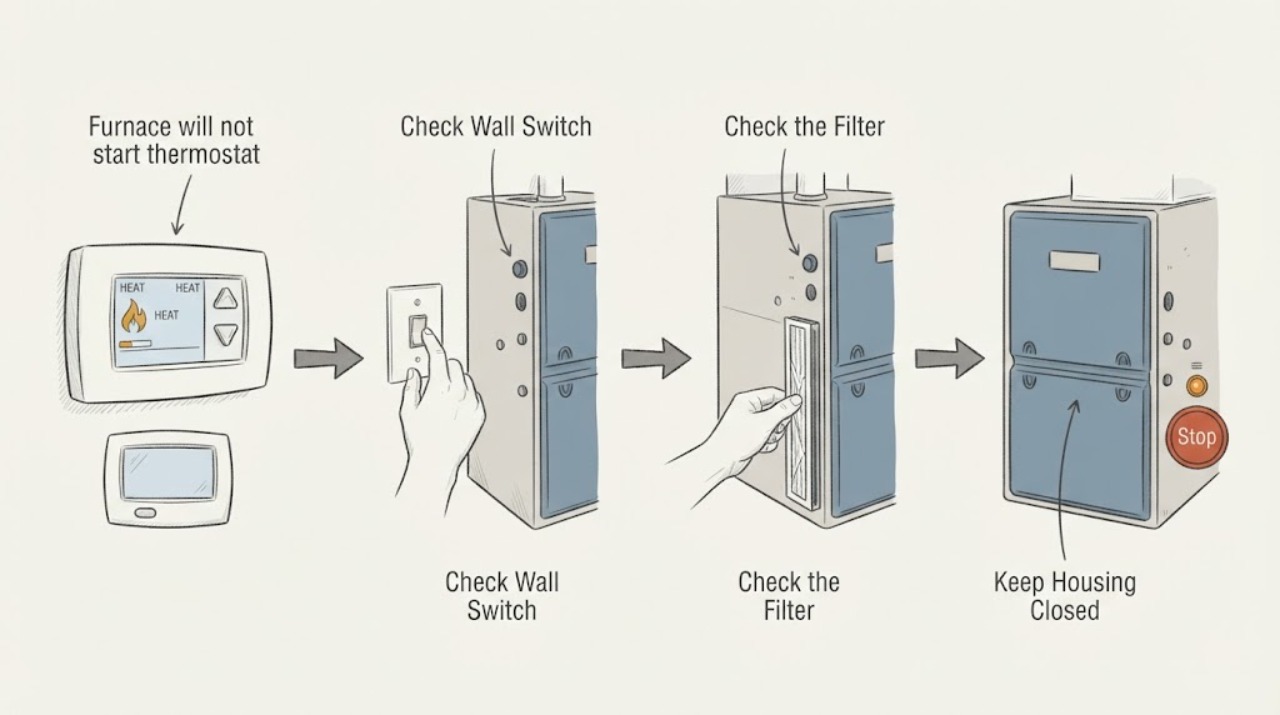
If the thermostat says it is calling for heat but the furnace does not start, verify the thermostat mode and setpoint, the furnace service switch, and the furnace circuit breaker without opening the cabinet. A dirty filter or blocked return can prevent safe operation, while a tripped limit, ignition or flame-sensing fault, gas-supply issue, control failure, or hard lockout can stop the sequence after the call begins. Listen from outside the unit for no response, a motor or inducer sound, clicking without ignition, or a start followed by shutdown, and record the pattern. Do not jumper thermostat wires, open the furnace, adjust gas controls, relight a pilot without the exact manual procedure, or repeatedly reset a breaker or safety control. A gas odor, carbon-monoxide alarm, smoke, sparking, abnormal flame, or repeated lockout requires leaving or shutting the system off as appropriate and arranging emergency or qualified HVAC help.
Before you begin
Safety first
- Internal electrical, gas, combustion, ignition, flame-sensing, limit-control, venting, blower, and heat-exchanger diagnosis belongs to a qualified HVAC professional. The user can verify thermostat settings, external power controls, accessible airflow, and the audible startup pattern without opening the furnace.
Work through in order
Diagnostic checks
Use only checks that match the exact appliance or system and its official guide.
-
Check 1
Verify that the thermostat is in Heat, the setpoint is above the room temperature, the display is active, and any battery or error indication is addressed using the exact thermostat manual; do not remove the thermostat or touch its wiring.
Expected result: The thermostat is not actually calling, has a blank or error display, has a weak battery indication, or clearly shows a heat call while the furnace remains silent.
Next step: Correct only the normal mode, setpoint, or battery condition allowed by the manual. If a confirmed call still produces no furnace response, continue with external power and airflow checks and arrange HVAC service if it persists.
Why this matters
Why: A mode, setpoint, battery, display, or thermostat fault can prevent a valid call from reaching the furnace. A confirmed call shifts attention to furnace power, airflow, startup sequence, or an internal safety or control fault.
-
Check 2
With dry hands and no smoke, sparking, water, or burning odor, check that the furnace service switch is on and that the labeled furnace or heat breaker is not tripped; do not repeatedly reset a breaker that trips again.
Expected result: The service switch or breaker is off, the breaker is in a tripped position, power appears correct but the furnace remains silent, or the breaker trips when heat is called.
Next step: Restore only an accidentally switched-off control if the area is safe and the manual permits it. If the breaker trips, will not stay on, or the furnace remains silent, leave it off and arrange qualified HVAC or electrical diagnosis.
Why this matters
Why: An off switch or tripped breaker can prevent the furnace from starting. A breaker that trips again points to an electrical or furnace fault rather than a setting problem; apparent power with no response keeps the controls, door interlock, and internal supply in consideration.
-
Check 3
With the furnace fully off, inspect the accessible air filter and make sure return grilles and supply registers are not covered or blocked; replace a visibly dirty filter only with the exact type specified by the manual.
Expected result: The filter is dirty, air paths are blocked, airflow was weak before the failure, or the filter and accessible vents are clear.
Next step: Do not run the furnace without its filter. If the confirmed thermostat call still does not start the furnace after the safe airflow check, stop cycling the system and arrange HVAC service.
Why this matters
Why: Restricted airflow can cause overheating and a safety shutdown, preventing a new start or causing a start-then-stop pattern. Clear airflow makes this cause less likely but does not rule out an internal blower, limit, ignition, or control issue.
-
Check 4
From outside the furnace cabinet, listen during one confirmed heat call and note whether there is no response, a motor or inducer sound, clicking without ignition, or a brief start followed by shutdown; do not remove panels or inspect the burner.
Expected result: The furnace is silent, a motor runs but no heat follows, ignition clicks without a flame, or the system starts and quickly stops.
Next step: Record the sequence, any display code visible without opening the unit, and the timing. Keep the furnace off and arrange qualified HVAC diagnosis for any failed or incomplete startup sequence.
Why this matters
Why: Silence keeps power, controls, and lockout in consideration. Motor operation without ignition can involve ignition, gas, venting, or flame-sensing paths. A short start followed by shutdown can involve airflow or a safety control. The sound alone cannot select a part.
-
Check 5
Check the area from a safe location for gas odor, a carbon-monoxide alarm, smoke, sparking, unusual flame visible only through a designed viewing area, severe heat, water, or repeated safety lockout; do not rely on smell alone and do not enter the cabinet.
Expected result: A gas odor, carbon-monoxide alarm, smoke, spark, abnormal flame, severe heat, water near electrical parts, or repeated lockout is present.
Next step: Leave immediately for a carbon-monoxide alarm, strong gas odor, smoke, fire, or active sparking and use emergency or gas-utility help from a safe location. Keep the furnace off and arrange qualified HVAC service for other safety symptoms.
Why this matters
Why: A fuel, combustion, venting, electrical, overheating, or water-damage hazard may be present and cannot be made safe by a thermostat reset.
Use your observations
Decision map
Find the observation that best matches what you see, then follow the next safe action.
-
PATH 01Next step
What you see
The thermostat display is blank, not in Heat, not set above room temperature, or shows a battery or control error, and the furnace has no confirmed call.
Do this next
Correct the normal setting or battery condition allowed by the manual. Do not alter thermostat wiring; arrange HVAC service if the display or call remains abnormal.
Why this path and its safety boundary
Why it matters: The thermostat or its power and settings are more likely than a furnace ignition fault.
-
PATH 02Next step
What you see
The thermostat clearly calls for heat, the service switch and breaker appear on, the filter and vents are clear, but the furnace is completely silent.
Do this next
Leave the furnace off and arrange qualified HVAC service. Do not open the cabinet, jumper the call for heat, or reset an internal safety device.
Why this path and its safety boundary
Why it matters: A control, door interlock, internal power, lockout, or furnace component fault is more likely than a thermostat setting or simple airflow restriction.
-
PATH 03Next step
What you see
A motor or inducer starts after the thermostat call, but the burners do not ignite, or the furnace clicks and then stops without producing heat.
Do this next
Keep the furnace off and arrange qualified HVAC diagnosis. Do not relight, clean, adjust, or bypass the ignition, flame sensor, gas valve, or pressure safety.
Why this path and its safety boundary
Why it matters: An ignition, gas-supply, venting, flame-sensing, pressure, or control issue is more likely; the safety sequence may be intentionally withholding fuel.
-
PATH 04Next step
What you see
The furnace starts briefly and shuts down before the home warms, especially with a dirty filter, blocked airflow, short cycling, or a repeated lockout indication.
Do this next
Correct only an accessible filter or vent obstruction with the furnace off and the manual's guidance. If the sequence still fails, stop operating the furnace and arrange qualified service.
Why this path and its safety boundary
Why it matters: Restricted airflow and an overheating limit response are possible, but a faulty limit, flame-sensing, heat-exchanger, blower, or other safety condition remains possible.
-
PATH 05Next step
What you see
There is a carbon-monoxide alarm, strong gas odor, smoke, fire, active sparking, abnormal flame, severe overheating, water on electrical equipment, or a breaker that trips repeatedly.
Do this next
Leave for gas odor, smoke, fire, active sparking, or a carbon-monoxide alarm and use emergency or gas-utility assistance from a safe location. Keep the furnace off and do not re-enter or restart it until qualified help clears it.
Why this path and its safety boundary
Why it matters: An immediate fuel, combustion, electrical, fire, or water-damage hazard may exist, regardless of the thermostat call.
Helpful context
Understand the symptom
A thermostat call is only the first step in the startup sequence
The thermostat can display a heat call while the furnace has no power, a service switch is off, airflow is restricted, or a safety control has prevented ignition. The sound that follows the call matters: silence, an inducer or blower sound, clicking without flame, or a brief start followed by shutdown points to different diagnostic paths. Do not open the cabinet to watch the sequence.
Check only the accessible controls and airflow
Confirm the thermostat is in Heat and calling above the room temperature, then check the nearby furnace switch and the labeled breaker. With the furnace off, inspect the accessible filter and keep return grilles and supply registers clear. A filter or vent check can remove a simple airflow cause, but it cannot prove the limit control, ignition, flame sensor, gas valve, or control board is healthy.
Use the symptom timing without forcing another cycle
If the furnace is silent after a valid call, power, control, or lockout is possible. If a motor starts but burners never ignite, ignition, gas, venting, or flame-sensing issues are more likely. If it starts and quickly stops, airflow or a safety shutdown is possible. Record one normal attempt rather than repeatedly turning power off and on.
Safety overrides the desire for heat
A gas furnace uses electricity as well as fuel, and internal components can include high voltage, hot surfaces, moving fans, and combustion controls. A thermostat call and the absence of an obvious odor do not make internal troubleshooting safe. A carbon-monoxide alarm, gas odor, smoke, sparking, abnormal flame, or water near electrical equipment requires immediate safety action and qualified help.
Safety boundary
Stop conditions
- Do not jumper thermostat wires, open furnace panels, adjust gas controls, clean or bypass a flame sensor or limit switch, relight a pilot without the exact qualified procedure, or repeatedly reset a breaker or lockout.
- Keep the furnace off and arrange qualified HVAC service when a confirmed thermostat call produces no start, an ignition sequence fails, the system starts and stops, a breaker trips, or basic filter and control checks do not restore operation.
- If there is a carbon-monoxide alarm, strong gas odor, smoke, fire, active sparking, abnormal flame, severe overheating, or water near electrical parts, leave the area and use emergency or gas-utility assistance from a safe location.
When checks do not resolve it
Need a professional?
Safety scope: Internal electrical, gas, combustion, ignition, flame-sensing, limit-control, venting, blower, and heat-exchanger diagnosis belongs to a qualified HVAC professional. The user can verify thermostat settings, external power controls, accessible airflow, and the audible startup pattern without opening the furnace.
Common questions
FAQ
Why does my thermostat say Heat On but the furnace does nothing?
The thermostat call may be valid while the furnace lacks power, has an airflow restriction, or is preventing startup because of an ignition, flame-sensing, limit, gas, vent, control, or lockout issue. Check only the thermostat, service switch, breaker, and accessible filter as the manual permits, then arrange service if there is no response.
Should I reset the furnace breaker when the thermostat is calling?
Check whether the labeled furnace breaker is tripped, but do not repeatedly reset it. If it trips again or the furnace still does not start, leave it off and arrange qualified HVAC or electrical diagnosis because a fault may be present.
Can a dirty filter stop a furnace from starting?
Yes. A clogged filter can restrict airflow, cause overheating, and trigger a safety shutdown. With the furnace fully off, replace a visibly dirty filter with the exact specified type and keep vents and returns clear. Persistent failure needs professional diagnosis.
What if the furnace clicks but does not ignite?
Clicking without ignition can involve the igniter, gas supply, flame sensor, venting, pressure or control sequence. Do not open the cabinet, adjust gas equipment, or clean the flame sensor yourself; leave the furnace off and arrange qualified HVAC service.
When is a furnace that will not start an emergency?
A carbon-monoxide alarm, strong gas odor, smoke, fire, active sparking, abnormal flame, severe overheating, water near electrical parts, or repeated lockout requires immediate safety action. Leave for gas or carbon-monoxide danger and use emergency or gas-utility help from a safe location.
Read the exact guide
Official sources
- Furnace Troubleshooting: Gas Furnace SolutionsTrane · Trane residential gas-furnace troubleshooting guide; fuel and ignition procedures vary by model
- Furnace Not Turning On? Troubleshooting & Repair GuideCarrier · Carrier residential furnace guidance; exact equipment and control sequence vary by model
- Furnace Not Turning On? Try These Troubleshooting TipsTrane · Trane residential gas-furnace guidance; exact controls and startup sequence vary by model
- Safety Section – Gas FurnacesTrane · Trane gas-furnace safety manual; exact installation and service requirements are model-specific
Community feedback
Share a repair observation
Share a plain-text repair observation. Accepted observations are published automatically; this page may take a moment to update.