
On this page
Start here
Quick answer
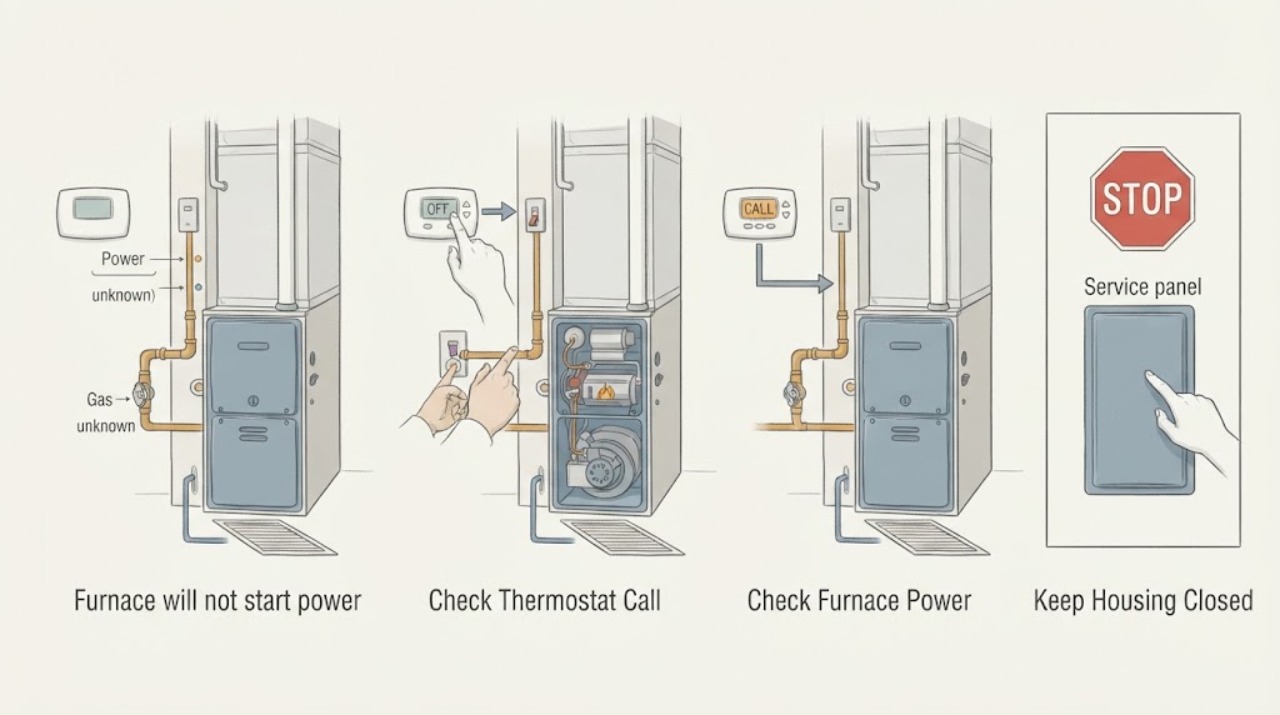
When a furnace will not start and you do not know whether power or fuel is available, begin with safe, external observations: confirm the thermostat is calling for heat, look for a furnace power switch or tripped breaker, check the filter and registers, and note whether the furnace is completely silent or begins a startup sequence. Do not open the furnace, test live wiring, manipulate an unfamiliar gas valve, or relight a pilot unless the exact owner manual and your local safety rules specifically support it. If a breaker trips again, the furnace shows an ignition or safety fault, gas status cannot be confirmed, or the unit still does not start after these checks, stop and arrange HVAC service. If you smell gas, hear escaping gas, a carbon-monoxide alarm sounds, or anyone has possible carbon-monoxide symptoms, leave immediately, avoid switches and ignition sources, get to fresh air, and contact emergency or gas-safety services from outside.
Work through in order
Diagnostic checks
Use only checks that match the exact appliance or system and its official guide.
-
Check 1
Look at the thermostat without opening it: confirm it is in Heat mode, the set point is above the current room temperature, and its display or indicator is present; replace batteries only if the thermostat instructions call for user-replaceable batteries.
Expected result: The display is blank, the mode is Off or Cool, the set point is not requesting heat, or the thermostat indicates a heat call while the furnace remains silent.
Next step: Correct only the accessible setting or battery issue described by the thermostat manual. If a heat call is present but nothing happens, continue to the external power check and do not open thermostat or furnace wiring.
Why this matters
Why: A blank or incorrectly configured thermostat can explain no startup; a clear heat call with no furnace response shifts attention toward furnace power, controls, safety lockout, or the fuel and ignition path.
-
Check 2
From a dry, safe location, look for the clearly labeled furnace service switch and the heating circuit at the electrical panel; do not remove covers or touch wiring, and do not reset a breaker if there is smoke, water, scorching, or another hazard.
Expected result: The furnace switch is off, the heating breaker appears tripped, the breaker will not remain on, or the switch and breaker appear on but the furnace is still silent.
Next step: If there is no hazard and you are comfortable identifying the labeled control, restore only the normal switch or breaker position once. If it trips again or the furnace remains unresponsive, leave it off and call an HVAC professional or electrician; do not keep cycling it.
Why this matters
Why: An off switch or tripped breaker can remove the electrical power needed even by a gas furnace. A breaker that trips again points to an electrical or equipment fault rather than a setting problem; power appearing on does not rule out an internal control fault.
-
Check 3
With the furnace not running, inspect the filter at its normal user-accessible location and look at return grilles and supply registers for obvious blockage; do not run the furnace without a filter or remove a furnace access panel.
Expected result: The filter is visibly loaded with dust, the return is obstructed, or several supply registers are blocked; alternatively, airflow looks unobstructed.
Next step: Replace a disposable filter with the correct type and orientation shown by the equipment or filter instructions, and clear furniture from grilles. If the furnace still will not start, stop at external checks and arrange service rather than opening the cabinet.
Why this matters
Why: Restricted airflow can cause overheating and a safety shutdown, while clear airflow makes a thermostat, power, fuel, ignition, or control issue more likely. A clean filter does not prove that internal airflow or safety switches are working.
-
Check 4
Set a normal heat call only after the thermostat and power checks are safe, then observe from outside the furnace cabinet whether the sequence is silent, starts a blower or inducer, attempts ignition, or starts and quickly stops; do not watch an open burner compartment or repeatedly restart it.
Expected result: There is no sound, a motor runs without ignition, ignition is attempted but no flame follows, or the furnace starts and then stops.
Next step: Record the sequence and any visible external status light or thermostat message without removing panels. Do not test the igniter, flame sensor, pressure switch, or gas valve; give the observations to an HVAC technician.
Why this matters
Why: Silence keeps power, thermostat, control, or lockout in question. A motor with no heat points toward ignition, fuel, or safety supervision; a brief start and stop can indicate a sensor, limit, airflow, venting, or other protective response that needs professional diagnosis.
-
Check 5
Identify the furnace fuel from its label, lease or utility information, and note whether the fuel status is known without touching an unfamiliar valve or opening the appliance; if a gas odor is present, do not operate switches or create an ignition source.
Expected result: The unit is gas or propane and fuel status is unknown, the household has a known supply interruption, or there is a gas odor or hissing sound.
Next step: For unknown fuel status without an odor, stop at identification and have the fuel provider or HVAC professional verify supply and appliance operation. For odor or hissing, leave immediately without touching switches, call the gas utility or emergency services from outside, and do not reenter until cleared.
Why this matters
Why: Unknown fuel availability can prevent ignition, but it cannot be safely distinguished at home from a failed valve, igniter, flame sensor, venting problem, or safety control. Odor or hissing changes this from troubleshooting to a possible gas emergency.
-
Check 6
Check only whether a carbon-monoxide alarm is sounding or anyone has headache, fatigue, nausea, confusion, or other possible exposure symptoms; do not stay inside to locate the source or operate the furnace to confirm a theory.
Expected result: The alarm sounds, symptoms are present, smoke or combustion odor appears, or the furnace has an unexplained lockout with signs of unsafe combustion.
Next step: Move everyone outside to fresh air, call emergency services from outside, and do not reenter or operate the furnace until responders and trained personnel say it is safe. If no emergency sign is present but the furnace still will not start, schedule HVAC service.
Why this matters
Why: Fuel-burning equipment can produce carbon monoxide when combustion or venting is faulty, and an alarm or symptoms require an emergency response rather than furnace troubleshooting.
Use your observations
Decision map
Find the observation that best matches what you see, then follow the next safe action.
-
PATH 01Next step
What you see
Do this next
Correct the user-accessible thermostat setting or battery issue according to its instructions. If the display stays blank or a correct heat call produces no response, have the thermostat and low-voltage circuit evaluated rather than opening wiring.
-
PATH 02Next step
What you see
Do this next
Restore a labeled switch or breaker only once when there is no visible hazard and the user can identify it safely. If it trips again or the furnace remains silent, leave it off and call an HVAC professional or electrician.
-
PATH 03Next step
What you see
Do this next
Stop repeated restart attempts, note any status indication, and arrange HVAC diagnosis. Do not open the burner compartment, handle an igniter or flame sensor, or manipulate the gas valve.
-
PATH 04Next step
What you see
Do this next
Have the fuel provider or qualified HVAC technician verify supply and appliance operation. Keep the furnace off if you cannot establish a safe, normal condition.
-
PATH 05Next step
What you see
Do this next
Leave immediately, avoid switches, flames, and attempts to find the source, call emergency or gas-safety services from outside, and do not reenter or operate the furnace until authorities and trained personnel clear it.
Helpful context
Understand the symptom
First separate no call for heat from no furnace response
A blank thermostat, a thermostat that is not in Heat mode, or a set point below the room temperature can prevent a call for heat. If the thermostat is calling but the furnace is silent, power, the furnace switch, controls, or a safety lockout become more likely. If you hear a motor or ignition attempt but get no heat, the fault is farther into the startup sequence. Record what you hear without removing a furnace panel.
Power and fuel are separate questions
A gas furnace still needs electricity for controls, ignition, and the blower, so a gas supply does not prove that the furnace has power. Conversely, a lit thermostat or furnace display does not prove that gas is available or that ignition is safe. Check only labeled, accessible controls and the thermostat; an unknown gas condition or a failed ignition sequence belongs with a qualified HVAC technician.
Know the immediate stop conditions
Never use the furnace as a diagnostic experiment when there is a gas odor, a carbon-monoxide alarm, smoke, unusual combustion noise, scorching, exposed wiring, or repeated breaker trips. Leave the area as appropriate for the hazard, avoid switches and flames when gas may be present, and get professional or emergency help from a safe location.
Only after diagnosis
Potential parts
- thermostat or thermostat batteries
Consider a thermostat or its batteries only when the display or heat-call check identifies a thermostat-side problem and settings or correctly specified batteries do not resolve it.
Confirm the existing system type, wiring, and manufacturer requirements before selecting a thermostat; do not assume a generic control is compatible. - furnace igniter
Consider an igniter only after a qualified technician confirms that the furnace receives a heat call and power but the ignition sequence fails at the igniter.
Match the exact furnace model and ignition system; this is an internal combustion-appliance repair, not a routine user replacement. - flame sensor or safety control
Consider these parts only when professional diagnosis finds that the furnace lights and then loses flame supervision or a safety control is confirmed faulty.
Verify the exact model and fault evidence with a qualified HVAC technician; do not defeat, jumper, or bypass a safety control. - furnace control board
Consider a control board only after power, thermostat call, airflow, fuel, ignition, and safety inputs have been checked by a qualified technician and the board is diagnosed as failed.
Use the exact equipment documentation and qualified installation; a board that fits physically is not automatically electrically compatible.
When checks do not resolve it
Need a professional?
Call HVAC service when a correct heat call and safe external power checks do not start the furnace, when fuel status is unknown, when a breaker trips again, when the furnace begins but does not ignite or quickly stops, or when any internal component would need inspection. Leave immediately and contact emergency or gas-safety services from outside for a gas odor, hissing, carbon-monoxide alarm, smoke, combustion odor, or possible exposure symptoms.
Common questions
FAQ
Can a gas furnace fail to start if the gas supply is fine?
Yes. A gas furnace also needs electrical power and a valid thermostat call, and it may be held off by airflow, ignition, flame-supervision, venting, or other safety controls. A known gas supply does not identify which internal condition failed.
What can I check when I do not know whether the furnace has power?
Confirm the thermostat display and heat call, then look for the clearly labeled furnace switch and heating breaker from a safe location. Do not remove panels or touch wiring. If a breaker trips again or the furnace stays silent, leave it off and arrange service.
Should I turn a gas valve to see whether the furnace starts?
Do not manipulate an unfamiliar gas valve as a trial. If fuel status is unknown but there is no odor, have the fuel provider or HVAC professional verify it. If you smell gas or hear hissing, leave immediately without operating switches and call from outside.
Why does the furnace start and then stop?
A brief startup followed by shutdown can involve ignition, flame supervision, airflow, venting, a limit or pressure control, or another protective response. Note the sequence and any external status indication, but do not open the burner compartment or repeatedly restart it.
What should I do if a carbon-monoxide alarm sounds while the furnace will not start?
Treat it as an emergency. Move everyone outside to fresh air, call emergency services from outside, and do not reenter or operate the furnace until responders and trained personnel say it is safe. Do not stay inside to locate the source.
Read the exact guide
Official sources
- Furnace Not Turning On? Try These Troubleshooting TipsTrane · Manufacturer guidance for general gas-furnace troubleshooting; follow the exact equipment manual and use qualified service for internal work.
- Carbon Monoxide Fact SheetU.S. Consumer Product Safety Commission · General safety guidance for homes with fuel-burning furnaces; it does not diagnose a furnace fault.
- Heater Not Working? Try Our Furnace Troubleshooting GuideCarrier · Manufacturer troubleshooting guidance; use the exact furnace owner manual for model-specific controls and procedures.
Community feedback
Share a repair observation
Share a plain-text repair observation. Accepted observations are published automatically; this page may take a moment to update.