
On this page
Start here
Quick answer
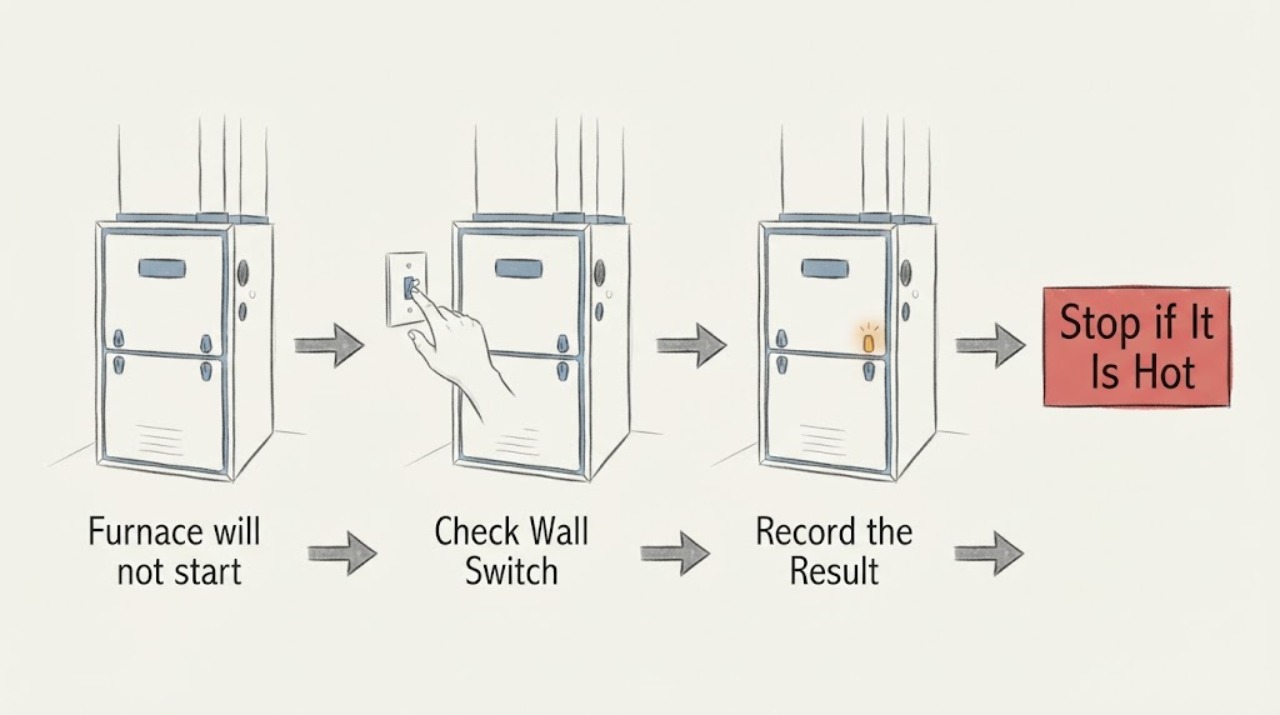
Start with safe observations, not a furnace-panel repair. Note whether the thermostat display is awake and calling for heat, whether the home has a broader power interruption, whether the furnace shows an external status light or code, and whether the return-air filter or registers visibly restrict airflow. Do not open the cabinet, handle wiring or gas controls, relight anything, or repeatedly reset the system. Stop immediately for gas odor, a carbon-monoxide alarm or symptoms, smoke, burning odor, a bang at ignition, or repeated breaker trips; leave the area as appropriate and contact emergency, utility, or qualified HVAC help. If the basic observations do not explain the no-start condition, a qualified technician must diagnose the electrical, combustion, ignition, and safety controls.
Work through in order
Diagnostic checks
Use only checks that match the exact appliance or system and its official guide.
-
Check 1
Look at the thermostat from a normal standing position and record whether its display is blank, shows a low-power or battery message, or is active with Heat selected and a call-for-heat indication. Do not remove the thermostat cover or touch wiring.
Expected result: Classify the thermostat as blank, active without a heat request, or active and requesting heat while the furnace remains silent.
Next step: Photograph or transcribe the display and note the room temperature and set point without making repeated adjustments. Include this information in a service request; if the display is blank, use another safe heat source only as appropriate and arrange HVAC service.
Stop if: Stop if the thermostat is hot, smells burnt, shows damaged wiring, or any person is at risk from loss of heat. Do not open it or attempt a wiring repair.
Why this matters
Why: A blank display or missing request points first to thermostat power or control communication; an active heat request with no furnace response shifts attention toward the furnace power indication, safety sequence, or a professional-only component.
-
Check 2
From outside the furnace cabinet, note whether other normal household lights or appliances have power and whether the furnace has an external power indicator or clearly labeled switch that can be viewed without opening anything. Do not operate a breaker, switch, fuse, or access panel as a troubleshooting experiment.
Expected result: Record whether the outage is general, whether the furnace’s external indication is dark or active, and whether an unfamiliar warning or fault indication is visible.
Next step: Write down the exact light pattern or display text and the time it was observed. Give it to the HVAC technician; use the owner’s manual only to interpret an external indicator, not to access internal components.
Stop if: Stop immediately for buzzing, arcing, a hot electrical smell, smoke, visible damage, or repeated tripping. Keep clear and contact a qualified HVAC or electrical professional; use emergency services when there is fire or immediate danger.
Why this matters
Why: A wider outage can explain a silent furnace, while a powered-looking house with no furnace indication suggests a furnace supply or control issue that requires qualified diagnosis. An external code may identify a direction but is not a homeowner diagnosis.
-
Check 3
Look at the return-air grille and any filter that is already accessible without removing a furnace panel. Note whether the grille is blocked and whether the visible filter surface is heavily gray, collapsed, wet, or obstructed; do not reach into the cabinet or disturb a wet filter.
Expected result: Record clear airflow space, a visibly loaded or damaged filter, or moisture or debris around the return.
Next step: If the filter is in a separate user-accessible holder and the owner’s instructions permit routine filter service, document its size and condition and follow those instructions with power safely isolated as directed. Otherwise leave it in place and request service; do not run the furnace with a wet or collapsed filter.
Stop if: Stop if the filter area is wet, moldy, damaged, hot, or inside a panel that would need removal. Do not clean, bypass, or operate the furnace to test a suspected airflow fault.
Why this matters
Why: A loaded filter or blocked return can reduce airflow and contribute to an overheating safety shutdown, but a visual filter check cannot establish the condition of the heat exchanger, limit control, or blower.
-
Check 4
From a safe location, observe the supply registers and the area around the furnace for blocked airflow, unusual sound, visible water, soot, or an odor. Do not approach a running fan, remove panels, or place hands near vents or the unit.
Expected result: Record no airflow request, a faint blower or clicking sound without heat, unusual banging or grinding, or visible moisture, soot, smoke, or a burning or gas odor.
Next step: Stop the furnace from being used and tell the technician the exact sound, location, timing, odor, and visible condition. Keep vents unobstructed only by moving loose items from a safe distance; do not touch the appliance.
Stop if: For gas odor, smoke, burning odor, a bang or delayed ignition, a CO alarm, or symptoms such as headache, dizziness, nausea, or confusion, leave immediately as appropriate, do not operate switches, and contact emergency services or the gas utility from outside.
Why this matters
Why: A sound without heat can reflect a failed start sequence, while unusual noise or combustion signs can indicate a condition that should not be tested by continued operation. Water or soot may indicate a separate safety or venting concern.
-
Check 5
Review the recent timeline without repeating a start attempt: note when the furnace last worked, whether the failure followed a storm or outage, whether it tried to start and stopped, and whether a thermostat or furnace code appeared.
Expected result: Record a sudden first failure, a sequence of starts followed by shutdowns, a recent power event, or a recurring pattern linked to a temperature change.
Next step: Give the timeline and any exact code to the HVAC professional. Keep the furnace off if a safety symptom occurred, and avoid repeated calls for heat while waiting for service.
Stop if: Stop all testing if the furnace repeatedly fails, trips a protection device, produces a combustion sound or odor, or the home becomes unsafe due to cold or loss of essential heat.
Why this matters
Why: Timing helps separate a no-request or supply event from a lockout, airflow, ignition, or safety-control symptom, but it does not justify resetting or opening the equipment.
Use your observations
Decision map
Find the observation that best matches what you see, then follow the next safe action.
-
PATH 01Safety boundary
What you see
The thermostat is blank or is not showing a heat request, while no unsafe odor or damage is present.
Do this next
Document the display and arrange HVAC service or thermostat support. Keep all wiring and the thermostat cover untouched.
Why this path and its safety boundary
Safety stop: Do not use internal wiring checks or repeated power cycling to force a call for heat.
-
PATH 02Safety boundary
What you see
The thermostat is calling for heat and the home has power, but the furnace has no response or only an external fault indication.
Do this next
Request qualified HVAC diagnosis and provide the exact status indication, timing, filter condition, and sounds observed. The issue may involve a control or safety sequence that is not safe to service by observation alone.
Why this path and its safety boundary
Safety stop: Do not remove a panel, bypass a safety, reset a rollout device, or attempt ignition or gas work.
-
PATH 03Safety boundary
What you see
The return is blocked or the accessible filter is visibly loaded, wet, or damaged, without a gas or combustion warning.
Do this next
Keep the furnace off and follow only the owner-approved routine filter procedure if it is genuinely external and safe; otherwise have a professional service it. Ask the technician to assess airflow and safety shutdown causes.
Why this path and its safety boundary
Safety stop: Do not run the furnace with a wet, collapsed, missing, or bypassed filter, and do not open the cabinet.
-
PATH 04Safety boundary
What you see
There is a gas odor, CO alarm or symptom, smoke, burning smell, soot, unusual ignition bang, or repeated electrical trip.
Do this next
Leave the area or home as appropriate, avoid operating switches or electronics when gas may be present, and contact emergency services, the gas utility, or a qualified professional from a safe location.
Why this path and its safety boundary
Safety stop: Do not re-enter or reuse the furnace until the responsible emergency or trained service personnel say it is safe.
-
PATH 05Safety boundary
What you see
The furnace remains silent after the safe external observations and no emergency symptom is present.
Do this next
Schedule qualified HVAC service and provide the thermostat state, external power/status indication, filter and airflow observations, timeline, and any code or sound.
Why this path and its safety boundary
Safety stop: Do not keep repeating start attempts or substitute a gas appliance, oven, or unvented fuel-burning device for home heating.
Helpful context
Understand the symptom
What a no-start observation can tell you
A furnace can appear silent because the thermostat is not requesting heat, the unit has no available power, airflow is restricted, a safety control has stopped the sequence, or a gas or ignition component needs service. The same symptom does not identify the failed part. These checks are intended to document the external state so a technician can start in the right place.
Keep gas and electrical work professional
Do not remove furnace access panels, touch exposed conductors, manipulate gas valves, relight a pilot, inspect an igniter, bypass a safety switch, or keep trying resets. If a gas odor or combustion warning is present, do not operate switches or electronics in the area. Follow local emergency and utility instructions from a safe location.
Only after diagnosis
Potential parts
- furnace thermostat
Consider this category only if a qualified diagnosis confirms the thermostat or its control communication is the cause of the no-start condition; a blank display alone does not prove the part has failed.
Confirm the heating system type, wiring requirements, control features, and manufacturer fit information before ordering. - furnace ignition control
This category is relevant only after a qualified technician identifies an ignition-sequence or control fault and rules out the thermostat, supply, airflow, and safety causes.
Match the exact furnace model, control revision, fuel system, and approved replacement information with the technician; no generic compatibility is implied. - furnace limit switch
Consider this only when a qualified diagnosis confirms a failed or incorrectly responding limit control. A dirty filter or blocked airflow can be the underlying reason for a safety shutdown.
Do not select a limit device by appearance or rating. The technician must confirm the furnace model, approved specification, and root cause before ordering.
When checks do not resolve it
Need a professional?
Call a qualified HVAC professional when the furnace does not start after safe external observations, an external status code appears, the thermostat calls for heat without a response, airflow is restricted, or the failure repeats. Treat gas odor, CO alarm or symptoms, smoke, burning odor, ignition bang, and repeated breaker trips as immediate safety escalation rather than routine troubleshooting.
Have this ready
- Provide the furnace and thermostat identity if known, thermostat display and mode, room and set-point observations, whether other household power is present, external status light or code, filter and return-air condition, sounds or odors, the last time it worked, and any storm, outage, or repeated-start timeline.
Common questions
FAQ
What should I check first when my furnace will not start?
Observe the thermostat display and heat request, the broader household power situation, any external furnace status indication, and the visible condition of the return-air filter or grille. Do not open the furnace, handle wiring or gas controls, or repeatedly reset it.
Should I relight the pilot if the furnace is silent?
Do not relight anything as a generic troubleshooting step. Furnace designs differ, and a gas odor, combustion fault, or unfamiliar control can make the situation hazardous. Use the owner’s manual only for information and ask a qualified professional to assess the system.
Can a dirty filter stop a furnace from starting?
Restricted airflow can contribute to overheating and a safety shutdown, but a filter’s appearance does not prove the cause. If the filter is in a genuinely user-accessible holder, follow the equipment instructions; do not run the furnace with a wet, collapsed, missing, or bypassed filter.
When is a furnace no-start condition an emergency?
Treat gas odor, a CO alarm or possible CO symptoms, smoke, burning odor, soot, an ignition bang, visible electrical damage, or repeated electrical trips as an immediate stop. Leave or isolate the area as appropriate and contact emergency services, the gas utility, or qualified service personnel from a safe location.
Read the exact guide
Official sources
- Your Guide To A Furnace Not Turning OnCarrier · General homeowner guidance; exact controls and procedures vary by furnace model and fuel type.
- Carbon Monoxide Fact SheetU.S. Consumer Product Safety Commission · Relevant to any fuel-burning furnace when a CO alarm, symptoms, or suspected combustion problem is present.
- Heater Not Working? Try Our Furnace Troubleshooting GuideCarrier · Use for broad orientation only; the owner’s manual and a qualified technician control model-specific work.
Community feedback
Share a repair observation
Share a plain-text repair observation. Accepted observations are published automatically; this page may take a moment to update.