
On this page
Start here
Quick answer
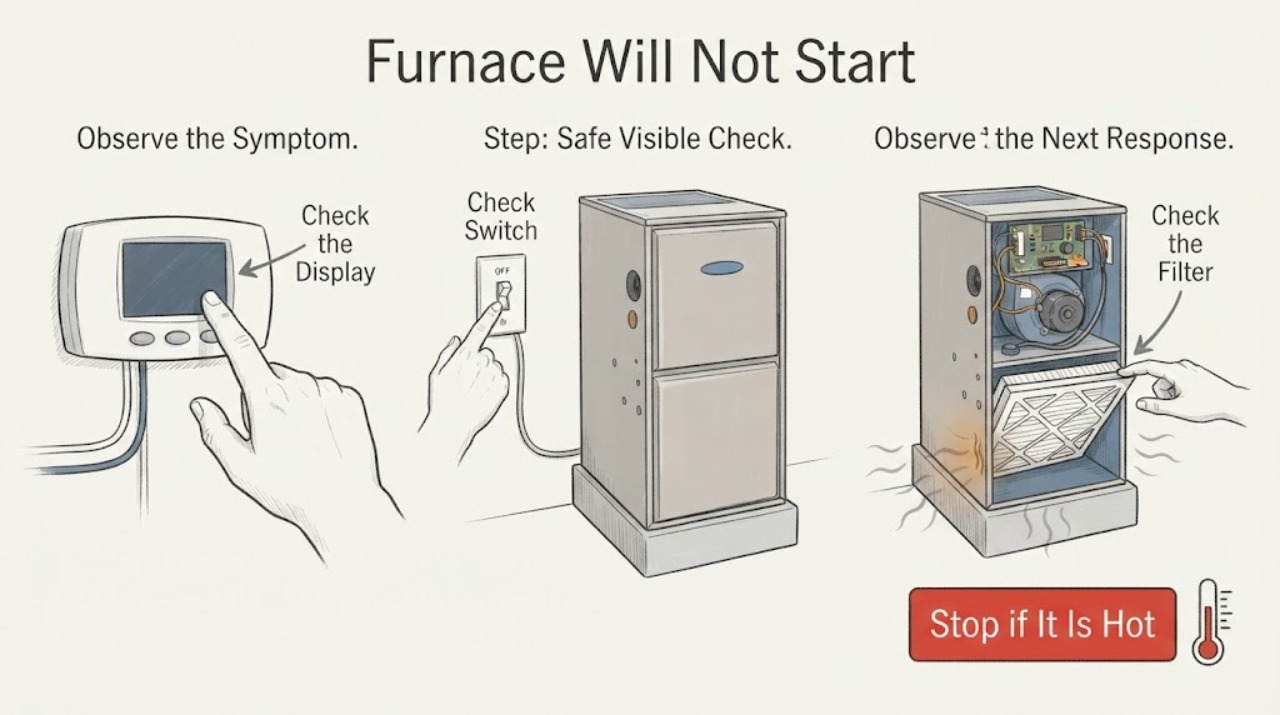
When a furnace will not start and the blower is completely silent, begin with the thermostat call for heat, the furnace switch, the circuit breaker, the blower access door, and the air filter. Then listen for whether any inducer, ignition, or relay sound occurs; a silent blower does not by itself prove that the blower motor failed because the thermostat, power supply, door switch, control board, lockout, or an upstream furnace sequence can prevent the motor from being energized. A clogged filter can contribute to overheating and a safety shutdown, while a silent motor after basic checks can indicate an electrical or mechanical fault. Do not open the electrical compartment, touch a capacitor, bypass a door or safety switch, relight a pilot after smelling gas, or repeatedly reset a tripping breaker. If there is a gas odor, carbon-monoxide alarm, smoke, burning odor, repeated breaker trip, exposed wiring, or no safe power isolation, leave the area as appropriate and contact emergency or licensed HVAC help.
Work through in order
Diagnostic checks
Use only checks that match the exact appliance or system and its official guide.
-
Check 1
Set the thermostat to Heat, raise the setpoint above room temperature, and confirm the thermostat has power. Set the fan to Auto for a normal heat call; do not repeatedly cycle the control while listening.
Expected result: The thermostat is off or in another mode, has a blank display, calls for heat but the furnace is silent, or the furnace begins a sequence after the setting is corrected.
Next step: Replace thermostat batteries only if the thermostat uses them and the manual supports it. If the heat call is valid, continue to the furnace switch and breaker without removing the thermostat or touching wiring.
Stop if: Stop for a blank display with exposed wiring, a burning odor, a gas odor, an unstable or scalding system, or any need to jumper thermostat terminals.
Why this matters
Why: An incorrect mode, low thermostat power, or no heat call can prevent the furnace from starting. If a valid heat call exists but the furnace remains silent, the fault moves toward furnace power, controls, door interlock, lockout, or another furnace component.
-
Check 2
From outside the furnace cabinet, verify that the nearby furnace power switch is on, the labeled furnace breaker is not tripped, and the blower/access panel is fully seated. Do not remove panels or reach inside; if a breaker has tripped, reset it at most once only when there is no odor, smoke, visible damage, or active fault.
Expected result: The switch is off, the breaker is tripped, the access door is ajar, the furnace powers up after correction, or the breaker trips again.
Next step: Restore only an accidentally switched-off supply or correctly seated panel. If the breaker trips again or the furnace remains silent, leave it off and arrange licensed HVAC service.
Stop if: Stop immediately for a repeat trip, buzzing/arcing, smoke, a hot switch or panel, exposed conductors, or a suspected electrical fault.
Why this matters
Why: A switched-off supply or open door can interrupt furnace power and the blower safety interlock. A repeat breaker trip points to an electrical or equipment fault and can damage the system or create a fire hazard.
-
Check 3
Inspect the air filter from its normal accessible slot and replace it only if it is visibly loaded or the owner manual calls for replacement. Check that return grilles and supply registers are not blocked; do not enter the blower compartment or touch the motor or capacitor.
Expected result: The filter is clogged, airflow openings are blocked, the filter is clear, or the blower remains silent after the filter check.
Next step: Install the correct filter orientation and close the access door, then make one controlled heat call. If the blower is still silent, stop replacing filters and arrange diagnosis.
Stop if: Stop for a damaged filter cabinet, water inside the furnace, a burning smell, smoke, a hot motor compartment, or any need to remove the blower assembly or electrical cover.
Why this matters
Why: A clogged filter or blocked return can restrict airflow, stress the blower, and contribute to overheating or a safety shutdown. A clear filter does not rule out a power, control, motor, capacitor, or ignition issue.
-
Check 4
During one heat call, listen from outside the cabinet for a click, inducer fan, ignition attempt, gas ignition, hum, or complete silence. Do not look into a burner compartment, relight a pilot, defeat a door switch, or interpret a control-board light code without the exact manual.
Expected result: The whole furnace is silent, a smaller inducer runs but the blower is silent, the blower hums without turning, ignition starts but heat does not continue, or a fault indicator appears.
Next step: Record the sound pattern and any visible code without opening the cabinet. Leave electrical, ignition, gas, and safety-component diagnosis to a licensed HVAC technician.
Stop if: Stop for gas odor, carbon-monoxide alarm, flame rollout, smoke, burning odor, repeated ignition attempts, a loud bang, or any request to measure live voltage or touch a capacitor.
Why this matters
Why: Complete silence keeps thermostat, power, control, door, and lockout causes in view. An inducer or ignition sequence with no main blower points toward the blower circuit, motor, capacitor, control, or a safety sequence. A hum can indicate a motor or capacitor problem, while an ignition-only fault is not fixed by replacing the blower.
-
Check 5
Check the owner manual for the unit's permitted reset or lockout procedure and perform it only after the thermostat, switch, breaker, panel, and filter checks are normal and no hazard is present. Observe one restart attempt from a safe position, then stop if it fails.
Expected result: The furnace restarts normally, remains silent, the blower runs briefly then stops, or the breaker/lockout returns.
Next step: If the unit does not complete a normal cycle, leave it off and give the technician the exact reset result, sound sequence, filter condition, thermostat call, and breaker behavior. Do not repeat the reset to force operation.
Stop if: Stop for any repeat lockout or breaker trip, gas or burning odor, smoke, abnormal flame sound, carbon-monoxide alarm, or an inaccessible/unknown reset procedure.
Why this matters
Why: A successful single reset may indicate a temporary control state, but recurrence indicates an unresolved safety, ignition, airflow, motor, or electrical problem. A blower that starts and stops is not equivalent to a healthy heat cycle.
Use your observations
Decision map
Find the observation that best matches what you see, then follow the next safe action.
-
PATH 01Safety boundary
What you see
Is the thermostat calling for heat and does the furnace have normal power with the access panel seated?
Do this next
Treat the furnace sequence, control, lockout, ignition, or blower circuit as the next diagnostic layer; listen once for sequence sounds and arrange service if the blower remains silent.
Why this path and its safety boundary
Why it matters: A valid call plus power moves the problem inside the furnace; an absent call or power explains why the blower never received a start command.
Safety stop: Correct only the thermostat mode, accessible switch, breaker, or panel seating when clearly safe. A repeat breaker trip or unresolved no-power condition needs service.
-
PATH 02Next step
What you see
Is the furnace completely silent, or does an inducer/ignition sound occur while the main blower remains silent?
Do this next
Record the sound pattern without opening the cabinet. Leave electrical, ignition, and safety diagnosis to a qualified HVAC technician.
Why this path and its safety boundary
Why it matters: Complete silence favors thermostat, power, door, control, or lockout causes. A partial sequence makes blower motor, capacitor, blower control, safety interlock, ignition, or sequence faults more likely.
-
PATH 03Next step
What you see
Is the filter clogged or are return grilles blocked, and does the blower remain silent after a correct accessible filter check?
Do this next
Replace the filter with the correct type and orientation, close the panel, and make one controlled call. If silence persists, stop and schedule HVAC diagnosis.
Why this path and its safety boundary
Why it matters: Airflow restriction can contribute to overheating and safety shutdown, but continued silence after the filter check points beyond routine airflow maintenance to controls, motor, capacitor, or lockout.
-
PATH 04Next step
What you see
Does a breaker trip again, a lockout recur, or any gas, smoke, burning, carbon-monoxide, or abnormal ignition symptom appear?
Do this next
Leave the furnace off. For gas odor or a carbon-monoxide alarm, leave the area as appropriate and contact emergency services or the gas utility; otherwise arrange licensed HVAC service.
Why this path and its safety boundary
Why it matters: The condition has crossed the homeowner-safe boundary and may involve an electrical, combustion, or safety fault. Repeated resets can worsen the hazard and do not identify the failed component.
Helpful context
Understand the symptom
A silent blower is a symptom, not a confirmed part failure
The thermostat can call for heat without the furnace reaching the part of its sequence that starts the indoor blower. Tripped power, an open access door, a control fault, a safety lockout, or an ignition problem can stop the cycle first. Trane lists thermostat, breaker/fuse, gas supply, door position, ignition, defective components, and lockout among reasons a furnace fan may not turn on. Carrier likewise lists thermostat, switch, breaker, filter, controls, motor, capacitor, and ignition-related faults as possible no-start causes.
Listen for sequence clues without opening the furnace
A completely quiet furnace is different from one that clicks, starts a smaller inducer motor, attempts ignition, or hums while the main blower stays still. If the inducer or ignition sequence occurs but the blower never starts, a blower circuit, motor, capacitor, control, or safety issue becomes more plausible. If the entire furnace is silent, start upstream with the thermostat and power. These sounds narrow the next step but do not make energized electrical testing safe for a homeowner.
Reset once only when the manufacturer guidance supports it
A power reset can clear a temporary control lockout on some furnaces, but a breaker that trips again is evidence of a fault, not an invitation to keep resetting it. Trane notes that newer furnaces may have a specific reset sequence, while Carrier advises service when a reset or basic checks do not restore a silent motor. Use the owner manual for the exact unit and stop at the first repeat trip, odor, smoke, or abnormal sound.
Safety boundary
Stop conditions
- Stop using the furnace and leave the area as appropriate for gas odor, carbon-monoxide alarm, smoke, burning odor, flame rollout, loud ignition, or immediate electrical danger; contact emergency services or the gas utility for urgent hazards.
- Do not open the electrical compartment, touch a capacitor, measure live voltage, bypass a door or safety switch, jumper thermostat terminals, or relight a pilot after smelling gas.
- Do not repeatedly reset a tripping breaker, lockout, rollout switch, or other safety control; a repeat trip requires diagnosis.
- Stop after one controlled restart or permitted reset fails, after the blower remains silent during a partial sequence, or whenever the filter/panel check does not restore normal operation.
Common questions
FAQ
Why is my furnace completely silent when the thermostat calls for heat?
Check the thermostat mode and power, furnace switch, breaker, access panel, and filter from outside the cabinet. If those are normal, silence can reflect a control, lockout, door interlock, power, ignition-sequence, or blower problem; do not open the furnace to guess which part failed.
What does it mean if the furnace blower hums but does not start?
A hum with no blower movement can indicate a motor, capacitor, or mechanical/electrical fault, but it cannot be confirmed safely by sound alone. Turn the furnace off and arrange HVAC service; do not touch or test the capacitor yourself.
Can a dirty furnace filter stop the blower?
A clogged filter restricts airflow, strains the blower, and can contribute to overheating or a safety shutdown. Replace it only from the normal accessible slot using the unit's instructions. If the blower remains silent afterward, the filter is not a sufficient diagnosis.
Why does the inducer run but the main furnace blower stay silent?
That partial sequence means the furnace is doing more than a completely silent no-start, but it does not identify the failed part. The blower circuit, motor, capacitor, control, safety sequence, or ignition path may need testing. Record the sound and call a licensed HVAC technician rather than opening the cabinet.
Should I keep resetting the furnace if the blower does not run?
No. Use only the exact owner-manual reset procedure once when no hazard is present. A repeated breaker trip, lockout, gas odor, smoke, burning smell, or failed restart requires the furnace to remain off and professional diagnosis; a carbon-monoxide alarm or gas odor requires urgent safety action.
Read the exact guide
Official sources
- Furnace Blower Not Working: Causes and SolutionsTrane · Trane blower-no-start causes, thermostat/power/filter/door checks, lockout behavior, and professional boundary for blower, capacitor, motor, and safety issues
- Furnace Not Turning On? Troubleshooting & Repair GuideCarrier · Carrier furnace no-start checks for thermostat, furnace switch, breaker, filter, controls, motor, ignition, gas supply, and safety warning signs
- Furnace Not Igniting? Find Out Why and What to DoTrane · Trane gas-furnace ignition, power, filter, gas supply, ignitor, flame-sensor, pilot, and professional safety guidance
- Furnace Blower Motor Repair & Replacement GuideCarrier · Carrier blower-motor guidance on a silent motor after basic checks, filter and compartment inspection, capacitor safety, and professional electrical boundary
Community feedback
Share a repair observation
Share a plain-text repair observation. Accepted observations are published automatically; this page may take a moment to update.