
On this page
Start here
Quick answer
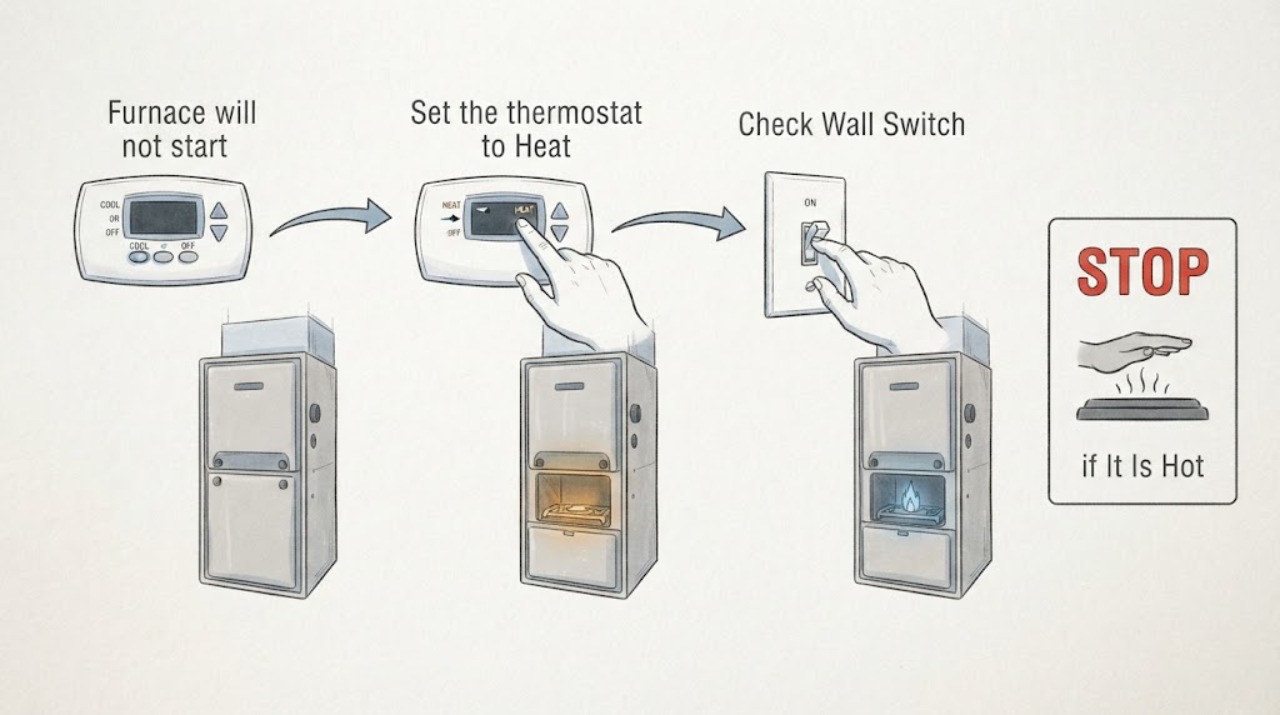
If a Carrier furnace will not start, first determine whether the thermostat is actually calling for heat and whether the furnace is completely silent, produces a click or motor sound, or starts and then stops. Set the thermostat to Heat above the room temperature, confirm the furnace switch and labeled breaker are on, and inspect the accessible air filter and external airflow. Carrier identifies thermostat settings, power, a tripped breaker, a dirty filter, ignition, flame-sensing, and gas-supply issues as possible causes. A single safe breaker correction may be reasonable when it is visibly tripped, but a repeat trip or returning lockout needs service. Do not remove the cabinet, test wiring, adjust gas, bypass a safety, or repeatedly reset the furnace. If there is gas odor, a carbon-monoxide alarm, smoke, soot, unstable flame, loud ignition, or burning/electrical odor, leave the area as appropriate and contact local emergency or qualified HVAC services.
Before you begin
Safety first
- The homeowner scope is limited to normal thermostat and power controls, external status observation, an accessible filter, unobstructed registers and returns, and recording the startup pattern. Do not remove the furnace cabinet, test live wiring, adjust gas pressure, service burners or ignition, clean a flame sensor, test a pressure or safety switch, bypass a safety, or repeatedly reset a fault.
Work through in order
Diagnostic checks
Use only checks that match the exact appliance or system and its official guide.
-
Check 1
Set the thermostat to Heat and set the target above the current room temperature, with the fan in Auto unless the thermostat instructions say otherwise. Watch and listen from a safe position for one call for heat without removing a furnace cover.
Expected result: The thermostat is off, in Cool, below room temperature, blank, or out of battery power; the furnace is silent; the blower runs; or a startup sequence begins.
Next step: Correct only an accessible setting or battery condition described by the thermostat instructions and observe one normal cycle. Record whether there is silence, a motor sound, ignition, or immediate shutdown; do not open the thermostat or furnace.
Stop if: Stop for exposed wiring, a burning or electrical odor, gas odor, smoke, an alarm, or any need to remove a panel.
Why this matters
Why: A mode, setpoint, or thermostat-power issue can prevent a call. A valid call with silence shifts attention to external power or controls, while blower or startup activity means the call reached the furnace and needs a different branch.
-
Check 2
Check the furnace service switch and the electrical panel for the breaker labeled Furnace or Heat. If a breaker is visibly tripped, move it fully Off and then On once; do not remove the panel cover or reset a breaker that immediately trips again.
Expected result: The switch or breaker was off and the furnace responds after one correction; the breaker trips again; or both were already on while the furnace remains silent or fails to start.
Next step: Allow one normal call for heat after the single safe correction. If the breaker will not hold, trips again, or the furnace remains unresponsive, leave it off and arrange qualified HVAC diagnosis; never use a larger breaker.
Stop if: Stop for arcing, a hot panel, smoke, a burning or electrical odor, water near electrical equipment, or a breaker that will not reset.
Why this matters
Why: An off supply can explain a silent furnace. A repeat trip suggests an electrical or equipment fault, while normal external power with no response makes a control issue, safety lockout, or internal fault more likely.
-
Check 3
With the furnace off and cool, inspect the accessible filter and its airflow arrow. Check that supply registers and return grilles are open and clear of furniture or stored items. Replace a disposable filter only with the size and type stated on the filter cabinet or in the exact appliance instructions.
Expected result: The filter is gray or loaded with dust, the arrow is reversed, vents or returns are blocked, or airflow appears clear but the furnace still will not start.
Next step: Install the correct filter, clear only obvious external obstructions, and observe one cycle. If the no-start remains, the filter dirties rapidly, or airflow is weak or noisy, stop at the user boundary and call qualified HVAC service.
Stop if: Stop if filter access requires removing the furnace cabinet, the filter is wet or contaminated, the furnace is hot, smoke or burning odor is present, or internal access is required.
Why this matters
Why: A blocked filter or restricted airflow can overheat the furnace and trigger an automatic shutdown, but a clean filter does not rule out a control, ignition, gas, or electrical problem.
-
Check 4
Read any Carrier status light or display through its normal viewing window, and observe the startup sequence from a safe position. Note whether the inducer or blower runs, whether burners visibly light if the design provides a safe view, and whether the unit stops after a few seconds. Use the exact model manual for code meaning.
Expected result: A status code or lockout returns; the inducer runs but burners do not light; the blower runs with no heat; the furnace lights and then shuts down; or no code is visible.
Next step: Record the exact code, sound, timing, and whether other gas appliances are working, then arrange qualified HVAC service. Do not clean a flame sensor, test a pressure switch, adjust gas pressure, relight an unfamiliar pilot, or bypass a safety device.
Stop if: Stop for gas odor, yellow or unstable flame, soot, loud ignition or bang, smoke, carbon-monoxide alarm, abnormal heat, or any need to open the combustion compartment.
Why this matters
Why: Ignition, flame sensing, gas supply, pressure proving, limit, or control faults may be involved, but the pattern cannot identify the failed part safely. A returning lockout is a safety indication, not a reset challenge.
-
Check 5
Create a service note with the thermostat mode and setpoint, switch and breaker state, filter condition, status code, startup sounds, cycle timing, and when the no-start began. Note recent work and whether the blower, inducer, burners, or only the thermostat respond.
Expected result: The same no-start pattern returns after a setting or filter correction, the furnace repeatedly starts and stops, a fault returns, or no safe check changes the result.
Next step: Give the note and exact model information to a qualified HVAC professional and keep the furnace off if it repeatedly faults or overheats. Protect occupants and plumbing during cold weather using safe local measures.
Stop if: Stop if the home is becoming dangerously cold, any safety alarm or combustion warning appears, the equipment cycles abnormally, or the next step involves internal parts, fuel, or live electrical work.
Why this matters
Why: A recurring or unchanged symptom means the underlying fault remains. Silence after a valid demand suggests power or control diagnosis; motor activity without ignition suggests a heating-sequence diagnosis; repeat stopping suggests airflow or safety diagnosis.
Use your observations
Decision map
Find the observation that best matches what you see, then follow the next safe action.
-
PATH 01Safety boundary
What you see
The thermostat was not calling for heat, was blank, or the furnace switch was off, and the unit responds after one normal user-control correction.
Do this next
Leave the corrected setting in its intended mode and observe a complete cycle; arrange service if the setting will not hold or the no-start returns.
Why this path and its safety boundary
Safety stop: Do not open the thermostat or furnace to repair wiring or controls.
-
PATH 02Safety boundary
What you see
The thermostat calls for heat and the furnace is completely silent even though the service switch and labeled breaker are on.
Do this next
Leave the unit off and arrange qualified HVAC diagnosis for power delivery, controls, door interlock, or lockout; provide the thermostat display and breaker behavior.
Why this path and its safety boundary
Safety stop: Do not remove the cabinet, test low- or line-voltage wiring, or bypass a door or safety switch.
-
PATH 03Safety boundary
What you see
The blower or inducer runs but burners do not light, or the furnace lights briefly and then stops.
Do this next
Treat ignition, flame sensing, fuel supply, pressure proving, or limit operation as possible and arrange qualified HVAC service with the sequence and status code.
Why this path and its safety boundary
Safety stop: Do not work on the igniter, flame sensor, gas valve, pressure switch, burner, or control board or bypass a safety.
-
PATH 04Safety boundary
What you see
The filter is visibly blocked or airflow is restricted, and the furnace starts and stops before completing a normal cycle.
Do this next
With the furnace off and cool, install the correct accessible filter and clear external registers or returns, then observe one cycle. If short cycling continues, obtain professional airflow and safety-limit diagnosis.
Why this path and its safety boundary
Safety stop: Do not run without a filter, repeatedly reset a limit or rollout device, or continue operation with overheating or unusual odors.
-
PATH 05Safety boundary
What you see
The breaker trips again, a fault or lockout returns, or the furnace remains unresponsive after the safe thermostat, power, filter, and airflow checks.
Do this next
Keep the furnace off and arrange qualified HVAC or electrical diagnosis, providing the exact code and what occurred after the single permitted reset attempt.
Why this path and its safety boundary
Safety stop: Do not install a larger breaker, keep cycling power, press an unfamiliar reset, or touch live wiring.
-
PATH 06Safety boundary
What you see
There is gas odor, a carbon-monoxide alarm or possible symptoms, smoke, soot, an unstable flame, loud ignition, or a burning/electrical smell.
Do this next
Leave the home or affected area, avoid flames, switches, and other ignition sources, and contact local emergency, gas-safety, or medical services from a safe location. Follow local instructions before re-entry.
Why this path and its safety boundary
Safety stop: Do not relight or reset the furnace, investigate the combustion area, or return until the responsible emergency or qualified professional says it is safe.
Helpful context
Understand the symptom
Classify what ‘will not start’ means
A Carrier furnace that is completely silent is a different problem from one that clicks, runs a small inducer or blower, or lights and then shuts down. Silence points first toward thermostat demand, power, or a lockout. Motor activity without heat points toward the ignition or fuel sequence. Starting and stopping can involve airflow restriction or a safety limit. These patterns decide the next safe observation; they do not prove a component failure.
Limit the homeowner checks to normal access
Check the thermostat, furnace service switch, labeled breaker, accessible filter, and clear registers and returns. Read a status light or code only through the normal viewing window or from outside the cabinet. If the filter cabinet is designed for homeowner access, turn off the furnace electrical supply as directed by its instructions before inspection and restore the correct filter and cabinet door. Internal controls, ignition, burners, flame sensors, pressure switches, capacitors, gas valves, and live wiring are professional work.
Do not turn a reset into a repair
A visibly tripped breaker or switched-off furnace can explain a no-start condition, but a breaker that trips again signals a problem rather than an invitation to keep resetting it. Carrier also warns against bypassing critical errors and directs persistent errors or burning smells to professional service. Do not press an unfamiliar rollout or limit switch, substitute a larger breaker, or keep power-cycling a furnace that is faulting.
Fuel-burning appliances need a firm stop boundary
If you smell gas, see an abnormal flame or soot, hear a loud ignition or bang, or a carbon-monoxide detector alarms, leave the home or affected area as appropriate and follow local emergency or gas-safety instructions from a safe location. Carbon monoxide is not reliably detected by smell. Do not investigate the combustion compartment, relight a pilot without a clearly applicable manual procedure, or re-enter until the responsible service provider says it is safe.
Only after diagnosis
Potential parts
- Carrier furnace air filter
Consider a replacement only when the accessible filter is visibly dirty or damaged and the exact size, type, and airflow direction are confirmed from the filter or appliance instructions.
Match the exact dimensions and filter type; never operate the furnace without a filter, and do not assume a clean filter will fix a no-start condition. - Carrier furnace igniter or flame-sensing component
Consider this category only after qualified HVAC testing identifies an ignition or flame-proving fault for the exact Carrier model.
Igniters and flame-sensing parts are model-specific and involve combustion and electrical safety checks; do not select one from the symptom alone. - Carrier furnace control, limit, or blower component
Consider this category only when professional testing confirms a control, safety-limit, blower, or related internal fault after the external checks.
Confirm exact model, voltage, motor or control characteristics, and installation procedure; do not use a part to mask a repeat breaker trip or lockout.
When checks do not resolve it
Need a professional?
Call for diagnosis for a persistent silent furnace, blower-without-heat pattern, returning fault or lockout, repeat breaker trip, failed ignition, unusual noise, or any internal component concern. Use emergency or gas-safety services first for gas odor, carbon-monoxide alarm, smoke, or possible exposure.
Safety scope: The homeowner scope is limited to normal thermostat and power controls, external status observation, an accessible filter, unobstructed registers and returns, and recording the startup pattern. Do not remove the furnace cabinet, test live wiring, adjust gas pressure, service burners or ignition, clean a flame sensor, test a pressure or safety switch, bypass a safety, or repeatedly reset a fault.
Have this ready
- Provide the furnace model if available, thermostat mode and setpoint, whether the thermostat display is active, switch and breaker behavior, filter condition, status code, whether the blower or inducer runs, whether burners light and for how long, recent work, and any unusual sounds or odors.
Common questions
FAQ
What should I check first when my Carrier furnace will not start?
Check that the thermostat is in Heat and set above room temperature, then check the furnace service switch, the labeled breaker, and the accessible filter. Make only one external breaker correction if it is visibly tripped. If it trips again or the furnace remains silent, leave it off and arrange service.
Why does my Carrier furnace click but not start?
A click or motor sound means the thermostat may be sending a demand while the furnace fails later in its startup sequence. Ignition, flame sensing, gas supply, pressure proving, or controls may be involved. Record the sound and timing and arrange qualified HVAC diagnosis; do not open the cabinet.
Can a dirty filter keep a Carrier furnace from starting?
Yes. A blocked filter restricts airflow, which can contribute to overheating and an automatic shutdown or lockout. With the furnace off and cool, install the correct filter and keep it in place. If the no-start remains, the filter is not a complete diagnosis.
Should I press the furnace reset or rollout button?
Do not press an unfamiliar safety or rollout reset as a routine fix. A returning trip indicates a fault that needs diagnosis, and Carrier warns against bypassing critical errors. Record the status and arrange qualified service instead of repeatedly resetting the furnace.
When is a furnace that will not start an emergency?
Leave the home or affected area and use local emergency or gas-safety guidance for gas odor, a carbon-monoxide alarm or possible symptoms, smoke, soot, an unstable flame, loud ignition, or a burning/electrical smell. Avoid switches and ignition sources and do not relight or re-enter until cleared.
Read the exact guide
Official sources
- Furnace Not Turning On? Troubleshooting & Repair GuideCarrier · Carrier residential consumer guidance; exact controls, ignition design, reset procedure, and safe access vary by model and installation.
- Common Thermostat Issues and How to TroubleshootCarrier · Carrier thermostat consumer guidance; a specific thermostat and furnace manual controls exact settings and compatibility.
- Furnace Troubleshooting: 7 Gas Furnace SolutionsTrane · Trane consumer guidance used for general gas-furnace safety patterns; Carrier model instructions and local emergency procedures control.
- Furnace Troubleshooting Guide | Fix a Furnace Not WorkingCarrier · Carrier residential furnace guidance; exact furnace design and owner procedures vary by model.
Community feedback
Share a repair observation
Share a plain-text repair observation. Accepted observations are published automatically; this page may take a moment to update.